

Episode #451:
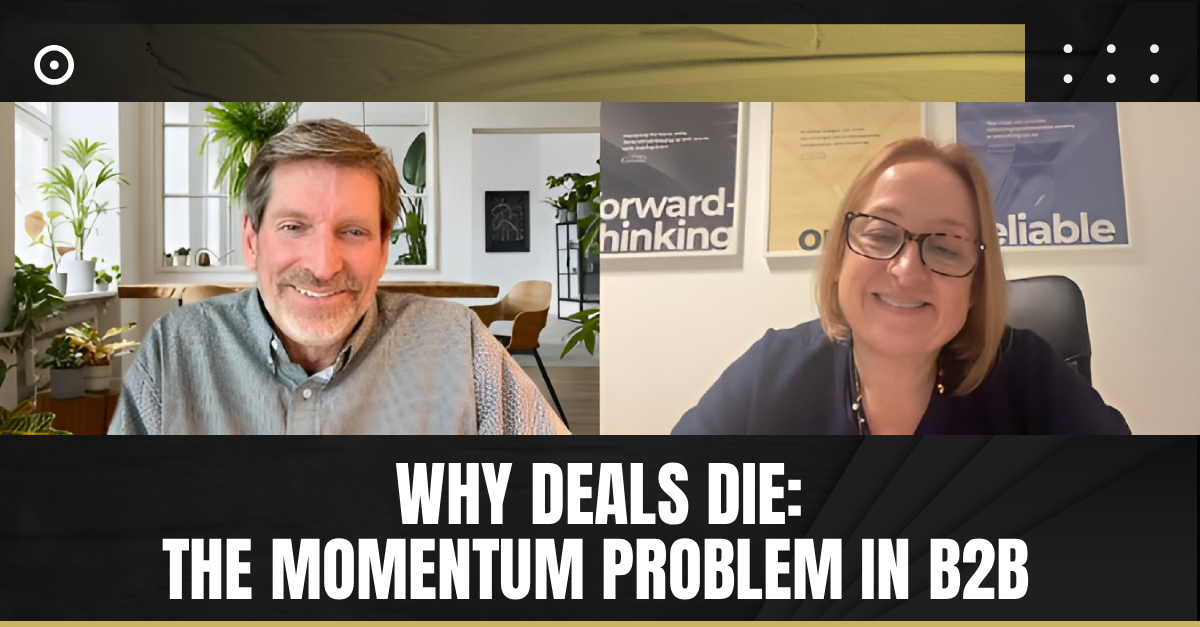
Grainne Maycock, Chief Revenue Officer at Acolad Group, explains why deals lose momentum. She outlines how internal friction and misalignment quietly stall progress. She also shares how trust is built through transparency and consistent follow-through. She closes with practical ways to operationalize customer voice and communication.
“You can never overcommunicate on any strategy, any topic, or any result. Be customer focused, but overcommunicate with your internal teams and your cross-functional teams.” – Grainne Maycock
In this episode, Grainne breaks down why B2B deals stall long before a buyer says no. She explains how internal misalignment creates friction buyers can feel, why trust requires consistent follow-through, and how a disciplined voice of customer approach protects growth investments. The result is a repeatable momentum model leaders can measure and scale.
Follow Grainne Maycock on LinkedIn
Follow Steve MacDonald on LinkedIn
[Transcript]
[00:00:05] Steve MacDonald: Welcome to the C-Suite Sales and Marketing Perspectives podcast. I’m Steve MacDonald, your host, and today we have a very special guest on with Grainne Maycock. Now we’re gonna be talking today that somewhere this is right in your wheelhouse, why deals die, the momentum problem in B2B, and we tend to focus a lot on what’s happening externally, why deals are stalling, why we’re losing momentum, and those are very important conversations.
[00:00:32] Steve MacDonald: But in our past conversations, you’ve talked about how there’s a tremendous amount of friction that can happen internally that kills momentum in deals. And you’ve got a tremendous background. You’ve been a Chief Revenue Officer. You are right now with the Aclo Group. You’ve been a Chief Sales Evangelist.
[00:00:51] Steve MacDonald: You’ve been a Chief Sales Officer, but you cut your teeth in operations, and you were the person that the sales team would bring to the call or to the meeting with the prospects to talk about the company and specifically what their expectations should be and what their relationship would be like. You have a very unique point of view that you bring to this because operations is in charge of making sure that everything internally is aligned. So,
[00:01:20] Steve MacDonald: We got a lot to unpack today, but what I’d love to do is just give you a moment here that, if you wouldn’t mind, just expanding on your background a little bit before we get started.
[00:01:29] Grainne Maycock: Sure. Thanks, Steve. I’m delighted to be here. Yeah, I think you hit the nail on the head. So I have spent the last two decades of a three decade career in revenue generation, revenue enablement, C-suite roles as a Chief Revenue Officer and Chief Sales Officer.
[00:01:46] Grainne Maycock: But oftentimes I’m asked, how did I start, how did I gravitate towards that? Especially having started my early career in program management in operations, and I think the big thing for me was curiosity, passionate curiosity about what problems we were trying to solve for a customer, what their environment was like.
[00:02:08] Grainne Maycock: Was it different from somebody else’s environment? Did it depend on the size of company? Did it depend on the industry? What value creation did the people we were talking to have to demonstrate to their shareholders, and I think because in my early career, I wasn’t the person getting a commission check. I wasn’t the seller.
[00:02:29] Grainne Maycock: It was easier for me to put aside any desire to win and instead dive curiously into, I’m being brought here to understand the customer, to understand their pain point, to understand what it is they hope to be able to say if they move forward with us. And that enabled my innate curiosity. I’m the youngest of six kids, small Irish family, and curiosity about each other and about the world around us is how we grew up.
[00:03:02] Grainne Maycock: So that kind of demonstrated in everything I did in business in the early days because I was young and clueless and all the things, but suddenly it was like, wow, I really like understanding customers. I like understanding their needs. And then when I came back from those early sales meetings, not being the seller in the room, I was really curious as to how our organizations at the time built programs to go.
[00:03:28] Grainne Maycock: Are we all aligned on understanding the commonality of clients’ needs? Are we understanding the commonality of challenges, the differences depending on size of customer, size of engagement, and if not, we’re reinventing the wheel each time. So I guess it was a natural step then, as I became account manager, business development manager, sales manager, and moved my way up into the C-suite.
[00:03:54] Grainne Maycock: What stayed with me was not just building revenue, but building a revenue engine that removed friction and accelerated client value so that you could repeat that client value for the segments you were going after and for the customers who would then tell others, wow, I really got value out of partnership.
[00:04:13] Steve MacDonald: You mentioned very eloquently there the coming back and then focusing in operations on the alignment internally. And on this podcast, we ask every B2B C-suite executive that comes on, what are your two greatest challenges for creating long-term sustainable growth? Number one challenge by far is internal alignment.
[00:04:35] Steve MacDonald: Nothing works without internal alignment. And we all know how big of a problem this is. I told you before, I’m really excited about our conversation here today, because we don’t talk about that enough. Right?
[00:04:47] Grainne Maycock: It’s okay. We haven’t got all the answers. I haven’t got all the answers, but I agree with you.
[00:04:52] Grainne Maycock: That alignment, when you think about aligning who you are, your values, who your customers are, who they’re not, what you’re trying to solve for them, what you can’t solve for them. Are you the right partner? What that looks like? Is it scalable? Is it repeatable? Are operations on the same page as sales? Do sales have a playbook?
[00:05:12] Grainne Maycock: Is technology’s roadmap aligned with what solutions say our clients need? Or does it fall down when you go, well, this is a fancy schmancy sales play over here, but technology is missing X or operations are missing training in Y. When you have all of those parts together, starting with customer centricity, customer understanding, value proposition, the ability to demo, the ability to apply use cases consistently, whether one of our clients or prospects is talking to.
[00:05:47] Grainne Maycock: A project management team, a program manager, a language team, an AI specialist, a seller, they should get the same conversation because there’s alignment, and if not, they can’t trust that you can move forward and be a team on their behalf.
[00:06:04] Steve MacDonald: I’m so glad you brought it up like three or four times, and we’re gonna talk about it in a few minutes.
[00:06:08] Steve MacDonald: But the second biggest challenge was a lack of deep understanding of the customer, right? And without that customer centricity, I mean, every company, and I’ve said this before on the podcast, we will all, as companies, say we’re customer first. We’re customer obsessed, right? But it’s how you put the actions behind those words.
[00:06:25] Steve MacDonald: And I love how you started out in operations and you just had a deep fascination and passion for really understanding the customer. That’s the highest voice of authority in our business, right? That understanding is the most important thing that we have to align around.
[00:06:40] Steve MacDonald: But I wanted to ask you a question because you started out our previous conversation saying, you know, Steve, you gotta see the whole company like you’re a CEO. And so I just wanted to ask you what you meant by that.
[00:06:53] Grainne Maycock: So for me, before I joined the C-Suite, whether I was in operations management, in language management, in account management, I saw the world through my lens.
[00:07:06] Grainne Maycock: What was it I needed to achieve by when? How much for whom? What were the key metrics for success? And if you were in a different department, you saw the world through that department’s metrics. When you’re in sales, you see the world through a very particular sales lens, and none of that is wrong. All of that is right.
[00:07:26] Grainne Maycock: You need to be able to see why you are contributing to the business, but the higher up you go, and as you join an executive team, as you are part of building and driving the momentum for that executive team to succeed in certain areas, you cannot just see things from one lens, even if it’s your lens. You have to be able to understand how the jigsaw pieces of your executive team come together.
[00:07:52] Grainne Maycock: What is shareholder value? What is top line? What is bottom line? How does top line get to bottom line? What are the decisions you need to make? How do those decisions affect how much you invest in CapEx for a certain technology play? How much you invest in sales training? Because you need to accelerate.
[00:08:12] Grainne Maycock: Maybe you’re a SaaS company and you’ve brought your company to 30 million ARR, but you need to get to a hundred million ARR. And it was founder led and you got to a certain point in your growth where the founder was heavily passionate and you sold, and then you got referrals and you had a good sales team.
[00:08:31] Grainne Maycock: Very tight knit. But suddenly you’re scaling at a different level to a hundred million, 200 million, 300 million, like we’re a 200 and something million Euro company. So when you do that, you need to enable things. So the choices you make when you look at it from a holistic perspective, how do we grow both revenue and profitability?
[00:08:56] Grainne Maycock: How do we invest in talent? How do we structure for optimization? How do we set aligned KPIs that remove that friction and enable us to get to where we want to go? How do we measure customer success, retention, advocacy? How do we measure the C rate? How do we look competitively at our industry?
[00:09:19] Grainne Maycock: How do we look outside and inside? How do we question and challenge ourselves? And I had an interesting conversation a few years ago with our current CEO, where I hadn’t realized in the past few years, I had naturally started thinking about the jigsaw pieces that drove a company as opposed to just drove the revenue in a company.
[00:09:42] Grainne Maycock: So now I can’t sit in a shareholder meeting and not think about all of the jigsaw pieces that combined to accelerate, to pull a growth lever, to optimize a sales playbook, to optimize an operational team to fit in with something to bring together tech and solutions and sales and operations.
[00:10:03] Grainne Maycock: So we’re all on the same page. And then to look at the challenges, to be able to transparently communicate to an organization if we’re pivoting or shifting to AI and what that means. So looking at a company as a company, this is where we are. This is where we need to get to. These are our constraints. These are our opportunities.
[00:10:25] Grainne Maycock: Where do we choose to put our big bets? How do we govern it? How do we measure it? How do we empower people? Which people, how? What do we say no to? How do we get good at making sure we say no and we say yes, so that when we say yes, it’s trusted? So it was funny, our CEO actually said to me, you are now facing the same challenges I face day to day.
[00:10:48] Grainne Maycock: You’re now embracing the same opportunities and potentials to pull levers. We’re doing it from flip sides of the same coin, but I can’t not see your area. You can’t not see every area. And when you do that, you build a company that has a purpose, that has a value creation, that has a passion for customers, but that’s backed up by governance and KPIs and measured initiatives and programs that say, well, am I doing well with customer advocacy or is it just something I say like behind me on the screen, whether it will appear clearly or not.
[00:11:29] Grainne Maycock: We have three values. It’s forward thinking, open, and reliable. Four. We live and breathe these values because we wanted to understand from a corporate perspective, how do you build values that everybody can live day to day, whether you’re in sales, operations, tech, IT support functions, finance, admin, wherever you sit in the company, how do you understand what these values mean to how you do your day to day job?
[00:11:58] Grainne Maycock: How you interact with your colleagues, how you show up for your customers and your prospects, how you show up when something isn’t working. And we, from a CEO, as well as a CRO perspective, I can’t not see how all of the pieces come together from culture to purpose, to vision, to measure, to governance, and I’m really, really grateful that has happened naturally by being surrounded by some pretty phenomenal executives.
[00:12:27] Steve MacDonald: One of the main reasons why this is a C-Suite podcast is because if you were the head of sales or director of sales, you would be 100% in your sales lane. As a C-Suite executive, we have to see a broader perspective of our companies. We’re accountable to the board, we’re accountable to the other executives.
[00:12:47] Steve MacDonald: We are responsible for the overall success of the company, not just our department, not just our quotas, right? So I love this perspective, and a lot of it people could think, values, mission, culture, these are buzzwords we’ve all said and heard before. But I can’t tell you how many executives I’ve talked to.
[00:13:09] Steve MacDonald: Who are buyers, by the way, right? You’re a B2B buyer when you’re buying something for your sales tech stack, right? So we all are in the position of the people who we sell to, and I can’t tell you how many conversations I’ve had about it. It seems like a sea of sameness from a competitive landscape.
[00:13:28] Steve MacDonald: And what really matters is the overall experience of what it’s gonna be like to work with you once I hire you. And that’s where culture, mission, and values, and showing up and being reliable, right, and the things that are on the wall behind you make a tremendous difference. Whether somebody’s gonna buy up front, whether they’re gonna churn, right?
[00:13:49] Steve MacDonald: Or you’re gonna have a long relationship, you’re gonna drive NRR, you’re gonna do all the right things. These are not soft metrics, what you’re talking about here. And so I just love that we’re digging into this. You mentioned that most companies, they’re building trust, and we have to build trust, but we have to do it in a time of change.
[00:14:12] Steve MacDonald: And you mentioned whether you’re a hundred ARR Euro company or 200 or 300, we’re always changing. We’re never the same company that we were, so we have a change management thing at the same time. Talk to me about building trust and why that’s so important for most companies that are always in a change motion.
[00:14:35] Grainne Maycock: I think one of the key things, whether it’s company or individual, is communication, transparency, and doing what you say you’ll do when you say you’ll do it. And if there’s a change in that, explaining what the change is, why, and what you’re gonna do next, whether that’s with your friendships, with your personal relationships, or as an executive, and it becomes more and more important.
[00:14:58] Grainne Maycock: The more responsibility you take on for leading and driving a company today. One of the earlier sessions I had today was an open Q and A where the teams came together and could ask anything, nothing off the table. Off you go. And this is important because we move at such a fast pace. We have executive debriefs.
[00:15:21] Grainne Maycock: For our leaders, we have town halls for our entire company. We have departmental meetings, we have executive meetings, we have board meetings, we have newsletters. All of that is never enough. Never enough. You think it is. The people writing it think it’s a lot and they’re phenomenally talented.
[00:15:39] Grainne Maycock: It’s never enough. You can never communicate enough. And in those open Q and A sessions, I think one of the things that I like about it is that people ask questions that you weren’t thinking about. You might be thinking about your revenue and your EBITDA and the top five deals that are gonna phenomenally move the needle or the talented person that you’re in competition with.
[00:16:05] Grainne Maycock: A competitor to secure, or the next board meeting, or your budget for next year. There’s a million things that take up your mind. But that communication brings you down to the pragmatic day-to-day things that matter to people. So what matters to one is different to what matters to the other, and that’s evidenced by the questions that come out in open Q and A.
[00:16:33] Grainne Maycock: Sessions like that. Somebody might be curious about strategy because they understood something slightly different, and how will it affect me? Super. Great question. Somebody else might be interested in growth potential. Somebody else who’s worried about what AI means. Two roles that were fully human and that are now hybrid, or that efficiency is driving something that’s different from what they expected.
[00:16:59] Grainne Maycock: Somebody else is curious and interested about the sales kickoff and where it might be. Somebody else is curious about training and how we’re going to upskill the next level of our sellers to tell executive-level stories. Because they need to empower their clients to tell a shareholder value story, because most people don’t realize most sales happen when you are not in the room.
[00:17:22] Grainne Maycock: Most sales at B2B companies happen when you’ve already pitched something. You’ve already had multiple conversations done. Demos, got all of the people around the table, you’re super aligned. Yay. You followed a sales process. Fantastic. You’ve got a sequence of events, great. It’s documented. Meeting summary, go.
[00:17:38] Grainne Maycock: Then that team is pitching to shareholders and you’re not there. So how do you make sure, again, communication, what’s likely to happen? What are the questions? How do you empower people? And I think different people are interested in different things, but the key for that building of trust: be open, be transparent, share, overshare.
[00:18:02] Grainne Maycock: Repeat. Repeat. Again, make people feel through your actions that when you say you’re open to any question that you are. That when you say, “Reach out, my door is open,” that means that team’s message, a Slack message, “Let’s grab a coffee. I see you’re in the HQ, or I see you’re here or there,” or, “Hey, I had an idea.”
[00:18:24] Grainne Maycock: “Can I share?” We had a really good example recently, and I remember when I got the ping on Teams. It was from somebody I had never had a conversation with. So we’ve thousands of employees. I’d never had a conversation with this person. They were in the IT team. We were in the middle of this major RFP, one of our US teams had a pretty large opportunity for scaling our multimedia business.
[00:18:49] Grainne Maycock: This team member reached out and said, “Hey, can I grab a few minutes?” And I went, oh, I must have broken something. So immediately my head went, I’ve broken some server or messed up somebody’s InfoSec, or Lord knows what I did when I was doing three other things. So I said, “Absolutely, of course you can.” It was an amazing conversation.
[00:19:08] Grainne Maycock: “Hey, I listened to you and the CEO and one of our SVPs on the town hall this week, and you were sharing a little bit more about what really moves the needle and how people even not involved in these things can influence and help. Would it help you to know that I’m actually a big fan and I’m on a user forum for that company and that team?”
[00:19:30] Grainne Maycock: “I’ve access to the strategy in the user forum, and I’d love to be part of the RFP process. And here’s three ideas about, if I was them, what I would do differently.” Holy crap. You are amazing. You are engaging, forward-thinking, open, and by the sounds of it about to be super reliable. Yes, thank you. That person didn’t need to reach out.
[00:19:53] Grainne Maycock: This wasn’t part of their day-to-day. This was cross-functional, but guess what? They felt a passionate connection to the company. The message? Why? Because we communicated. So building trust goes in other directions as well to connect people to go, wow. And the very first thing I did after that conversation, which by the way, he still doesn’t know I did:
[00:20:14] Grainne Maycock: Let’s have a conversation with our CEO about how to celebrate him in the next town hall and that type of value. Because trust is about the little things over and over, compounded. It’s not just about the big strategy or the big next. It’s how you get there. It’s how you make a team feel that they can do anything.
[00:20:34] Grainne Maycock: They can overcome anything, and they want to be amazing. They want to look back in several years and go, “Oh, my time at that company at AAD was amazing. It was hard. I learned things. I was challenged. I did all the things,” but guess what? I trusted. Just like somebody coming to an executive, and I’ve had examples where they
[00:20:53] Grainne Maycock: need help on something, or they need to balance something personal with something work-related. Trust is not just about the big things, it’s about the day-to-day little things and how you show somebody what you say is what you mean. And when they challenge that, they’ll get exactly what you’ve said in return.
[00:21:15] Steve MacDonald: You know, VCs, PE companies, they focus on the team first, the idea second, right? And what you’re talking about here is how do we responsibly, as C-Suite executives, build the right team, the right culture, the right values. That gentleman never would’ve stepped up, I imagine, if you hadn’t had that kind of a culture where he felt very comfortable just picking up the phone and calling the CRO and saying, “Hey.” You know, he didn’t even say, “I got some really good ideas for that RFP.”
[00:21:45] Steve MacDonald: Says, “Can I have a conversation with you?” But you were open to it, right? You were accessible. That’s a huge deal. Huge deal.
[00:21:54] Grainne Maycock: Somebody else recently, and it was funny, they were in our Paris HQ. And they’re Irish, and I hadn’t seen them in a while. I’m Irish, but I’m in our Paris HQ more than I am anywhere else.
[00:22:07] Grainne Maycock: And they went, “Ooh, I heard your office has Irish tea bags and milk,” because the French aren’t big fans of milk. They drink black coffee. “How about a chat?” And I popped down to your office and you stick the kettle on. Again, somebody in a completely different team, a member of a tech team who reports to somebody else, who reports to somebody else, and my response: absolutely. The insights and the connections you get when you build team relationships and an openness to that value
[00:22:38] Grainne Maycock: It’s priceless because people will be open with each other as well. They’ll be more positive when you have something challenging to go, “Hey guys, we actually have a problem over here. I need your help. I need us to come together to solve it.” And we have 20 more intelligent people than me in this room.
[00:22:55] Grainne Maycock: Here’s where we need to get to. How fast? What? Who steps up? So if you don’t have that trust, you can’t build anything upon it. You can’t build relationships. You can’t build give and take. You can’t do phenomenally amazing things with the same or fewer resources. It has to be win-win.
[00:23:14] Steve MacDonald: It’s interesting. Literally just about a week ago, Forrester came out with their predictions for 2026, and they said that trust will be the ultimate currency for B2B buyers. What they didn’t say is the trust internally and how important that is as currency for alignment and performance internally. I just wanted to make that distinction because I think you’ve got such an important point that you’re making here, and at the beginning you talked three, four different times about your passion about understanding the customer, the voice of the customer.
[00:23:51] Steve MacDonald: So I’d like to shift a little bit here and just get your opinion, right? You know, on a scale of one to ten, how important is the voice of the customer? One, not at all? Ten, critical to our long-term success in the business. Like, why? What’s your thought on that?
[00:24:09] Grainne Maycock: So if you decide to build solutions, technology, or services to solve a problem for customers.
[00:24:19] Grainne Maycock: If you don’t truly understand, is that their problem? Is that a common problem? Have you misunderstood how they might apply it? Or you have a solution but you fail to understand some of the architectural technology connectivity, processes, and restrictions that organization might have, whether it’s in adopting AI solutions, whether it’s in InfoSec needs, whether it’s in procurement practices, whether it is all the eggs in one basket on one platform versus multi-vendor tendencies.
[00:24:57] Grainne Maycock: If you truly don’t understand how an organization works, as well as the problems they have, as well as who’s involved and how they tend to approach things, you can build the best solutions in the world, but if you don’t understand how customers are going to consume, apply the use cases, you won’t scale.
[00:25:21] Grainne Maycock: You may have a handful of successes, but you’ll fall down or you’ll reinvent the wheel, which can cause friction. It can stall momentum. It can cause frustration across teams. So you truly need to know, am I solving the right problem? Am I solving it in a way that’s consumable? Am I solving it in a way that’s scalable?
[00:25:42] Grainne Maycock: Am I solving it in a way that customers are going to be super excited to go, “Yes, that one. It’s easier than this one over here”? And you’ve thought about our InfoSec 12-week process, get through the hoops, and you’ve thought about our procurement three-year practices, and you’ve thought about integration into our three other systems and how you would show that.
[00:26:05] Grainne Maycock: And you’ve thought about our users, and you’ve thought about how procurement needs to hit their bonus because they’ve got a particular cost-saving optimization over two to three years. And more importantly, you’ve passionately understood why we need to solve this problem, what the impact will be, how to govern, and how to measure it.
[00:26:25] Grainne Maycock: And guess what? You’ve sent us the actual people who will do the work with us, be the true partners, as opposed to just sending us salespeople, delightful as all salespeople are. You’ve sent a team that engages with us in the right way with the right level of conversations. And I think without that, how important is the voice of the customer?
[00:26:47] Grainne Maycock: You could build an amazing product and spend a lot of money and go, “Oh, it hasn’t got SOC 2 Type II compliance. Oh, it doesn’t meet the latest EU AI Regulatory Act. Oh, they don’t want American data, they want European data, or vice versa. They want American, not European, X, Y, and Z. Oh, it’s not regulatory compliant with X, Y,”—super solution that you’re all sitting in a room with, with no voice of the customer. Not ideal.
[00:27:16] Steve MacDonald: I think this is why it was second amongst C-Suite executives, and McKinsey, I’ve talked about this on the podcast before, came out with a study in 2023 that only 15% of companies actually execute well on a voice of the customer program. Most of the C-Suite execs that I talk to say, “Steve, that’s probably too high, 15%.”
[00:27:39] Steve MacDonald: But they talk about how it’s the fuel for ideation and innovation, and so my question to you is, how do you recommend understanding the voice of the customer? How do you recommend making sure that this is a continual, operationalized part of the business that we have?
[00:28:02] Grainne Maycock: So we have several ways, formal and informal.
[00:28:05] Grainne Maycock: So we have Net Promoter Score. We all know that we would love 100% of our customers to respond to NPS so that the promoter results you get are amazing, but it also represents 90% plus of your customers. That tends not to be the case, so it’s a subset of the voice of your customers. But if you do it well, if you make it easy, if you make it not too onerous and not too often, and a very simple thing, you get really valuable insights and you give a voice in there to not just answer the NPS question, but to give feedback on your top four or five: “Guys, thanks a million for this. This has helped drive X feature or Y product,” or, “Here’s an accolade, pen. Thank you very much. Here’s a little notebook.” It can be something simple that’s formalized.
[00:28:57] Grainne Maycock: It’s several times a year, two to three max. That’s great. We benchmark against competitors. We benchmark against ourselves last period. All of the things we benchmark against in B2B and what’s appropriate in this space. So we’re very happy with our NPS. However, it’s a subset. The day-to-day you do with your customers:
[00:29:18] Grainne Maycock: The quarterly business reviews, the project analysis, the “How do you feel about this on a scale of one to five, the little star?” How did the project go? “Wow, I just clicked a star. Five stars. Yay!” Gamified next, or one. Okay. If somebody’s not following up with somebody who put a one in a box that had one to five, we have a problem in that we might state we love customer feedback, but we’re not paying attention.
[00:29:39] Grainne Maycock: So the second way is ongoing. So the project, one to five, “Were you happy?” And we’ll look and make sure we connect. It’s the day-to-day conversations with our project managers, or operations teams, or sellers, and making sure that the importance of what our customers say is fed back, both positive and negative.
[00:30:05] Grainne Maycock: “So I’m really missing X.” What they say about competitors, that there is a place, a channel to feed that back. So we’re looking, and we have a Matrix central team. We have a solutions team, we have a pre-sales team, marketing teams that take that analysis and look at what’s the commonality of the feedback.
[00:30:21] Grainne Maycock: Super interesting stuff. “Am I going planning on changing partners in the next six to 12 months?” Everybody’s looking at that. Yes, no, why? “Am I planning on adopting more AI in the following use cases?” Yes or no. Why? Have they got a solid solution or what are the areas I’m missing? The value of listening to customers, truly listening, helps drive your business forward.
[00:30:46] Grainne Maycock: And then what we do less frequently, but reasonably frequently, and enough for us to have independent feedback, is we engage third parties where it’s not us. It might be a large consulting house. It might, like, we have 1, 2, 3. We have at least four consulting companies that we work with regularly, and we want them to challenge us versus the competition.
[00:31:11] Grainne Maycock: To interview our customers independently about what they love and hate about working with us, how we compare to others, what those insights are, and we take that at an exec team level, at a sales team level, to go, “Guys, this isn’t us. This is what our customers are saying to somebody else.” The value of that is phenomenal, and no matter what our customers say, again, going back to trust.
[00:31:39] Grainne Maycock: We trust that they have spent time expressing opinions that we act on.
[00:31:46] Steve MacDonald: I have to say, I wish we had another two hours, but we’ve covered so much territory here. What I’d love to do is get your thoughts on one last question and a short answer on this because it’s a single takeaway. What is the one thing that you would like to have other B2B C-Suite executives, that are gonna be consuming this podcast,
[00:32:09] Steve MacDonald: take away from our conversation, the one most important thing?
[00:32:13] Grainne Maycock: You can never over-communicate on any strategy, on any topic, on any result. Be customer-focused, but over-communicate with your internal teams, your cross-functional teams. You think somebody understands X? Let’s make sure.
[00:32:31] Steve MacDonald: I have to say, I know people are gonna have questions, and I would love to provide a link to your LinkedIn profile, if that’s okay, so people could reach out.
[00:32:39] Grainne Maycock: Absolutely.
[00:32:40] Steve MacDonald: Well, you know, we bring different voices of your peer community together. B2B companies that are in an ABM go-to-market motion, ton of SaaS companies come on here. And the idea is that we all have a different perspective and insights from our experiences in our years in the business and then in
[00:33:00] Steve MacDonald: leadership positions as C-Suite executives. And if we can bring all that together and share with each other, then that’s the rising tide that lifts all boats, and you were an amazing part of that today.
[00:33:10] Grainne Maycock: Thank you. The one thing I would say to SaaS companies that I’ve come across, and especially in recent years, founders who are growing to the next level, if I was to give one takeaway there, is don’t underestimate the accelerated growth lever that going global is. Don’t just exist in English. Remove the language barriers and start spreading to non-English markets. And that’s where I can help as well.
[00:33:36] Steve MacDonald: Well, fantastic. Grainne, I just wanted to say thank you for coming onto the podcast.
[00:33:41] Grainne Maycock: It was a pleasure, Steve. Thank you very much.