

Episode #466
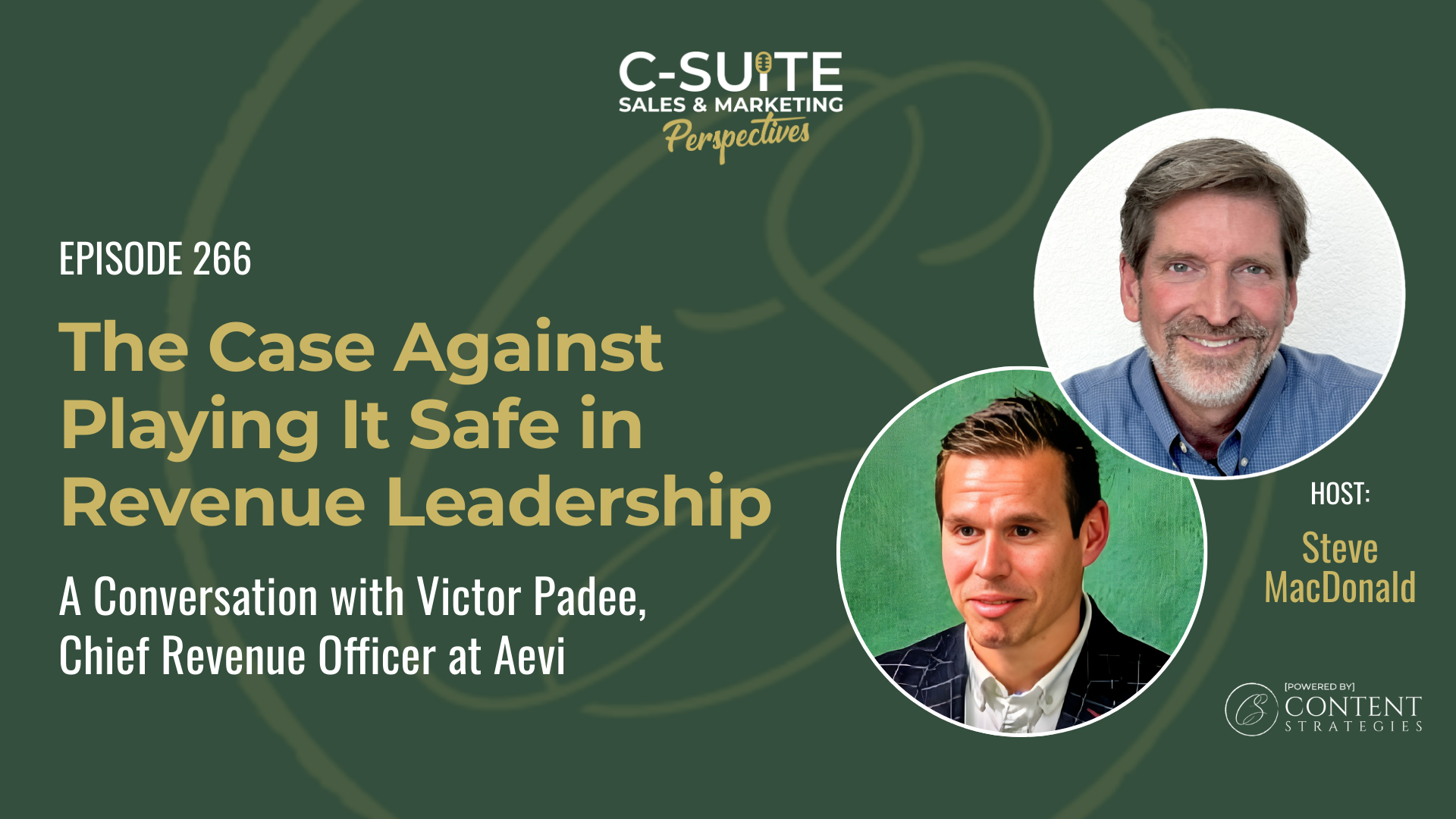
Victor Padee, Chief Revenue Officer at Aevi, explains why revenue leaders must stay adaptive while keeping a clear long-term direction for their teams. He outlines how customer truth, ICP focus, and consistent experimentation help teams avoid distraction and improve outcomes over time. He also shares how demand creation, authentic thought leadership, and trust-building can shift deal momentum within enterprise buying groups and drive inbound interest from major brands.
“Unless we are solving a problem or helping someone accomplish, avoid, or repair something important, we will not reach a point of generating revenue. It is a constant process of readjustment. It requires having a clear north star, making adjustments, and then adjusting again as conditions change. It also requires the courage to recognize when something must be broken and rebuilt from the beginning.” – Victor Padee
In this episode, Victor breaks down what modern revenue leadership requires when markets shift fast. The conversation connects customer truth, ICP focus, and steady experimentation to real business outcomes. It also shows why trust and demand creation must start early, long before buyers raise their hand.
Follow Victor Padee on LinkedIn – https://www.linkedin.com/in/victor-padee-mba-5a3624b/
Follow Steve MacDonald on LinkedIn – https://www.linkedin.com/in/stevensmacdonald/
[00:00:05] Steve MacDonald: Welcome, everyone, to the C-Suite Sales and Marketing Perspectives podcast. I am Steve MacDonald, your host. Today, we have a very special guest on, Victor Padee. And Victor, you are the Chief Revenue Officer at Aevi, and you have been in the financial services industry your entire career. You have risen to a point where you started out as a young man out of college, coming from Poland to the UK with 500 pounds in your pocket, started working in factories, loading trucks, and now you lead an international revenue team, sales, marketing, partnerships, and the roadmap for the product. You have the go-to-market strategy for the entire international market. You have a lot on your shoulders, and what we are going to talk about is some of the lessons you have learned along the way, including the case against playing it safe.
[00:00:59] Steve MacDonald: Why playing it safe is actually not the path to revenue leadership, not the path to success, and that actually sometimes we need to break what is already working in order to recreate success in the long run. There is a lot to unpack here. What I would love to do is ask if you would mind expanding on your background a little bit before we get started.
[00:01:24] Victor Padee: Sure, Steve. Thanks for a great introduction. When you say it like that, it sounds like an amazing journey. Maybe from the outset it is. When you actually go through the journey, maybe it does not sound as impressive. But yes, I came over from Poland between my first and second year of uni with 500 pounds in my pocket, believing I could make it work. Maybe there is this kind of attitude and courage to say, actually, I am going to break the mold and start again.
[00:01:54] Victor Padee: Maybe this was the seed that influenced my actions and my career trajectory to the point where I am at. Very fortunate to be at Aevi. I have amazing teams of sales, marketing, partnerships, and pre-sales. I work very closely with our CTO on our product roadmap and with our executive team on our go-to-market strategy to ensure we survive and thrive. And one of the things that we talked about was having the courage to break the status quo. For me, I guess part of it is driven by the very simple fact that over the last two or three years, I have seen more change than I have probably seen in 20 years leading up to that point.
[00:02:36] Steve MacDonald: We cannot rely on what we used to do and still continue to create the same success. And you have not only broken the mold. We are going to talk about that. You have asked for patience from the rest of your executive team and the board to seed a strategy that is working quite well now. We are going to get in and unpack all of that. But what I would love to do is, being at the top can be a lonely place, and there is a thing called the executive isolation reality, right?
[00:03:08] Victor Padee: Yeah.
[00:03:08] Steve MacDonald: And you know how isolating the C Suite role can be and how that feels and how that impacts your performance and what you do.
[00:03:18] Victor Padee: Sure. I think there is a certain degree of expectations when people look up to you, and you are at the proverbial top, at the C Suite, at the top of the structure, at the top of the company. There is this expectation that you would, A, have all the answers and maybe never make a mistake. And it is predominantly still a male-dominated place, and I do not think people talk enough about how lonely it can be. The reason behind it, I feel, is that many C Suite executives find it difficult to speak to other C Suite executives because most people they know are within the same industry, or there might be rival companies. And then you do not want to show weakness, right?
[00:04:01] Victor Padee: But also, speaking to anyone that is within your company, some people will see this, again, as a sign of weakness or maybe a lack of confidence. Therefore, you find yourself in a place where you have a lot of thoughts that you cannot really soundboard with other people. This is why I wanted to get involved with having a podcast with you today. If there is one person who will benefit from it, that will be great.
[00:04:26] Victor Padee: Another element in this is that my spouse and my wife, she is super smart and amazing, but she does not understand the industry. She still jokes and says she still does not know what I do, even though I have tried to explain it to her many times. Me going to her with some individual thoughts and observations, she will listen, but what kind of good advice or tactical advice can she provide me with? That is obviously a little bit difficult.
[00:04:52] Victor Padee: I think there is an element to that. I think we are getting better. We are getting better at sharing stories and speaking to each other. People are finding more mentors and mentees. I think things are improving. The stigma around mental health, loneliness, and authenticity is now diminishing. I think there is still a long way to go.
[00:05:15] Steve MacDonald: Amazing, because I talk to C Suite executives every day on this podcast, and there is still a really tremendous amount of feelings of isolation, but also feelings like I do not belong, imposter syndrome. Do I really get it? Am I as smart as my contemporaries?
[00:05:34] Steve MacDonald: I think having a community where you can come together, where you can hear and share, normalizes the challenges. We realize nobody has all the answers. We are not the only ones. Absolutely. So it is important, right? It is important not to feel isolated. But also, as you said, if from every conversation we can learn one thing to take away, even one thing, we are all the better for it, because we have to constantly educate ourselves. We are going to get into that because you are a huge believer in education.
[00:06:10] Steve MacDonald: What I wanted to ask a little bit about is that you feel there is a gap when we do not talk to each other. There is no sounding board. There is a lack of feedback from the marketplace on what is being tested and what is being tried. So we have to be our own innovation suite all wrapped into one, right?
[00:06:31] Victor Padee: Sure.
[00:06:31] Steve MacDonald: How do we get around that, and what kind of impact does that have on our business?
[00:06:37] Victor Padee: We all think that we go through unique problems, right, which is quite interesting. When you actually speak to other people, we all go through similar stuff. Not the same, but similar stuff. Are there enough forums and spaces, or communities, where you could really discuss it? I do not think there is. So you then repeat the same mistakes and go through your own iterations of learning.
[00:07:06] Victor Padee: It is important to still have the courage to do it, to break it and reinvent yourself because of the pace of change, because of how things are. This is why we still have a role for consultants and external non-Execs coming in and maybe having more formal arrangements. Can we do a little bit more in non-formal arrangements and communication, and have a CRO forum to say, listen, guys, I am trying this, does it really work? I have seen this new AI tool, and it promises great results, but does it really deliver what it says on the tin, right? I do not think we do it enough.
[00:07:37] Victor Padee: One thing I recently heard is that now people are using AI. What we may need to all think about is that whichever AI tool you are using will learn your habits andhow you operate. So then you could create a one-on-one echo chamber. Then they say, oh, it is very empathetic. It understands me a lot. The reason behind it is that it is as close to a mirror of you as it could be. It is not the only tool people should use. Having different views, opinions, and perspectives, maybe from outside the industry or the region, is something we should really encourage.
[00:08:19] Steve MacDonald: You have alluded to this twice now, and so I want to ask you a little bit more about it. At the beginning, you talked about how in the past few years, there has probably been more change than in the rest of your entire career, right?
[00:08:31] Victor Padee: Sure.
[00:08:32] Steve MacDonald: And that trajectory is not changing. So, based on what we know, our ICP is constantly evolving andchanging. The market is constantly evolving. Technology and its role, expectations of the value that we provide. You could go on and on.
[00:08:50] Victor Padee: Yeah.
[00:08:51] Steve MacDonald: In that world of change, you talked about how we need to stay up to date. We need to educate ourselves. We need to be talking to others in the marketplace, or we are falling behind quickly. The other aspect of this that you talked about is the need to take your own people inside of the company along this journey of change.
[00:09:16] Steve MacDonald: If it is constantly changing, we can feel like we keep getting the rug pulled out from under us. What was yesterday’s target is not the same target today. How do you take people along on the change journey and align vision along the way so the team is aligned and moving forward?
[00:09:39] Victor Padee: Sure. There is so much to unpack here, Steve. A lot of questions, but I absolutely love it. So, first of all, I think I looked at some statistics from Salesforce recently. The average tenure for a CRO is 1.8 years, which is around 21 to 22 months. The revenue leaders beneath that are 13 to 18 months. Sales rep turnover, it is an average of a year and a half, right? The average ramp-up time is 3.2 months. If you deduct the ramp-up time from the 18-month tenure, you are left with a window of around 13 months, or a year. What can you achieve in a year?
[00:10:20] Victor Padee: We are becoming more and more impatient. We expect everything to be today. We expect delivery today, the same day, or the next day. If it is not delivered within that timescale, we are getting frustrated. Because of the rise of AI, in the past, when you asked somebody to build a website, they said it would take two or three weeks. Now you could prompt it, and within 15 seconds, you have a website. It inevitably affects how we operate, how we think, and the expectations set from the outside, as well as from the inside.
[00:11:01] Victor Padee: So in all of this, I think it is very important to clearly articulate the long-term vision and have a long-term strategy that, yes, gets tweaked, but ultimately remains the same until you have given it enough time to be embedded, so people do not have a whiplash effect from constant change. If you have CROs coming in every 1.8 years, they come in, get embedded, and by the time they’re embedded, they start thinking about something else. How much actual doing can you really accomplish?
[00:11:30] Steve MacDonald: Can I ask you another follow-on question on this? The vision I got is we can be bobbing up and down in the sea, and the waves and the wind are taking us in certain directions. But if we have that long-term focus, at least we know where the horizon is. We know where we are trying to head. That is an internal grounding mechanism. Is there an equally powerful external grounding mechanism, which is the voice of the customer? The reason why I bring it up is that in our previous conversation, we talked a lot about this, but there was this amazing study by McKinsey that said less than 15 percent of companies actually execute well on a voice of the customer program, yet we all know it is the highest voice of authority in our business.
[00:12:16] Steve MacDonald: None of us would ever say we are not customer-first. We are not customer-focused. Every single one of us would say we are. It is to the degree that we are, and is that customer voice the grounding rod as well in terms of where we are going, what we are doing, and who we are serving? Is that important as well?
[00:12:38] Victor Padee: Ultimately, the short answer is yes, it is very important. A few elements in all of this are, first of all, what we think is not right. What our customers think is right. Because ultimately, we do not get paid on nice presentations and nice meetings. We all get paid on revenue. Unless we are fixing the problem or helping someone accomplish, avoid, or repair something, we will not reach a revenue point. That is a fact. Are we listening to customers enough? I would like to say that we do, but then I think that would be naive. Because I do not think we are spending enough time with our customers. I do not think we are keeping our ears to the ground.
[00:13:20] Victor Padee: I think there is also an element in all of this that there is a dilution of the message. If you have, let us say, a customer service representative or salesperson speaking to a customer, and the feedback is negative, by the time it reaches their manager, it has been softened. Then it is being softened again. By the time it reaches the C-suite, it is actually completely, drastically different from what it initially was.
[00:13:43] Victor Padee: There is a big role for people at every single level of the company to be speaking to customers. People at the C-suite, management level, and across every part of the company should be speaking to and interacting with customers. Our CEO is absolutely amazing in that regard. He is the best salesperson in the room, and he loves being in front of customers. He brings it into board discussions, and as a result, he gets it. That is an element in all of this.
[00:14:12] Victor Padee: Another element that I am trying to spend a lot of time on is crystallizing our ideal customer profile and fully understanding who our top customers, potential customers, and potential targets are. We sit within the enterprise space, enterprise retail, and enterprise field. Every single one of the customers that we have, while on paper they sound like the same customer, when you actually dig into what they are trying to achieve, they are completely different businesses. So there is a risk in all of that. If you are not laser-focused on your ICP, then you will get distracted. Then you have to really prioritize which customers we are going after and which problems we are going to solve for them.
[00:14:56] Victor Padee: Then we could serve these niche customers as well as we can, rather than spreading ourselves too thin. If you ask a hundred people what the problem is, you will probably get a hundred responses. You then need to try to prioritize and refocus the company at every level, saying we need to do this because it will benefit us long term. Doing something for short-term revenue, while it looks great on the P&L, might have a detrimental effect on us in the long term. It might shift our strategy by two or three degrees, and as a result, that could hurt us in the long term.
[00:15:34] Victor Padee: Seventy-five percent of existing SC 100 companies will not exist in two years’ time. It is a scary stat. When I looked at this, I was blown away. It is not easy. Let us face it, nobody is going to get it right. It is a constant process of readjusting, setting a north star, then readjusting again, and trying to say, “okay.” It also requires the courage to say we need to break it now to start again. If you continue like that, we might be okay for two or three years, but then in year three, we will have a cliff drop in performance, and then we will disappear. We have had plenty of examples like that. Looking at Blockbuster, Kodak. Oh gosh, they were amazing companies.
[00:16:18] Steve MacDonald: Oh yeah.
[00:16:19] Victor Padee: Even ask anyone these days who Kodak are and they would not know. Like Blockbuster.
[00:16:23] Steve MacDonald: They were like icons in the industry before. You just said something incredible. You just said we have to be prepared to break it in order to succeed. What did you mean by that? What do you mean by the idea of needing to break something that looks successful, and why?
[00:16:41] Victor Padee: Sure. I will give you a real-life example of me. Every single day, every single week, every single month, I look at every function I have and visualize it as a dial on my dashboard. I have sales, marketing, partnership, pre-sales, and product. I look at this and decide which dials I need to move. Whether I move them at the same time or whether I move one of them more. I look at this and ask myself a question. What are we doing? Is it good? How do I know it is good? And how can I improve it?
[00:17:15] Victor Padee: Just because something is working extremely well right now does not mean that it will work very well in the future. I am always looking for the banana skins and thinking, okay, can I improve this? Yes. For example, our lead count is trending in the right direction. Will this strategy be successful only in this quarter, or can I replicate it in quarter two, quarter three, quarter four? If it does not stand up to scrutiny every time I approach this problem, then I improve it.
[00:17:49] Victor Padee: I have to again give credit to my C-suite, to the CEO and CFO. I have a lot of freedom regarding bringing new ideas and A/B testing. For example, having different campaigns in place where we run a certain campaign, look at the results, and then run a parallel campaign at the same time. Looking at our marketing messaging, having one that is a little bit more traditional versus one that is a little bit more out there, left field, and then looking at the results and constantly thinking, okay, where do we need to tweak this?
[00:18:21] Victor Padee: The same with speaking with customers. We had a big campaign. We had a lot of great meetings. But none of those great meetings really resulted in tangible opportunities. For me, that was an amazing meeting. We meet up, shake hands, and everyone pats themselves on the back. But I was like that is not going to guarantee success for us. We need to tweak our ICP so there is more real pain. We tweaked it, and all of a sudden, we had fewer meetings, but the number of opportunities increased drastically.
[00:18:55] Victor Padee: It is the courage of saying that doing the same thing and expecting different results is a sign of madness. I constantly question myself and think, “Can I do things better?” Can I do things differently? Can I test some of the stuff I see? I try to educate myself on different tools and approaches to ask: Does it work for me? Will it work in our industry? Will it work for us? And will it work for my team?
[00:19:19] Steve MacDonald: I want to dig a little bit deeper because we had a phenomenal conversation the last time we got together. Our title here is The Case Against Playing It Safe in Revenue Leadership, and you had to take a leap of faith to do something that would take time to reap the benefits. You are just now starting to see many of the benefits of a program you put in place and had to sell throughout the company, the C-suite, and the board level. It was about taking content and promoting it in an educational form. If you could tell us the risk you took, the leap of faith that you took here, what you are doing, and why you are seeing success.
[00:20:00] Victor Padee: Sure. The specific example was actually bringing on board a demand generation manager. In sales and marketing, we talk a lot about demand capture. But the way we purchase things has changed. The buying cycles are different from what they used to be. I look at the way I purchase things. When I am looking for a holiday, a car, or a mobile phone, I tend to do a lot of research to form my own opinion. Then I either purchase online or reach out to two or three people when I already have a preformed opinion.
[00:20:34] Victor Padee: For some reason, business-to-business salespeople think that is different. It is not. We operate in in-person payments. I could guarantee that there will be a company that says our in-person payments do not work, and they will ask somebody to find the best in-person payment solution. What they will most likely do first, when they sit at their desk, is go online and say what the best in-person payment solution is. Or they go into ChatGPT and say, “This is our situation: X locations and regions. Who would be the best to serve me?”
[00:21:04] Victor Padee: What this prompted in my head, the shift in buying habits, is the idea that we need to create more demand. Whenever people are searching for that solution, we are at the forefront of their minds. We are creating a lot of content. We are creating many communities. We speak with industry experts, so we produce a lot of useful content for our potential audience. It is useful to us in helping with our strategy, but it also helps put Aevi on the map.
I have named this kind of strategy All Eyes on Aevi. I want as many people talking about Aevi and thinking about Aevi whenever they are looking for an in-person payment solution. It is not your traditional approach. What I proposed to our CEO and CFO, I said I would like to bring somebody in that I know is very good at creating demand, creating the community, bringing the right people that we could learn from, and then we could influence, and create a lot of thought leadership pieces, real thought leadership pieces. I am not talking about a white paper that is a sales leaflet dressed as a white paper.
[00:22:20] Victor Padee: Thought leadership pieces are provoking. They are really sparking great discussion and drawing attention to certain problems. We had an agreement. We brought that person on board, and in the first three months, we saw no results. Normally, at that point, people will start panicking and say, what is happening? I said, listen guys, just bear with me. This is not a short-term process. We need to wait for the results and then see what kind of ripple effect it will have in the long term.
Four months later, we had the APAL activity. Five months down the line, we had a big uptick. Then, six months later, all of a sudden, in the last month, three international brands came to us directly asking what we could do for them. These were brands that we would not have been able to approach ourselves. One of the brands is among the top 10 in volume worldwide, and they approached us because of the demand generation and thought leadership we are doing. The number of doors and rooms we have opened and sat in has really been invaluable. I do not think we could have done it with advertising campaigns alone, PR, or producing amazing white papers.
[00:23:41] Victor Padee: I am not saying we should stop doing it because it is still part of the overall tools and dials that we have. But introducing that, I put my neck on the block and said, listen, I really believe in it, and I think we should be doing it. Now we see the results. Now it is much easier for me to say, actually, yes, we need to continue doing it. But having this period and having this buy-in, that we should be focusing on it was crucial to succeed. If we stopped in month three, we would not have the results that we have now. This idea of how long we have to prove certain things to make them really work is important.
[00:24:15] Steve MacDonald: See, what I love is you have taken where the industry is going, and there are plenty of studies that all of us can see from Bain, Google, and Six Sense that talk about day one in the buyer’s journey when they decide, hey, we are looking for an international payment solution, right?
[00:24:33] Steve MacDonald: Day one. They decide on four of the five companies they are going to consider, and over 90% of the time, one of them is the one they buy from. The day they decide, if you are not top of mind, you are out of the game. What you did was you said we are going to get in the game before they decide. Absolutely. We all look for buying intent signals and form fills, and things like that, but that is intent after the buying decision has been made. We are chasing our tail at that point.
[00:25:06] Steve MacDonald: What you have done is you said, because thought leadership can be many things. A lot of people look at thought leadership, and they say that is the thing the CMOs talk about, building the brand and awareness, and it is a long-term thing. Yes, sure, it is good. What you are saying is no, it is critical. The buyer’s journey has changed, and we all know that. They are waiting until they are almost done before they even want to talk to us. The ones they want to talk to are the ones they decided on day one.
I think there is a massive takeaway here for any B2B C-suite executive with an ABM go-to-market motion. If you are not doing what you are doing and focusing very clearly on developing awareness of who we are and building trust by delivering value through thought leadership, then you are missing something important. Back to what you said about the voice of the customer. You cannot create great thought leadership that evokes conversation and answers the right questions if you do not know who your customer is and have not ruthlessly crystallized your ICP.
[00:26:04] Steve MacDonald: All the things that you have been saying throughout this whole podcast build a learning system, I think, for other C-suite executives. That was why I was so excited when you and I first had this conversation. Is there anything that I am missing from that, as we want to close out?
[00:26:22] Victor Padee: There is one thing that you mentioned, and it is a great summary, thank you. There is one word that, for me, I keep drilling into everyone: the idea of trust. Unless you have a Rolodex, those things are now a thing of the past because we have more options, more relationships, and more international business.
[00:26:45] Victor Padee: How can we build trust so that when people talk to you, they realize that you have been consistent with your messaging, that you are not just saying something for the sake of saying it? You believe in the problem you are solving, the ICP, the sector that you are in, and the region that you are in. How do you build trust?
These days, with the use of AI, you could build the most beautiful marketing campaign. It will have the right personalization. It will have the right words. You could create a lot of amazing AI-made videos. But does it really build trust?
[00:27:23] Victor Padee: I think people are now more and more looking for authentic opportunities, authentic communities, and authentic companies that are relentlessly trying to build trust and bring people to the table. Bringing thought leadership to your table that might not directly benefit them. Creating a partner ecosystem that helps with trust. Sometimes saying we are not the right partner for you and admitting it. Saying, listen, there are other people who could serve you better. We are not right for you because of the stage of your growth, of our product, et cetera.
[00:28:00] Victor Padee: Building this long-term trust. This is the idea of a bank account that I always think about. When I was an individual contributor, my biggest deal took me 10 years to win. It was three rounds of RFPs, and two rounds were unsuccessful. But throughout those 10 years, I changed companies three times. What I did was consistently speak to the buying team. I consistently spoke to the C-suite and the payments team.
When the third round, the RFP, came up for renewal, they messaged me and said, “Listen, Victor, you were the only person who kept in touch with us over the last decade.” We want to sit down with youand have you help us shape the RFP, but we will still proceed with the RFP. What else are we missing?
[00:28:45] Victor Padee: The way I imagine it, I was the first search on Google. They looked for it, they formed their opinion, and as a result, we won the RFP. It was one of the biggest deals in the company’s history. I remember it actually did my annual target in a week of trading. Again, it goes to the idea of trust. When we ask people to part with their money, and these days we have on average six to ten people involved in the decision-making process, there is a strong bias toward staying with an incumbent, since it is seen as the lowest risk.
When we ask people to part with money in enterprise deals, six-figure and seven-figure deals, unless we have this trust built throughout the company and throughout the buying center, the idea or chance of winning is extremely small.
[00:29:31] Steve MacDonald: I have to tell you, I wish we had another hour. We might need to have you back on the podcast. This has been such an amazing conversation. I just want to say thank you because the goal here is to bring C-suite executives together so that we can all share our learnings, our successes, our triumphs, our tribulations, everything.
[00:29:50] Steve MacDonald: If we do that, then it is all part of a rising tide that lifts all boats. Oh my goodness, Victor, you were such an important part of that rising tide today. I just wanted to say thank you for coming on to the podcast today.
[00:30:02] Victor Padee: Thank you for having me. Like we said before, if that helps one person out there, if somebody improves by listening to my ramblings and our conversations, then my mission is done. I will feel very accomplished. Thank you for having me, Steve.