
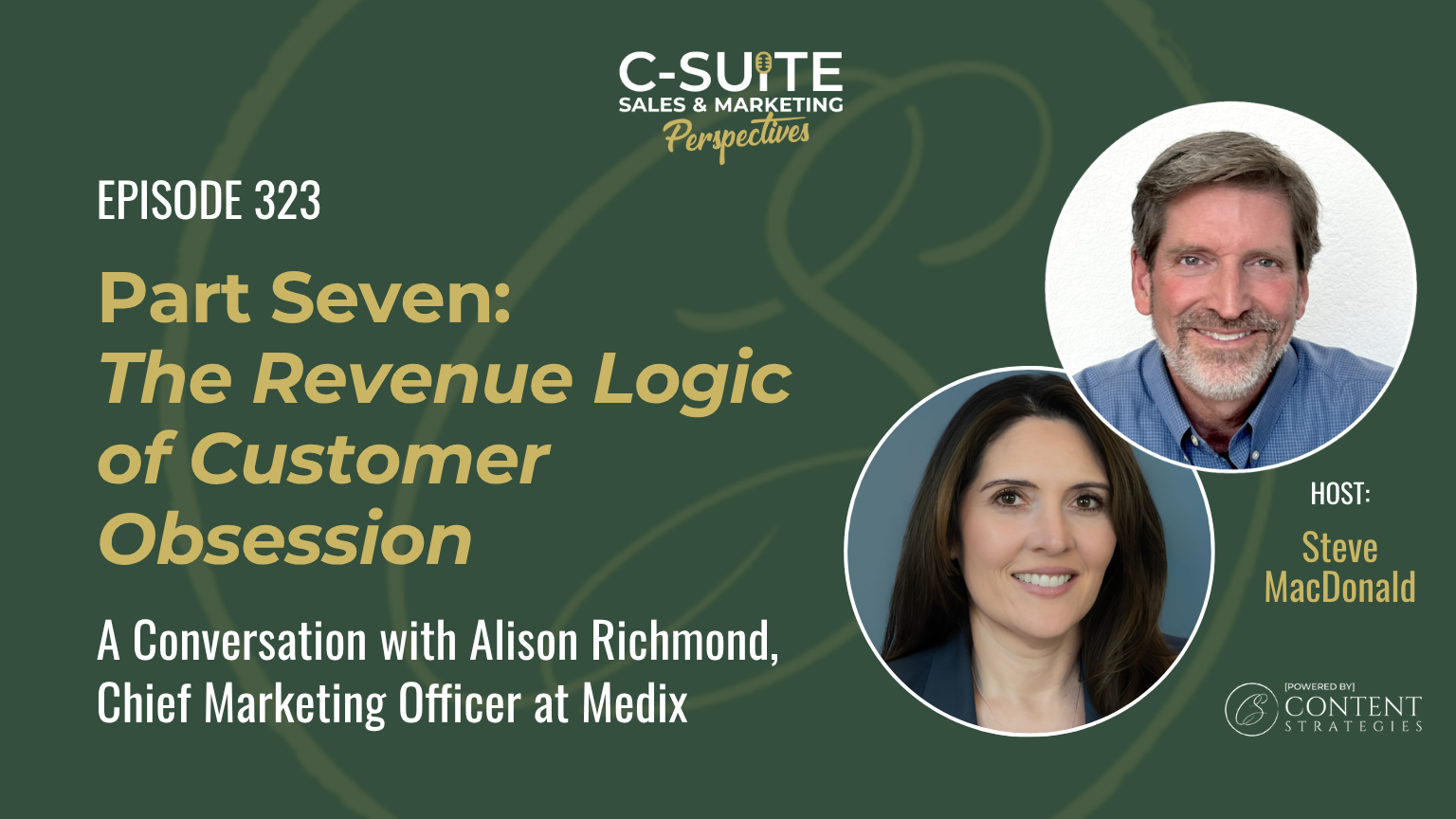


Episode #323:
Alison Richmond, Chief Marketing Officer at Medix, explains why customer obsession requires more than collecting feedback. She explores sales and marketing alignment, customer experience, and the importance of asking better questions. Alison also shows how customer insight can shape decisions, strengthen trust, and support growth across the business.
“Your best marketing campaigns and marketing moments come from that long-running relationship you have with your customer. Start by asking and learning where your customers are today and what they think of you today, and make sure that’s always part of the conversation going forward.” – Alison Richmond
Alison explores how companies can turn customer understanding into a practical growth strategy. She explains why sales and marketing need continuous alignment, why customer insight must move across teams instead of remaining siloed, and why leaders need a clear way to connect brand promises with real customer experiences. The conversation also examines how customer experience influences trust, AI-driven discovery, revenue decisions, and long-term business growth.
Follow Alison Richmond on LinkedIn
Follow Steve MacDonald on LinkedIn
[Transcript]
[00:00:10] Steve MacDonald: Welcome, everyone, to the C-Suite Sales and Marketing Perspectives podcast. I’m Steve MacDonald, your host. And we have a special guest on today, Alison Richmond. Now, Alison, you’re a Chief Marketing Officer, and I’ll let you expand a little bit on what you do and your responsibilities, but what’s really interesting is you’ve done something that Gartner and Forrester around the world have said, “CMOs, you’ve got to do this,” right?
[00:00:34] Steve MacDonald: You’ve got to be in charge of the customer, and you hold all customer experience under you as well as all marketing. And that’s a big task, right? Because that’s much broader than marketing. That covers the entire go-to-market strategy, building trust at every turn. We know how important that is these days, just even getting onto the shortlist, right?
[00:00:54] Steve MacDonald: So I love that about your background. You’ve been in B2B the whole time. Also, you’re very passionate about something that is the number one challenge that all of us face. And I ask questions every time that a C-suite executive comes on the podcast. So over 125 times, I’ve asked the question, what are your two greatest challenges for creating long-term sustainable growth?
[00:01:17] Steve MacDonald: Internal alignment, by far, is the number one, and you’re very passionate about making that happen internally. So I want to dig into that. But the whole topic rolls up today to the revenue logic of customer obsession, and how do we tie that together? What does customer obsession mean? And then, yep, for our CEO, CFO, and boards, how do we connect that to revenue? So I would love to give you a moment to expand on that background before we start.
[00:01:48] Alison Richmond: Absolutely. Thank you, Steve. It’s so fun to be here today, and I have to say, the incredible customer experience team that I’ve adopted in this organization has done remarkable work for a number of years now, and we’re just so thrilled and having a lot of fun aligning them within marketing.
[00:02:04] Alison Richmond: So I’m excited to talk about that today as well. But I will pause on that and share a little bit more about myself first. I have been in marketing for almost 25 years. I actually started on the PR and events side of things, and quickly moved into marketing roles, more product marketing, and then leadership roles for the last 15 years. Been in the staffing and professional services space with a real, as you said, passion and experience in aligning the sales and marketing efforts for the best outcomes possible.
[00:02:35] Steve MacDonald: I have to start out and just say, we stated it upfront, the number one challenge we all face is internal alignment. You brought it up right away, and you just lit up. Why do you see internal alignment as the biggest challenge? But then, obviously, the flip side of the biggest challenge is that we can turn it into our biggest opportunity. So how do you see internal alignment, and how, from your position internally in the C-suite, do you help foster internal alignment?
[00:03:02] Alison Richmond: Yeah. I think for so many companies and so many marketing departments in particular, there’s a lot of passion around launching good campaigns, understanding your audience, and bringing that all to market. You have these great leads in your possession, and you sometimes see them not take the next steps. There’s a quick, historical reaction to blame sales, when really it’s no one’s fault, in my opinion, because we have one chance to get to know our customer and have a continuous relationship with them. I have loved the opportunity for marketing to really start thinking like sales and think about the handoff process, but specifically how the customer sits at the center of everything that happens from the very first touchpoint all the way through the retention process.
[00:03:48] Alison Richmond: Yeah. And I think that’s why I’m so passionate about sales and marketing alignment, because it really only works. You can drive in the leads, you can close the business, but it has to work together because you have to be thinking about the customer first. So what I like to do there, what my experience has taught me, is the best thing to do there is to really focus on the outcomes first. What is the business goal that everyone wants to drive together, and not lose sight of that, and internally keep the reminders really high about what gets you there? So the high-level marketing metrics that we, as marketers, I, as a marketer, tend to lean on are really top of funnel; it’s about education and alignment on why those matter to the final outcome. That’s what I love getting to talk about and geek out about as we go through any of our internal conversations.
[00:04:39] Steve MacDonald: Yeah, you know, we can, as marketers, we can talk very eloquently about leads and marketing attribution, downloads, and page views, and all kinds of different things. But really, all that matters is the outcome at the end, and we’ve been beaten over the head for a number of years now. You gotta be really pipeline-focused, right? Because in the end, if we’re not helping produce and then close the pipeline.
[00:05:02] Steve MacDonald: You talked in our prep call about this. You mentioned the handoff there, right? But we know, ’cause as marketers, we get all kinds of requests from sales all the time: “I need this, I need help on this,” at every stage where they’re trying to close deals, and so it’s not really the handoff, as you put it before. It’s a continuous relationship and alignment, right? If we’re truly focused on the business outcome, then we don’t disengage. It’s not like a baton pass, right? Where, “Oh, now it’s gone, and we have nothing to do.” It’s collectively aligning throughout the buyer’s journey, and you talked really eloquently about that in the call we had before this.
[00:05:42] Steve MacDonald: How do you stay connected? How do we make it not a handoff? ‘Cause that’s the old way. It’s like, “Oh, MQL, throw it over the wall. We’re on to make, getting the next,” and it just doesn’t work that way.
[00:05:54] Alison Richmond: No, it doesn’t, and I think that as the CMO, there’s something I always challenge my team on, which is when we’re developing a campaign, our final plan does not end at the handoff either. It really talks about what that handoff looks like. Who is getting the lead, who is getting the email response, whatever the case is, where is that going, and then what piece of content or what information will they need next to continue down the funnel and close the deal? To me, that’s a really important part as a marketer to think about and to challenge your team on: where do you end your marketing goals, and where do you include that handoff piece in your campaigns?
[00:06:34] Alison Richmond: From there, I think what we talked about last time in particular was just the continuous conversation. It’s a continual customer. It also has to be a continual conversation. You can say sales and marketing are aligned because you’re meeting so often or you do even have a shared outcome, but how often are you talking about what’s really happening once the campaign is launched or a little further down the funnel? To me, the real fun comes in not just launching the campaign, but then talking about, “Here’s what we learned from it, here’s what we need to change from it,” and making sure that sales has a voice and feels like they have a partner in saying, “This isn’t working. You may have driven in all of these leads, but they’re actually not the right leads.” Or whatever the case may be. So, it is always about learning, not just ending the conversation after the campaign launches.
[00:07:22] Steve MacDonald: We’re all smart people. You didn’t get to be a Chief Marketing Officer because you didn’t know what you were doing. But every department has a really smart person running that department, and we know how to make decisions, and we don’t need to wait for anybody else. That’s part of what tears internal alignment apart: we’re off doing different things as a part of the overall go-to-market, and we’re making decisions all the time.
[00:07:45] Steve MacDonald: But one thing that you said in our previous conversation was that there’s one thread that runs through it, and you talked about the customer. If we’re all focused on the same needs and the same customer, that’s a natural alignment. This will blow you away, but Forrester did a study a few years ago and found that only 3% of companies, B2B companies, are truly customer-obsessed, and McKinsey said only 15% even use the voice of the customer in their strategic decision-making. This is a real issue.
[00:08:20] Steve MacDonald: I had a woman on; she led a go-to-market agency, was a partner, said hundreds of different customers, and they’re customers of the B2B companies. She said, “We always start with alignment, and we always use the voice of the customer as the number one change agent to get everyone to collectively agree on what it is that we’re aligning on.” Does that ring true for you?
[00:08:46] Alison Richmond: It does. It definitely makes sense. I think having the voice of the customer in a few different places, from the voice of the customer and how they understand your brand at the very top of the funnel is an important part of that voice when you’re thinking on the early phases of the marketing and sales alignment and the process, but then really understanding the experience that they’re having with the brand, that’s the true differentiator to me.
[00:09:11] Alison Richmond: I really think of it as your marketing, like your best marketing campaigns and marketing moments, they come from that long-running relationship you have with your customer. So making sure that you have regular check-ins and that you have information that is first being collected, but then I think it’s really about how that information is being shared and how decisions are being shaped based on what we’re learning. So making sure that information doesn’t go into its own silo and it’s really shared across the business, so everyone can be making decisions based on the customer value.
[00:09:45] Steve MacDonald: So you said another thing, that it’s really hard to do that, right? What makes it so hard? These are basic things, if you really peel it back. Oh, we’re all gonna align, and we’re gonna align around the North Star, our customers. There couldn’t be a more basic set of objectives, right? Why? Why is it so hard to do that?
[00:10:09] Alison Richmond: Good question. I think it comes down to the fact that everyone cares about it, but it sometimes is in a silo, and it doesn’t get the attention that it needs. Sometimes it’s not represented at the C-suite level, in my experience, in past lives, and sometimes it is just not included in a way that everyone can digest. Data points that everyone really cares about. I think that’s what’s most important. But I will say, sometimes on the flip side, there’s almost too much information, too much information collected about the voice of the customer, and then no one knows where that one source of truth is, or what is the one thing that we’re rallying around.
[00:10:49] Alison Richmond: So I think back to one of the things you were saying was getting really clear on those few things that you really wanna know about your customer. And if I zoom out, I think about it as the brand promise. What is the brand promise that your company has? And then are you living that through the customer experience? And if you can keep answering that question, then I think everything gets a little bit easier. But it is, just like I mentioned on the sales and marketing alignment, it is a constant conversation, and it is something that someone has to always be championing.
[00:11:20] Steve MacDonald: Here’s what’s interesting: when we come up with a brand promise, and we’ve all lived through revamping brands. We’re not talking about logos and colors and the homepage of the website. We’re talking about: what do we stand for? What is our promise? What are the challenges? Who are we serving? All of that. We’ve done those kinds of things time and time again, and you feel like, is anybody else in the company reading this? Is anybody else actually, like, adopting this?
[00:11:47] Steve MacDonald: One of the biggest things, and I’d love to get your thoughts on this, is how do we sell that internally? You talked about leading teams. If teams aren’t aligned, it doesn’t matter. We could have the best documents. We have the best strategy. The C-suite can meet, and we can all nod our heads and agree. But if the individual teams themselves don’t understand, don’t agree, aren’t motivated by it, or see how it impacts their lives, what they’re doing today, how does that make it out into the teams?
[00:12:22] Alison Richmond: I am a big fan of Simon Sinek, going back to his very early days and the entire concept of Start With Why. That video, to me, really was meant to speak to the external part, like how you communicate your brand to your customers. I took so much of that in how you communicate internally, and how you bring people together. That’s how you do a lot of what you said. Why are we doing all of this work? What are we trying to accomplish? And then consistently reminding people of that.
[00:12:53] Alison Richmond: I say all the time, from previous experience and a little more on the change management side in a past life, I say, seven times, seven ways. You have to make sure that you are delivering the message in different formats, in different conversations. The heart of it stays the same, but the kind of mechanisms around it change, so it really resonates with people. Just like anything we do in marketing, it needs to be done multiple times. I think it’s just as important internally. Every time you’re having a big, especially if it’s a cross-functional team check-in meeting, whether it’s something you put on I was gonna say the board. But so there’s something you put up on, you know, at the start of your presentation deck, or you just talk about at every team kickoff, or whatever the project is.
[00:13:35] Alison Richmond: You keep reminding everyone, “Why are we doing this work?” Usually a simple, with the voice of the customer, right? Or growth, but ultimately, I like to think of those two as one and the same. So I think it’s that. I think it’s continually having a clear why, and then continually coming back to that. That can be on the big scale, like an annual goal, or, to me, that can be and needs to be on the project scale. So what’s the thing from this one project that you’re working on? What is the why there? And then, I think really great leaders help ladder the two together.
[00:14:09] Steve MacDonald: So important, because we get motivated by understanding the why, and if we really feel like we’re making a difference, and the team gets it, and we’re all a part of the solution, internal campaign, internal messaging, and reinforcement is something that we sometimes just forget about, quite frankly, right? It’s in the priority list of the proactive things that we’ve got to do every day.
[00:14:35] Steve MacDonald: You know, it’s the kind of thing where it’s like, I’ll get to that tomorrow, then it’s next week, and then it’s next month. This internal messaging and internal campaigns, how important is that? If you were just to give us your thoughts on that.
[00:14:48] Alison Richmond: Yeah. I think it’s incredibly important. I think it is so critical to the project and its outcomes, and I really think it’s so easy. I have been guilty myself so many times of getting stuck in the tactics and the details, and you’re jumping from meeting to meeting, and you wanna get really close to the like, “Okay, we gotta do this, we gotta do this to get to that end game.”
[00:15:10] Alison Richmond: But I think any time you need to help your team make a decision, any time you need to make a decision, sharing with the group that why, that mission statement around the project, it’s going to lead to better outcomes. But as you said, it’s also gonna lead to, like, really a, a rallying of the group working on the project that’s going to bring even more innovation to the conversation.
[00:15:31] Steve MacDonald: You know, and it seems like if we’re just communicating that this is our strategy and what we’re doing, but if it’s cloaked with, “This is what we’re learning. These are the trends. This is the evolving challenges of our customers and how we need to meet that challenge.” We all know the world’s changing underneath us every day, and faster than ever with AI and everything. So our buyers are living that as well. If that messaging stays grounded in that voice of the customer. So this is a question that I would love to get your opinion on, ’cause this is the actual sixth recording of the series on the revenue logic of customer obsession.
[00:16:10] Steve MacDonald: And one thing that keeps coming out is that we don’t have the understanding of the voice of the customer that we want. We’re not satisfied, in general, with the level of understanding, and then distributing that and making it so that it impacts everyone on every team in what they do every day as a part of the machine that moves things forward. So it was put to me this way, and then I’ve been carrying it on the rest of the series. We’re not in enough of the right rooms at the right time, talking to the right people, asking the right questions. I’d just love to get your reaction. You could agree with that, you could disagree with that. Whatever your sentiment around that is, I’d love to get your take on it.
[00:16:53] Alison Richmond: I am someone that really believes the right questions make all the difference. So I don’t, yeah, disagree with any of that, but the part that I think is so critical and has made the biggest difference in my experience is asking the right questions. But I’m gonna add something to that. So ask the right questions first internally about what you want to be learning. Is this something like the voice of the customer that carries through their experience, or is it something more nuanced because you’re trying to make a decision about launching some sort of new product or feature? That is often a different set of questions. Really dialing in on the right questions for the right goal is the part that I am incredibly passionate about, and I wholeheartedly agree with what you just said.
[00:17:36] Steve MacDonald: So it was interesting. I put that little cadence of not in the right rooms at the right time, asking the right people, asking the right questions, and I put it into Claude and ChatGPT, and I said, “What do you mean by that in the world of B2B and ABM, right?” And they said, “In the world of B2B, the vast majority of questions that we ask are very operationally based, like about us, our product, our launches, our campaigns, our sales strategy. The questions that don’t get asked enough are about them, about our customer.”
[00:18:12] Steve MacDonald: It’s like always when you meet somebody at a cocktail party or something, it’s always easier to talk about us. You, you get cornered by that person, and you’re like, “They had a great time ’cause they talked about themselves all the time.” How do we stay focused on the customer? How do we talk about them more than we talk about us?
[00:18:31] Alison Richmond: I think it’s asking the questions on what their pain points are, and almost forgetting about ourselves and our product or our service, and really asking, “Yeah, what, what matters to you? What’s one thing that’s slowing you down in your day?” Or, “What’s one thing that would help make your life easier?” I love asking that question. “What’s one thing that you think would make your life easier?” One story that always carries me forward is how the iPod was launched, and how that was really about something new and different, and a pain point that sometimes people didn’t even realize they had. But what a value did it bring to have 1,500 songs in your pocket?
[00:19:08] Steve MacDonald: Huh. Yeah. You’re right. It was not about product features; it was about the experience. That’s where I’d like to divert a little bit here and bring it back to: you have a very different purview than most of your contemporaries as chief marketing officers, ’cause you oversee customer experience.
[00:19:26] Steve MacDonald: A lot of B2B companies, there isn’t anybody that’s overseeing customer experience. We talk about it, but there’s nobody who’s in charge of it, and that gives you a very, very different lens on how you are a contributor on the C-suite, accountable to the board, everything. What does that lens mean to you, and how do you think differently, wearing both those hats, CMO and chief customer experience officer? Even though I know your title is CMO, nobody else oversees it. You do.
[00:19:57] Alison Richmond: I have to say first, it was a big commitment to the company years before I joined to really create a customer experience team, and really put that value there. So I was very lucky that I walked into an organization that already had that true care for the customer. They weren’t just saying it; they were living it. But the opportunity, as I got more involved and we started talking about it, was: how do we learn from this? How do we advocate for this and communicate it in a way that does drive growth?
[00:20:25] Alison Richmond: And I think Forrester even came out with a report, it might’ve been this year, talking about how companies that really connect their brand promise to the customer experience were seeing three and a half times larger growth, revenue growth, and that is a great example of what I think the goals are for so many companies right now, and why marketing should be more connected to the customer experience overall, is because marketing gets this really cool job.
[00:20:52] Alison Richmond: I know I’m a little biased, but of sitting at the center of so many different aspects of what happens in a company, from thinking about what’s happening external in industry, to figuring out how that aligns with what’s happening internally to create campaigns and other growth strategies that really matter, and adding in a real connection to the customer experience and their point of view in shaping all of those strategies is so exciting, and I think so important to how companies will continue to grow.
[00:21:22] Steve MacDonald: You just did a brilliant job in answering, what is the revenue logic of customer obsession? ‘Cause you don’t have an incredible customer experience if you’re not obsessed with the customer themselves and really digging through and understanding that experience, ’cause that experience isn’t just, if you’re a tech company, using the product or the consumption of the professional services. Customer experience starts with the very first interaction. Customer experience, really, to get on the short list today, you’ve got to be known and trusted.
[00:21:53] Steve MacDonald: You’ve got to create experiences that build trust way before they even become a customer. Like, so customer experience kind of limits what you and I have been talking about, because the experience really spans everything that happens before they become a customer, and then obviously when they are a customer. There are a lot of boards, and there’s a lot of C-level executives who can’t connect the dots because customer experience isn’t one thing, right? It’s not, oh, a campaign that, like, nailed it and brought in all these leads. That’s very direct attribution. Customer experience doesn’t always have that direct attribution.
[00:22:32] Steve MacDonald: Forrester study went a long way to saying, “Okay, we know we’re on the right track.” Like, how have you experienced overseeing the role of customer experience and how it impacts revenue? Like, a story or just a trend, a takeaway. How do you connect those dots just from your own experiences?
[00:22:52] Alison Richmond: It’s very interesting. We are going through a process right now to really tie those revenue numbers together, but I think what we know a bit more anecdotally, perhaps, or just what we’ve seen in the growth of the business, is that the customer experience has been part of the conversation, and our team presents regularly on different ratings and different scorings, and we’re working to continue to make decisions around that, that I think will only continue to drive the growth.
[00:23:23] Alison Richmond: Kind of a side note I want to make on what you just said around the customer experience is the importance of review sites in AI search today. Yeah. And one thing that I think is really important, and why this is going to really matter more than ever to companies, is that as the customer is searching today for information about you and building that trust, when they go to the LLMs, one of the most cited sources is review sites.
[00:23:52] Alison Richmond: Now your customer experience is really at the heart of that top of the funnel conversation and information. That’s changing the credibility and the relationship so early on that I think companies are going to continue to see the importance of not just understanding the voice of the customer, but really prioritizing it, because it’s gonna matter in a tangible way sooner in the process. That is just fascinating to me.
[00:24:20] Steve MacDonald: Yeah. The LLMs are doing a really good job. Instead of us having to go to individual sites and look up reviews and ratings, which we do, it brings it all together, right?
[00:24:29] Steve MacDonald: And gives an overall conclusion after having seen all of that. So it makes it easier, okay? Those review sites of what our customers are saying about us and the experiences they have, they’ve always been important. They’re certainly getting a larger share of our buyers’ time as they evaluate us. It’s making it easier and easier for them to do that. So I’d love to ask a question in an area that we haven’t really figured out yet.
[00:24:55] Steve MacDonald: You’re in charge of the customer experience team, which means there’s a customer experience budget that gets allocated, because a team is a real expense. One of our biggest overhead expenses is people. You said you came in, the experience team was here, but you’ve got to justify the spend on the customer experience team.
[00:25:19] Steve MacDonald: I am sure you’ve had board-level, CEO level, CFO conversations about, “Hey, we’re spending this kind of money on this team. What are we getting out of it?” How do you just justify internally, without naming names or different things like that, but just the strategy of, like, how do you answer that question? How do you justify having a dedicated team for customer experience?
[00:25:41] Alison Richmond: Yeah. It’s a very good question. I think it’s why every company is going through the process of really determining how we can tie more revenue activities directly back to that customer experience. I think it’s a little like the concept of brand was, maybe 10 years ago, which is that the company really has to first have a belief that they care and that it will matter over time, which is a hard thing to take into a financially driven conversation. But it really is, to me, the differentiating factor.
[00:26:14] Alison Richmond: So being able to say, “This is an investment today, but our goal is to turn this into a growth center. So let’s figure out how we’re going to measure that growth, how we’re gonna define what that growth goal looks like, and then how we’re going to benchmark where we’re starting and where we are in a year from now, two years from now, three years from now.” But it is initially an investment, and it’s something that you have to have a team around you that really supports.
[00:26:40] Steve MacDonald: Yeah. So last question, and this one is the hardest one, because we’ve covered a lot of territory already. But if there was one thing that you wanted other C-suite executives that are gonna be consuming this podcast, the one most important thing that you wanted them to take away, if they take away anything, what is that one thing?
[00:27:06] Alison Richmond: Start asking questions about what your customers are thinking and doing, and figure out how to get those answers. Whether it’s a full team that you need to develop, whether it’s some research, an agency partner, just start by asking and learning where your customers are today and what they think of you today, and make sure that’s always part of the conversation going forward.
[00:27:30] Steve MacDonald: I love that. There was a woman a couple of years ago, and she’s a three-time B2B CMO and, if I get this right, a value accelerator advisor for Goldman Sachs. She helps direct $100 million investments into companies and things like that, and she said, “We should be spending, Steve, as CMOs, 20% of our time just talking to customers and asking the right questions.” It’s that important.
[00:27:55] Steve MacDonald: And so I love that your takeaway is, we just gotta, we gotta be asking questions. My takeaway from your takeaway is that work never ends, right? Yes. Understanding the customer never ends, and we like to treat it like a project, right?
[00:28:10] Steve MacDonald: Checked the box, did our NPS survey again. Here’s what came back, right? And we really have to have that curiosity to keep asking the right questions, keep learning, and be a real student of our customers.
[00:28:21] Steve MacDonald: I just wanted to say thank you for coming on, because if we can all share from our own experiences and perspectives and what we’ve learned with the rest of our peers in the industry, then I call it the rising tide that lifts all boats. You were an amazing part of that rising tide today, and I just wanted to say thank you for coming on.
[00:28:38] Alison Richmond: Thank you so much. That is incredibly kind, and as an avid listener of the podcast, I’ve learned so much through hearing others’ stories. I just appreciate the opportunity to be a part of it.