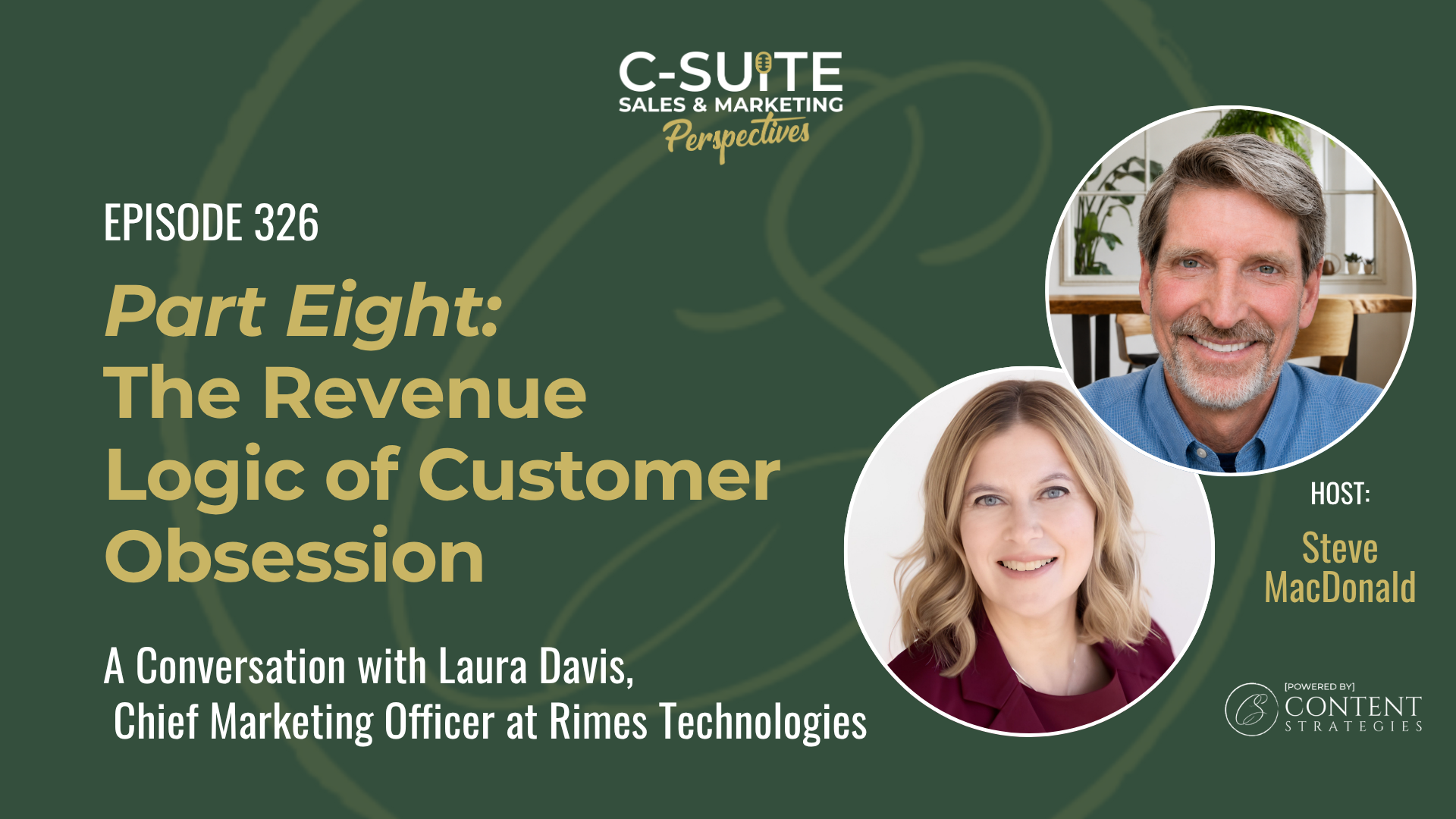


Episode 326:
Laura Davis, Chief Marketing Officer at Rimes Technologies, explains why customer obsession must translate into commercial outcomes. She explores customer intelligence, AI, data strategy, internal alignment, and pipeline accountability as markets rapidly evolve. Laura shows why sustainable revenue ultimately depends on continually understanding what customers need and building the business around those priorities.
“The customer is everything. Even in the context of AI and our whole industry changing, and the practice of marketing changing and all the different things, at the end of the day, you need to build and sell something the customer wants to buy and hopefully keep buying.” – Laura Davis
Laura connects customer obsession directly to the commercial realities facing B2B leaders. She explains why companies need continuous customer conversations, stronger data foundations, pipeline accountability, and shared priorities across teams. She also explores how AI can deepen buyer intelligence and create always-on engagement, emphasizing that technology matters only when it helps the organization solve meaningful customer problems and deliver measurable business outcomes.
Follow Laura Davis on LinkedIn
Follow Steve MacDonald on LinkedIn
[Transcript]
[00:00:10] Steve MacDonald: Welcome, everyone, to the C-Suite Sales and Marketing Perspectives podcast. I’m Steve MacDonald, your host. And today, we have a really interesting guest on, Laura Davis. Laura, you’re the Chief Marketing Officer at Rimes Technologies, and you are a global CMO. You’ve held global marketing responsibilities several times.
[00:00:31] Steve MacDonald: What we’re gonna be talking about today goes in a lot of different directions, but if there was a bucket underneath that was gonna catch everything, you and I were just talking about this: it’s really the revenue logic of customer obsession. As CMOs, we know we’re all supposed to be focused on the North Star, which is our customers, right?
[00:00:51] Steve MacDonald: But there’s often a very large chasm between being customer-obsessed, customer-focused, and actually executing on that. In a number of different ways, we’re gonna unpack that today. But what I’d love to do is to say, you’ve been in the fintech world for a long time. You have a really great focus, and this is gonna lead to an obsession with AI strategy, a number of different things on data management, and how important that is today.
[00:01:20] Steve MacDonald: We learned something new right before we started: that we are both owners of older golden retrievers. And I live near Golden, Colorado, and once a year, it’s inundated with golden retrievers and owners that come to Golden, Colorado. You would love it at some point. But I’d love to turn it over to you for a moment and maybe explain a little more about your background before we get started.
[00:01:46] Laura Davis: Great. Thank you, Steve, and it’s a pleasure to be here today and to meet you, almost in person anyway, and maybe your dog in person at some point. But I’ve been in this business, meaning, like, at a vendor servicing financial services for more than 20 years. I know the industry really well. I know marketing in this industry really well.
[00:02:05] Laura Davis: And I always say how that has shaped me, growing up adjacent to the financial services industry, is that I’m always hyper-focused on the commercials, and that’s why we’ll talk more about customer obsession and how that translates in the context of marketing, and really always delivering on outcomes and not getting caught up in whatever the latest distraction is.
[00:02:30] Steve MacDonald: So I wanna come back to that, the focus on outcomes, but outcomes are preceded by our strategy and our execution. You and I talked previously about what happens to the strategic decisions that we make on a regular basis when the customer stops being the center of our focus. McKinsey did a really interesting study a couple of years back that found less than 15% of companies use the voice of the customer in their strategic decision-making.
[00:03:02] Steve MacDonald: Absolutely amazing. So what happens when we lose that focus on the customer?
[00:03:09] Laura Davis: I think right now, there’s just such an overwhelming amount of noise and change and positive things happening in my industry, in all industries, especially with the advent of AI. But it’s a really good example of where something new, a shiny new toy, can cause all of us to get distracted from what’s at the heart of our business.
[00:03:34] Laura Davis: You mentioned our North Star earlier. Why I always think of it as the basics haven’t changed. You need to build something the customer wants, successfully execute on that, sell it, and then rinse and repeat to a degree, and loop that customer feedback into everything you do at your business, and continue to partner with your customers day by day, and have with the customer and also the market, like what the market wants and is willing to pay.
[00:04:03] Laura Davis: I think some of the things that happen is there can be overwhelming changes in industry. Arguably, the advent of AI is like the Industrial Revolution. Maybe not. There’s discussion around that, but it is a big change. But what can happen, what I see happening, is sometimes companies are losing focus on what it is our customers actually want: a solution in search of a problem versus a problem in search of a solution, and it can get off track with that, and I think that’s what we see happening in some areas.
[00:04:35] Steve MacDonald: I get a lot of conversations with C-level executives on our board asking us, “What’s our AI strategy?” Or my CEO is asking me as the CMO, “What’s my, you know, what’s my AI strategy?” And it’s never tied to outcomes. It’s almost like we know there are good things that will come from an AI strategy, so what are we doing?
[00:04:55] Steve MacDonald: There’s never a conversation. Talk to me about a time where you’ve been in front of the board where they just generically said, “Hey, why aren’t we doing more of this?” Or, “Why aren’t we doing more of that?” There’s always an outcome that’s tied to it. Your focus on outcomes, I think, is really important. And so here’s the question.
[00:05:12] Steve MacDonald: I just had two conversations over the last two weeks inside of the series on the revenue logic of customer obsession with a Chief Sales Officer and a Chief Revenue Officer. They both agreed that in an environment where it’s harder to get access to executives, those meetings are fewer and farther between those meetings.
[00:05:31] Steve MacDonald: When those meetings happen, they’re shorter, and they’re happening more and more at the end of the journey. That’s what their competitive advantage is: understanding their customers that insight that’s allowing them to be a partner, not a vendor selling. Now, that’s been the Forrester, you know, Gartner, you have to be the trusted advisor kind of thing.
[00:05:55] Steve MacDonald: But it’s really interesting to hear C-level executives that are in charge of a sales organization saying, “That’s what we need to be.” It’s more imperative today as AI is giving everybody kind of a lift in terms of what they understand and what they know. Leaning on the true customer obsession is becoming more important than ever, was their conclusion. So that’s a long ramble, not really a question, but what rings true in that for you?
[00:06:26] Laura Davis: I 100% agree with that. In the context of marketing, marketers often get ahead of what is going on in the industry, what customers are talking about, and where things are shifting. So when I think of my company’s past and present, what does that look like?
[00:06:44] Laura Davis: It’s understanding the context of financial services. New regulatory mandates are coming down the pipe. There are all of these things that sit adjacent to this big industry shift happening with AI. What the customer wants are solutions that will help them do their business better, and that’s where, if you can stay in front of that conversation and really pick up on and use AI and other powerful tools to understand what are they talking about, where are they showing up, what is keeping them up at night, and then how can we stay in front of that in terms of how we go out and talk to the customer, both kind of top-of-funnel marketing conversations down to where salespeople are sitting in front of them in a room.
[00:07:25] Laura Davis: I think the other thing that’s really important, and a really successful entrepreneur, an entrepreneurial company I used to work with, was always of the mindset, you need to be speaking with your customers every single day. Every single person should have 50 meetings a year. Doesn’t matter whether that’s someone sitting in IT, sitting in marketing, or sitting in sales; everyone should be customer-facing.
[00:07:47] Laura Davis: I’m a big believer in that as well. I think it helps remind you that without your customers, you have no business. So you have to really understand where they’re at, what their priorities are, what’s shifting for them. In my industry, it’s things you hear elsewhere. You know, it’s like the pie is shrinking, margins are compressing, business is more complex. They have more data and information than ever before. How can they make it simpler? And those are the kinds of things we lead with.
[00:08:17] Steve MacDonald: So I love it. You set a really high bar, and I love that you did this: everyone should have 50 meetings a year; everyone should be customer-focused.
[00:08:27] Laura Davis: I think there was a Lance Uggla. People can go look up who that was.
[00:08:31] Steve MacDonald: Well, that’s okay because you believed it and you said it. But even as, like, CMOs, right? Yeah. We know, and again, like the Gartner, Forrester of the world, they’ve been telling us for years, you gotta play the role of chief customer officer, right? That role doesn’t exist in the B2B world.
[00:08:45] Steve MacDonald: There is in B2C. We know that we need to take on that mantle, and we usually start at a position; the first thing we do is start calling customers. There’s not a sales conversation. I’m new; I’m here to learn. You have these deep learning conversations, but then they stop because we get really busy, and we see our list of things- even the proactive things just grow and grow.
[00:09:09] Steve MacDonald: One of the most difficult things is staying connected meaningfully to the customer. And a four-time B2B CMO who was on the podcast said, “Steve, we’re not in enough of the right rooms at the right time with the right people asking the right questions.” The 50 meetings a year…
[00:09:30] Laura Davis: I was gonna say, we can edit this after: 50 meetings a month.
[00:09:36] Steve MacDonald: Fifty meetings a month?
[00:09:37] Laura Davis: So in the context of that company, 50 meetings a month was how that company operated. Now, for a marketer, that might turn into 50 meetings a quarter, or you’re at an event, and you have 50 conversations a month. I think it’s a high bar in what you should be aiming for, to your point.
[00:09:54] Laura Davis: That’s gonna play out differently in different groups, but the point of it is exactly that, that the customer informs how we think about the business. It informs how we think about how we’re transforming our product and our go-to-market strategy based on where the customer and the industry is going, rather than, like, a heavy inward-looking focus of, again, we have these shiny new toys, we have all these things we think are clever.
[00:10:19] Laura Davis: We’re transforming our organization to make it better for ourselves. All of that’s great, but that doesn’t matter to the customer. What matters to the customer is solving their problems cost-effectively and doubling the size of their business, given all the pressures they’re under.
[00:10:35] Steve MacDonald: So I want to lean a little bit on your database management focus, because in a world of AI, where every go-to-market team member is on AI every day and fulfilling, whether it’s RevOps or customer success or marketing, sales, and the individual team member, the entire go-to-market motion is really running through AI now.
[00:11:01] Steve MacDonald: The database, like the LLMs and even the new models that come out, they’re a commodity. You’ve got the same ones that I do, that your competitors do. It’s really, how do we utilize them? And they’re only as good as the data that goes into them. So database management used to be, like, in the day and age of digital transformation, “Oh, we’ve got to bring all of our databases together.”
[00:11:24] Steve MacDonald: We’re too siloed. We’re too fragmented. And here we are, what, 15, 20 years later, we’re still too fragmented. We’re still too siloed. But now we’ve got the entire go-to-market team utilizing LLMs that can really benefit from having all of our knowledge, our proprietary knowledge, and the unstructured data, those conversations.
[00:11:46] Steve MacDonald: What’s your advice for the C-level executives that are on and listening today of the importance of a database strategy and how it’s getting more and more important?
[00:11:55] Laura Davis: It’s super important, and it speaks to the fundamentals of what companies like Rimes and other companies in the industry are doing from their customer perspectives.
[00:12:04] Laura Davis: In terms of bonds, or first in terms of financial markets, our Rimes customers and many others are looking to apply agentic workflows across their own products and services. None of that can be done without a strong foundation underneath it, especially in regulatory markets, or regulated markets, I should say, because they need to be able to show the lineage of every decision that’s been made.
[00:12:26] Laura Davis: That’s my starting point of how I think about it. Again, having grown up adjacent to regulated markets, where any product that you supply has to stand up to that. Now, moving that into when I put my marketing hat on, in a marketing context, I think we’re a little bit grappling with this, if not more so, as much as any other industry and any other marketing org.
[00:12:47] Laura Davis: We have lots of tools at our disposal. Our company has done a great job experimenting and trying different things. We’ve got maybe three, four, or five different sources of marketing information and databases. How do we bring that all together into a single store? It’s something we’re working through in real time with some help from our product teams and others, where we started the conversation of, like, focus on what matters.
[00:13:12] Laura Davis: When I think about in-house tools, again, inwardly looking stuff in a small to medium-sized company, at the end of the day, I want most of the resources focused on paying for the customer, developing good products. Marketing matters a lot, too, but in terms of in-house development, we’re trying to focus on what matters and the use cases where we’ll get the most return and the most bang for our buck.
[00:13:37] Laura Davis: And it tends to be, like, our motions where we’re trying to open up new markets, bring in new logos, new customer types, and really focus there on making sure we have the very best information out of our own systems as well as external databases and applying some agentic workflows there to make that work.
[00:13:55] Steve MacDonald: The market, we know, all markets are shifting rapidly, more than ever before. Our playbooks, it’s almost a dirty word these days because as soon as you think you have a playbook, you’re rewriting the playbook. The biggest thing that’s happening in the world of AI here is that it’s shifting the expectations of the markets we serve.
[00:14:15] Steve MacDonald: They want much higher quality, much more value, much quicker. And I think you talked about AI as also a trap where you can chase a shiny object, but if it isn’t really focused on value, ’cause that’s the expectation, how are you giving me more value in a shorter period of time? It sounds like there’s a lot of initiatives happening internally here, but how do you keep your team in particular focused on the things that you know are gonna create the right value?
[00:14:49] Steve MacDonald: Because we can play with the LLMs all day long on efficiencies and different things, which are really important.
[00:14:56] Laura Davis: For sure. Having worked for so many years adjacent to financial services, I’m used to delivering to some kind of audience, always, and I think about marketing in that context.
[00:15:10] Laura Davis: I’m always a believer, if there’s no pipeline, it doesn’t matter. We really back what we do under the objective of, I won’t even say lead generation, ’cause leads don’t matter if there’s no pipeline. Yeah, like pipeline generation and empowering our salespeople, whether we’re providing kind of top-of-funnel coverage or anything else in between, like really helping them open and progress deals, which, in an enterprise sales environment as I work in, can take sometimes 12 to 18 months, right?
[00:15:40] Laura Davis: That’s where we start, but we’re rallied around a common set of numbers we’re working towards across the whole company and building everything we do based on that. And in the context of how we’re using AI, it’s like, how does that help us do more with less? How does it help us elevate the quality of what we’re doing, a better understanding of customer insights, a better understanding of the performance of our campaigns?
[00:16:04] Laura Davis: We are starting to get fractional on some of that now, for sure, right after a trial-and-error process, I think similar to any organization. Work. So, we see, so a lot of, I think, within my group or other similar companies, is big spend on AI marketing, AI experimentation, like you might see in consumer-facing marketing work.
[00:16:31] Steve MacDonald: What’s so important about that is I have a lot of CMOs that come on, and they’re feeling like they have imposter syndrome. Mm-hmm. They’re feeling like they don’t have a seat at the table. They’re feeling like they’re treated as one of the largest cost centers in the business. They’re as good as their last lead.
[00:16:47] Steve MacDonald: You could go on and on and on and on. But what you’re talking about with that experimentation on marketing spend, understanding that we do represent a huge cost center, right? Yeah, in the business, our CFO, the CEO, and the board are all gonna hold us accountable to doing something with that spend that really creates a return on investment.
[00:17:10] Steve MacDonald: Has AI, in your mind, helped you in your experimentation that you’re doing versus the A/B copy tests, the different things that we’ve been doing forever? How has it enabled you to experiment and then communicate ROI to the stakeholders who are holding you accountable for that marketing spend?
[00:17:32] Laura Davis: I think it is, for sure, helping us maybe not experiment, but have better intelligence on what we’re trying to do.
[00:17:42] Laura Davis: And that’s, again, partly the context of the industry I work in. It’s a pretty defined universe. I think this would be completely different, you know, at a SaaS where you’re selling across multiple different industry verticals and whatnot, right? But in ours, it was really helping us understand faster, cheaper, and more in-depth if we’re targeting a certain ICP or group of personas, where they are, what they’re doing, what they’re worried about, where the conversations are that these groups of people are having.
[00:18:13] Laura Davis: That, we’re seeing some real benefits. Things like content production and whatnot, we’re definitely seeing a lift as well. We always have a human in the mix, again, of course, ’cause we end up with the AI slop, as they call it, that we see everywhere. It’s just, you can tell right away if something was written by AI without a little bit of thought put into nuance and voice and all those things.
[00:18:37] Laura Davis: And then, in terms of ROI, the AI in the marketing context is at the beginning of helping us see better returns by being able to have more of an always-on marketing motion that is continually touching the universe that we wanna talk to, versus typically marketing, even in a digital sense, it’s a one-and-done campaign, and you move on, and you move on, and you move on, and you check back.
[00:19:02] Laura Davis: It’s helping us to have a more continuous loop there and then surface insights about different groups of people we’re talking to at a lower cost.
[00:19:12] Steve MacDonald: So you said the word insights three times in that answer. And we talked about insights upfront, and that those insights come out of a customer-obsessed organization and that kind of focus. Here’s an interesting thought. We have a lot, a lot of operating systems and technologies and everything. Where is the operating layer that takes in insights? Think about it this way: we all have CAB meetings. We come out of these customer advisory board meetings, we’re like, “Oh, we learned so much.” Then it probably makes it into a sales meeting or a marketing meeting.
[00:19:48] Steve MacDonald: It makes it into a bullet point or two. It might even make it into a sales presentation or proposal. And then a month later, it’s died out. Two months later, where is it? A quarter later, it’s like it never happened. We allow insights to decay, and that’s one of the things that I think I’m hearing from you that AI is really helping. It’s helping insights stay at the forefront.
[00:20:15] Steve MacDonald: If there’s a database where we put this together, they don’t decay, right? They stay top of mind and present within the workflows that we’re doing every single day. Is that a good takeaway from what you’re saying, or?
[00:20:27] Laura Davis: I think at the front end of the customer conversation, yes. We’ll see how this evolves as the LLMs and the costs evolve. I can see, as a marketer, many of them are gonna switch to a paid model, just like Google did back in the day. This will probably all change, but right now, you can definitely use these tools to have almost real-time insights on things people are talking about in your industry, especially in a defined industry like mine.
[00:20:56] Laura Davis: You can set up, whether you’re gonna set up agents or just, you constantly have your pulse on, yeah, news, different things going on. So that bit, yes. The internal discipline to turn that into a product roadmap and customer outcomes, I think that really comes down to how we run our organizations and think about customer-led product development alongside the company strategy and the board strategy.
[00:21:23] Laura Davis: Those things don’t always sync up great, and that’s okay. But really, being led by having your eye on the horizon of where the industry is going and what the customer needs to solve their next problem. I do think we get better smoke signals. You know, I said earlier, marketing can be a good advance. I think we can get great signals now, especially in defined industries, on where things are going.
[00:21:47] Laura Davis: I think actioning that is as challenging as it’s ever been, right? Because as a company, especially a small, mid-sized company, you’re probably busy working on everything you told your customers you would do last year and deliver this year, and then all of a sudden, you’re getting signals that actually the industry wants to go over here or over here.
[00:22:05] Laura Davis: That’s probably as challenging as it’s ever been.
[00:22:08] Steve MacDonald: A number of things you said in there, one I wanted to pull out, which is you talked about the different departments working and working independently and not always syncing up. I don’t know if you remember, but in the call we had, we prepared for this; I asked you a question.
[00:22:24] Steve MacDonald: It was, “What do you think the two greatest challenges for creating long-term sustainable growth are from a C-suite level?” The number one answer across over 125 different C-suite executives is that internal alignment is the number one challenge. What’s interesting is, if that’s the number one challenge, what’s the solution to that?
[00:22:45] Steve MacDonald: I had this three-time B2B CMO on, and now she’s a partner at a go-to-market consultancy, deals with hundreds of B2B ABM-focused companies. And she said, “It is so clearly the number one.” It’s the number one way that we tackle: how are we gonna help these people? We assess where everybody is. She said, absolutely, by far the number one. She’s also said, though, the number one change agent to bring everyone together is the customer; nobody argues with the customer.
[00:23:16] Laura Davis: Yeah. I got some really good advice at one point in my career, when I was working with an organization going through a lot of change. A mentor and colleague of mine gave me the advice that if you stay focused on the customer, all of this will just, you know, rally around that.
[00:23:33] Laura Davis: Keep everything focused on the customer and where they’re going, and in my context, the customer meaning the industry, like where things are going quarter to quarter, what we see happening a year out, the company’s capacity to deliver on that. Just, if you remain laser-focused on that, everything else falls away.
[00:23:51] Laura Davis: I completely agree with that, ’cause it also helps with all the normal human behaviors that can come out. Yeah. Everybody can have their axe to grind or their pet project or whatever the case may be, something that you can get emotionally attached to. If you stay focused on the customer, I think it helps rally the troops around the right North Star.
[00:24:11] Steve MacDonald: So I think you’ve been answering this question all along, but for the CEOs, CFOs, CROs, and CMOs that are gonna be listening, the CGOs, how do you connect revenue to customer obsession? Because there are so many things that, you know, independently, a number of different variables, and they all add up to, yes, this is gonna impact revenue.
[00:24:33] Steve MacDonald: But there’s not always that direct connection. But how do you connect revenue to customer obsession?
[00:24:43] Laura Davis: I think, for me, I look at it as if we aren’t connected to the customer, that revenue is gonna go away. And it might not happen overnight, but quarter by quarter, the cancellations will start to come in, and the churn will go up, and all of a sudden we’ll see we might have been chasing this shiny toy over here that was excellent, but in the meantime, we lost the base of our business over here.
[00:25:05] Laura Davis: So that’s how I think about it, and then when I put my marketing hat on, that’s why it’s so important to understand what the customer is centered around. Our value proposition gets built around that, and then hopefully that also translates internally into the broader go-to-market motions and how that gets activated with customer feedback into what we’re doing in the coming year.
[00:25:31] Steve MacDonald: I have to say that I want to continue on for a lot longer, but I have one last question. We’ve covered so much territory here that I want you to be able to say, if there’s one thing that you want the C-suite executives that will be consuming this podcast to take away, if there was one thing, what would that one thing be?
[00:25:52] Laura Davis: I think it’s really what we’ve been talking about. The customer is everything. Even with AI and our whole industry changing, and marketing changing, and all the different things, at the end of the day, you need to build and sell something the customer wants to buy and hopefully keep buying.
[00:26:09] Laura Davis: At its basic level, the business of trade is still the same, right? Yeah. And so, for me, I like to go back to the basics and really think about that. When we put together our marketing plans for the quarter, that’s how we get back to: what are we trying to influence? What do they want to buy? Are we equipped to meet that need in the market? The questions around that versus competitors and all the rest. I sometimes think, especially now, there’s a real need to get back to the basics.
[00:26:41] Steve MacDonald: It’s amazing that more than a quarter of the way through the new millennium, right? Yeah. That we’re still talking about some of the basics, how hard it is, and how we can never be relenting.
[00:26:52] Steve MacDonald: The 50 customer meetings a month, I love that as a bar. And so I just want to say that thank you, because the mission of this podcast is to bring different C-suite executives from all over the world to share their perspectives, their insights, their experiences, their learnings. And if we can all learn from each other, then it’s the rising tide that lifts all boats. You were an amazing part of that rising tide today. So I just want to say thank you for coming on.
[00:27:19] Laura Davis: Oh, well, thank you for having me. I appreciate it.