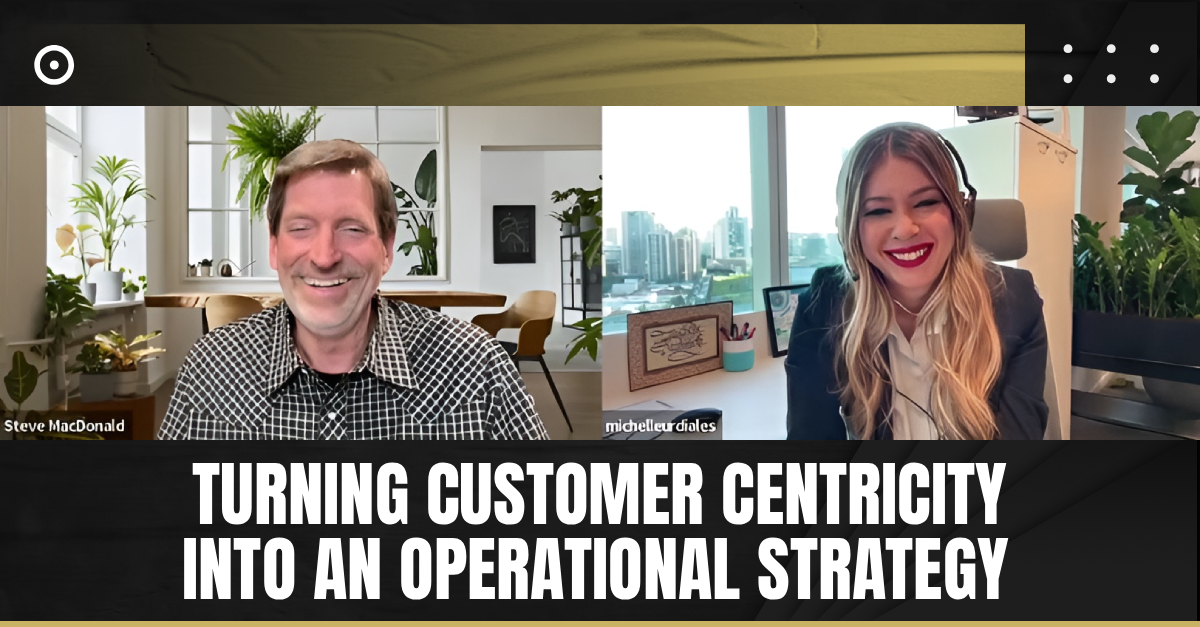


Episode #248:
Michelle Urdiales, CMO at LAM and a Member of the Regional Leadership Board at A.P. Moller – Maersk, explains how customer centricity must move beyond intention and become an operational strategy. She outlines how working backward from the customer shapes leadership decisions, prioritization, and long-term value creation. Michelle connects customer focus to retention, trust, and internal alignment across the organization. Her insights show how sustainable growth follows when customer value leads every decision.
“Never lose sight of the customer. Stay close to the business and the customer, and make it intentional. Plan these conversations, bring in the voice of the customer, and apply what you learn daily. This drives personalization, creates meaningful experiences, and completes the growth circle for their benefit.” – Michelle Urdiales
In this episode, Michelle shares how global leadership experience across technology, logistics, and B2B environments shaped her customer-first mindset. She explains why organizations must move past slogans and dashboards and embed customer insight into daily decision-making.
Follow Michelle Urdiales on LinkedIn
Follow Steve MacDonald on LinkedIn
[Transcript]
[00:00:05] Steve MacDonald: Welcome everyone to the C-Suite Sales and Marketing Perspectives podcast. I’m Steve MacDonald, your host, and today I think we have one of the most interesting conversations, the most important conversations, that we’ve ever had on the podcast.
[00:00:16] Steve MacDonald: We’re gonna be talking about customer centricity and not just because all of us say we’re customer first. We’re customer focused. Of course we are. It’s about walking the walk, talking the talk, right? It’s about what do we do? How do we operationalize the voice of the customer as a strategy? And we have on Michelle Urdiales.
[00:00:38] Steve MacDonald: And if I didn’t say that right, please, when I turn it over to you, correct me, but you are the CMO of Latin America for Maersk, and you also spent five years as inside of Amazon. And I’d love to have you explain your role there. Your role today is very much, you have a seat at the table, the leadership team, the executive team that is making decisions that go far beyond marketing, and that’s why we bring C-Suite executives on here. Just because CMO is in your title, it doesn’t mean that you are restricted to the function of marketing, right?
[00:01:13] Steve MacDonald: You are in charge of the overall success of the business and whatever that means, and that’s the priority that we wanted to talk about here today. It how do we literally operationalize customer centricity? And so what I’d love to do is just ask you to maybe explain a little bit more about your background before we dig in.
[00:01:35] Michelle Urdiales: Sure. Thanks for having me, Steve. It’s a pleasure to be here today. So I started my career back in the nineties, mostly on high tech companies, global companies working for 3Com, Iomega, various signed the.com dot nets right at the check marks for digital security certs, which was divested for Symantec, but also with AWS and now at Maersk, which is an integrator for logistics globally, with presence in more than 130 countries and based out of Latin America, covering Latin America, but driving the transformation for customers in leading marketing, but also driving those decisions inside of the regional leadership team as well.
[00:02:19] Michelle Urdiales: So, a long story short, but lots of customer centricity along the way. And I made the move from technology and telecom into logistics and supply chain, but also to drive this digital transformation that it’s super relevant to our customers here at Maersk.
[00:02:38] Steve MacDonald: Well, you speak so passionately about the voice of the customer, and I’d love to learn from you what you learned working at Amazon, right? Known as the most customer centric organization, and you worked on the customer side and the commercial side as well. And so this is a B2B podcast, right? For companies that are in a ABM go-to-market focus, what we can learn because.
[00:03:03] Steve MacDonald: The transformation. We talk about transformation. The expectations on the B2B side have been so influenced by the consumer side and primarily led by what we expect from Amazon these days. I would say. I’d love to ask you just to start with, they have what’s called an empty chair policy at every meeting, virtual meeting, in-person meeting.
[00:03:28] Steve MacDonald: Is that still alive? And what does that mean, and why is it important that we should even be talking about it here today?
[00:03:35] Michelle Urdiales: So, absolutely. I was at AWS, which is the cloud business of Amazon, right? So mainly working with B2B startups, developers, enterprise, digital native business, and government.
[00:03:48] Michelle Urdiales: As well. So O and Ds and education and et cetera. So it’s more mainly B2B. I was not in the B2C side, but it was true, of course. So it was an MBA as I talk about customers. I bring this, it’s ingrained in my profile. I truly believe that’s the right thing to do. It was true in a sense that all decisions were made take starting from the customer.
[00:04:12] Michelle Urdiales: So we used to say, working backwards from the customer perspective. So thinking about all the investments, all the plans, all the strategies, we would ask, what is the benefit for the customer? So it was ingrained into the processes and either way that we led. They all the decisions that we were taking, and processes and everything across the marketing plans or outside of it, was to please the customer, increase customer value.
[00:04:39] Michelle Urdiales: And this is something that we kept reiterating and learning from, which I bring to Maersk for the past three years that I have joined Maersk. So AWS was my previous experience. And now with Maersk, we are driving the same behavior and thinking on moving the gravity from the internal perspective, from starting from the customer and thinking about how we can add more value and help them solve additional challenges and making their lives easier and better every day. So that’s our focus now.
[00:05:15] Steve MacDonald: So, you know, it’s really interesting. I ask every C-Suite executive who comes onto the podcast before we get on this call, and I say, from your perspective, what are the two greatest challenges to creating long-term sustainable growth across all the C-suite executives?
[00:05:29] Steve MacDonald: Number one is internal alignment as a challenge. Number three is the balance between short and long term. Number two is the lack of deep understanding of the voice of the customer in the C-suite. Executives talk about, Steve, that’s the part that helps internal alignment, right? That the voice of the customer is our north.
[00:05:54] Steve MacDonald: That’s what aligns us and the long term versus the short term. If we just stay focused on the needs of the customer, that solves all of our issues. And over our conversations, what I’ve gotten from you is that if we just stay focused on the need of the customer versus our own growth objectives and internal KPIs and things that we tend to think about every single day, right?
[00:06:22] Steve MacDonald: How are we doing on this month’s quota, this quarter? How is next quarter looking, right? Those are very internal focused. Those kinds of things, they solve themselves if we stay focused on the customer. What’s right, and that was what I’ve been taking away from our conversations.
[00:06:39] Steve MacDonald: Is that a good takeaway as we kind of get started in this, your passion for the voice of the customer and understanding them? And I wanna have your definition of what that is, but is that the number one thing we should be focused on above all else?
[00:06:55] Michelle Urdiales: I think it’s a combination. Of course, business literacy is super critical for you to be successful in everything that you do.
[00:07:03] Michelle Urdiales: But what I have seen in my experience is that many organizations talk about customer centricity. Who hasn’t seen before a graphic with the customer at the center and all the functions represented with arrows pointing to the customer, but you don’t really feel it. They don’t live it. So it cannot be just like a graph or a poster.
[00:07:25] Michelle Urdiales: It’s something that is ingrained in everything that you do, with all the decisions, with the planning, with what you’re solving for your customers, who you want to serve, what are their pain points, their aspirations, their expectations, their challenges. So it needs to be beyond the demographics and the firmographics of the customer.
[00:07:44] Michelle Urdiales: Of course you need to know the name, the email, the vertical, the size of the company, but it’s way beyond that, and you cannot get that through surveys or Power BI or the data exclusively. You need to go broader. You need to be invested and interested in the success of your customers.
[00:08:05] Michelle Urdiales: So my preferred way to do that is through conferences, through customer calls or meetings. So I just had a customer meeting this week, and I intentionally make time to listen to them, because you can hear things that you’re gonna be connecting the dots beyond the data. It’s also important, but you’re gonna hear more things that are not going to be part of it.
[00:08:29] Michelle Urdiales: And then you create this entire plan to please your customer and to address their needs, being through a product development, an enhancement in your service, or something else that you haven’t thought about. Ideally, you would be able to innovate on their behalf, right? To think about what they need even before they know that they need it, about what they need, right?
[00:08:52] Michelle Urdiales: So you know what’s going on, and then you can come up with a solution and to surprise them. So I think it’s all those elements that come together. And you can also represent your customers inside of a room and challenge the status quo and inform organization because you have data and quality information to inform the other peers so you can work together towards the benefit of the customer.
[00:09:18] Michelle Urdiales: And then it creates the virtual circle right on the word of mouth and the brand that we care a lot about. But it’s something that you normally do not discuss, you know, with the top management. You need to bring the data and the results. But the brand is not just the logo. The brand is all the customer experience and all the things that the customers are exposed to while working with you.
[00:09:43] Michelle Urdiales: You know, when they’re talking to us, we are the company. So you know how we are serving them, because customer feedback gives you direction. You’re not flying blind when you have this data. It’s not something that you think your customer is going to need or like or want, right? It’s something that is really informed, and that’s what we need to be super focused, laser focused on the customer and keep repeating the process because things might change.
[00:10:14] Michelle Urdiales: One happy customer today might have an issue tonight and tomorrow. Guess what? It’s going to be something different. So you need to continue with this feedback loop on working for them and informing them and asking for more feedback. So it’s a constant work. It takes a lot of work, but it’s really rewarding, I can assure you.
[00:10:36] Steve MacDonald: So a number of things are going through my head to kind of validate what you’re talking about here. McKinsey came out with a big study and they determined that those kinds of voice of the customer conversations that you’re talking about, the data is super important. We learned so much.
[00:10:52] Steve MacDonald: We have so much more data than we need. That’s another problem. But talking directly to customers, and they said that’s the quickest path to ideas and innovations in our company. But they also said that less than 15 percent of companies actually execute well on a voice of the customer program.
[00:11:14] Steve MacDonald: And most of the executives, the C-suite executives that I share that with, say, Steve, I think that’s probably too high.
[00:11:21] Michelle Urdiales: Wow. I’m so glad it’s not my case. But anyway,
[00:11:26] Steve MacDonald: But that’s why I think it’s so important, right, that we talk about this. And what I would do in your mind, I want to reframe this conversation towards.
[00:11:39] Steve MacDonald: Why it’s important, because ultimately we’re judged on growth. Ultimately, we are part of our board, and nobody’s probably even asking a question, right? So how do we equate a customer centricity program, operationalize it? How can you help connect the dots for us to growth in the business that a board understands?
[00:12:02] Michelle Urdiales: Right. So it’s not one thing or another. It’s both, because think if the customer is not happy and does not stick around with you, you’re not gonna grow.
[00:12:11] Michelle Urdiales: So that’s the thing. You need to keep bringing the voice of the customer and potentially drive the outcomes with the best as possible to create the best customer experiences and address the things that the customers are looking for.
[00:12:26] Michelle Urdiales: Circle back with them to ensure that this is the case, right? Because sometimes you think it’s, yeah, I have addressed it, check the box, and you do not come back to the customer. So you need to continue to do this at the same time that you’re driving value. So as I said, it’s a virtual circle. You need to drive the results.
[00:12:43] Michelle Urdiales: You need your customers to stick around because the customer centricity creates retention, right? If you do not care about the customer and you’re not paying attention, the price is super high because you’re gonna have a churn problem. And then you’re gonna need to drive, you know, additional programs to bring additional customers that are not going to stick around if you don’t solve for these problems.
[00:13:06] Michelle Urdiales: And it’s also very concerning. So it’s a way that you’re gonna be balancing at the same time that you’re driving growth. The growth is just going to happen. If you have the customers that are happy working with you, you’re helping them to succeed and to be better on what they do day by day and helping them, serving their customers better, right?
[00:13:30] Michelle Urdiales: They’re making them being successful because they work with you. So that’s the beauty. And then it just like happened because we keep bringing those customer cases. And by the way, it’s one of the things that I think is the most powerful, as opposed to talking about a product or a solution or a service.
[00:13:48] Michelle Urdiales: You bring other happy customers to talk about it, right? So by working with you, you help them solve for something or latency or issue or scale better or save money, whatever it is that you’re providing to your customer. It’s much better for them to connect, and they see multiple cases from multiple verticals and sizes on.
[00:14:10] Michelle Urdiales: How they can relate with those customers. And then you’re just like, you are there as a consultant to support them to be successful and not just like concerned about a short-term sell. Closing a business right now, you’re thinking about a long-term growth with them. It’s a long-term partnership that are going to be transactional customers.
[00:14:31] Michelle Urdiales: Everybody has them, right? Most of the times you have people that come and go, but we want all of them to have great experiences with us, right? Always elevating the bar.
[00:14:42] Steve MacDonald: Oh, I love how you answered that question, because the question was about how do we tie customer centricity to growth in the business?
[00:14:49] Steve MacDonald: And you immediately started talking about existing customers and the issue around churn. So it seemed to be citing a lot of studies today, but both McKinsey and Forrester have studies about like, I think Forrester said 73 percent of new annual revenue should be coming from existing customers, yet we chase new logos like there’s no tomorrow.
[00:15:13] Steve MacDonald: And we could never stop doing that. That’s not the point here. The point here is that growth is tied dramatically first as a priority to our existing customer base. So when you talk about customer centricity and where it can be applied to growth, I love how you went to that, and reducing customer churn and taking.
[00:15:34] Steve MacDonald: Happy clients and taking their sentiments and sharing it with the new business pipeline and others that are considering us. In fact, there was a woman on three-time B2B CMO, and she said, Steve, it just always works better. Everything we do when the voice of the customer precedes ours. They’re the trusted peers. We’re the sellers.
[00:15:58] Steve MacDonald: And you gotta go no farther than like the latest LinkedIn Edelman Trust Barometer to see that we are way down the list in terms of trusted. It doesn’t mean that we can’t have significant conversations. That’s not the point. The point is they trust their peers way up here. And that’s always gonna be the case, right?
[00:16:14] Steve MacDonald: And that’s why they’re waiting longer and longer to wanna even talk to us in the B2B cycle, right? Is because they’re doing their own work and they’re validating from their trusted sources. So the more that we can put their peers, the voice of our customers in front of them, about the experiences and the value that they had, A, we’re gonna grow our existing customer base, but we’re gonna impact the new business process as well.
[00:16:39] Steve MacDonald: And there can’t be a better strategy doing that. But I want to talk about this, because you talk about that internally to have that seat at the table. You also, and I asked earlier as the number one thing, voice of the customer.
[00:16:53] Steve MacDonald: You said you gotta have business acumen, right? Yes. Talk to me about the business acumen and what you mean by that, because it’s so important.
[00:17:02] Michelle Urdiales: Yeah, for me it’s how you deeply understand the business that you’re ingrained in, and then, you know, you can add much more value. So you need to understand what are the goals of the company.
[00:17:13] Michelle Urdiales: Of course, customer centricity is one of the pieces that you’re gonna bring into the equation, but you need to deeply understand how you can serve your customers. So where you can win, what are your strengths as a company, what you’re trying to achieve together. And then you can bridge this with the customer needs in a way that you know exactly how to serve them better and how to navigate across the organization.
[00:17:37] Michelle Urdiales: So that’s one piece. The other piece is there are so many people, and I have seen this in so many occasions, taking marketing as an example, of marketers trying to communicate with the stakeholders or executives, talking the marketing lingo. And sometimes it’s not well perceived because they are talking EBIT and revenue and, you know.
[00:18:01] Michelle Urdiales: What is the impact for the business? Trying to make those decisions when you’re talking about clicks or impressions or traffic, it’s not that it’s not important, but we need to have a common language that you’re gonna be tracking and, you know, marching in the same direction, rallying around the same goal with your peers, which is your organization.
[00:18:22] Michelle Urdiales: So you need to zoom out. So it’s not about your function. Sometimes you need to take unpopular decisions that are not gonna be beneficial for your function, but it’s for the benefit of the entire organization. So that’s what I mean. You need to think business first. And it’s not for marketing, it’s for HR, for CX, for legal, for finance, for everything.
[00:18:42] Michelle Urdiales: You need to think about, you know, the common objective of the organization to be successful so you can collaborate and serve your customers better in the way that you know what’s going on and what is the best way that you can serve them.
[00:18:56] Steve MacDonald: Right? You better know, reflecting back what you just said.
[00:19:01] Steve MacDonald: If I’m a CEO, I’m a CEO, CFO, and I’m on the executive committee and I’m with you when we’re making strategic decisions about the growth of this business and what’s important or not, I better know numbers like NRR, like Net Recurring Revenue, and how what we’re doing impacts the KPIs.
[00:19:21] Steve MacDonald: They track. They’re not tracking cost per click, right? They’re not tracking marketing attribution, right? It’s not that they don’t care about that. That’s, I think, not your point. The point is that we spend a lot of time learning about our external customers, where we have very important internal customers.
[00:19:41] Steve MacDonald: Our compatriots on the executive committee, the other departments, so that when we’re working with sales and whether it’s a brand new sales rep, it’s the head of sales, it’s the CRO, right? They have ways that they look at the business, things that are important to them, right? And we need to be able to speak their language and translate.
[00:20:00] Steve MacDonald: So here’s my question is, a lot of CMOs come onto this podcast and I talk to them, and they have an inferiority complex. They feel like they don’t have a seat at the table. They feel like they have imposter syndrome. They feel like they’re as good as their last set of leads that they sent into the company.
[00:20:21] Steve MacDonald: And what you’re talking about is a very different CMO relationship with the growth of that business and integrally involved with the other departments, the C-suite, the board, and how we’re planning for growth. And I think that’s something just to be underscored. Like, do you feel like you have a seat at the table?
[00:20:44] Steve MacDonald: And I know what your answer’s gonna be, the basic answer, but how? Tell us as other CMOs and CROs too, right? Anybody. How do we get a seat at that table, and how do we keep it?
[00:20:57] Michelle Urdiales: Yeah, so that’s the root cause, right? If you’re not talking the language of the business and they don’t see how this connects to what we’re trying to achieve as an organization, it’s going to be super hard.
[00:21:08] Michelle Urdiales: So that’s why I recommend that you, of course, you need to continue to drive the things that are meaningful to your function, but you need to bring the impact. And I have seen many times from multiple organizations and big CMOs saying marketing does not sell. So what are you doing, right? So we do sell. Oh, it’s a combination of work.
[00:21:29] Michelle Urdiales: We do it together. So we’re not gonna be reporting to revenue because we do not close the sales. So, but we want to measure together. It’s not me or you, it’s something that is in collaboration. So the benefit is to see the deals that are closing because it’s also going to inform your strategies and, you know.
[00:21:50] Michelle Urdiales: What made that deal close? What were the interactions of these customers with the things that we’re providing? What was the feedback that can also serve other customers? Or even to your point on the Pareto message that you’re giving on the 80 percent that we have in terms of accounts, how we can cross sell and upsell and to really be meaningful to these customers.
[00:22:09] Michelle Urdiales: What is the next purchase? Oh, the propensity to buy, right? So you can accelerate that customer to make their lives better. So I think it’s a combination of things. So if you’re not talking that language, you can also jeopardize even the function, because we don’t know if it’s having the results that are expected.
[00:22:29] Michelle Urdiales: So it’s really hard to debate for more investments so you can drive your products forward and you can continue investing, reinvesting in the business. That’s why we need to think as a business person. So it’s not a given. You need to earn that seat, right? And by the time that you bring all those elements, and there’s nothing wrong in educating the stakeholders, you can have those talks, right?
[00:22:52] Michelle Urdiales: So this is how it works. But when we come to a business conversation, we need to be ingrained into knowing your business inside and out, the numbers, the gaps, where you can also see how I can support here. I can make a difference here with an additional campaign activation, ABM, whatever your tactic might be.
[00:23:13] Michelle Urdiales: But the importance is really how you connect the dots to raise the bar and take it to the next level. So I think that’s where the misconception comes. And I know people try to protect, but I think it’s something that we need to start thinking about, collaboration effort as an organization and not in silos.
[00:23:33] Steve MacDonald: Absolutely. And I think the lesson for all of us here is so Gartner, Forrester, I think it was McKinsey or maybe Deloitte, but they have all made recommendations that B2B companies need to have the role of a Chief Customer Officer filled, and most B2B companies don’t have that as a C-suite level.
[00:23:58] Steve MacDonald: And they recommended that the CMO take that mantle. Now, whether you’re here as a CRO, I just interviewed a CRO a few weeks ago, and he said, Steve, the most important thing that we can do is have continual conversations with our customers. And then he leaned in and he said, Steve, this is a four-time B2B CRO.
[00:24:14] Steve MacDonald: So those aren’t sales conversations. Those are non-sales conversations that we all need to be having. So whether you’re the CEO, you’re the CRO, you’re the CMO, we all have to be focused on the customer in the way that you’ve been talking about. But here’s my question to you. Who brings the voice of the customer together?
[00:24:36] Michelle Urdiales: Everybody. It’s the role of everybody. There’s no owner of the customer centricity. If you think about the person that will pick up the phone or send a message or issue an invoice, everybody needs to think customer first. So from the top down, you need to walk the talk and give the message and create the culture that you keep bringing the voice of the customer all the time.
[00:25:00] Michelle Urdiales: So people start to live and execute on it, and they know what the expectations are, because it’s not just one department. Everybody needs to have this culture and celebrate the customer and be, you know, the ambassador of the customer inside of the organization. I wouldn’t put one person in charge of that at all.
[00:25:19] Steve MacDonald: I like the way that you frame that as it’s gotta be a culture, right? But the culture does have to get set. If it’s not set by leadership, we will have a culture. But yeah, a culture that is strategically formed so that we can serve our customers better and therefore grow as a business has to come from leadership.
[00:25:36] Steve MacDonald: Right.
[00:25:36] Michelle Urdiales: Absolutely.
[00:25:37] Steve MacDonald: So I love that the thought here is, if only 15 percent of companies are operationalizing or executing well on a voice of the customer program, then the natural question is why and how do you get around that? Like how do you make sure that you mentioned that you just, you had a conversation, right?
[00:25:58] Steve MacDonald: Lots of CMOs and CROs come on. They’re like, hey, I start up and one of the first things I do is I call and I talk to customers, right? And it’s a non-sales environment and I learn, and you might do 10, 15, 20 of those, but then you get busy, right? And then all of a sudden you find out you stopped doing it, and then you’re like, oh shoot, it’s been two months since I talked to a customer.
[00:26:20] Steve MacDonald: That’s what typically happens. We get busy. How do we operationalize voice of the customer? Because it’s this important. How do we make sure we’re constantly talking to customers?
[00:26:33] Michelle Urdiales: Yeah, be intentional. So you need to have a program. It needs to be programmatic and be in your calendar and something that you keep reiterating.
[00:26:40] Michelle Urdiales: So we have multiple surveys, which is not just the survey, but we have customer councils. And for marketing, I think it’s easier in a way that, of course, marketing needs to take care of the customer because we are connected to the market and we are the bridge, right, between the company and the customer.
[00:26:58] Michelle Urdiales: Together with other colleagues from sales, from other functions, but we are producing content and we are in contact with them. So in a way that we gather feedback from the programs and we make it intentional, putting together these conferences where we ask their questions, we interview them, and we make it happen in a day by day.
[00:27:19] Michelle Urdiales: As part of your calendar, as your operation, because this is going to be forming your next campaign, your next content, the way that you’re gonna be forming a panel, what they’re interested in in terms of trends, a map or report, what they wanna hear about. I also lead customer comms, so what is really interesting for them?
[00:27:41] Michelle Urdiales: So it’s a two-way for me. We hear the customer and we feedback the internal organization on how we’re gonna be driving our plans and our strategies and everything. And at the same time, we inform the customers on the things that may impact them or they might be interested in on their next step with us.
[00:27:59] Michelle Urdiales: So, and not just products. As I said, it’s something interesting about the trends, the finances, the economy, the industry that they might be looking out for. It might impact their businesses for better or worse, right?
[00:28:24] Michelle Urdiales: So this is something that we keep doing, the two-way door to support the customers and to bring their voice into the organization and always challenging.
[00:28:24] Michelle Urdiales: So asking the right questions and bringing the voice of the customer with broadcasts and stuff that we do with events and with our content as well. So it’s something that is ingrained in our day by day, and I think it’s an opportunity for, of course, we can always do better.
[00:28:50] Michelle Urdiales: And we look every day. We think on how we wake up, as I told you, on how I can do better and raise the bar a little bit further up than what we have done in the last cycle. So what we can do today to be better each one of the days, because, you know, the world keeps evolving and they have options and there are lots of complexities, and we need to be watching out for them.
[00:29:06] Steve MacDonald: So every single answer you’ve given, I’ve been writing down notes. Thank you. I don’t normally do that during a podcast, but our human brains are wired so much that we can only really retain two or three things at a time.
[00:29:20] Steve MacDonald: The C-suite executives, the VP of sales, marketing, anyone who’s listening to this podcast today, if there was one thing that you wanted to make sure that they took away from this entire podcast, what would that one thing be?
[00:29:35] Michelle Urdiales: I would say never lose sight of the customer. So be close to the business and be close to the customer and make it intentional, right? So make a plan to have these conversations and to bring the voice of the customer and reiterate with what you’re learning in your day by day activities.
[00:29:56] Michelle Urdiales: So it really needs to be intentional. So I keep repeating it because that’s what I think it needs to be the takeaway from this, because it’s going to drive all the personalization and to create things that are going to be meaningful to the customer. And it creates the virtual circle that we talked about for growth and for their benefit.
[00:30:18] Steve MacDonald: That’s my one takeaway from your one takeaway. Be intentional. Because if not, then we lose focus on it because we get busy, right? And we substitute familiarity with the customer.
[00:30:33] Steve MacDonald: Maybe what we learned a month ago or two months ago or last year at the conference we had. And I think you brought up earlier that our ICP is constantly changing, so we have to be intentional about, I think you said, make this programmatic, which means we can’t let up on it.
[00:30:53] Steve MacDonald: I gotta say, there’s gonna be tons of questions from people coming in. Is it appropriate, absolutely, to ask about a link to your LinkedIn profile that people could absolutely have questions?
[00:30:59] Michelle Urdiales: My pleasure. Of course. Please do share.
[00:31:03] Steve MacDonald: Michelle, the mission of this podcast is to bring together different insights, different perspectives, different experiences on how we create success inside of our B2B companies from C-suite executives from all over the world. And if we can do that, that’s the rising tide that lifts all boats.
[00:31:20] Steve MacDonald: And you were an amazing part of that rising tide today. And I just wanna say thank you for coming onto the podcast.
[00:31:27] Michelle Urdiales: Thank you for having me. It’s been a pleasure. And kudos back to you, right, because it’s a very beautiful mission to make the world a better place.