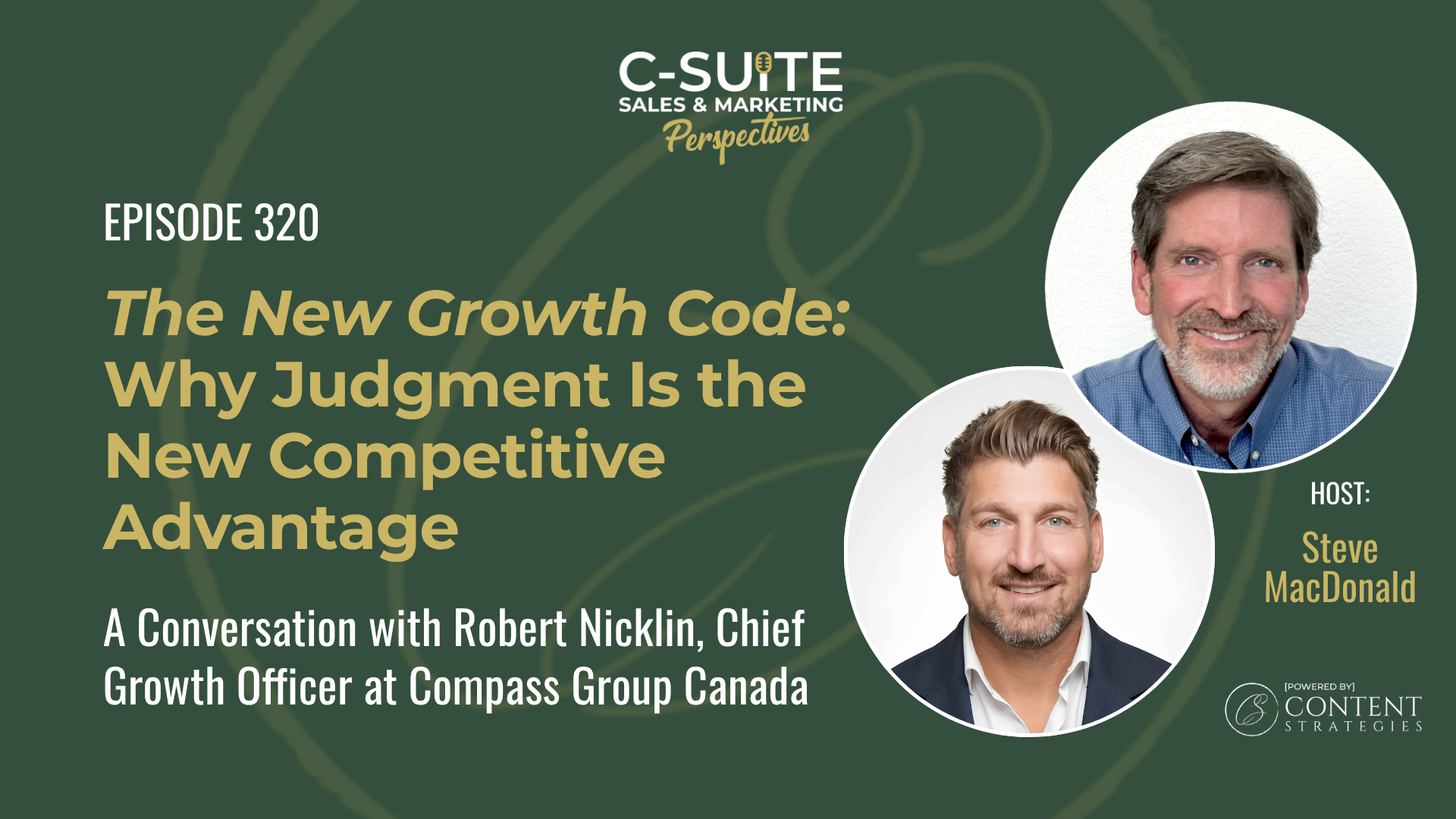

Episode #320:
Robert Nicklin, Chief Growth Officer at Compass Group Canada, explains why judgment is becoming a defining competitive advantage. He explores how behavior, adaptability, observational intelligence, trust, and stronger questions shape sustainable enterprise growth. Robert also reveals why leaders should design repeatable growth systems instead of continually chasing short-term outcomes.
“Growth is something that you design. It is not something you chase. A true growth system is built and designed, and once you have created that system, you should have people who can sit within it. That is about leaders creating strong leaders who create strong leaders.” – Robert Nicklin
The conversation offers practical guidance for turning these ideas into everyday leadership actions. Robert shows how thoughtful interpretation, honest feedback, and consistent behavior help teams respond effectively when pressure rises. His perspective gives executives a clearer framework for developing capable leaders, improving execution, and creating lasting organizational performance.
Follow Robert Nicklin on LinkedIn
Follow Steve MacDonald on LinkedIn
[Transcript]
[00:00:05] Steve MacDonald: Welcome, everyone, to the C Suite Sales and Marketing Perspectives podcast. I’m Steve MacDonald, your host. And today, we’ve got a really interesting guest here, Robert Nicklin. Now, Robert, I’m going to ask permission to call you Rob. But formally, you are now an author, and I want to give you that status. You are publishing the book The Growth Code, and I would love to hear a little bit more about that. You are a Chief Growth Officer, and I want to hear a little bit more about that as well. But we’re going to be talking about what you wrote in that book and how you apply it on a daily basis. What does The Growth Code mean? I think you put it in terms of why judgment is the new competitive advantage.
[00:00:45] Robert Nicklin: Right. Yeah.
[00:00:46] Steve MacDonald: We’re going to dig into that big time. But I would love to hear a little bit more about your background. I know you started out early in your career as a fitness trainer and coach. You learned a lot there. I want to learn a little more about what you learned there and about behaviors when working with people, because that’s a big part of The Growth Code.
[00:01:04] Robert Nicklin: Absolutely.
[00:01:05] Steve MacDonald: But you moved on in an interesting transition. All of our careers go like this these days, right? Yeah. Into operations and sales, and now you’re the Chief Growth Officer at Compass Group, right? What I’d love to do is kind of take us along that journey a little bit. Explain a little bit more about your background, and then we’re going to dive into The Growth Code.
[00:01:26] Robert Nicklin: Thank you, Steve. Yeah. Probably some of the things that not a lot of people know about me are that I did start my career in fitness as a former personal trainer and coach, even down to coaching my son’s soccer team on the weekend. I’ve coached other teams throughout the years.
[00:01:40] Robert Nicklin: And probably what I realized, or have come to realize later in my career, Steve, is that I was kind of formulating those ideas and understandings way back, 25 or 30 years ago. Exercise, like commercial sales or enterprise growth, all comes back down to behavior. And so, even though I spent the last 25 years in more of an enterprise sales environment, and now in the role I’m in as Chief Growth Officer with Compass Canada, I think what I learned in the very early stages was just that. Revenue follows behavior.
[00:02:17] Robert Nicklin: Any outcome that we want to measure is based on the action. And so, I think, really, what The Growth Code has become now is a collective of knowledge and understanding around what I like to say is why people do what they do the way they do it. We try to put all those kinds of life lessons, if you will, into one place, and I’m excited to be sharing it with my coauthor, Leslie Efrat.
[00:02:40] Steve MacDonald: I love the way you phrased that, and I wrote it down. Revenue follows behavior. There’s a lot of talk about optimizing for revenue. But if we optimize for the right behaviors, the revenue will follow. I think that’s a really important lesson as we get into this. Explain a little bit more. Expand on revenue following behavior. Explain that connection to us, if you could, to start out.
[00:03:04] Robert Nicklin: In sales, or I would say generally in life, if you think about something that you want to change, I would say most people, whether they’re listening to the podcast or we’re all sitting at home, at any given point, there’s something that we would always want to change about ourselves. And there’s no lack of motivation in people, from what I’ve understood. One of the modules inside The Growth Code framework within the book is the Behavior Change Model and helping people understand how change actually comes about.
[00:03:30] Robert Nicklin: And so, I think, because I’ve been able to be part of, witness, and help so many other people, I’ve recognized later in my career that rather than chasing growth as a number, what you’ve actually got to do is invest in the people who create the number in and of itself. And so, you can always look at the difference between a leading indicator, which is all the effort, and a lagging indicator, which is the outcome. So, one of the principles in The Growth Code is that action is effort, and outcomes are the evidence. And I think I’ve generally lived my life that way, whether it be on the gym floor, selling, or just in terms of personal growth and developing people. And so, it really all disseminates into that philosophy, Steve, which is that action is effort, and the outcomes are the evidence of that.
[00:04:15] Steve MacDonald: So, I love that. The actions are like this: words are cheap; actions aren’t, right? That’s the difficult part. I had a four-time B2B CMO on the podcast about a year ago, and she said, “Steve, there’s only one thing I want to talk about on your podcast.” I’m like, “Okay, what’s that?” She said, “I want to talk about execution.” Right. Where all good strategy goes to die, right? It’s really the execution and putting it into the hands of the teams that execute, high-performance teams. Those people are what make high-performance companies.
[00:04:45] Steve MacDonald: Yeah. And so, I know a big part of this is human behavior, and I’d like to break that down into how you work with the humans as part of this equation. We keep talking about AI, and I could talk about AI on every single podcast. Believe me, I can make it the central point of every podcast, right? But what I love is your focus on behaviors, or human behaviors. Everything that we do is to create better responses, which are the behaviors of the audience that we’re trying to influence. And so, you talked upfront about why judgment matters so much in this. Yeah. And I wanted to give you a chance to explain what you meant by that.
[00:05:34] Robert Nicklin: Yeah. Honestly, I think judgment in the future world, Steve, is going to become the competitive advantage for people. We are living in a world where there’s no shortage of information. In fact, one of the things I like to say quite often is that it’s not about what you know; it’s what you do with that knowledge, and more importantly, how you use it to help others. In my early career, when I think back, what separated you as a good salesperson was that you were the information carrier. The more information you had, the more that created a point of differentiation. Now, everyone has access to the same information, so what actually becomes the point of differentiation is your ability to interpret that information with good judgment.
[00:06:12] Robert Nicklin: One of the things that we’ve got to continue focusing on as leaders is understanding what is going to separate the leaders of today from the leaders of tomorrow. It is how they interpret data, but more importantly, Steve, how they do it under pressure. When the stakes are high, and you’ve got multiple pieces of information, how do you make sure that you’re acting in the right way with the right information that you’re getting, and that the information you’re getting is accurate? I think the judgment part is probably going to become one of the biggest competitive advantages in business.
[00:06:39] Steve MacDonald: Oh my gosh. I have to tell you this. Yeah. So, I was doing some deep research on Claude the other day.
[00:06:44] Robert Nicklin: Okay.
[00:06:45] Steve MacDonald: Around prompting, because MIT, their Sloan School, came out with a big study, and they said that with the new models that keep coming out, half of the value from these models is not the model itself. It’s what goes into the model.
[00:07:01] Steve MacDonald: Right.
[00:07:01] Robert Nicklin: Right.
[00:07:02] Steve MacDonald: Right. And the pattern that Claude sees is that the prompts going into the models have two of the six inputs that are needed. And they talked about how AI then has the capability to help the user who has the right judgment. Judgment is the word that it used.
[00:07:23] Robert Nicklin: Yeah.
[00:07:23] Steve MacDonald: The AI could bring in the reams, the unlimited amount of data that no human could keep track of in their brain, but pair it with human judgment.
[00:07:35] Robert Nicklin: Yeah.
[00:07:35] Steve MacDonald: And that is the equation to create in that environment, right? Create the right prompts. Totally. And it seems like all of our go-to-market teams are on AI. They’re prompting to do the workflows and the outputs that they need to be part of the engine that’s going forward, right? So, it just triggered something in me. I didn’t even realize that Claude used the word “human judgment.” And so, I just wanted to underscore what you were saying there in terms of the importance of that.
[00:08:03] Robert Nicklin: Yeah.
[00:08:04] Steve MacDonald: Right. That’s a competitive advantage. Basically, Claude sees it that way too. Yeah. Sure. So, how do we foster that judgment? Because I don’t think we can just say it’s a given, right? Because we’re all human, we all have good judgment, and everybody on our team is going to have good judgment, make all the right calls, and we’re all headed in the right direction. How do you, as a Chief Growth Officer, foster judgment inside an organization in the right ways?
[00:08:32] Robert Nicklin: Yeah. I think questioning is one of the biggest things. Whenever I get asked in the business, “Rob, what are the one, two, or three things that we can do to improve?” Honestly, Steve, the answer comes back to the same thing. Just ask better questions, and ask more of them. And I think it is no different from creating better outcomes. It’s kind of the reverse side, isn’t it.
[00:08:52] Robert Nicklin: If you want better access to information coming from AI, you’ve got to prompt better and learn how to prompt. If you want to be able to make a better judgment call, you’ve got to know how to ask better questions so that you have the information you need to make a decision, especially under pressure and especially when the stakes are the highest.
[00:09:09] Robert Nicklin: Because, as I said, I think in today’s modern world, there’s no shortage of information. The competitive advantage for the leader is not going to be the person who can consume more knowledge. It’s the person who can actually think better. I think that’s going to be the key thing. You’ve got access to the same thing. Who can think better, ask better questions to validate, and create quicker, faster, more meaningful outcomes.
[00:09:33] Steve MacDonald: Really interesting. So, judgment isn’t just deciphering and making a decision about all these things that are in front of me. It’s having the good judgment to know what the right questions are that will get me the right information, right. I had another Chief Growth Officer on, and she was talking about how we’ve got to be in the right rooms at the right times, asking the right questions.
[00:09:57] Robert Nicklin: Yep.
[00:09:57] Steve MacDonald: And we don’t really think that way. We have our commercial go-to-market process, and it runs the way that it runs. We have conversations that are naturally happening, but we’re not thinking about it. There’s another big line of thinking these days in the B2B world. As B2B buyers are waiting longer and longer to talk to us, and they’ve locked the shortlist, they’ve got four to five vendors that they’re reviewing. They’re in validation mode when they’re talking to the sales organization.
[00:10:26] Steve MacDonald: At the beginning, when they’re deciding, “Hey, this is a big problem. We are having a big challenge. How big of a deal is this? Do we need to put resources toward it? How timely is this? Do we need to assign a budget?” They go through a lot of thinking upfront before they lock the shortlist. And that’s what this other CRO, or CJO, and I were talking about. We’ve got to get into the right rooms, ask the right questions at the right times when those kinds of conversations are happening, and be the right kind of partner.
[00:10:54] Steve MacDonald: So, what I’m taking away is that judgment isn’t just about assessing well what’s in front of us. It’s also about judging how we get the right information and who we’re talking to.
[00:11:05] Robert Nicklin: Yeah.
[00:11:05] Steve MacDonald: So that we’re getting the right information at the same time. Is that a good takeaway?
[00:11:10] Robert Nicklin: Yeah. And not to pile on to what you were saying, but I think one of the other things is that, statistically, there’s a lot of data out there that the human brain is faced with over two million pieces of information coming at it in any given moment in time.
[00:11:24] Robert Nicklin: And generally, the human brain deletes, distorts, or generalizes that information. And imagine now, again, as you just said, all the things you just rightly said, you’re now adding another layer of information coming at you, whether it’s true, if it’s not, is it validated. And so, I think that’s how our isms and biases are created, because we’ve either generalized, distorted, or deleted information that’s coming at us.
[00:11:47] Robert Nicklin: I think taking time to slow down and really look at what’s in front of us, I think, is also the biggest thing. So you can make the right decision, and again, right room, right person, right deal. I think all the things that you just absolutely just said.
[00:12:00] Steve MacDonald: So, I want to talk about a term you mentioned, which is observational intelligence. Yeah, and reading what isn’t being said.
[00:12:11] Robert Nicklin: Yeah. Yeah.
[00:12:12] Steve MacDonald: And how important that is. So tell, tell me more.
[00:12:16] Robert Nicklin: I think one of the biggest things, I think this is probably post-COVID as well, Steve. It probably goes back to post-COVID that the further removed we’ve become from being all together collectively, I think one of the things that I’ve noticed, certainly, and I ultimately encourage as much as I can, is getting people back together. Not because I think that there’s, yes, the human connection, and that’s all very important, but what we’re removing is the observational learning. And to the point you just made, quite rightly, which is, what is happening that’s not being said. How do we spot those moments of the behavior that shows up when people in a room aren’t speaking? Who’s afraid to speak? Who comes forward. Those frowning moments, those lean-in moments, or those, more importantly, those lean-away moments.
[00:12:59] Robert Nicklin: For me, observational learning is a big part of that. From an understanding of, again, reading the room, and I don’t want to go off tangent, but I’ve got a really great example, which I put in the book, which is a case study. When I first took over a big new job when I was young, I got overpromoted into a position, my first one in hospitality, and I remember walking into this kitchen of this beautiful, big, four-star hotel, and we had free lunches at the time. And the perfect example of this is. And I was asking where the food was.
[00:13:27] Robert Nicklin: A 1,000-seat wedding going on, the head chef turned around very quickly, goes, “Oh, you want staff lunch.” I was like, “Yeah.” And he literally threw this plate of food across the kitchen at me, and he goes, “There’s your lunch.” And that, for me, is about knowing what’s happening in the room, not what’s on the agenda.
[00:13:44] Robert Nicklin: For me, it was about the food and everything else that was going on. So, I think that situational, that observational learning, just be aware of what’s going on, the stuff that isn’t being said. And I use that as an example because that was a very humbling experience that I share in the book, and has stayed with me for a long time. And I try to use that to just reinforce the observational learning that’s so important nowadays when you get people together.
[00:14:07] Steve MacDonald: What a great lesson in life.
[00:14:08] Robert Nicklin: Yeah.
[00:14:08] Steve MacDonald: When you took a plate coming at your head.
[00:14:11] Robert Nicklin: Here we go. Big plate of spaghetti. You can imagine how humbled I was that day, to this day.
[00:14:17] Steve MacDonald: One of the dynamics that all of this is happening within today is, call it a pressure cooker, whatever, things are happening faster than ever. Every C-level executive that comes onto this podcast, I ask the question, “What are your two greatest challenges for creating long-term sustainable growth?”
[00:14:34] Steve MacDonald: More and more, I’m getting answers about keeping up, keeping pace, keeping ahead of the competition in a world where, with AI coming in and everything, it just, everything is happening so quickly. We’re under pressure more than we ever have been before, and how do we adapt to that environment, and how does that play into what you’re talking about and what we need to be doing as a result, and acknowledge that’s the atmosphere that we’re in today.
[00:15:05] Robert Nicklin: I think, first and foremost, pressure reveals behavior. It’s what gets noticed when everything’s fine or not. How does behavior under pressure actually adjust, to your point, the need for more adaptability? I think, for the longest time, Steve, you go back the last 10, 20 years, everybody knows what IQ is. It’s what you’re born with, and then there was this big explosion on EQ, and everyone had to be more emotionally intelligent. Okay. All right. We’re more emotionally intelligent. And IQ and EQ, that’s what used to scale you.
[00:15:34] Robert Nicklin: As we’ve continued to see such changes in the world we’re in, and obviously with AI as well, you’ve got to look at all of the factors of intelligence that make a big part in the adaptability, the word you used. Something we talk about in The Growth Code is called the intelligence seesaw. And if you think of the fulcrum being cultural intelligence, certainly in the enterprise world, you can show up to people’s meetings virtually or in person, and you don’t necessarily know who you’re meeting or what age, race, religion, or ethnic background they’re from. And having a very strong understanding of cultural intelligence is critical, which is why it’s the fulcrum. And then, when you think about how you use that balance, IQ, yes, is important; EQ, yes; and your SQ in terms of your ability to be able to move around in a room. But the most important thing now is to be able to pivot in the moment, understand, again, with the observational learnings, with the information that we now have available to us in abundance, how are you adapting in those moments in real time when the situation is changing, or something is coming at you.
[00:16:34] Robert Nicklin: I think the single biggest skill going forward, coupled with observational learning, is adaptability under pressure. And we’re all facing it. But how does that show up? Or in what ways do we need to start being able to use it? And I really think that, under high-pressure situations, I think the people who can learn to understand adaptability as an intelligence are the ones that I think are going to have the biggest success going forward. I really do.
[00:17:02] Steve MacDonald: You know, I used to have this boss. Talk about a story, right? So, I had this boss, and he’d always say, “A system under pressure reveals its flaws.” Yeah. And I would always think of, like, a pipe, like in your house, that when it got too much pressure, it would, like, maybe if the pipes froze or something, it would burst, and it would burst. Yeah. At a seam, right. It would reveal the flaw.
[00:17:21] Robert Nicklin: Right.
[00:17:21] Steve MacDonald: At that moment. One hundred percent. And what I’m thinking about is what you’re saying here: we really need to think about. We can’t just say, “Okay, we know things are happening faster.” We have to actually have a plan to adapt to that environment. And if we don’t have a plan to adapt to that environment, then we’re just going to be a system that’s under pressure that just starts revealing all of our flaws. What do we have to do to adapt? If adaptability is a key today, what do we need to learn from that? What do we need to take away from what you’re saying?
[00:17:51] Robert Nicklin: Honestly, I think it starts with self-evaluation, Steve. Most importantly, I think it’s about how you’re evaluating, or who else are you leaning on to help evaluate you on your most difficult days, not just your easy ones. I think you’ve got to be open to feedback, you’ve got to be open to advice, and you’ve got to allow people trusted, close to you in those moments of pressure, to help you understand how you’re showing up.
[00:18:17] Robert Nicklin: For me, adaptability is the intelligence of the modern leadership world. I really do. That is going to be the thing that scales a great leader in today’s world: their ability to adapt. On the most difficult days, where you really have to take those moments to self-evaluate: how did I show up? I call this the weather in the room. What is the weather you set in the room? Because you’re responsible for the weather in every room you walk into. I really believe that, and I think that’s a big part of it. How, when you walk in, how do you use that immediate moment to adapt in the environment you’re in? So, I think adaptability is an intelligence that modern leadership is critical of. I really do.
[00:18:53] Steve MacDonald: Yeah. Yeah. It’s interesting. Everything you’re talking about adapting behaviors and judgment, there is an individual level, but collectively, we have to operate as a team, and that team has to be aligned. At some point, this adaptability and this judgment have to come together to align us as an organization and individual teams that are the high-performance teams that we know are the ones that make high-performance businesses. In terms of team alignment and building growth, and building trust within that team and externally, like, how do you align people? With this philosophy we’ve been talking about, how does it come into alignment so that companies can use this to grow?
[00:19:44] Robert Nicklin: First of all, I think it comes back down to, I look at trust as emotional harmony in the workplace. That’s what I would say. Do people generally believe they’re in a position to be able to speak the truth? We talk about showing up as your authentic self, but do we really mean it? Are you in a place to want to receive feedback? That’s actually a big question as a leader. If I’m going to give you feedback, are you in a place to receive it? And if so, then how do we help make sure that we’ve got a path to be able to help support that? So, I think trust itself is about emotional harmony.
[00:20:12] Robert Nicklin: What I’ve realized, Steve, as I’ve got older, and I would like to think wiser in my years. I kind of learned that on the gym floor. In my early 20s, I would have people come to me of all different ages, typically very older, and trust that they’re putting in their greatest fear. A, they don’t want to be there. B, they’re wearing clothes they don’t want to be in. They’re having to face into some kind of a superficial body image that they think they should be, but they’re not.
[00:20:37] Robert Nicklin: And I think what I did then, which I’ve been able to kind of, again, talk about in the book and bring it forward, is create a safe space for people. And it’s focusing on what I love to talk about; it’s about what’s right, not who’s right. And I think in business, that is what creates trust.
[00:20:53] Robert Nicklin: It’s not, when you’re in a meeting, who’s right, who’s got the loudest voice. It’s about what’s right for this moment and how to move us forward. When you can create that type of environment centered on emotional harmony and psychological safety, those two things run simultaneously. Then, I think, again, behaviorally, when you make those conversations available, when you make that room available for people to speak, that immediately builds trust, and trust becomes behavioral, and that becomes repeatable, and that’s what people observe.
[00:21:21] Robert Nicklin: And so, I think that, for me, is one of the biggest things I work very hard to establish. Again, I think something that I was very fortunate to have learned before I even realized what I was being taught from my early career.
[00:21:33] Steve MacDonald: And doesn’t that transition? That’s not only building trust internally and doing what’s right in the moment. That’s what our clients want from us too.
[00:21:41] Steve MacDonald: Yeah. Right. I.
[00:21:42] Robert Nicklin: Agree.
[00:21:43] Steve MacDonald: I mean, that’s not just internal team building. And trust is so important. Before the shortlist is formed, like the day it’s formed, there are four or five on there, and it’s set. Yeah. And then, 95 percent of the time, the winner is from that shortlist. And so, getting on that shortlist is about building trust in advance. So important to us. And with everything you said, I was thinking, duplicately, that makes sense internally and externally. Exactly. To build trust.
[00:22:10] Robert Nicklin: Yeah.
[00:22:12] Steve MacDonald: And Forrester came out at the beginning of the year with its predictions for this year and talked about how trust was the currency to get into the deal, win the deal, and keep the deal. The Growth Code, how does trust fit into how you see The Growth Code working?
[00:22:28] Robert Nicklin: If I were to paraphrase, trust accelerates execution. Once you’ve built trust, you have to maintain that. But I think trust is earned over time. It’s not just given immediately. I would say, actually, conversely, Steve, it’s probably lost over time. I’m someone who trusts immediately, and then it’s lost over time. Because you either show up, you do what you say you’re going to do, you add value, and you’re able to do something for someone.
[00:22:52] Robert Nicklin: One of the biggest things in sales nowadays, in the modern world, is that the role of a salesperson is to help someone move toward a difficult decision, toward change. Yeah. And you’ve got to be able to trust someone, not necessarily like someone, for them to be able to make that decision. And I think, once that trust has been established, then I think it’s very important. But within an organization or a team, when teams trust each other, and organizations trust organizations, that’s how you can scale success. And so, I think trust, for me, once built, can absolutely accelerate the execution of growth. And clients and relationships, I think, are really important.
[00:23:30] Steve MacDonald: So, there’s been a lot written, like that trust prediction from Forrester, that building trust means that you’ve also done the hard work. You’ve understood, and you’ve worked to understand them and their industry as your buyers. And you’re coming in not just selling, but you’re coming in, and you have something important to say.
[00:23:52] Steve MacDonald: You’ve proven that the call, the time that you’re asking from them, is worthy of them. Mm-hmm. Spending that time. With the shortage of access to executives and their time, we’ve got to make the most of it. So, is there a correlation between customer understanding and trust in your mind?
[00:24:12] Robert Nicklin: A correlation between trust and understanding is probably what becomes cultural, right? Yeah.
[00:24:17] Steve MacDonald: Yeah.
[00:24:18] Robert Nicklin: It’s what clients see. It’s what they see gets recognized and rewarded. It’s what your internal teams see getting rewarded, especially when no one’s watching. Really, what drives that is the culture. We talk about culture a lot as if it’s like a slogan on the wall. But I also think that culture, Steve, comes back down to behavior again. Everything centers back on what you are tolerating. What are you? Again, what are you rewarding and recognizing, especially when no one’s watching.
[00:24:44] Robert Nicklin: Because that’s what gets repeated, and clients see that. Customers see that. Yeah. And I think that’s what creates that trust, and trust is what drives culture in an organization.
[00:24:55] Steve MacDonald: I ran a podcast in the HR and talent acquisition industry for a long time, and in there, I talked to a lot of CHROs and CPOs. But I also talked to a lot of CEOs and chief technology officers, and everybody was talking about the importance of culture. Because we think about attracting the right talent, we’re just going to have hordes of great people we can choose from. But they’re looking at us. And they’re making a decision, “Is this the right kind of company and the right kind of culture that I want to be a part of?”
[00:25:29] Steve MacDonald: And keeping our teams happy is such, yeah, an important part of delivering on that trust and that understanding. And mass turnover is not only costly from a revenue and financial perspective, but from a relationship perspective as well.
[00:25:47] Steve MacDonald: Yeah. So, that culture, yeah, it’s way more than the plaque on the wall or the page on the website that has company values written on it, you know.
[00:25:54] Robert Nicklin: Exactly. Yeah.
[00:25:56] Steve MacDonald: We’ve covered so much territory here that I just have to ask, if there were one thing that the C-suite executives who are going to be consuming this podcast, that you wanted them to take away, if there were one thing you wanted them to remember, what would that be?
[00:26:12] Robert Nicklin: Good question.
[00:26:13] Robert Nicklin: From my experience, I think, more than anything else, growth is something that you design. It’s not something you chase. And because I think everything comes back down to behavior, Steve, I think a true growth system is built and designed. It’s not something you chase. If I had another one, I would also say the greatest thing you should be proud of as a leader is that you can actually sit back and observe leadership behaviors in others.
[00:26:41] Robert Nicklin: The other key thing is, once you’ve created a growth system, then you should have people who can sit within it. And I think that’s about leaders creating strong leaders who create strong leaders. And I think, yeah, they’re probably my two biggest takeaways, or those aha moments, that growth is designed, not something you chase, for sure.
[00:27:00] Steve MacDonald: I’ve got to tell you, one of my biggest takeaways, and I love your takeaways there, is that we just have to work a lot harder on what can be thought of as soft skills. Right. Mm-hmm. But they’re not. As the business accelerates, the pace accelerates, and change accelerates, those soft skills, or those relationship skills, I put it this way, those relationship skills and judgment skills, are going to become more and more important as time goes on.
[00:27:30] Steve MacDonald: Totally. And we have to be diligent about that and have a plan. So, I love everything we talked about here. And I have to tell you, the whole mission of this podcast is to bring really interesting perspectives together from C-suite executives across the board, all over the world. And we learn so much every single time. And I call it the rising tide that lifts all boats. And you were.
[00:27:55] Robert Nicklin: Love it.
[00:27:56] Steve MacDonald: Just an amazing part of that rising tide.
[00:27:57] Robert Nicklin: No, I appreciate it. And listen, I appreciate the opportunity to come on and have a conversation with you. I’ve truly enjoyed it. If anything we’ve shared here is inspiring or motivational, or someone else is sitting, dealing with the same challenge, then that’s what you hope to try to achieve through these conversations, right? Which is to try to find like-minded connections or opportunities, or to solve something that someone’s sitting on and think, “Yeah, you’re not the only one dealing with the same kind of problem, and how do we solve for that for the future.” So, yeah, no, I really appreciate the opportunity.
[00:28:24] Steve MacDonald: Great. And I hope everybody has a chance to get out and grab The Growth Code. And thank you for coming on. I appreciate all the time.
[00:28:32] Robert Nicklin: Thank you, Steve.