

Episode #216:
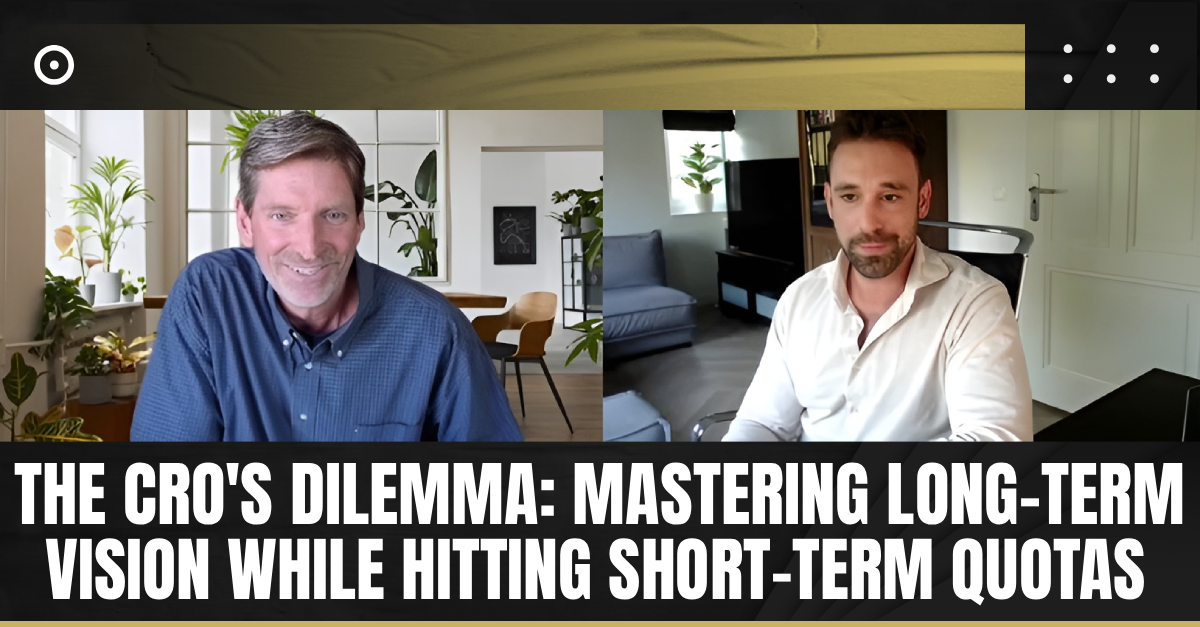
Tarmo Van Der Goot, Chief Revenue Officer at Frisbii, explains how to reconcile quarterly targets with durable growth. He frames Net Revenue Retention as the North Star that keeps short-term choices tethered to strategy. He details how a unified ICP, tight product partnership, and direct voice-of-customer contact prevent reactive churn. He closes with culture and focus as the foundation for cross-sell at scale.
“Make sure that your short-term, quarterly goals are aligned with your long-term decision. The way I approach it is making sure that the long-term strategy is my anchor for the short-term decisions.” – Tarmo Van Der Goot
This episode examines how a CRO strikes a balance between near-term targets and durable growth by utilizing NRR as a guiding principle, aligning on a single ICP, and translating the voice of the customer into actionable product outcomes. Expect clear examples on cross-sell, operating cadence, and culture so teams can connect daily choices to long-term outcomes.
Follow host Steve MacDonald on LinkedIn
[Transcript]
[00:00:05] Steve MacDonald: Welcome everyone to the C-Suite Sales and Marketing Perspectives podcast. I’m Steve MacDonald, your host, and today we have a very, very special guest on Tarmo Van Der Goot. Now Tarmo, you’re not only the Chief Revenue Officer at a FinTech company, Frisbii. I think you said for 15 years you’ve been in FinTech and you’ve seen it all.
[00:00:22] Steve MacDonald: Right. You see very VC, PE backed company, founder led, right? You know, privately owned companies. So what we’re gonna talk about today is a common problem across all of the companies, but you’ve seen it from different perspectives, and it’s the dilemma of mastering the difference between a vision that is very long-term, but very short-term deliverables.
[00:00:49] Steve MacDonald: I mean, we don’t usually go into a board meeting and people ask about the long-term brand and how we’re doing. It’s usually how are we doing this quarter and what does next quarter look like? Right? So there’s very competing objectives inside of an organization, and we want to kind of, from your perspective, the CRO’s perspective, we wanna talk about how do we master the long term versus the short term. And if you could just maybe give us a little bit more on your background before we get started.
[00:01:18] Tarmo Van Der Goot: Yeah. Happy to, Steven, and of course, happy to be here. You said it perfectly. So, in FinTech more than 15 years, and I’ve been on the heavily VC funded side, privately owned side, and companies on the road to IPO. I’d say reason for this is actually something one of my mentors said very early on in the beginning.
[00:01:36] Tarmo Van Der Goot: Just gave me that piece of advice that if you find a vertical that you like, stay with it because there’s nothing more valuable than building up experience over time in a certain segment. Obviously, you need to be a little bit lucky, and that the segment that you start out with is a segment that you actually like, and that’s also continuously growing and evolving so that it stays interesting.
[00:01:57] Tarmo Van Der Goot: But yeah, no, I mean, I said that’s a very good piece of advice I received early in my career.
[00:02:01] Steve MacDonald: Well, fantastic. I’m gonna jump right into what might be the most difficult question. Break down for us, if you could, and maybe just articulate the tension, the misalignment internally, long term versus short term. And then we’re gonna talk about what we want to do about it.
[00:02:22] Tarmo Van Der Goot: Yeah. And it’s different companies, right? I mean, if you’re an IPO company, I mean, the competing priorities between making sure that you hit your quarterly numbers—otherwise the analysts are gonna have a field day with you—while at the exact same time looking to demonstrate your long-term goal. That’s critical, right? So always balancing those two. Similarly though, for pre-IPO companies or heavily funded companies, whenever you’re in the boardroom, it’s always that conversation around, hey, what are your core common goals? While at the same time, do they fit into the long-term strategy?
[00:02:54] Tarmo Van Der Goot: Or are we just trying to reinvent the wheel every time to aid our number at the end of the quarter? Or are decisions that you’re making now impacting the long-term goals that you have down the road as well? I mean, this is a continuous dragon with multiple heads, right? It’s always that if you were to reach your quarterly goal, let’s say at the first or second month, great, you have way more time to focus on the long-term strategic opportunities as well.
[00:03:17] Steve MacDonald: Well, one of the big things that’s an affecting factor here is the ever-changing, the ever-expanding ICP, right? Our ideal customer profile. One of the things that brings in alignment and then, you know, takes long term and short term and brings them together is a real good definition of who we’re serving. But navigating that and the changes that have to happen, right? How do you think about the ICP and how does that play into alignment across these goals?
[00:03:51] Tarmo Van Der Goot: I’d say the ICP lies at the core of almost any budget or long-term strategic plan that you have. If your ICP was a misalignment with your sales or revenue model, your starting point is off, right?
[00:04:06] Tarmo Van Der Goot: So you might be going left while you should actually be going right. So if I take that to Frisbii, for example. So Frisbii is a group of five businesses now. They all work in the same vertical, in the same segment, but not all of them had the same business model, and not all of them were targeting the same customer segment.
[00:04:26] Tarmo Van Der Goot: So from an ICP perspective, I’d say the first things that we needed to do was come together and make choices. Because you can’t bet on all horses. You can’t say, well, we are five companies now, this is doing really well in this segment, this company is doing well in that segment, so let’s bet on all those horses and let’s celebrate all the way to the finish line.
[00:04:48] Tarmo Van Der Goot: So specifically in our case, you need to unify the business and unify the group into one singular culture. I mean, there’s a lot of things you need to do in order to achieve this, but going after that or having that alignment and going after the same ICP within that group, I mean that’s absolutely critical.
[00:05:07] Tarmo Van Der Goot: This is something that a lot of us realize as well, where look, it’s one thing to continuously measure your ICP with the numbers that we see on a daily basis, right? But it also means that you do more than just going through a win-loss analysis.
[00:05:22] Tarmo Van Der Goot: You’ve actually literally sat down with your customers yourself, right? And taken the time in your agenda to sit down with your customers or your prospects and knowing what priorities they have, knowing what kind of feedback they have, giving you firsthand feedback on the sales cycle or other touchpoints that they’ve experienced so far.
[00:05:41] Tarmo Van Der Goot: I’d say that’s super valuable information to continuously measure. Hey, is my ICP still matching where I think it is? Or am I too lost in the win-loss analysis without actually hearing the voice of the customer?
[00:05:56] Steve MacDonald: So you just brought up a really important point, the voice of the customer, right? It’s the highest authority voice inside of the business. And I’ve been doing actually a lot of research on this. You look at reports from McKinsey and Bain and Deloitte, and most B2B companies don’t have a dedicated voice of the customer strategy. Right. But it’s so important.
[00:06:19] Steve MacDonald: Tell us a little bit about, you know, maybe your idea of the importance of the voice of the customer and how it can impact what we’re doing, and specifically bringing alignment together.
[00:06:32] Tarmo Van Der Goot: I think to start by saying, what’s the metric or what’s the measurement, as the CRO or anyone in the executive team, that you look at the most?
[00:06:41] Tarmo Van Der Goot: So for me, my North Star, for example, is the NRR rate, so the Net Retention Revenue. So in order for me to safeguard that rate—sure, we’re gonna talk about this potential a little bit further, and we discussed that it should be 70% of your revenue growth—the voice of your customer is going to be absolutely critical.
[00:07:00] Tarmo Van Der Goot: In order to safeguard that number, for me it indicates sustainable growth, versus just burning cash after acquisition or just spending the funding that you just received, right? This also ties into what we discussed previously between am I focusing on my quarterly goals or my long-term strategy. All of that is something that the NRR is telling you in one way or another. Am I doing the right thing?
[00:07:25] Tarmo Van Der Goot: Is my customer base growing? Am I listening to the customer? Are my quarterly goals aligned to my long-term strategy? It really is like a North Star that gives you, on a high level, just a very good overview on the health of your business.
[00:07:38] Steve MacDonald: It also helps balance short versus long term, right?
[00:07:42] Steve MacDonald: There’s a lot of Chief Revenue Officers that really only act as a Chief Sales Officer that focus specifically on new logo development. Right. But you mentioned it. There was a study that was done by Forrester that said B2B companies, 73% of new annual revenue should be coming from our existing clients.
[00:08:02] Steve MacDonald: Which means we have to have a dedication on that. We have to have a long-term perspective on how we foster and cultivate that relationship and grow that relationship, right? So NRR, Net Revenue Retention, it should be the North Star, right? It should be. How does that, as the North Star, help create, you know, bring together that gap, that chasm between long and short term in your mind?
[00:08:33] Tarmo Van Der Goot: Good question. I actually heard a couple of questions in there. So I’d say one of the things that you were asking is also maybe potentially around—so if the NRR is such an important metric, for all the analysts that are only focusing around this number, why are we not talking about this even more? I’m not saying we don’t. Or why, as a CRO, do you sometimes have that natural tendency to focus more on new logo growth than net retention?
[00:08:59] Tarmo Van Der Goot: Even though the NRR rate is my North Star, it doesn’t mean that I don’t have this innate natural tendency as well to gravitate towards new business, just because that’s how I was created and that’s how I built my career. Starting like sales is what you know, right? It’s your comfort zone.
[00:09:13] Tarmo Van Der Goot: So obviously, when you’re stepping in that position, your comfort zone will always have a natural, it’ll also attract your attention just from a natural perspective. Customer success, I’d say for a lot of us, is either something new or something that wasn’t always top of mind.
[00:09:30] Tarmo Van Der Goot: So it’s something you always need to make sure that you incorporate in your day to day or your long-term and short-term strategy to make sure that it’s actually a big and important part of the growth of your business. Right? You can’t say my NRR is my North Star, and then at the same time, your focus is on new business.
[00:09:48] Tarmo Van Der Goot: The other thing I’d say, where the challenge lies for a lot of us in our position, is to also understand that metric and to actually have visibility on what’s organic growth and what’s land and expand. But in different organizations—and it’s always something that you should be very mindful of—is how much was actually responsible for the market in general growing, which is still very important.
[00:10:16] Tarmo Van Der Goot: But then, if you’re really honest with yourself, is that, did we do this? Or were we on lockdown for the last two years and the entire market changed, so our company changed with it, so we were just riding this wave? Or how much of this is actually proactive, right? So during renewal, did we actually do a land and expand exercise?
[00:10:40] Tarmo Van Der Goot: Did we start with the proof of concepts? Again, did we do a land and expand? Did we actually identify greenfield opportunities to add to the account? Or do we get a signal that says, hey, this contract expires after three months, we give them a call, and wait, you’re doing more revenue now, awesome, here’s your updated contract. So that’s something that you need to continuously be very mindful of. When you’re looking at the NRR and the numbers are all green, ask: okay, is this market, or is this us? And if you have great visibility on this, it immediately is gonna give you action points to take.
[00:11:13] Steve MacDonald: You know, as a Chief Revenue Officer overseeing land and expand and new logo development, a part of that has to be a partnership with product, because we have to have the right products in order to cross-sell and upsell, right? If we don’t have the right avenues and opportunities to do that, that 73% of new annual revenue is going to keep going down and down and down. So how closely do you align with product in the roadmap and what’s going on there?
[00:11:48] Tarmo Van Der Goot: I’d say if you’ve been working in a certain industry for a very long time, you speak the same language of that industry, so it helps you to connect with product a lot more, right?
[00:11:59] Tarmo Van Der Goot: So the conversations that I as an executive can have with the product team in FinTech are completely different. If tomorrow I would join a completely different industry where I need to start from scratch, I would be more in the learn mode versus the education mode.
[00:12:18] Tarmo Van Der Goot: Right? So there’s a huge benefit of having worked and built up experience in the market. And again, speaking that same language as the people in product, it just makes life easier for both sides. And it’s critical that if you don’t have a weekly or a monthly sync with the product team, I would really reassess your agenda and see if there’s anything that you could potentially move out and make sure that you had that sync with product.
[00:12:45] Tarmo Van Der Goot: You can’t listen to the voice of the customer if you don’t have a regular sync with the product team where that voice of the customer can actually be made actionable.
[00:12:54] Steve MacDonald: So, we talked a lot about, you know, NRR now and cross-selling opportunities. You are also bringing in and merging a group of companies.
[00:13:05] Steve MacDonald: And so there’s naturally built-in opportunities, right, to cross-sell and upsell. You’ve been in environments where you didn’t have that and now you are there. What is your advice for companies that are on both sides? Right. In terms of, because what I’m getting, and one of my big takeaways here, is that you need to be innovating.
[00:13:30] Steve MacDonald: You need to be iterating. The opportunities to cross-sell, upsell, and leverage that. And we don’t always get handed here: we’re merging a group of companies, so just boom, naturally it’s gonna happen, right? There’s gonna be opportunities to cross-sell and upsell versus we have to make them, and how much time we have to think about and put towards that.
[00:13:51] Tarmo Van Der Goot: I’d say the biggest lesson that I’ve learned, and maybe the biggest piece of advice that I can give when it comes to cross-sell, is the internal cross-sell is more difficult than external. That internal alignment, if you have that completely figured out, cross-sell becomes a natural thing.
[00:14:12] Tarmo Van Der Goot: You don’t necessarily think of it as a cross-sell anymore, and this is the Nirvana stage, right? I’m not saying this is easy, let’s all go for this. I’m just saying, you know when you’ve arrived, when you’re no longer thinking about cross-sell as different products. It’s kind of more like, well, it’s just more different product SKUs of the product that I’m offering.
[00:14:30] Tarmo Van Der Goot: And it just starts internally, right? Do you have that internal organization that’s perfectly aligned where everything is marching in the same direction? And it doesn’t matter if it’s product X or product Y, but no, everything is a way in and everything is a land and expand and we’re all working together.
[00:14:47] Tarmo Van Der Goot: We’re all educated. We all know exactly what to do. You don’t look at it as a cross-sell anymore. That’s the perfect ten. And then it’s a matter of, okay, how do we get there as an organization? So how do we get to that stage where internally it shows up as a cross-sell, but we internally are thinking more, aligned more as a single product. We live different entry points.
[00:15:08] Steve MacDonald: Yeah, it’s almost like going back to your point on the importance of the voice of the customer, because it should be such an evolutionary opportunity to bring to the customer, right? That yes, it’s a cross-sell, it’s a different product, but it should really be one solution.
[00:15:27] Steve MacDonald: And I’d love to hear your thoughts about that, because it is easy, especially with mergers and acquisitions. There’s a board saying, I want you to cross-sell and upsell. And then sometimes we have to backtrack and ask, how does that actually provide one cohesive solution, right? Versus organically created cross-sell, upsell opportunities usually come from our conversations with our customers because they need this. Those cross-sell, upsell opportunities—are those easier than the merger and acquisition ones, or what’s your thoughts there?
[00:16:06] Tarmo Van Der Goot: We made a very clear and strategic decision by the executive team and the CEO around culture. The internal alignment, like culture is everything. So specifically our group, which is private equity owned as we talked about, right, the five companies merging together, it’s how do you get five companies to act as a single company, to act as the integral parts together that are more important than the single unit.
[00:16:32] Tarmo Van Der Goot: So what we did was just let go of the individual brands that we had with the products. Which is not an easy decision to make, because some of these products were and still are market leaders in their region, with brand recognition that you only get after being active in certain markets for 10 years.
[00:16:52] Tarmo Van Der Goot: So very high visible brands. The executive team made the tough call to let those branding names go and move forward under a new name, which is Frisbii. And there are a lot of reasons to do this, but I’d say the most important one is culture and having that singular mindset within the group.
[00:17:16] Tarmo Van Der Goot: As in, you know what, we’re not this particular product line. We’re not that particular product line. No, we’re Frisbii. We’re one company. This is why I just mentioned it starts from within the company or within the business before we can even think about having a successful cross-sell strategy in the market.
[00:17:34] Steve MacDonald: Absolutely. I mean, you’ve brought up culture a number of times, and one of the most important parts of company culture is empowering and bringing together and aligning teams. And it’s, you talk to any PE company, VC company, right? They invest in the people first, the idea second. Right. So this idea of rebranding and bringing everybody together to create one culture, what I take away from that is to create one high-performance team, right?
[00:18:08] Steve MacDonald: One high-performance brand and powered by a team. And you can’t be a high-performance team if you’re a silo, right? So it makes perfect, perfect sense. I would love to know though—you talked about a long-term vision trap. We talked before about balancing board expectations with strategic growth. That’s a board decision, right?
[00:18:30] Steve MacDonald: That makes leadership decision. Makes perfect sense. What is it that you were talking about when you mentioned the long-term vision trap?
[00:18:38] Tarmo Van Der Goot: I think this is, again, something that most CROs struggle with on a day-to-day basis. It’s the board that wants predictable quarterly numbers. And as we all know, building something durable takes patience. So those are already two competing goals, right?
[00:18:52] Tarmo Van Der Goot: Yeah, we want predictable quarterly revenue, and we want that combined with long-term revenue growth. Meaning you can’t make short-term decisions—or too many of them—because every time you go a little bit left, then another bit left, then another bit left. And all of a sudden you look back two years later and say, “Okay, didn’t expect to end up here, but here we are.”
[00:19:13] Tarmo Van Der Goot: I’m not saying you’re not going to be able to reach your goal, but you’ve probably been zig-zagging a little bit. And then if you’re really honest with yourself, you’ll probably ask the question: could I have gotten here sooner? And probably the answer is yes.
[00:19:34] Tarmo Van Der Goot: And that’s what I mean by making sure that your short-term quarterly goals are aligned with your long-term decisions. So the way I look at this, Steve, is just making sure that the long-term strategy is my anchor for the short-term decisions.
[00:19:52] Tarmo Van Der Goot: We all need to make those quarterly decisions, but every time we need to anchor them on, “Hey, is this still in line with the long-term goal?” If the answer is yes, execute. If the answer is maybe, align. If the answer is no, don’t do it.
[00:20:09] Steve MacDonald: You know, I’ve learned over time that one of the most important questions to ask is this one: What haven’t I asked? Right? I mean, the whole topic here is the CRO’s dilemma—mastering long-term vision while hitting short-term goals. How do you deal with this? How do you deal with the long-term vision and the short-term goals?
[00:20:29] Tarmo Van Der Goot: I don’t want to get all philosophical here, but growth—or knowing you’re doing the right thing—comes when you’re no longer looking at this as growth being either short term or long term. I’d say that the job of the CRO is to make sure that both of them work together, if that makes sense.
[00:20:47] Tarmo Van Der Goot: And again, as we previously talked about, that’s Nirvana, that’s ten. As soon as you get that realization that the decisions and the strategic positions you’re making in the short term are anchored in your long-term goals, then you know that you’re doing the right thing.
[00:21:03] Steve MacDonald: Yeah, yeah. So I have one last question, and here it is. We’ve talked about so much. If there was one takeaway that you wanted the C-Suite executives tuning in today to walk away with, what would be the one thing you’d want to make sure they took from our conversation?
[00:21:25] Tarmo Van Der Goot: I’d say maybe my key takeaway is: always, sometimes, just find a couple of minutes at the end of the day—or whenever you have some time—and really look at what you’re doing. Ask yourself the tough question: am I doing this to reach my quarterly numbers, or are these decisions in line with my long-term goals?
[00:21:51] Tarmo Van Der Goot: I’m not saying that all of your decisions need to be anchored to your long-term goals. But again, can you sit down and honestly say that the path you’re on—two, three years from now—when you look back, you’ll be able to say, “Yeah, these decisions were all anchored in the long-term goals”? Or were you always trying to fix the fire of that particular day, which fixes whatever needs fixing in the short term, but delays where you need to be?
[00:22:10] Steve MacDonald: We get so busy with the day-to-day, the fires, that we can look back a month, three months, six months, a year, and think, “That’s all I did. I was just putting out fires. But I lost that North Star. I lost where we have to be proactive.” And that’s what I’m taking away from what you’re saying—that we just can’t lose the long-term vision.
[00:22:37] Steve MacDonald: While we’re accomplishing the short-term goals. And that balance, I think, is so important. But when you first said the North Star is NRR, I was like, hallelujah! Because I knew then that you had a very balanced perspective on long-term development and growth of your existing clientele.
[00:22:58] Steve MacDonald: In the end, that’s what every new business prospect wants to see anyways—that your existing clients have stayed with you a long time, and they’re growing in all the ways you’re helping them. It really does help on both sides.
[00:23:13] Tarmo Van Der Goot: I’ll take maybe one more piece of advice, which again, I think is a no-brainer as well, but it depends on the organization. There’s a big difference if your organization is founder-led or not.
[00:23:21] Tarmo Van Der Goot: So like the voice of the customer we just talked about—if it’s founder-led, more often than not, the voice of the customer is very well known by the founders, right? I mean, they started from wherever they started, they grew the business to whatever it is today.
[00:23:43] Tarmo Van Der Goot: And I’m sure the conversations you’ve had with founders show that they always had that passion for the customer. It’s innate, it’s their default setting. They’ll even work in the customer support department one day out of the week just to get that feedback.
[00:24:00] Tarmo Van Der Goot: I think for everyone listening as part of the executive team.
[00:24:02] Tarmo Van Der Goot: If you came in at a later stage of growth, remind yourself that you need to make the time in your agenda to listen in on calls—even if it’s only once a month. We all have recording programs within the revenue org. Either join them live, which I think is obviously the best thing to do, or just go through the recordings. Make sure you get that unfiltered feedback. Because otherwise, by the time it reaches your ears, it’s already gone through a couple of layers. Then it’s an opinion about an opinion. So it’s always good to jump on those calls yourself every now and then and get that unfiltered truth.
[00:24:40] Steve MacDonald: I love that. We have more data than we’ve ever had, but what you just said right there—I think that’s my most important takeaway. Having those unobstructed conversations outside of a sales conversation, right? Where it’s actually just all about learning.
[00:24:59] Steve MacDonald: It’s all about understanding what they’re going through. We can’t replace that in the process. I love that. You know, it’s this kind of conversation that is the mission behind this podcast. Because all of us as executives, we all have different experiences, insights, and perspectives. But if we can share them with each other, that’s the rising tide that lifts all boats.
[00:25:23] Steve MacDonald: And I just want to say thank you, because you were a really important part of that rising tide today. But I do know one thing—people are going to have questions. Would it be okay if I gave out a link to your LinkedIn profile so people could reach out to you and ask questions?
[00:25:38] Tarmo Van Der Goot: Of course. Happy to.
[00:25:39] Steve MacDonald: Fantastic. Well, Tarmo, thank you so much for coming on and helping add to the ongoing conversation. As C-suite executives, we all have our functional roles, but we also share the role of planning and creating long-term, sustainable growth. I just think this conversation was wonderful today. Thank you.
[00:26:02] Tarmo Van Der Goot: Thanks for the invite. It was great for me to do as well.