
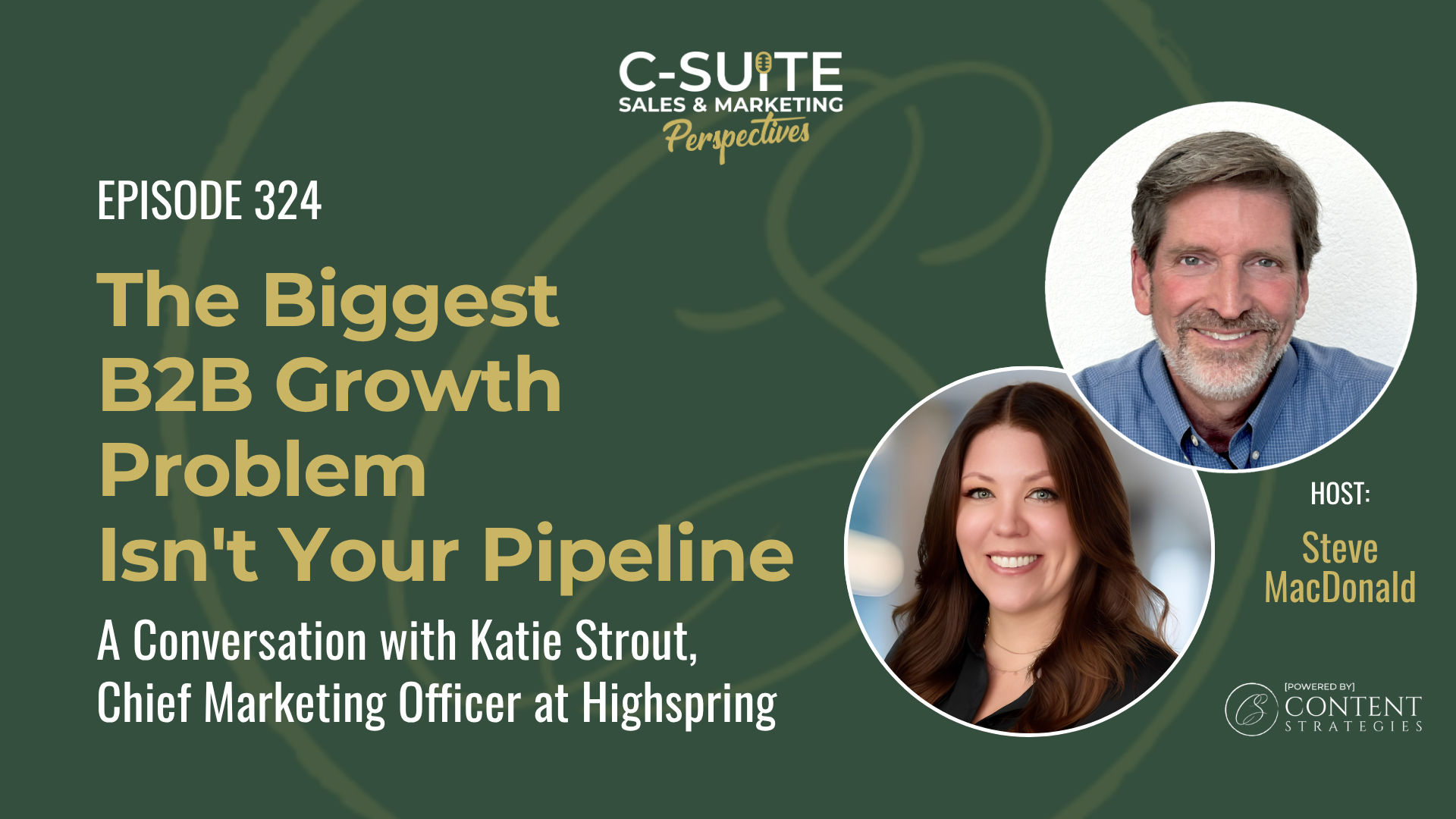


Episode #324:
Katie Strout, Chief Marketing Officer at Highspring, explains why sustainable growth requires more than a stronger pipeline. She shares how customer problems can align teams around shared outcomes. Katie explores why sales and marketing should operate as one connected revenue motion. She also explains how customer validation, internal trust, and shared ownership can turn marketing into a commercial growth partner.
“Growth and revenue belong to the whole organization. It’s not the responsibility of any one function. It happens when marketing, sales, technology, delivery, leadership, customer success, all of those things come together around customers’ problems to solve and deliver business outcomes.” – Katie Strout
Katie explores why sustainable B2B growth depends on more than pipeline generation. She explains how leaders can align teams around customer problems, connect marketing more directly to revenue outcomes, and replace traditional sales-and-marketing handoffs with shared ownership. The conversation also examines how customer insight, internal trust, long-term relationships, and customer validation can strengthen growth strategy and business impact.
Follow Katie Strout on LinkedIn
Follow Steve MacDonald on LinkedIn
[Transcript]
[00:00:05] Steve MacDonald: Welcome, everyone, to the C-Suite Sales and Marketing Perspectives podcast. I’m Steve MacDonald, your host, and today we have a very special guest: Katie Strout. Now, Katie, what’s interesting about your background is that you’ve been a Chief Marketing Officer for a long time. You’ve got a very varied background. You were steeped heavily in marketing technology, and you focused not only on alignment between sales and marketing, but on revolutionizing how we talk about impact on revenue.
[00:00:40] Steve MacDonald: As Chief Marketing Officers, we’ve been told and hit over the head so many times, we’ve got to be very pipeline, very revenue-focused, and rightfully, we have to be mindful of, carefully mindful of, what is the outcome that we’re trying to achieve here, and how do we contribute to that? But we’re going to dig into a lot of that. One of the most interesting parts of our previous conversation is that you’re seeing sales and marketing really becoming one motion, one team. And I love that, ’cause internal alignment is such a massive challenge.
[00:01:13] Steve MacDonald: I ask questions at the beginning of every call that I have about what your two greatest challenges are for creating long-term sustainable growth, and I’ve done that over 125 times now with C-suite executives. Internal alignment is by far the number one challenge. So before we get in, though, and start digging into all of this, I would love to have you expand a little more on your background, if you don’t mind.
[00:01:37] Katie Strout: Absolutely. So, as you mentioned, I have quite a varied background from an industry perspective. I’m currently in professional services, and I’ve been in professional services for about eight years now. Prior to that, I was in video games, insurance, construction, a lot of different points of view that I think have helped shape me to be a more well-rounded marketer and well-rounded executive.
[00:01:58] Katie Strout: As a marketer, I always say we cut our teeth in a depth of a vertical, right? Some people start in communications. Some people start in content or design. I was fortunate enough to cut my teeth in marketing technology, so a lot of my work has always been focused on outcomes, data, getting data foundations right, and serving the right message to the right person at the right time. I’ve been saying that since 2011, and as technology and the marketplace have started to advance towards that becoming a reality, I feel like I’m in a fortunate position where I’ve got a lot of the foundational knowledge and understanding of that to help drive that forward.
[00:02:34] Katie Strout: My internal saying to my team is, “I care less about what color the button is. I care whether or not people click on it.” And at the end of the day, the outcome’s what we’re trying to drive towards, and so that is what we’re keeping at the forefront of our mind every time we’re making a decision about how we’re supporting the business.
[00:02:51] Steve MacDonald: I’d love to dig right into what you’re saying there. Very outcome-focused. So, very outcome-focused, what that means is, by default, every single one of our individual go-to-market team, sales, marketing, product, customer success, RevOps, we’ve all got to be on the same game plan. We all have to be aligned. I was saying before, it’s such a difficult thing to do.
[00:03:11] Steve MacDonald: How do we tackle that? Before we talk about how we’re really one department, how do we talk about how we come together and align? And maybe even start out with: why is it so hard? This shouldn’t be. We’re all one company. Nobody’s telling us, “This is how you have to align.” We write the rules ourselves internally. Why is it so hard, and then what have you learned how to do with it?
[00:03:35] Katie Strout: I think it’s hard because it’s interpretations of the same problem through different lenses. A lot of people have their lived experience in their vertical, and they’re interpreting the same problem in a slightly different way. I think, as executives, it’s really important that, as cross-functional executive teams, we align on those outcomes from the top down. Because I think in some organizations, they’re expecting the individual teams to define the outcome, and that’s where you have people chasing different metrics that are all ultimately chasing the same goal.
[00:04:07] Katie Strout: If the executive team can come together and say, “Our expectation is that every team is focused on driving X, Y, Z from the top down,” it’s much easier for teams to align on tactics, plans, and strategies that get us towards that goal. I’m a little bit less worried about setting strategic goals and more about setting strategic outcomes from the very beginning. Our executive team has done a really good job of framing our growth plan around the outcome we’re trying to get to, rather than setting yearly or annual goals that we want people to try and hit. Those outcomes are much more tangible for people to try and achieve, right?
[00:04:46] Steve MacDonald: It’s interesting because those outcomes, we’re all supposed to be outcome-focused. Outcomes can’t be, “Grow revenue.” Outcomes can’t be this generic: “We want revenue, sustainable revenue growth.” We talk a lot about NRR and things like that. How do you define outcomes? You kind of have to peel the onion back at every point and say, “We have to be detailed. We’ve got to define exactly what we’re doing, and then we’ll define how we get there.” But how do you, as a C-suite team, come together and define that in a tangible way that the teams can understand?
[00:05:22] Katie Strout: I think it starts with having a really in-depth understanding and shared understanding of your customer and the problems that they are looking to solve and what you are there to help solve for them. At the end of the day, your customer doesn’t care how their problem gets solved. They just want it solved, so if you frame outcomes around solving your customer’s problems, it’s much easier for everybody to get on board with the same growth direction.
[00:05:49] Katie Strout: If an executive team just says, “Grow revenue by 20% next year,” everybody’s going to have their own flavor of what that means and what that looks like, and you’re going to have a lot of teams competing tactically and strategically against each other to grow revenue. If instead you say, “Our goal is to help solve this outcome more. We’re moving in this direction. This is the path that we’re seeing a lot of traction in the market. This is what we’re hearing in client conversations. This is what the market is saying and doing,” and you have everybody centered around a certain specific objective, defining it as it relates to your customer and as it relates to the solutions that you offer, it’s going to be a lot easier for people to say, “Okay, I can focus on that,” and not just broad-based 20% revenue growth across the board, where people go crazy coming up with all kinds of different ideas all over the place. It becomes a little bit not collaborative.
[00:06:39] Steve MacDonald: I love that you answered the question with, you define outcomes based on problems and challenges of your customers.
[00:06:49] Steve MacDonald: I had this woman; she’s a three-time B2B CMO, she’s now a partner at a B2B go-to-market agency, has worked with hundreds of mid-market B2B companies, and she said, “The biggest change [00:07:05] agent inside of a company is the voice of the customer.” We can all have our own independent opinions, ideas, and ways to grow revenue 20%, but there’s one customer truth.
[00:07:21] Steve MacDonald: So that begets another question for you, which is, how do you get at one customer truth?
[00:07:28] Katie Strout: For sure. I think that you have to be really crisp and clear on who your buyer is, and I think in this market in particular, and especially as AI makes content production and execution much more accessible and scalable, you have to be extremely crisp on who you are talking to. You’re not going to have one customer truth if you’re trying to talk to 10 different people. Who is your actual ideal customer profile, and how are you boiling that down?
[00:07:55] Katie Strout: I think it’s a combination of multiple factors you’re bringing together into aligning what’s the most important thing to solve for them. You have to bring in actual recorded conversations with clients, whether that’s through sales calls, meeting notes, or whatever that might be. I still feel like quantitative surveys are underrated. Get a broad-based view of what that audience is thinking, feeling, and believing, and then I think the third one is market trends. How are people talking about it to their teams, on their stages, at their conferences, in their media notes?
[00:08:27] Katie Strout: Combining those three things together, I think, gives you a pretty crystal view, but it’s not going to work if you’re trying to be that for everybody. You have to, in this market in particular, be extremely crisp about who you’re talking to. The noise is just going to get louder if we’re not very clear and pointed on where we’re trying to go.
[00:08:44] Steve MacDonald: So I wanted to run something by you. So we’re in the middle of a series right now on the revenue logic of customer obsession.
[00:08:55] Steve MacDonald: Okay? One of the CROs said, “Steve, we’re not in enough of the right rooms at the right time with the right people asking the right questions.” This is a CRO saying this, right? And I said, “What about all your sales conversations?” And it was a little bit of a loaded question, ’cause we had talked about this before on the prep call. He had said earlier, he said, “Today, in the sales conversations, the buyer is waiting longer and longer to want to talk to us, and it’s after they’ve established their short list. They’re in a validation mode.”
[00:09:24] Steve MacDonald: So all of that, those insights that we love to get around how they frame their problem, how they think about their problem, how they prioritize their problem, what kind of resources they think they even need against their problem, what kind of timelines do they associate with it. Everything that makes it VAMP qualify. But if we’re not in those kinds of conversations that happen earlier in the buyer’s journey, he said, “Our conversations are harder to get, they’re fewer and farther between, and they’re shorter when they happen.”
[00:09:55] Steve MacDonald: So that’s what’s happening to those conversations in an environment where it’s at the very tail end of the buyer journey, a validation process. How do we get more conversations? Most CMOs, when we start a new job, what do we do? We call up customers. “Hey, it’s not a sales conversation. I’m here to learn,” right? “I’m new. I’d love to learn.” Or CAB meeting. We come out of CAB meetings, we’re like, “Oh my goodness. That was so incredible,” right? How do we get more of that?
[00:10:25] Steve MacDonald: Because, to your point, this is the way that you define the very outcomes that your company is after.
[00:10:32] Katie Strout: I mean, I think for us, it’s a focus on relationships, and it’s playing the long game. So if you’re focused on sales conversations, I think you’re automatically focused on the wrong thing. It is a difficult job as marketers because we are always balancing long-term reputation and being top of mind with those more specific conversion metrics that happen at the tail end of the journey you mentioned. But they pay dividends when you focus on both of them together.
[00:11:04] Katie Strout: If you focus on the long term, and we’re focused very much on building relationships with clients and having them look to us as a trusted partner and having conversations towards solving those problems. It’s very possible and real that your problem right now we can’t help you solve, and that’s okay. We’re happy to refer somebody else who can help you. We’re happy to just have the conversation and lend an ear. Because then, eventually, when you do have that problem, that relationship already exists, and we’ve already given before we’ve gotten. I always say, at least in professional services, you can’t manufacture a need.
[00:11:41] Katie Strout: In B2C, it’s a little bit easier. You can play with ethos, and you can manufacture a need for shoes. You can’t manufacture a need for transaction services or finance transfer pricing, but you do have those relationships in your back pocket, so you are there when they are ready or when they’re talking to their colleague who is ready, and that’s really going to be the name of the game.
[00:12:03] Katie Strout: Again, especially as the noise becomes louder and AI compresses the ability to create content into something that anybody can do, those relationships are going to be what takes you to the bank because you aren’t going to be able to manufacture that with machines.
[00:12:18] Steve MacDonald: So it’s really interesting, everything you’re saying, because we know 95% of the market is not in the market to buy what we’re selling. We know that. We know that ABM is all about creating relationships, which means relationships are new at some point, and they need to get built; they need to get fostered. Trust needs to happen. Yet when you go into board meetings, nobody’s saying, “Katie, how’s the long game going?” Right? You know? Yeah. Yeah. No, everybody’s like, “What’s this quarter’s quota look like? What’s next quarter look like?”
[00:12:48] Katie Strout: Right.
[00:12:48] Steve MacDonald: So most compensation packages for sales teams are based on that short-term attainment. We know one thing: we reward another. There is no reward system internally for playing the long game, and another CMO said it this way, which I think is exactly what you said in one line: “Today’s brand is tomorrow’s demand.” Our brands are trust marks; our brands are a signifier of a relationship, some, you know, organization that you can trust. So that probably goes back to what you were talking about at the beginning: not being aligned.
[00:13:30] Steve MacDonald: But now I’m going to ask, in that environment, you talked about how you really truly think that sales and marketing is one motion. That it’s one team. Explain your thinking there, because I liked a lot of your thinking, and I think it breaks down external barriers in what you’re talking about.
[00:13:48] Katie Strout: Yeah. It really is one funnel that marketing has influence over, and sales wants end-to-end insight. They’re not two separate things, and I’m really passionate about being a revenue-aligned marketer and helping create relationships at scale. So I don’t really like to think about it as brand marketing. I think of it as relationships at scale, and how can we as marketers help to ensure that our point of view is crisp and clear in the market, that we’re helping with events and strategies that are going to get you in front of the right people, and that we’re keeping top of mind with that 95% at scale with very clean, relevant, in-depth information, valuable information, that is providing value back and helping protect the sales team’s time for when that conversation is ready.
[00:14:42] Katie Strout: It’s a healthy blend of both. Obviously, sales is involved in that whole funnel, as I said, but I think there’s a lot of opportunity for us as marketers to lean into how we help the sales motion end to end instead of thinking of it as marketing owns this, handoff, sales owns that. If we’re all working together, again, on those outcomes that we’ve defined, whether that’s meetings, whether that’s actual opportunities, whether that’s revenue, all of those things being jointly owned by both teams is going to ensure that the activities happening on both sides are driving in the same direction.
[00:15:18] Steve MacDonald: The vivid picture that I got as you were talking there was the opposite of how marketing and sales have worked, which is a baton pass. You run a race. “Oh, marketing creates the leads. Oh, sales, you take it. We go back to creating leads. Now your job,” right?
[00:15:32] Katie Strout: Exactly.
[00:15:33] Steve MacDonald: Yet we know sales is constantly like, we get so many requests from sales constantly. “I need help on this and that,” right? And what they’re really saying is, “I need you to stay connected longer.”
[00:15:44] Katie Strout: Exactly.
[00:15:45] Steve MacDonald: “I need you to be involved. I need you to help me nurture. I need you to help in a number of different ways.” We need to lean into that, and we need to run a three-legged race, not a baton pass, right?
[00:15:55] Katie Strout: You know, it’s funny you mention that because at our last sales meeting, I used a YouTube Short clip of a failed baton handoff pass between two people in an Olympic race to illustrate what we don’t want to become. I think you’re absolutely right with that analogy. It’s one; we’re one team running together. It’s not a handoff anymore, and I think more people who keep thinking of it that way are going to get lapped by the people who are embracing it and staying wholly connected.
[00:16:24] Steve MacDonald: If we’re going to be one team, what are, like, the top two or three things that you try to do in order to foster that kind of a relationship? Goals are great. We’ve got to be one team. We’ve got to work together, but we’ve got to define actually how we get the job done, right?
[00:16:39] Katie Strout: Yeah. I think this is going to sound really basic, but it starts with trusted relationships internally. As marketers, I think we need to put on our listening ears. We want to listen to the customer. We also have to listen to our partners. I don’t ever want to feel like I don’t know exactly what my business stakeholders are trying to achieve. I not only know that; I believe in it, and I’m right alongside them in trying to achieve it. I think too often, marketing leadership wants to define their own flavor of what that success looks like, and they’ll present metrics that paint the story they want to tell.
[00:17:14] Katie Strout: At the end of the day, if it’s not helping the business achieve what they’re out to achieve, it doesn’t help me, and it doesn’t help the business grow. I’ve spent a lot of time in my role at Highspring sitting down with my business partners and building a super trusted relationship where I know exactly what they are trying to achieve, and they trust me to be in the trenches with them on that.
[00:17:35] Steve MacDonald: So one of the things I love is the relationship focus, and actually that question I ask is: what are your top two challenges for creating long-term sustainable growth? Number one was internal alignment. Number two was lack of deep understanding of the customer, which is the change agent that defines the outcomes. Number three was lack of trust externally and internally. I love that you brought up that you have to create and foster those relationships internally.
[00:18:03] Steve MacDonald: What you went on to say there was that we have to be aligned on the same outcomes. If we’re aligned on the same outcomes, doesn’t that mean that we need to be aligned on some of the same KPIs? Marketing has very traditionally had our own unique set of KPIs. Doesn’t that mean we need to share responsibility for how we’re measured against the same outcomes?
[00:18:27] Katie Strout: Absolutely. Absolutely, and I’ve started providing reports to my executive team on marketing’s influence on sales metrics. It takes trust to present it that way because I’m not coming after sales credit. Initially, there’s always that little bit of rub of making sure I show you that I understand what you are trying to do and that I am helping connect to that directly.
[00:18:47] Katie Strout: I don’t present any traditional, I would say, marketing KPIs to my team at all. I’m not talking about website visits. I’m not talking about bounce rates. I’m not talking about email send volumes and open rates. I don’t present any of that. I actually call those vanity metrics because while they might make me look good, and I expect my teams to know them, so don’t get me wrong, it’s an important thing for the marketing team to understand and translate. But if it isn’t coming out in the outcomes we’ve agreed on, it really doesn’t matter.
[00:19:14] Katie Strout: The only time I do present them back is if it’s in an insightful way that helps articulate a change in direction that we are making. So we saw this change in this metric, and we believe it means this, and this is the action we are taking to help drive the outcome we’ve all achieved together.
[00:19:33] Steve MacDonald: So, is there a story that you could tell, without naming any names, that just brings to life this shared responsibility, shared outcomes, shared ownership of the buying journey? Because you’re right, we slice up the buyer journey. The buyer is the same buyer, right?
[00:19:52] Steve MacDonald: Unless there’s a buyer committee and all that, but they don’t look at it as handoffs and stages, right? We manufacture that. Is there a story of how it’s worked well that you could share with us?
[00:20:04] Katie Strout: Sure. When I took on this role, there was a lot of skepticism about marketing’s ability to contribute to revenue at all from a certain part of our business. They were very open in telling me, “You can help me make decks look pretty. I appreciate your social media posts, but beyond that, I don’t really need you.” I’m paraphrasing, obviously. They were very polite and professional in how they said it.
[00:20:31] Katie Strout: I said, “Great. Love to prove you wrong. Let me hear what you’re trying to achieve. Let me hear what you’re trying to get to, and let me show you what we can do.” It just took us really getting close together and aligning. It started with, “Here’s where we think we’re influencing the pipeline.” And they were like, “We think you’re wrong because this person was already in this stage of consideration,” and blah, blah, blah. But through those conversations, we’ve gotten to a point where we’ve said, “You can’t say we’re hurting. We’re going after the same things you’re going after, and you’re starting to see traction, and we’re not trying to argue for credit, but we’re trying to show you that we’re sitting alongside you.”
[00:21:09] Katie Strout: The buyer journey is very nonlinear, and it takes, depending on the research that you look at, anywhere from 7 to 27 times for somebody to hear a brand and make a connection before they are actually considering doing business with you. And all we’re trying to show you is that we’re sitting next to you, and we are proving to you that we are going after the same things you’re going after, and it’s in lockstep with you.
[00:21:32] Katie Strout: We’re at a point now where they’re inviting us to their go-to-market meetings. We have a seat at the table for strategy conversations. They’re looking to us to help shape their narrative when they’re going after analyst conversations and doing strategic presentations. And I think that work, while it started as baby steps, has really accelerated to the point where we’re now seen as a commercial partner and not just a marketing cost center that sits alongside.
[00:21:57] Steve MacDonald: Oh my gosh. I can’t tell you how many CMOs I’ve talked to that feel like they don’t have a seat at the table. They’re seen as one of the biggest cost centers in the business. They feel like they have imposter syndrome, right? Yeah. Because they’re looked upon as, “You’re as good as your last lead,” right? It’s like a comedian that’s like, “Okay, my last joke was a good one.”
[00:22:16] Steve MacDonald: You know, I’ve got to keep it going.
[00:22:17] Steve MacDonald: One of the things that’s interesting, as I weave everything that you’ve been saying here together, is that the voice of the customer, when they’re inviting you into the meetings and helping you with, asking you for your help in messaging and things like that, what they’re asking for a lot is an interpretation of how to message to the customer, how to motivate the customer. And that’s where the CEO, CROs, and CMOs that I talk to that really have a focus, like you, on customer obsession, that’s the one voice that matters. In B2B, we don’t have anybody that’s in charge of the voice of the customer.
[00:22:59] Katie Strout: Exactly.
[00:23:00] Steve MacDonald: B2C companies have chief customer officers, chief experience officers. Like Gartner, the Forresters of the world have been telling us as CMOs for years, you’ve got to play the role of the chief customer officer. I heard between the lines that you started representing the voice of the customer, the chief customer officer, and helping them put it into everything they do. Is that a good interpretation of what you said?
[00:23:24] Katie Strout: It is. My personal philosophy in life is, “Be the change you want to see in the world.” So, you see a gap, you know it’s important, you understand its strategic importance, and I believe in leaning into that. That’s what I’ve really done.
[00:23:36] Katie Strout: I like to call myself a chief growth officer more than a chief marketing officer because that customer obsession, that market lens, that driving towards helping the business grow holistically is marketing, for sure. But I think marketing’s starting to outgrow the title of marketing in a lot of companies.
[00:23:55] Steve MacDonald: Oh, interesting. So, everything makes perfect sense. You talked about how, at the very beginning, you were a very revenue-focused marketer and were trained that way. When I say things like the revenue logic of customer obsession, the reason why we’re even in a series like that is that it’s really hard to prove.
[00:24:16] Steve MacDonald: How do you prove to the rest of the executives on the C-suite, how do you prove to the board, how do you prove that there is revenue logic in being so focused, obsessed about the customer? There’s lots of outside evidence. Forrester did a big customer obsession study and found that only 5% of B2B companies were actually customer obsessed. But when you are, revenue grows faster, profit grows faster, and you retain clients at significant levels, like 50%. So, there’s very much a direct logic to that, but we don’t get credit for it. How do you connect the revenue logic of what you do?
[00:24:55] Katie Strout: It’s definitely tough, and if you’re expecting it to look like a cost per acquisition number and tie directly to some sort of an attribution measurement, you’re probably never going to get there. I think it comes back to aligning on objectives, measuring toward those objectives, and showing how your metrics align to those objectives.
[00:25:15] Katie Strout: If you’re trying to take credit in the truest sense of the word and having attribution directly attributed to your channels, it’s going to be a difficult story to tell. But in concert, everything together, pointing towards that direction and those outcomes that you’ve all aligned to, showing how what you’re doing is actually making traction in those areas.
[00:25:33] Katie Strout: What helps in a sales-led organization like I am in, having the people in the room hear it, validate it in the conversations that they’re having with their customers directly. One is the numbers can definitely show it correlationally, for sure, and then the other is they get it validated for them in conversations. And those two things together are really powerful because it’s the direct customer validation as well as the numbers.
[00:25:55] Steve MacDonald: I’ve never had anybody say that before. It makes so much sense that if the rest of the executives, in their conversations they’re having with prospects and customers, if they hear it coming back to them, played back to them, how they frame the challenges are well accepted, then there’s just an overall greater sense of, “Hey, we’re really getting it here.” Exactly. Right? You know, we’re on the right track.
[00:26:19] Katie Strout: Exactly.
[00:26:19] Steve MacDonald: Really smart.
[00:26:22] Katie Strout: Using customer validation to validate our customer obsession. Think about it.
[00:26:26] Steve MacDonald: I love it. I love that. So, here’s the thing. We’ve talked about so much here. Yes. And I wanted to give you an opportunity: if there was one thing that you wanted the other C-suite executives that are going to be consuming this podcast to take away from our conversation today, the one most important thing, what would you want them to take away?
[00:26:49] Katie Strout: I think the one thing I would want people to take away from this conversation is that growth and revenue belong to the whole organization. It’s not the responsibility of any one function. It’s not sales’ responsibility. It’s not the responsibility of product. It happens when marketing, sales, technology, delivery, leadership, customer success, all of those things come together around customers’ problems to solve and deliver business outcomes. It really has to be everybody taking ownership together.
[00:27:19] Steve MacDonald: I love that. I have to tell you, the mission of this podcast is to bring C-suite executives from all over the world together who have been solving challenges and problems for decades, and how are we navigating AI and new technologies, and how are we ripping up and rewriting our playbooks. If we can all share our ideas together, then I call it the rising tide that lifts all boats.
[00:27:44] Steve MacDonald: You were an amazing part of that rising tide today. So, I just wanted to say thank you for coming on to the podcast.
[00:27:51] Katie Strout: Thank you so much for having me. This has been a great conversation. I always love chatting with other people who are passionate about this in the way that I am, so thank you so much.