
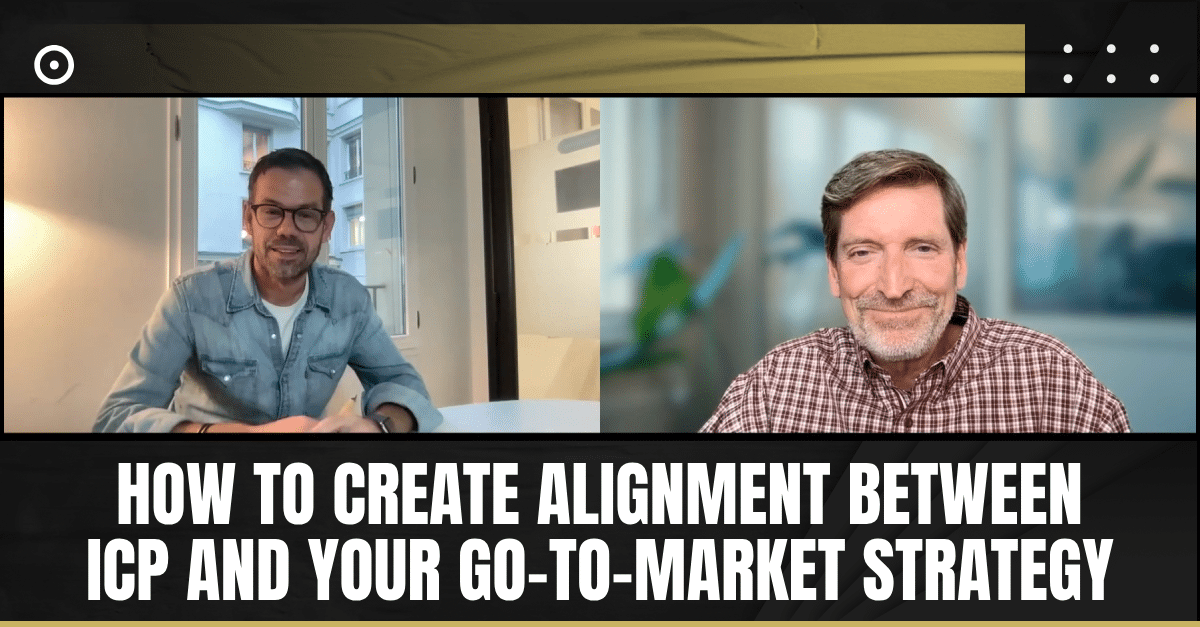


Nicolas Deswarte, CMO of Thiga, shares insights on aligning Ideal Customer Profiles with go-to-market strategies. He emphasizes weekly customer engagement to ensure marketing, sales, and customer success efforts resonate with real needs. He also shares his insights that drives alignment, campaign effectiveness, and clarity in organizational communication.
“The people in the company who are facing customers should know the learnings from your customers and apply them immediately. That’s also how we feed the brand with those product learnings, settings, and marketing insights.” – Nicolas Deswarte
Nicolas Deswarte emphasizes the value of connecting Ideal Customer Profiles with go-to-market strategies through regular customer engagement. This method strengthens collaboration across teams, especially between sales and marketing, while boosting campaign impact. By representing market insights, marketing leaders inspire trust and shape strategic decisions.
Follow Nicolas Deswarte on LinkedIn
Follow host Steve MacDonald on LinkedIn
[Transcript]
[00:00:00] Steve MacDonald: Welcome everyone to the C-Suite Sales and Marketing Perspectives Podcast. I’m Steve MacDonald, your host. Today we have a guest, Nicolas Deswarte and you are the CMO of Thiga. What is so special about what we’re going to be talking about today is it goes to the very foundation of the growth and alignment that we have inside of our companies.
[00:00:27] Steve MacDonald: Nicolas, you’ve taken things to a whole new level, which I’m going to let you explain. But the bottom line is we’re going to talk about how to create alignment between your ICP and your go-to-market strategy, and not just create the alignment, but make it really simple, really straightforward, and really easy to act on.
[00:00:46] Steve MacDonald: It’s one thing to get that information. It’s another to translate it and make sure that the entire organization is ready to take action on it for growth. So that’s what we’re going to be talking about here today. But before we dig in and get started, I’d love to give you a minute or so here to give us a little bit more on your background.
[00:01:06] Nicolas Deswarte: Yeah. Thank you for hosting me today. Really exciting to talk about this awesome topic regarding my background. I started my career as a product manager 12 years ago. This was really related to the ICP and discovering your customers in terms of usage. So learn how to discover my users.
[00:01:27] Nicolas Deswarte: Then ultimately I will bring him back to my marketing role. Now that I’m at CMO, I’m keeping that methodology and bringing him back to the ICP and to frame my go-to-market strategy. So that’s the point for today.
[00:01:42] Steve MacDonald: You know what, Nicolas, what I’d love to do is I’d love to start out by getting your point of view on why you feel the foundation to growth in the business is by being customer centric, understanding your ICP, bringing that into the marketing, but then bringing that in and helping it translate into action steps for the rest of the organization.
[00:02:04] Nicolas Deswarte: In fact, as a marketer, I think you are obsessed with your market. And basically, you are obsessed with finding the right audience and triggering them the right message.
[00:02:14] Nicolas Deswarte: What’s the best to know more and be in the kitchen with your market and discover and talk to your customers? So I think it is all about knowing your customers to set your go-to-market strategy and you take it to all new levels. So in our previous conversations, you said, Steve, I make it a goal to talk to a customer at least once every week.
[00:02:37] Steve MacDonald: When most CMOs come into a new role, and I’ve interviewed a lot of CMOs, part of the playbook is we get on the phone or an online call like this, and we just have a conversation with customers. We do it 10, 15, 20 times, but then it stops. Because we have our roles, the CMO, we have a lot to do. But your point of view is it should never stop. You should always be doing this. Why?
[00:03:03] Nicolas Deswarte: I used to call, this is my client culture. This is absolutely strange, for example, when I joined the company, I had a meeting with the sales team and the first question I asked them is who in your clients is your buddy, where you have a great relationship together and you can introduce myself or I can pop into your next meeting and give me just 15 minutes.
[00:03:28] Nicolas Deswarte: I will introduce myself saying that today I have nothing to sell. I would just like to know more about them. For example, what is the key topic that’s stopping you from sleeping in your professional career? And talk to me about that. What’s your struggles? Where is your pain? In an ideal world, how would you be able to solve this pain? Give me some more about that. So first of all, the sales guy will tell you, man, you’re crazy. You just have to reply. Don’t worry. I will not steal your job. I’m the marketer, you are the sales, and we have different positions, but I just would like to do more about this person.
[00:04:08] Nicolas Deswarte: Being in the kitchen with this person, I know more about their digital life, how, and which kind of applications they’re using. This is here more to know their digital culture. If they are more on the traditional side or if they are innovators, super geeks, et cetera. And that, that’s pretty much it.
[00:04:28] Nicolas Deswarte: When you are popping into a sales meeting saying that you have nothing to sell, generally people are super keen to talk to you just because they will talk about their position, their routines and their struggle. So, people who are passionate are super keen to talk about it. Don’t be afraid to go and pop into the meetings and just say that let’s get to know each other. That’s the point. That’s all.
[00:04:55] Steve MacDonald: Tell me a story a little bit about, because I would agree that the sales team would look at you and go, you’re freaking crazy, right? After you’ve done this, what are the kind of conversations you’re having with sales about why that really worked well? Or what’s their impression after having you come into their meeting and do that?
[00:05:17] Steve MacDonald: Thumbs up. I think it’s good. That was horrible and everyone does that again. What’s their impression, the sales people?
[00:05:23] Nicolas Deswarte: So first of all, usually they told me, hey, your approach is really cool. He’s really nice. And he’s really focusing on them and not on your products are not on your objectives ultimately.
[00:05:36] Nicolas Deswarte: So I think this is the first thing that talk to their mind when they’re listening to me talking to their clients, but then, the real goal of that is not really to feed the sales teams, with those learnings, obviously, this is super important for us to understand everything, but on my POV, every week.
[00:05:58] Nicolas Deswarte: Positions into the company who are facing the customers should know those learnings and apply them right after just to create an alignment using the same vocabulary, using the same way to talk about the things. And that’s how we are also bringing and feeding the brand based on those product learnings and settings and marketing aspects. That’s the key for me, when you’ve got learnings from your customers.
[00:06:28] Steve MacDonald: So I have five questions I want to ask you based on all this. But the first one is, why do you keep doing it? Let’s say you’ve done that 15 times, 20 times, 25 times. Why do you want to keep going more?
[00:06:43] Nicolas Deswarte: I also have my personal questions really related to the hot news I have to tackle and my objectives as a marketer.
[00:06:52] Nicolas Deswarte: I’m jumping into the meeting and saying, okay, today I would like to talk about this topic, this very specific topic. Let me know how you are handling that, how you are managing that. I’m also asking two different questions. What’s your team like to change if they have a Majestix?
[00:07:10] Steve MacDonald: Oh, that’s a good question.
[00:07:12] Nicolas Deswarte: This question brings a lot on the table. I also, starting the conversation simply, what is the pain and how do you think me, my company will be able to solve your problem?
[00:07:25] Nicolas Deswarte: It’s better if it is a real prospect that never had a demo or never sees your products or things like this because they are really bringing on the table their ultimate wish.
[00:07:40] Steve MacDonald: I have never heard that kind of a question before, but what I love is because in a sales conversation, it’s all about, here’s what we could do for you, right?
[00:07:49] Steve MacDonald: It’s never, what do you think we could do for you? That’s an amazing turn on the table. I love that. So, all right, you have these conversations on a regular basis because there’s a never ending, insatiable appetite for learning that we need. How does this, from a global perspective, and I want to dive deeper into this, how does this feed into it. Not only marketing, how does this feed the entire go to market strategy of the company?
[00:08:20] Nicolas Deswarte: So once I’ve got these learnings, usually we have monthly routines into the company. So here at Tiga, we’re doing monthly all ends meetings. So everyone is joining. A meeting room, and this is broadcasted through a Google meet or other video conference.
[00:08:40] Nicolas Deswarte: Then just asking my CEO to give me five to 10 minutes just to expose the learnings I had for this month. This has to be really focusing on the actual priority of the organization and your company. And then generally I’m using five bullet points. So this month, I’ve learned this. In terms of marketing and client facing, here is how this will translate.
[00:09:07] Nicolas Deswarte: So that could be an image that could be a catch line, a kind of sentence that you should use in every single interaction you could have with someone on the market. When I say someone on the market, that could be a prospect that could be a client, but that also could be a talent for hiring purposes and a client for customer success. Every person who is talking to the market, never forget that your candidates and your next partners could be tomorrow, your clients.
[00:09:42] Steve MacDonald: Here’s a huge takeaway from what you just said . As marketers, we think all the time about learning about our customers and then translating that into demand gen campaigns, sales, enablement, materials, things like that.
[00:09:59] Steve MacDonald: What I heard you say is. You’re actually calling it a campaign, whatever it is, but you are thinking very specifically about how I’m going to communicate this. I have messages internally. My first audience is my company and if I don’t do a good job translating that internally, then how are we going to, as an organization, serve our customers? Is that a good takeaway that you spend time thinking specifically about how to translate and communicate?
[00:10:33] Nicolas Deswarte: Absolutely. what I used to call, would like to be the voice of the market.
[00:10:37] Steve MacDonald: There are a lot of CMOs that I have on this podcast that talk to me about imposter syndrome and legitimately earning the right to have a seat at the table as a C-suite executive. If you have the voice of the market, you have the voice of your customers or ICP, that gives you the most powerful voice at the table because they are the highest authority and who else has that voice? It’s not sales, right? Sales has those conversations all the time, but just like you said, they’re having a very different kind of conversation and actually the one who records sales conversation said that actually the rep talks in those meetings, two thirds to three quarters of the time.
[00:11:20] Steve MacDonald: And they’re talking about us, not about them. They’re not learning. They’re not getting that voice of the market, right? So, I think that’s what I’m thinking about here now. One of the things that you said before we got onto the recording was that your team does a masterful job of having meetings where there is immediate actionable, very simple, straightforward, but immediately actionable.
[00:11:44] Steve MacDonald: Like. Leave this meeting. I know what kind of things. Tell us about how you orchestrate that and what you’re doing.
[00:11:53] Nicolas Deswarte: You have to be really simple, straightforward in your communications and give some examples more than ever. There’s also a challenge. In fact, we are using the Notion platform.
[00:12:06] Nicolas Deswarte: To gather and to put all those learnings available for all the company and we also print out a simple sheet with two or three bullet points. Who are these clients? What I’ve learned and how can I use this learning? On my daily routine, this is printing and sticking on the wall, where we’re living, et cetera, where everyone can see this kind of learning.
[00:12:32] Nicolas Deswarte: So actually we’ve got maybe a hundred little sheets stick on the wall just to have and to show the learnings. And it’s also a way to avoid the Notion syndromes with tons of Notion pages that nobody will read. When you interact with your different stakeholders from the company, this is a message that you always have to bring to the table.
[00:12:55] Nicolas Deswarte: Remind you that I’ve had this conversation with this person, we’ve learned that we can do this way, but not that way. Remember that and stick to that.
[00:13:06] Steve MacDonald: Because this is one of the things that is learning management, content management. Programs companies, they try to take all the things, the learnings, the materials, the enablement materials, like all these things, this constant learning program, if it doesn’t get translated into something that’s actionable from that meeting, but also what about three months from now this subject that we talked about and how you balance and prioritize that because you’re learning all the time and just getting lots of time sales to read the materials we put together for them, right? It is a challenge. How do you combat that challenge?
[00:13:46] Nicolas Deswarte: As I said, repeating again and again checking also at the final stage of the sales process, reviewing the proposal and making sure that we are all aligned with the marketing and the sales proposals. It’s also sometimes creating some documents for them, for the sales teams, to make sure that everything is covered in terms of branding aspects, benefits that we would like to put up front on this proposal.
[00:14:16] Nicolas Deswarte: Marketing teams have to be really close to the sales team. So for example, here we have weekly meetings. Sales and marketing, and then we are sharing those learnings. Obviously, the hot news that we are going to have, and they are bringing their challenge that they have on their actual pipelines.
[00:14:36] Nicolas Deswarte: You have to set this relationship with the sales and all, basically all the people who are facing the market, clients, customers, talents, et cetera. This is super important. This is also something that sometimes marketers are forgetting. There are no marketing and sales teams, right?
[00:14:57] Nicolas Deswarte: There’s business teams. We should all focus on the same persona on the same things, our clients and our markets. So that’s why it’s important for me to be positioned at the voice of the market, sharing all that information to everyone who is in contact, direct contact with the market.
[00:15:17] Steve MacDonald: So again, I have five questions, but here’s the most important one. Because you are having these kinds of conversations on a regular basis with your ICP, with your customers, one of the biggest challenges in B2B companies is alignment. Not only on the definition of the ICP, the deep understanding, the why to the point where there was a study and it showed that on average, just on the definition of the ICP between marketing and sales, it was at 16 percent of sales and marketing teams have alignment.
[00:15:51] Steve MacDonald: When you are providing this voice of the market, you are basically representing the voice of your prospects, your ICP, what does that do for alignment? How does that help alignment?
[00:16:06] Nicolas Deswarte: In fact, this one is simple. In my opinion, we have company objectives. We all have to be set to reach those kinds of objectives, the company objectives.
[00:16:17] Nicolas Deswarte: We have to be all aligned and all moving forward with the same messages, the same way to talk about the product, the same way to talk about them. And then. If we are all aligned from marketing, from branding, marketing, sales, as well as customer success, there’s a branding effect behind that.
[00:16:40] Nicolas Deswarte: So you are serving your brands as well as your sales pipeline and obviously your market. So this is how you can create the alignment through the company objectives and being all aligned, all set it to reach this objective, we have a common objective. Let’s go all together and work all together to reach it. That’s the way I think.
[00:17:05] Steve MacDonald: We’ve talked a lot about the teams, the go to market teams. As an executive of the company, you’re in board meetings and you’re getting questions like, how are we doing on the quota this year or this month, this quarter? And how’s next quarter looking? How are we going to wrap up the year?
[00:17:22] Steve MacDonald: You’re the one that’s holding the voice of the market in these meetings. How does this translate to an executive board level and the kind of conversations because as a C suite executive? You have your functional role as a marketer. You also have an executive role that’s responsible for the strategic planning and growth of the company overall.
[00:17:44] Steve MacDonald: How does this impact your executive role and the other executives?
[00:17:50] Nicolas Deswarte: In fact, as a company, you have a mission and the mission is to make things different for your market. So when it comes to big decisions and big alignments, I used to take some examples. All the sheets that are on the wall, I bring it on the table with the executive committee and say, okay, we have a lot to do on this kind of market. I don’t know, running out these kinds of features going into this new market. We have to go into this new orientation, the new challenge, just because there’s a lot of demand on the markets. I’m bringing it back on the executive committee through example and through tangible elements.
[00:18:34] Steve MacDonald: You said something before we started recording today. You said, by doing this and constantly having these conversations, you said, it helps me develop more trust in my own decisions.
[00:18:48] Steve MacDonald: Does that translate then to more trust that as an executive level, strategically growing this business, that everyone has more trust in the decisions that you’re making?
[00:19:01] Nicolas Deswarte: Yeah, it’s just erasing the questions we may have in an executive committee. We have a question. I potentially have an answer because I already have these questions to the market, to my contacts and to the potential customers of prospects.
[00:19:15] Nicolas Deswarte: I had the answer. Let’s try and test it out and roll out the offer on a strategic point of view. Let’s go for this and test it out.
[00:19:24] Steve MacDonald: Everybody has trust in that. At least trying that doesn’t mean it’s going to be correct every single time and we’re going to fail. We’re going to learn from that.
[00:19:31] Steve MacDonald: But you’re giving trust in here’s an educated guess at what’s going to make sense and what’s going to help us grow versus everybody’s opinion. Cause we’ve all been in executive board meetings where there’s 10 different opinions going around the table. There’s only one opinion that really matters and that’s the opinion of the customer.
[00:19:52] Nicolas Deswarte: Absolutely. Absolutely. That’s why I’m always bringing and always talking for the customers and not myself as a CMO.
[00:19:58] Steve MacDonald: Right. You’ve already talked a lot about how you do these things, but if you just could say the challenge of getting this kind of information on an ongoing basis, what are the best practices in staying customer centric or I would even call customer obsessed? What do you think are the best practices in order to do that?
[00:20:17] Nicolas Deswarte: First of all, you have to work with the sales team or to find the best person to talk to. The relationship should be great.
[00:20:26] Nicolas Deswarte: They should be happy about your products if they are already using your products or they should have a good image, at some point, of your company and your products. So the first step is to make a good selection of who you will talk to. Second, you have your own objective in this conversation. So you can try to orient the way you will frame the conversations by simple questions. Today, I would like to talk about this kind of topic. How do you manage that? Or you are asking them, what is actually the main pain you are having and how, in the ideal world, you would like to solve this kind of stuff?
[00:21:10] Nicolas Deswarte: That’s great, but I have an example that sometimes, you have to balance that kind of feedback.
[00:21:17] Nicolas Deswarte: I was working for a FinTech company and the main struggle we had from our prospect and customers was regarding Excel. Microsoft Excel. Just because it’s a huge source of errors. It is painful. This is not dynamic. You have to spend a lot of time on that to set your templates, et cetera, and ultimately get your reports. As a think tank company, we wanted to solve this kind of pain and so we’ve launched a massive digital campaign against Excel.
[00:21:53] Nicolas Deswarte: So you have banners, search engine, SEO, SEM content against Microsoft Excel. We were super happy about this key message. We spend a lot of money on that. But the fact is, one week after the launch of this campaign, that was a real failure. Why is it a real failure? Just because I was focusing on CFOs as a target, but in fact, CFOs by themselves will never quit Excel. On every single tool they have, they are extracting the data and putting it into an Excel sheet.
[00:22:33] Nicolas Deswarte: Just change the data by itself. This is how they used to work. So you can fight against Excel. But the feedback that was, Excel is my pain and that’s why it’s good also to talk to your customers, but it’s also important to see how they are working on a daily basis.
[00:22:54] Steve MacDonald: I got to tell you something. I want to talk for another two hours because I got it. I got enough questions for that but what I’d love to do is ask one last question. We’ve talked about a lot here. If there was one thought that you wanted to leave the audience, if they retained anything, this is what you would want them to retain. What would that be?
[00:23:16] Nicolas Deswarte: Simple. If tomorrow you are meeting one of your potential clients, I think you should be super proud to hear that your product is the number one product that he is using. So, to make it happen, you have to know exactly how he wants to use your product, who you will be able to recommend your product to, and obviously how your product really changed his life, his professional life. So, if you want that, just talk to your customers to know more about them.
[00:23:55] Steve MacDonald: I love it. We got to raise that up on the priority list that can’t just be something we do in the playbook in the first 60 days or something.
[00:24:03] Steve MacDonald: Talk to a bunch of customers and then we get it. Such great words of wisdom. I know there are going to be people who have more questions here. Would it be appropriate if we gave a link to your LinkedIn profile so people could reach out and ask questions?
[00:24:19] Steve MacDonald: Well, Nicolas, thank you so much for coming on and sharing. I can just feel the passion right behind what you’re talking about here. So, I can only imagine how it translates to success inside the company. Thank you. Thank you for all your words of wisdom today.
[00:24:33] Nicolas Deswarte: Thank you to you, Steve. Absolutely awesome to be part of your podcast. If anything pops, and if you have any questions, feel free to send me an email, that would be awesome.