
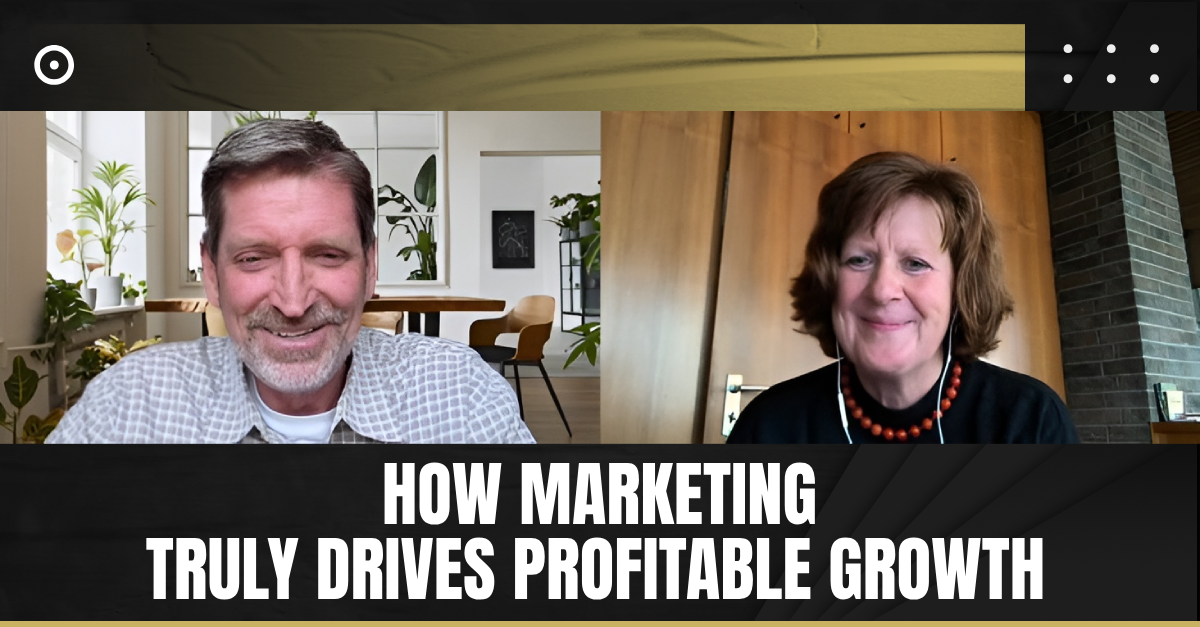


Episode #198:
Barbara Toens, Global CMO at Gantrex, brings her pricing PhD and global B2B experience to this in-depth discussion. She explains how marketing earns its C-Suite seat by ensuring every decision starts with deep customer understanding. Barbara shares best practices for VOC calls, cross-functional alignment, and transforming marketing from a cost center to a growth engine.
“When marketing leads customer conversations, we transition from vendor to trusted long-term partner.” – Barbara Toens
In this episode, Barbara Toens explores the strategic role of marketing in driving profitable growth through customer-centric leadership, voice-of-customer initiatives, and value-based pricing. She also learned how CMOs can influence cross-functional teams, build trusted customer partnerships, and move beyond transactional marketing to measurable business impact.
Follow Barbara Toens on LinkedIn
Follow host Steve MacDonald on LinkedIn
[Transcript]
[00:00:05] Steve MacDonald: Welcome, everyone, to the C-Suite Sales and Marketing Perspectives podcast. I’m Steve MacDonald, your host. Today, we have a phenomenal conversation with an expert guest we have on, Barbara Toens. Now, Barbara, you are the Global Chief Marketing Officer for Gantrex. You actually have a PhD in pricing, which is fantastic.
[00:00:27] Steve MacDonald: And that’s going to bring a lot of expertise to what we’re talking about here today. One of the things that I learned, which was fantastic, is you actually were a professional tennis player and played in all the biggest tournaments all over the world. That’s just a phenomenal background and something to be very proud of.
[00:00:45] Steve MacDonald: What I would love to do is—before we get started, and we’re going to talk about how marketing truly drives profitable growth and what is our role as CMOs in order to do that—but before we get into that, I’d love to hear a little bit more about your
background.
[00:01:00] Barbara Toens: Great. First of all, thanks a lot for having me, Steve.
[00:01:03] Barbara Toens: Looking forward to our conversation. And yes, maybe as introduction, you are right—I might have a slightly different background, with having a pricing focus as part of my marketing education. But I’m sure we’ll touch on that a little later on in the conversation, as I see it as part of a holistic marketing function, really.
[00:01:24] Barbara Toens: And yeah, like you said, I’m the CMO of Gantrex. Gantrex is an industrial engineering company. We deliver solutions for cranes and crane rail systems. We have offices in 25 countries also. So with that, the marketing position is also a truly global role, with all the cultural differentiation implications.
[00:01:49] Barbara Toens: And yeah, in terms of my role, I cover the—let’s say—the classical marketing aspects, including, of course, lead generation. But my responsibilities also include strategic pricing. In terms of background, I actually started in the automotive industry for Ford and what used to be Chrysler Jeep at that time, which, for any marketing career, I find a perfect starting point because it taught me so much about all aspects of, let’s say, classical marketing.
[00:02:18] Barbara Toens: I then moved on a bit more into industrial—or let’s still call it B2B—marketing, which added a bit more of a strategic perspective to my marketing responsibilities. If I would summarize, high-level, my main focus or main expertise, which I try to deliver in daily life as well, it’s a lot about building brands and then monetizing that brand power via pricing to really ensure value delivered is value captured.
[00:02:57] Barbara Toens: And all that, of course, only possible with having the most important person in the business—the customer—at the center of everybody’s mind.
[00:03:06] Steve MacDonald: We’re going to dissect that in a big way. But what I want to do is I want to start out—when you become C-suite, you still have responsibilities, functional responsibilities in marketing—but you’re now an executive of the business.
[00:03:19] Steve MacDonald: You’re responsible for being a part of that executive team that plans for long-term strategic growth of the business. When you joined, or from your perspective, what has that done for your responsibilities and then the impact that you can have on the business?
[00:03:39] Barbara Toens: Ah, that’s a very interesting question. First of all, I think it’s so important to have the marketing voice at the executive table, because I think we bring, in marketing, a very different perspective and expertise. We really ensure that all discussions and decisions focus on the customer. What will it do to the customer? What impact will it have on the customer?
[00:04:09] Barbara Toens: And I think the role we play in executive teams is also to ensure every decision is considered with an outside-in approach—instead of the probably more typical inside-out: “We are strong at this, we can do this, and then we’ll find a way to market it.” It starts with the customer. What are the real needs? With a true understanding, how can we bring solutions?
[00:04:36] Barbara Toens: I think as marketing, we push for becoming a partner of the customer instead of just one of many suppliers. And I think that’s the special view of marketing, which, from personal experience, also takes a while to have it recognized—that marketing is more than, “Ah, fun visuals, having a fun time, and yeah, generating some leads.”
[00:05:03] Barbara Toens: No, we do have a bottom-line impact as well if we approach it in a holistic way. And I also see it as our job—and probably our natural capability—we are good at communicating externally, but to be effective, we need to do it internally as well. We work closely with sales, naturally, as being a commercial team, and have close relations with finance, with innovation, with product development, to continue bringing that customer view and keep the conversation going—all that also happening at the executive table.
[00:05:43] Steve MacDonald: You said so much there that I want to unpack, because there are a lot of B2B CMOs that have imposter syndrome.
[00:05:48] Steve MacDonald: Yes, yes. They’re looked upon as running a department—as one of the largest cost centers in the business. Their job is lead generation and, yes,
[00:06:00] long-term branding—but if we’re not helping to fill that funnel, and that job’s not being done to the satisfaction of sales, then all of a sudden, kind of the fingers start pointing our way.
[00:06:11] Steve MacDonald: And this isn’t a point of view. We’ve had so many CMOs coming on, and they talk about how this is a constant conversation that they’re having inside of the CMO communities that they’re in and things like that. So what you just did is you just talked about how CMOs have a seat at the table.
[00:06:31] Steve MacDonald: There’s not a company out there that doesn’t say, “No, we don’t want to be customer-focused. We’re not customer-obsessed.” Everybody wants to be, but the degree that they actually are makes a huge difference. And you started talking about something that was moving towards this deep understanding of the customer.
[00:06:49] Steve MacDonald: So when we spoke before, you talked about how you didn’t believe that most companies did have a deep understanding. They had more of a familiarity with their customers. What did you mean by that?
[00:07:02] Barbara Toens: From experience in and throughout companies I worked for, and what I see on the market, there is a high—I would almost say superficial—belief in data.
[00:07:11] Barbara Toens: We get customer data, we know demographics, we know purchasing habits, so we must know the customer. But having data to understand customer activities is a must. It doesn’t mean you truly know a customer, because that’s just above the surface. What I see as the marketing role is really to go below the surface, because that’s where the motivations behind certain activities of a customer lie.
[00:07:41] Barbara Toens: Is it because the customer is under cost pressure? Is it because they’re expanding globally? What are their strategic plans? To understand the “why” of customer actions—for me, that, combined with the more superficial data, leads to a true understanding. And I think the specific need for marketing to bring this understanding is because, for us, it’s clear that everything on the mass customer side is a perception.
[00:08:13] Barbara Toens: Our brand is perceived differently by you than by your best friend. The value we deliver—we each have a personal perception, which is impacted by our experience, by our peers, by our use of a product or service. And to understand what drives that perception—that’s, for me, the holistic approach to having a really customer-centric view.
[00:08:41] Barbara Toens: And from there, from that knowledge, you can step on and become really a solutions partner for the customer. But you can’t do it on just data you have on your laptop.
[00:08:54] Steve MacDonald: And a lot of companies do. We have more data than we’ve ever had before.
[00:08:57] Steve MacDonald: So it is easy to think, “Wow, we’ve got more data, we understand our customer better than ever before. Just dig deep in there.”
[00:09:05] Barbara Toens: Yeah.
[00:09:05] Steve MacDonald: And then, boy, on top of that, we have sales having conversations with prospects all the time. Customer success is having conversations with customers.
[00:09:13] Steve MacDonald: We’re talking to prospects and customers. We’re getting all this data. We pretty much have what we need.
[00:09:20] Steve MacDonald: But you had a unique perspective, which I loved, which is that when customers or prospects are talking to sales, right? That is a very specific environment, and there’s like a shield that’s up—you’re being sold to.
[00:09:34] Steve MacDonald: The amount that you’re gonna open up and truly talk about your challenges—and something that I looked up since you and I last talked, Gong, who’s like the biggest recording company of sales conversations, they did a huge study, like three, four thousand different sales conversations. And you know what they found out? That the sales rep talks, on average, two-thirds to three-quarters of the time.
[00:09:57] Barbara Toens: Yeah. Not a surprise, huh? Just say it’s jump.
[00:10:01] Steve MacDonald: And then you look at customer success conversations and you say, okay, their goal is to put out fires, answer questions, and cross-sell and up-sell. You would never define or design a true deep—as you characterize it—deep understanding learning program of the customer, and run it through existing processes that have a different set of context, a different set of goals and outcomes in mind, right?
[00:10:28] Steve MacDonald: But we use that data and those conversations as a proxy to really understanding our customers. Now, here’s where I think this all leads, and it was a second thing that you brought up: we are, as B2B sellers to B2B buyers, we have less trust than we have ever had. You could look at like global Edelman Index, Trust Index.
[00:10:55] Steve MacDonald: In the United States, it’s going down the fastest. In Europe, it’s going down extremely fast. 74% of B2B buyers don’t believe the customer evidence we present to them. Over 60% of buyers think that salespeople are misleading intentionally. And that if you put them on a hierarchy of who is trusted the most, salespeople are down at the bottom.
[00:11:21] Steve MacDonald: So this is the environment we have, and you wonder why they’re waiting longer and longer. They’re doing more and more of their research, and they don’t want to talk to us until the very end of the process. Put one and one together, and it clearly equals two. So here’s my question to you: in that kind of an environment, what do we need to do?
[00:11:45] Steve MacDonald: And your answer to that, in our previous conversation, is dig deeper into the customer and the understanding of the customer. Why do you think that is the antidote, right, for what I call the trust epidemic that’s happening here?
[00:11:59] Barbara Toens: Let me start from a different angle. I started at Gantrex seven years ago, and what I started to initiate right from the beginning was VOC calls—voice of the customer calls—but conducted by marketing. The initial reaction from sales colleagues across every region was, “Oh, come on Barbara, what do you wanna know about my customer? I can tell you. You don’t need to bother him.”
[00:12:25] Barbara Toens: “I know my customer.” And I said, “You will be surprised. When we talk to them, you hear things you have never heard about.” Anyway, we got to start VOCs, and that, for me, is part of the trust-building story. First of all, like you said, sales managers talk to their customers all the time, but it’s always a transactional relationship.
[00:12:51] Barbara Toens: And from the customer’s point of view, I would say there’s always the price elephant in the room. Because when I talk to my sales guy, in a way, my final objective is still to get more for a lower price. He’s my transactional contact. If marketing steps in, first of all, we conduct such an interview very differently.
[00:13:13] Barbara Toens: You talked about the percent—the share of talking done. The marketing person, well-trained to do a VOC, to the customer, isn’t even obviously steering the conversation. We are guiding it from the background and having the customer narrate their challenges, their story. And we guide it by questions that show we understand the customer’s business.
[00:13:38] Barbara Toens: For me, that’s number one to build trust. If you randomly ask me questions, I’m at one point like, “Come on, please do your homework first.” I understand your business. I get you to talk. And honestly, Steve, we had many VOCs done where, at the end, the customer said—in this case, Steve is one of our guys to conduct the VOC—said, “Steve, my goodness, you got me thinking about topics and strategy I wasn’t fully aware of. Thanks for this conversation and for helping me clear my mind on the way forward.”
[00:14:00] Barbara Toens: And I think another reason why marketing needs to conduct the VOCs is twofold. For one, for us, it’s natural to feed back findings and conclusions across the whole company. We don’t keep it for ourselves to say, “Cool, we can build bigger, greater campaigns—good for us.” We feed it back to innovation: “Hey, the customer has this need. Maybe you look into developing the service,” into operations, into sales, of course.
[00:14:28] Barbara Toens: And I think another distinctive factor is sales talks to active customers. For a good VOC, we talk to all kinds of customers. We talk to lost customers—customers we haven’t seen doing business with us for three years. We try to get in touch. And something I find very impactful—we do what we call postmortems after big projects. So we have a big project bid we lost. And if I ask sales, “Why did we lose?”—”Oh, price. Ah, the competitor was 15% cheaper. What do you think? How can I compete?”
[00:15:19] Barbara Toens: So that’s where we say, “Let’s do a postmortem call with the customer.” Sales says, “Oh, I can tell you the answer.” Then he will point out the price. And we say, “No problem. Let’s see what else we can do.” So when we conduct these calls, first of all, the challenge is to overcome this deadbeat, “Oh, it was price,” answer—because there’s more behind. Why is a competitor cheaper?
[00:15:50] Barbara Toens: Did they deliver less? Then let’s learn: What was a good enough offer? Maybe we over-spec’d by not understanding the customer need.
[00:16:00] Barbara Toens: Did they deliver the same, but then it was at a much cheaper price? Maybe the level of product or service quality was not comparable, which takes us to a learning: either we didn’t communicate that value to the customer—with all the impact on their business—or maybe that high-quality level of a specific service wasn’t really what the customer needed at this time.
[00:16:20] Barbara Toens: So as an outcome of these VOCs, we have lots of learnings, more customer insight. And I felt every single one of the customers appreciated it in the end. Because they started it somewhat defensively—sort of like, “Yeah, just lower your price and I’ll consider you.” In the end, they were sharing their interests, their story, and their decision-making process, and appreciating that we said, “Thank you. We wanna improve next time. We wanna deliver better proposals to you.”
[00:17:00] Barbara Toens: So that’s, for me, what sets a true VOC apart from a sales discussion with customers. It brings so much more value.
[00:17:11] Steve MacDonald: Oh my gosh. So if they’re the highest voice of authority and we’re not learning the kind of things that you’re talking about from the voice of the customer, then we’re flying blind. We’re trying to do this with one hand tied behind our back.
[00:17:23] Steve MacDonald: Yes.
[00:17:23] Steve MacDonald: Let me ask a question you may not anticipate, but I bet you I know what the answer is on both sides of the spectrum. After you did these voice of the customer calls—which I’m sure is an ongoing process—what does that do with the relationship, both internally with sales, when you’re feeding now this kind of information that they don’t have (because there is a very large alignment issue in the B2B world between marketing and sales), and then what did it do for the relationship with the customers that you were talking to? So both sides,
[00:17:58] Barbara Toens: Interesting ones, I would say, sales. In a way, it has a natural hesitation to open that door to marketing, always thinking, “Oh, they will finger-point,” like, “Oh, you didn’t understand this point.” To overcome this, what we did was—we now make it a habit to have the key account sales manager of that respective customer just listen in. It’s understood,
[00:18:21] Barbara Toens: he cannot step into the conversation, but we want him to just listen in. We explain it to the customer like, “He’s your key contact. It’s for relationship building.” With that, we say, “It’s here. This is no finger-pointing or deep dive discussion on what did our sales not do to make you perfectly happy.”
[00:18:42] Barbara Toens: They see it’s an open-minded discussion. And to be fair, I would say 95% of our sales managers afterwards came to us and said, “Thank you. Actually, I have actionable insights now. I get back to the customer and I work on solving and bringing a solution for a specific challenge I just learned now.” So, in the end, they are highly appreciative, and we then tackle it from a commercial team.
[00:19:10] Barbara Toens: For me, this is a sales and marketing perspective. On the customer side, for me, I see them viewing it as an essential step to seeing Gantrex as a trusted partner, as an expert partner who cares about their real long-term development challenges, market challenges, and somebody they can ask a question to.
[00:19:40] Barbara Toens: Very often in these calls, our guys get a technical question, which they can either answer or say, “Hey, I’ll put you right in touch with our expert.” There’s no charge to that, obviously. This is just—we provide our expertise. And the more you do that, and if it’s aligned with an overall value delivery and communication across all touchpoints, this builds trust.
[00:20:05] Barbara Toens: But it takes time. But then it’s a cohesive approach. You talk rich content, you deliver rich content, you walk your talk, and then you are believable. And then you are really a trusted partner, which makes all the difference, I think.
[00:20:23] Steve MacDonald: Yeah.Vendors talk transactionally. Vendors talk about what they do and the challenges that you have that we can address.
[00:20:31] Steve MacDonald: But if you can understand the greater challenges that they have to deal with for their success, and you can lend advice—and it may not even be something that you directly do—but if they can see that you’re seeing them holistically, like you said there, and truly, honestly trying to learn and trying to help, then that transitions you out of being a vendor
[00:20:52] Steve MacDonald: and that transactional world. And at the same time, it helps the sales team understand that—I did probably eight series of podcasts, eight different episodes on why B2B CMOs fail so quickly. The number one issue was misalignment with the sales department. Yeah, the number one issue.
[00:21:11] Steve MacDonald: And it was because sales didn’t feel like there was good value coming from marketing. And in fact, from an industry perspective, the content that marketing creates for sales—over two-thirds of it is never used. In fact, sales doesn’t even think it has any value. Right?
[00:21:34] Steve MacDonald: Yep. Now we can unpack that—and a lot of that, right? But there’s a lot that happens there. But the number one thing that marketing can do is be that voice of the customer. Most B2B companies do not have a chief customer officer.
[00:21:45] Steve MacDonald: Yeah. But marketing—we are the department that has all the connective tissues to every single department, right? And if we see them as our internal customers and ask, “How do we make them more successful?”—the number one way to do that is by bringing the voice of the customer to them. I think it’s brilliant.
[00:22:03] Barbara Toens: Absolutely. Yeah.
[00:22:05] Steve MacDonald: Now, here’s where your pricing background comes in. Because listed on the top frustrations for B2B buyers with the sales process is lack of transparency on pricing. You gotta dig, and it’s so customized and complex that you just gotta—they feel like they have to go through numbers of different rounds and meetings just to get to a price.
[00:22:27] Steve MacDonald: You’ve got a PhD in pricing. I would just love to hear your perspective on transparency, trusted partner—take it in the voice of the customer. How does that all weave together in a pricing strategy that we need to put together?
[00:22:44] Barbara Toens: I’m a very strong proponent for having pricing under marketing responsibility because I see the whole approach as marketing delivering like a virtual value circle.
[00:22:58] Barbara Toens: So it starts with marketing defining the value proposition, bringing the needs of the customer to, let’s say, the innovation team. Then value is created in a product or in a service. But that value needs to be communicated, which is again marketing material—marketing activities, podcasts, webinars, whatever it is.
[00:23:23] Barbara Toens: That value needs to be delivered by sales, but with documentation to remind the customer what he bought, why he paid a price. This can be case studies, can be reference lists, whatever. And then most important—value needs to be captured, which is the actual sticker price you pay. But first of all, ideally, in an ideal value pricing world—in negotiation with a customer, price is the last item you touch. You talk value first, and then price is the natural outcome.
[00:24:00] Barbara Toens: You negotiate a bit, but it should not be a shock—“Oh, I have to pay this much for it?” So for me, it’s essential. Across all touchpoints with the customer, we consistently talk about what is the value we bring to you.
[00:24:16] Barbara Toens: Also highlight service values that we don’t price at all. Like in our case, customers can call anytime saying, “I have an issue. The crane rail is coming loose. Can I send you a picture? Can you give me advice?” Our sales guys do that. They don’t send an invoice for that, because we work with the customer on a long-term basis. And also—in this case, we do value pricing. To do effective value pricing—again, it starts with the customer. What are the value attributes in a product or service a customer
[00:25:00] Barbara Toens: really perceives as value-adding to their business? These are the ones you use as arguments why you have a certain price point—because your product performs in this way, has a longer warranty, a longer lifetime—whatever it is for that customer.
[00:25:10] Barbara Toens: So you highlight that in terms of the core “Let’s Talk” product you bring, you have arguments for why quality is so high—it has a price. But in the pricing discussion, you always, besides the core product, talk about the augmented product, which is the sales team we have, the R&D team we have, the expertise we have that we give to the customer as part of the package price he pays.
[00:25:39] Barbara Toens: So, I find it very important for customers to not just be sold a product, but to understand what he gets for it. Then he can make a decision—is he looking for lowest price? Maybe then this is not the best partnership. Is he looking for value for money? Yes. Then this is something we can talk, we can work together and come together.
[00:26:02] Barbara Toens: In terms also of customer lifetime value, we are not in it for a one-time transaction, usually. You have a few of these customers, but we want to grow with the customer. For us, we want to grow share of wallet, but also look at it as a lifetime relationship—a customer lifetime relationship. And so in this sense, again, price also communicates the value, because you cannot communicate value, have high quality, and then come with a very low price. Something makes me wonder then, as a customer, what’s wrong here? Something is wrong. Maybe the quality isn’t as good as I was told. So it all needs to be consistent. And then the price is a differentiator and a proof of value. Of course, quality and everything must fall in place so that there’s no disappointment after purchase, after installation.
[00:26:57] Barbara Toens: But I see price as a very active marketing mix element that needs to be embedded in all the other ways of communication and go-to-market strategies that we have. Otherwise, it’s a short-term sale.
[00:27:12] Steve MacDonald: It makes so much sense—and pricing as a function of value and perceived value. And if we don’t know how our customers are going to perceive the value.We’re very good as B2B companies. We know how to sell, we know how to create products, we know how to market, right?
[00:27:30] Steve MacDonald: And how to price. And every single one of those has to be tied to what’s the most important from the customer’s perspective. So, back to your voice of the customer strategy. Without a voice of the customer strategy, you don’t actually have the underpinnings for a pricing strategy either, do you?
[00:27:47] Barbara Toens: Absolutely. I might think, as a producer, it’s all about product lifetime. If we can deliver 10 years product lifetime—hey, customers must be happy. But if I don’t talk to the customer, maybe that customer is selling on and just needs to guarantee two years warranty. Then he doesn’t care if there’s an additional eight years—he pays for it, it’s zero value for him.
[00:28:15] Barbara Toens: But unless you talk and understand the customer’s business, you don’t know this. You act on superficial data and wonder why you don’t succeed or why you lose a customer after the first purchase.
[00:28:29] Steve MacDonald: I have to tell you, we’ve talked about so much. I feel like we need to do an entire series on what we’re talking about here. But if there was one takeaway that you wanted the audience to have, to leave from this podcast episode, what’s the most important takeaway that you would want them to have?
[00:28:49] Barbara Toens: I would say—to feel confident, especially to our marketing colleagues—we bring a bottom-line impact. We drive profitable sales by having this full-scale knowledge of, and playing both a tactical and a strategic part. We not only add value, but we drive the company’s bottom-line results as well, and we can be confident about that.
[00:29:18] Steve MacDonald: And therefore, confident for our seat at the table.
[00:29:21] Barbara Toens: Absolutely.
[00:29:24] Steve MacDonald: As executives and part of that C-suite team.
[00:29:27] Barbara Toens: Coming back to our usual challenge.
[00:29:30] Steve MacDonald: Yes. Here’s what I know—people are gonna have questions. Would it be appropriate if I gave out a link to your LinkedIn profile that people could reach out?
[00:29:34] Barbara Toens: Absolutely. I’d be happy to start a conversation, sure.
[00:29:38] Steve MacDonald: Fantastic. It’s the mission of this podcast to bring different perspectives from different C-suite executives in the B2B world based on their insights, their years of experience, so that we all can learn.
[00:29:52] Steve MacDonald: And I call that the rising tide that lifts all boats. And you absolutely did that today. So I just wanted to say thank you, Barbara.
[00:29:59] Barbara Toens: Thanks, Steve. It’s been a pleasure. Really enjoyed it.