
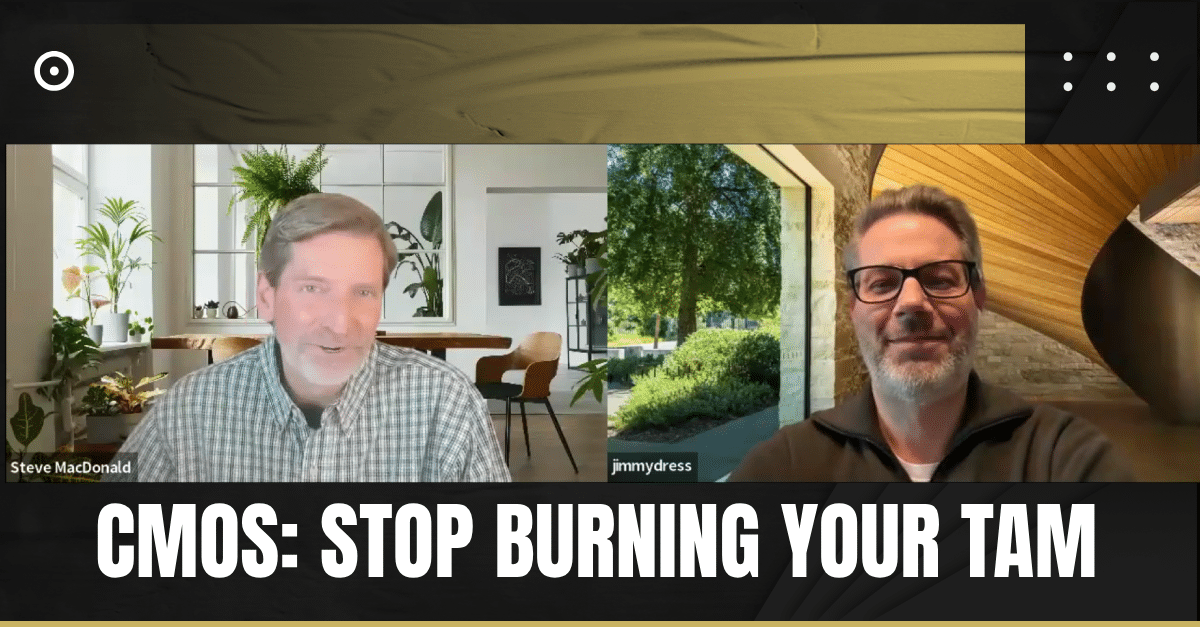


James Dress, Chief Growth Officer at Corus, discusses the evolving role of C-suite executives and strategies to avoid exhausting your Total Addressable Market (TAM). He emphasizes the importance of building trust with clients and moving away from aggressive lead-gen tactics. He also shares insights from his experience in SaaS and healthcare to align marketing and sales strategies with business goals.
“I strongly believe CX is paramount for any company to be successful and it has gotten even more interesting because of customers working through omnichannel experiences. Now, you have to connect those experiences in online, in-person, and virtual settings while maintaining a common data layer.” – James Dress
Adopting a customer-as-expert approach transforms SaaS engagement, driving loyalty while aligning offerings with future market needs. This service-first mindset requires a time investment but fosters deeper advocacy and long-term trust. By treating TAM as finite, businesses can focus on delivering value and meaningful connections, ensuring sustainable growth and market resilience.
Follow James Dress on LinkedIn
Follow host Steve MacDonald on LinkedIn
[Transcript]
[00:00:00] Steve MacDonald: Welcome everyone to the C-Suite Sales and Marketing Perspectives Podcast. I’m Steve MacDonald, your host. Today, I guarantee we have a conversation that all of us need to hear. We’re here with James Dress. Now, James, you are the Chief Growth Officer at Corus. You’re a two-time Chief Growth Officer.
[00:00:22] Steve MacDonald: You’re a former Chief Sales Officer. So you’ve had a lot of executive experience, but right now you’ve been brought in, and you’re in charge of the entire go-to-market strategy. Your thoughts on how all of us as C-suite executives need to be thinking about an evolution in our roles and how we think about addressing the market and going to market? That’s what we’re going to be talking about today. Stop burning your TAM. Stop doing the kinds of things that we’ve always done in the past.
[00:00:52] Steve MacDonald: Let’s think a little bit better, a little more evolved about what we’re doing and how we’re approaching the market. But before we jump in there, I’d love to give you just an opportunity to take a minute and give us a little bit more about your background before we get started.
[00:01:05] James Dress: Yeah, sure. Thanks a lot for the invitation. This is exciting. The things that you mentioned, I’m very passionate about. My background started in marketing. I was very focused on marketing, even in fast-moving consumer goods and then in healthcare. I had the opportunity to join a couple of startups, SaaS startups, which I think is really where you have to understand the sales funnels, not just the lead gen, not just the top of the funnel, but really the whole funnel. I think that was instrumental in helping me to be where I am today—shifting from just marketing, generating leads, generating awareness, supporting the business, and launching products, to understanding the whole sales funnel.
[00:01:43] James Dress: A couple of things about me personally: I love sailing, and I’m originally American, living in Barcelona for the last 25 years.
[00:01:50] Steve MacDonald: I think that’s a whole other podcast because I’d love to hear more about that. But let’s start here. I want to talk about this evolved role. You’ve been in marketing, you’ve been in sales, and you’re now overseeing the go-to-market strategy, which includes customer success, and everything. So, you’ve played and now have all perspectives wrapped up and rolled into one.
[00:02:16] James Dress: What are your initial thoughts on what this evolution in the role needs to be?
[00:02:23] James Dress: Interesting question because I think it can happen organically in my case, right? In the SaaS companies, in the startups, these companies don’t have the budgets to have several C-level people. You have a C-level person, and I think that’s why the whole “growth” moniker came up. These startups, a lot of them SaaS, are saying, “Hey, we need somebody in charge of marketing. We need somebody in charge of business development. We need somebody in charge of customer acquisition. We need somebody in charge of revenue.”
[00:02:49] James Dress: And so, growth emerged. In my case, I think it was just curiosity. How can we generate leads? I think one of the first startups I was in was in ed-tech SaaS. How do we generate leads? How do we get in front of customers? After getting over that hump, it became about understanding the customer journey, the metrics we’re using, and how we can project leads to ARR, MRR, those types of things—churn, etc. All of a sudden, this was different from just lead generation and top-of-the-funnel activities.
[00:03:22] James Dress: So that’s what my role is now. I was originally Chief Marketing Officer, and I knew this would happen. After 11 months, they said, “Hey, you’re the growth person.” I said, “Yeah, I know. That’s fine. We’ll just change the title.”
[00:03:37] Steve MacDonald: The perspective and the evolution that, we met before we were talking, you posed a question that I’ve never thought of before.
[00:03:45] Steve MacDonald: I’m a former B2B SaaS founder myself, and my clients and the companies and folks that come on here are executives from SaaS companies. Typically, when we’re going after different rounds of funding and everything in the VCs and private equity firms, they hate it.
[00:04:00] Steve MacDonald: We say this, but we always do: if we could just get 1 percent of the TAM, right? This TAM is this massive, sprawling thing, and you’re like, I wonder if what we’re doing is just burning our TAM, right? We’re not going to get a chance to go back. This challenge of burning the TAM—what does that mean?
[00:04:21] Steve MacDonald: And how do you think about that?
[00:04:23] James Dress: Yeah, I agree with you. I think this was something that happened to me in my last company, and I just never really thought of it. I think it’s a bit of an ostrich-head-in-the-sand type thing. I just wanted to start saying, how can I get X percentage of my TAM?
[00:04:35] James Dress: So I just have a marketing strategy; it’s just trying to get as much as possible, but the last company I was in, we were hitting a lot of our team. Then I started thinking about, okay, now I’ve gone through the round once in this geography, what do I do now? I need to generate leads.
[00:04:56] James Dress: How many emails do you get that are people who are using these engines that contact you? It looks like a personalized email, but it’s not. If you’re using, let’s say, your traditional methods to get in front of your customers or potential customers, there’s a time when you will run out, I guarantee you, you will run out.
[00:05:22] James Dress: And when you run out, then you’re going to say to your BDMs or your BDRs and your marketing team, okay, now I need more leads. Okay, yeah, I’ve talked to everybody. What do you want me to do? Do you want me to email them again? Do you want me to call them again? I thought, wow, I would say we’re being a bit reckless.
[00:05:40] James Dress: I don’t want to use words that are completely negative because I don’t want anyone to feel like what they’re doing is not right. We all face the same challenges, but it was a bit reckless. And I feel the same challenge here now—we have to be very careful. You want to make small mistakes often but make sure the reiteration every time is a bit more thoughtful, a bit more reflective.
[00:05:56] James Dress: In the sector I’m in now, we have our end customer, dentists. There’s a finite number of those. You can go through and identify who they are. If you say, okay, I’ve contacted 75 percent of them but I only have a 20 percent market share in that other 50%, can I still get them? Could I still potentially be part of their choice set?
[00:06:15] James Dress: So there are two things: one is making sure that when we say, okay, we’ve talked to 75%, how have we talked to them? Have we done it in a way that still keeps the door open for me to come back to them? The second question is, okay, the first round didn’t work or is not working as I expected. What do I do now?
[00:06:29] Steve MacDonald: The typical SaaS company—and we all do this, and as a SaaS founder, I’m guilty—are so in love with what we do. We’re all convinced that as soon as they know, the floodgates open. Right there.
[00:06:43] Steve MacDonald: Wow. When they know, that’s just going to open up all kinds of opportunities for us. And that’s just not how it works. But because of that mentality, because we’re thought leaders of our tech, our product, our babies, that’s what we talk about.
[00:06:56] Steve MacDonald: You started talking about building trust with thought leadership. I could send 15 different emails of pure thought leadership and never burn my TAM. I could send 15 emails about me and potentially burn my TAM pretty quickly, right?
[00:07:14] Steve MacDonald: There’s this balance. So, in your mind, what is the importance of building trust through thought leadership? Because thought leadership is all about them. It’s all about helping them and their challenges, right? What’s your thought on that?
[00:07:29] James Dress: In the healthcare industry, where your end customer is our doctors, you need to help them feel more confident about the treatments that they’re giving. So they’re looking for that. There’s training and education that you can do.
[00:07:36] James Dress: So, I’d say the thought leadership challenge is there, but it’s not just about what thought leadership is now in SaaS. The thought leadership is, yes, you need to build trust through thought leadership, full stop.
[00:07:53] James Dress: The challenge is, “Okay, what is that thought leadership?” We always go back to, “If I can help them understand what their problem is and give them insight on how to solve it, I’ve got it made. That’s my thought leadership.” That’s the ABC of content marketing and account-based marketing. We know that, right? But the actual question is, what is that thought leadership? Are you understanding the problem, or are you hoping that your software fixes a problem you think they might have? So, to answer your first question, yes, it’s super important.
[00:08:27] James Dress: The second question is, I think assuming you’re going to reach that thought leadership threshold is a big challenge.
[00:08:37] Steve MacDonald: I have to tell you, because I talk to a lot of folks on the podcast about this, and one of their biggest challenges is coming up with relevant thought leadership. This is well-documented, right? Seventy percent of B2B buyers think the thought leadership they read has no value for them. Forbes did a big study and gave B2B marketing, particularly thought leadership, a D-minus. Think about this—if your kid came home with a D-minus, what would you be doing? Yeah, that’s unacceptable. As an industry, we are accepting that, right? So, how do we overcome this? If the evolution in our roles is thinking about our customers and how we serve them first, their challenges are this: we help them with this. This is important, but it’s only a part of what they face. How do we evolve? How do we not get the D-minus? How do we not burn our TAM by just selling? What do we need to do to overcome these challenges?
[00:09:52] James Dress: That’s a good question. One thing that works—but you have to be very careful, and it has to be in the early stage—is getting customer feedback on how your product should be used and developed. That takes a lot of humility. One, it takes a lot of reiteration, and you have to be much more sophisticated because I’ve tried this, and it works. It’s really about getting customers involved early and saying, “Hey, I’m interested in what you have to say. I think this product does this, what do you think?”
[00:10:32] James Dress: Developing relationships at an early stage is key, but SaaS companies don’t have time for relationships. We make time for lead conversations, demos, and subscriptions. Why? Because VCs want to see metrics and how quickly those metrics are met. If I had the silver bullet, Steve, I’d share it with you, and I could make a lot of money, but I think really developing key relationships at the beginning of the go-to-market stage is critical.
[00:11:09] James Dress: For two reasons: one, you start gaining advocacy; and two, you really understand on a one-to-one basis how your product is helping them. Otherwise, if it’s a sales call, let’s be honest—you’re selling, even though we do consultative selling and ask questions. At the end of the day, there’s a pressure to sell, and that usually trumps any real conversation about the problem.
[00:11:34] Steve MacDonald: I think you had a tremendous answer there because what you said is key: talking to your customers, right? They’re the highest authority in the business. In fact, Amazon has an empty chair policy. There’s an empty chair in every meeting to represent the customer. If the customer were sitting here, how would that influence what we’re doing?
[00:12:00] Steve MacDonald: You’ve got to have these real conversations with customers. In fact, Gong, who is the number one company for recording sales calls, did a big study and found that out of thousands of sales conversations, the sales rep talks two-thirds to three-quarters of the time. You’re not learning much when you’re doing all the talking. If you’re selling, I’m not going to share my secrets.
[00:12:30] Steve MacDonald: A consistent thread throughout this podcast is that when I ask these questions, CMO’s say, “Here’s my playbook: I’ll call 15, 20, or 25 customers to start, because that’s unencumbered by the pressure of a sales conversation. That’s a real conversation.” The problem is, we’re too busy to keep doing that. But last week, I spoke with a three-time B2B CMO who’s a value accelerator advisor for Goldman Sachs. She said, “Steve, there’s nothing more important than having ongoing conversations with your customers or your ICP. It’s foundational.”
[00:13:12] Steve MacDonald: So when you said, “We need to have these conversations we don’t typically have,” that caught my attention. That’s the challenge: how do we do it?
[00:13:34] James Dress: I think, first of all, it’s about initiative. You have to want to do it, which is, I think I told you this before, that’s not a comfortable thing for a lot of people to do. Let’s be honest, calling up customers depends on how big your organization is and who the customers are—how close, not proximity, but how close can you be to the customer? Can you just call somebody up and talk to them? Are they going to give you time? So there’s a bit of, let’s say, reflection on that. And I think that’s my first challenge. I’m a salesperson, but let’s be honest, how do you structure calling customers?
[00:13:52] James Dress: So we’re super busy. And another thing we have to realize, I think this is interesting, we are not their priority. We are not our customer’s priority.
[00:14:17] James Dress: Right. And I harp on that all the time. We think we are because we’re our priority, but we’re not our customer’s priority. You said that you went from this to this.
[00:14:26] James Dress: I think it’s even this, where their priority, if we solve a need and they have a problem in the moment, then we’re their priority, but we’re not their priority. I think the first thing is you have to want to do it. And then the second thing is, who is on the ground talking to customers every day? Hey, what are you hearing? Could I talk to this person? Because if you ask your sales team, again, we talk about growth, you are the growth person, but usually, there are salespeople making the calls, making the demos, visiting the customers or what have you. What are you hearing? I’m hearing this. Okay, can I talk to a couple of your customers?
[00:14:58] James Dress: And then you come back with a lot of information. And then the second thing is, I think we don’t want to hear what the customer says. What does the customer say if something completely floors our strategy? What happens then?
[00:15:13] James Dress: Yeah, I have this idea, I have this value proposition and I have this go-to-market strategy and okay, I really need to talk to customers now. Okay, let’s go talk to the customer and the customer says, sorry, this just isn’t interesting to me.
[00:15:23] James Dress: Okay, I’m fine. Talk to another person that, you want to know this. At the end of the day, everybody would like to know this, but that doesn’t fit into your plans.
[00:15:31] Steve MacDonald: No, that never does. And here’s what I think is interesting. I talked to a lot of CMOs that have an imposter syndrome.
[00:15:42] Steve MacDonald: And they talk about how hard it is to earn a seat at the table, the executive table. And what we usually end up talking about is if there is one highest authority in your business and it’s the ICP, right? The people that you’re prospecting with every single day. Then if you represent their voice, does that not give you the most important seat at the table, not just a seat at the table, right?
[00:16:15] Steve MacDonald: So this is something that the company needs. This is something that, as growth officers, executives of the company, we need, even if it’s hearing the hard things. There is not one SaaS company that hasn’t pivoted. I guarantee it. If we talk about our exec meetings, we talk about board meetings, there’s always a pivot.
[00:16:41] Steve MacDonald: And sometimes that pivot is on the growth scale, right? As we’re growing and we’re taking on larger clients and different challenges, we have to pivot, right? But if we’re not having that voice in our current go-to-market strategies and how we’re pivoting, how we’re innovating.
[00:16:58] Steve MacDonald: I just talked to a CMO-CRO combination. They both came on together and they were at a company that they were involved in when they had $5 million in ARR. Now they’re at $100 million in ARR five years later, and they’re on track to go to $200–250 million ARR and they said fundamentally.
[00:17:19] Steve MacDonald: Really, who we are each year has changed dramatically. And so therefore what we do for our clients changes dramatically, right? And what could, because of what they need from us? The golden truth is our ICP is complex and they’re always changing.
[00:17:39] James Dress: I think the key thing is get out and talk to your customer, or at least have your ear to the rail. I would say very consistently. And I think, of course, that’s what you always hear, and like you said, but it’s not easy. You have other things; you got to launch products, you got to report, you have to do campaigns.
[00:17:58] James Dress: There’s just a lot of stuff going on to take probably the most important thing, but it’s also probably what takes proportionally the most amount of time. It’s to just go out and talk to a couple of customers.
[00:18:07] Steve MacDonald: It’s interesting. As a Chief Sales Officer before and Chief Growth Officer now, there are things we always have to say no to. There are those tantalizing deals that help hit our quota but aren’t the right fit for the company—they’re the ones that will churn.
[00:18:23] Steve MacDonald: They’re the ones that will eat up resources, and not only will they churn, but they won’t expand. 30 to 40 percent of our revenue each year should come from customer expansion. We know there are things we need to say no to. As a CMO, it’s hard to say no to all those incoming requests.
[00:18:42] Steve MacDonald: They eat up our time and take us away from priorities, like talking to our customers. I was a fractional CMO for a year, and every time I came in, I’d get a laundry list of what never got done. “Here’s the sea of tactics, Steve, that we’d like you to handle as the CMO,” they’d say.
[00:19:04] Steve MacDonald: And nobody had prioritized them. They weren’t aligned with a go-to-market strategy, but as CMOs, we need to be able to say no.
[00:19:14] Steve MacDonald: Not everything is important to do, right? As long as we’re all in alignment on what we’re supposed to do, that will help. I’ve interviewed 150 C-suite executives and learn every day from folks like you, James, because we all have bits and pieces of how to put it together.
[00:19:32] Steve MacDonald: But I guarantee you, what’s run consistently through there is being connected to our customers. I’ve never talked to an executive who said that was a bad idea, or that it wasn’t a priority.
[00:19:45] James Dress: I think that’s a good point. I think if you look at yourself in the mirror every morning and ask, “Have I done enough to talk to my customers?” usually the answer is no. It’s the most important thing, but also delicate and difficult. Not everyone enjoys it. Some people just prefer their area of work.
[00:20:00] James Dress: A lot of us are told, “This is what the customer says; this is what the customer wants,” and that gets you thinking about priorities for the first few months. But at some point, you have to test what you’re doing with the customer. Is it really on track?
[00:20:18] Steve MacDonald: One takeaway from this conversation is I hadn’t really thought about it like this: If we’re not learning from our customers and helping them, we’re just selling to them through demand gen campaigns, SDR outbound, and everything.
[00:20:35] Steve MacDonald: We’re just burning our TAM. If we’re not demonstrating how we’re helping on a consistent basis, we’re going to burn through our limited TAM. I never thought about it that way, but it’s a good perspective. But if there was one thing you’d want executives watching this to take away, what would it be?
[00:21:06] James Dress: Before we had that conversation, Steve, my first thought was, understand your main growth levers. You talk about the funnel, new customer acquisition, cross-selling, upselling, etc. But I think I have two points: Point A—understand your growth model, your growth levers.
[00:21:25] James Dress: Spend time and resources on it. We tend to forget that we’re one person, and you might have a team. I have a large team right now, but at the end of the day, I need to structure them on where they’re going. I’m one resource, so I have to think about where I’m putting my effort and where I want my team to focus.
[00:21:40] James Dress: For us, cross-selling is the biggest opportunity, but our marketing is set up to focus on acquiring new customers. There’s a bit of misalignment, but the real growth is going to come from cross-selling. Our TAM still has a lot of room to grow.
[00:21:46] James Dress: The second thing, related to what we’ve been talking about, is to make sure you’re talking to your customers and have a mechanism for doing that. Build that into your daily, weekly, or monthly habits as a CMO.
[00:22:30] James Dress: I think on a weekly basis, I want to talk to two or three customers. Both points are important, but the second one, especially based on what we’ve spent the last 10 minutes talking about, is to make sure you’re having good conversations with your customers.
[00:22:49] Steve MacDonald: Yeah, it’s the kind of thing that we can’t just let slip through the cracks. James, the vast amount of conversation we’ve had here is going to spark all kinds of questions, I know, from the audience. Would it be appropriate if I gave out a link to your LinkedIn profile so people could reach out if they had questions?
[00:23:06] Steve MacDonald: Of course. In the podcast? Of course, yeah, of course. Fantastic. I cannot underscore the value of your marketing, your chief sales officer, and your chief growth officer background in sharing this kind of point of view as growth officers—us, really, inside of our companies.
[00:23:27] Steve MacDonald: What we need to be focused on, what we need to be thinking about and evolving. And I just, I will forever now think about and talk to the folks on the podcast about how you are not burning your TAM because I think that’s a really good question. I’m sure…
[00:23:42] James Dress: Sure, there are people out there that have thought about it, and they’ll probably say to you, “This is an easy fix. You can do this.” And that’s probably the case. I’m sure there are smarter people than me out there who have already thought about this and are addressing it. But it was a revelation to me. You just think there’s an unlimited number until you’re selling to the whole market, which you never do—it’s just unlimited.
[00:24:01] James Dress: I came to the conclusion that’s just not the case.
[00:24:04] Steve MacDonald: Absolutely. James, thank you for coming on and sharing all of these insights. I really appreciate it.
[00:24:10] James Dress: My pleasure, Steve. Thanks for having me.