

Episode #197:
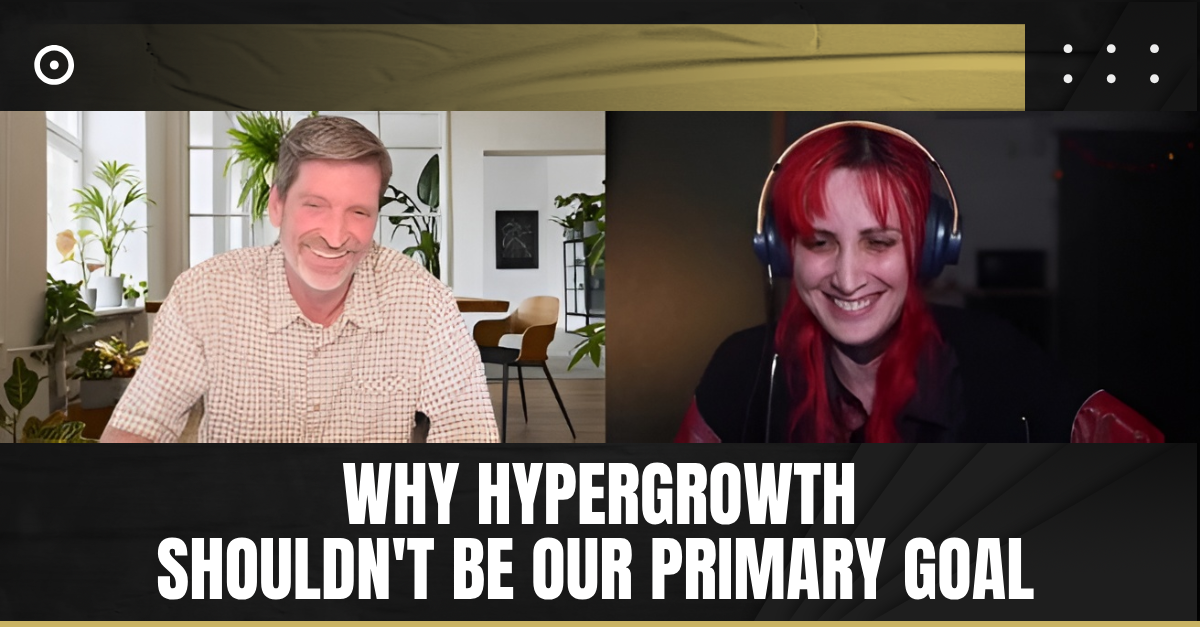
Luna Shirley, CRO at ROI Hunter, challenges the obsession with hypergrowth and its hidden costs. She shares industry data showing 73% of revenue stems from existing clients and explains why Net Revenue Retention (NRR) is critical. She also discusses how focusing on customer success and team wellbeing leads to sustainable profitability.
“We need to understand what lies behind sustainable growth. It is profitability and reasonable growth momentum. Profitability allows you to retain the freedom to make the right and necessary decisions, while reasonable growth momentum enables you to continue investing in your people and your clients.” – Luna Shirley
Luna uncovers that a people-first approach, AI readiness, and retention strategies can drive sustainable growth. With firsthand lessons from leading ROI Hunter through a turnaround, she delivers hard-earned insights CROs can use today.
Follow Luna Shirley on LinkedIn
Follow host Steve MacDonald on LinkedIn
[Transcript]
[00:00:05] Steve MacDonald: Welcome to the C-Suite Sales and Marketing Perspectives podcast. I’m Steve MacDonald, your host, and today we have a very special guest, a very important topic—maybe even a contrarian point of view—on why hypergrowth shouldn’t be our primary goal. And to talk about that, we have on Luna Shirley. Now Luna, you’re the current CRO at ROI Hunter.
[00:00:28] Steve MacDonald: You’ve been a CRO multiple times. You’ve been a CEO, you’ve been a CMO. You’ve got a very, very broad perspective from the C-suite on how to create long-term sustainable growth inside of B2B businesses. So I want to tap into that today in a big way. But I found it interesting because you love to immerse yourself in subcultures and you live in different places.
[00:00:53] Steve MacDonald: In fact, I think you’re living in Japan right now, if I’m correct. Maybe before we get started, expand a little bit more on your background, and then we’ll dig in.
[00:01:03] Luna Shirley: Absolutely, Steve, thank you for the introduction. Hi, everybody that is listening. I’m Luna Shirley, and I generally think about myself as a senior manager in MarTech with experience growing Series A and Series B such businesses.
[00:01:17] Luna Shirley: That is generally my bread and butter. And during my career, I’ve been on both the client side—mostly, in my case, those were online retailers and agencies—but mostly have been on the side of a tech vendor. Now I am working as a CRO for a very wonderful company called ROI Hunter, as Steve already said. The company is headquartered in Brno, Czech Republic, and currently it influences almost two and a half percent of global e-commerce through product performance management, which basically helps marketers to understand their campaign performance on an individual product level.
[00:01:59] Luna Shirley: And I definitely, 100%, enjoy creating an environment that helps businesses to achieve sustainable growth. And also, I do live in Japan, yes.
[00:02:16] Steve MacDonald: Let’s do this. I want to start exploring this contrarian point of view of yours, right? Why hypergrowth shouldn’t be our primary goal. And to get us started, first I’d love to know what your definition is of sustainable business growth and how you think about that.
[00:02:33] Luna Shirley: Got it.
[00:02:33] Luna Shirley: That’s a very good question. But let me pedal back a bit about the hypergrowth, because I think that it’s very important to go on that a bit. Because hypergrowth was the name of the game for many years, and for a lot of businesses, it still is the case—even now, when a lot of things changed in the business.
[00:02:55] Luna Shirley: But I would say that even though it really pushed businesses to excel and some thrived, there were many that really struggled—still struggle—and were built on very bad and shaky foundations and failed. And what’s even worse, it burned out a lot of people in this business. I don’t know anybody in tech that’s been in tech for five years that has not had an episode of burnout.
[00:03:24] Luna Shirley: I wonder, as part of the management of businesses, it is our responsibility to take care of our people. It’s not just our responsibility to take care of the business’s bottom line. It’s about the people, because those people will stay in tech. They will remember us. We need to do right by them as well as right by shareholders.
[00:03:45] Luna Shirley: But I think we need to have a really balanced approach. And for me, that balanced approach is about sustainable growth.
[00:03:55] Steve MacDonald: Now what’s really interesting—because you just focused very heavily on the importance of the people, right? We do a lot to create high-performance teams, right? VCs, private equity companies—they invest in the team first, the idea second, right?
[00:04:10] Steve MacDonald: And I’ve done probably 20 different podcasts on the importance of company culture for attracting and retaining the right talent—to make sure that you have those high-performance teams. So if we burn those teams out, we are defeating the very foundation for how we create growth within our business.
[00:04:31] Steve MacDonald: That’s my takeaway from what you were just saying. Is that a good takeaway?
[00:04:35] Luna Shirley: Exactly. It is a wonderful takeaway because if we are really burning those people out, we are defeating the purpose of why we are building those high-performing teams. What are we left with? We are left with burned-out people that have trouble even waking up every single day and trying to deliver business. And there is a limited number and limited amount of people.
[00:04:56] Luna Shirley: And that is something that we have to really consider. What is that long-term perspective?
[00:05:04] Steve MacDonald: There’s a number of different perspectives that you have that kind of come into this long-term sustainable growth, and one of them also was the trajectory that we are all on with AI and technology.
[00:05:19] Steve MacDonald: We all know it’s disruptive. We all know it’s here to stay. We all know it’s one of these things that’s not going away. But what’s your point of view on our adoption of AI and our competitive advantages in adopting that and moving forward?
[00:05:39] Luna Shirley: Another very good question, and I think that it is really quite challenging—and probably anyone that’s in tech feels that AI disruption is there firsthand. And for us, even though I wouldn’t say that everything really went according to plan, I believe that we were quite lucky. I’m talking about ROI Hunter specifically.
[00:06:03] Luna Shirley: We, as a business, have been really investing a lot into cultivating domain knowledge within the business to really ensure a high level of mutual trust with our customers. And really, a huge shoutout goes—especially to our product and customer success team—who are incredibly and extremely knowledgeable.
[00:06:26] Luna Shirley: Talking about customer success—since we have generally mid to large-size deals, we can invest into strong customer success teams. And we do. We really do. It’s by far the biggest single commercial team that we have in ROI Hunter. And that is important. And I’m finally getting slowly to the point that I wanted to make.
[00:06:50] Luna Shirley: Especially now, in a crowded market very much disrupted with AI, it is incredibly challenging to really know what you
should invest in—what will help you, what will help you grow. But I digress. And we may talk about customer success a bit more later. But to answer your question—and I believe the question was, how can businesses really achieve that sustainability, even if they are disrupted by AI? My answer would be to focus heavily on enabling the environment for one of my most favorite business metrics, and that is net revenue retention and its growth. Provide value to customers that already know and trust you, and they know that you’re worth paying for. So if you come up with something new—something that makes their life easier, helps them to achieve targets—and they know that you are there to always support them, they will invest in you. And for me personally, that is the recipe for success in this current environment. Focus on how to make your current customers that already know you, that trust you, successful. Invest into them. Because if you do, they will invest back into you.
[00:08:07] Steve MacDonald: So, you brought up a subtopic in there that I want to dive into a little bit—NRR, right? Because most companies, and particularly CROs that have a quota over our head, are held to very short-term accountability. And NRR is driven by net retention of existing clients—not going after new logos, yeah—but growing and expanding, upsell, cross-sell, existing clients. And I think it was Forrester that came out a couple of years ago with a study that showed that 73% of revenue actually comes from our existing clients. Absolutely underscores the importance of why you brought up NRR. But I have to just ask you, right? Because most CROs don’t focus on NRR—even though you are a Chief Revenue Officer. So revenue should come from the easiest place we get it, right? We should be chasing down growth that we can scale most efficiently—and it comes from our existing clients, right?
But you’re still—you go into board meetings—and I know everybody right at the beginning is like, “How’s this quarter going, Luna? What’s next quarter looking like?” Right? The focus is always very short-term. But growing our client’s business over the long term—I think this goes right back to your point of view. It’s not about hypergrowth, it’s about long-term sustainable growth. That is an enlightened CRO perspective, from my humble opinion, talking to a lot of CROs.
[00:09:37] Luna Shirley: Thank you for saying so. And I think that my perspective comes from a background that generally—and typically, and please correct me if I’m wrong here—but I see that most CROs come from a directly sales background. So it comes naturally to them to focus on sales—new revenue, new logos. I come from, initially, a marketing background, and then I’ve pivoted slowly toward revenue operations, more business intelligence—and it happened that I naturally became a CRO. So for me, I try to upkeep that balanced point of view. Because for me, MRR at the end of the day is really connected and composed of various elements—new revenue, and revenue coming from existing customers—and then potentially from other sources like subsidies. But I would really go in-depth.
So, for example, when asked in a board meeting, “Okay, how is next quarter looking like? When are we going to end?” Yes, I’m talking about new revenue, what we had in the pipeline, how is that looking. But I also make a point to say, “Okay, looking into our current customer base, what are the opportunities that we have there for overages? For upsells? What are massive, major renewals upcoming?” Because if we start looking at the whole picture, then—I don’t know what we are doing here as C-levels, I would say.
[00:11:06] Steve MacDonald: You mentioned something when we were talking before, and it really stuck with me. You said that if we don’t adopt AI, back to the AI part of the conversation, then we become irrelevant. You’ve risen AI to the stature, right? As a business growth engine that if we’re not adopting it, then..
[00:11:28] Luna Shirley: We die.
[00:11:30] Steve MacDonald: Explain your thinking.
[00:11:32] Luna Shirley: Okay. I see it from various different points. When it comes to our business—our business, since it’s in MarTech—we’ve been disrupted by AI a lot, like from a product perspective. Whenever we sell ROI Hunter out there, we are always asked, “Okay, so what’s your AI play?” Okay, so that’s one thing. That’s one disruption coming up. Do we have it? Is it strong? Our revenue would have to show that. And then also, I do see it on the side of our commercial teams—when it comes to sales as well as customer success. For sales, what I’ve been really seeing a lot—especially as AI was hyping up, and still is hyping up—time to close deals is getting incredibly long. Like I know that when we have been looking at our time to close back here about a year ago, it was roughly 90 days—80-something days. Now it’s about 120 days. It’s been growing. There are a lot of caveats there. It’s taking a lot of time for customers and clients to say, “Okay, I want to go with you.” Because they are uncertain. Should we invest into you as a business if things may change in the next two months? Should we sign that yearly contract if things may be very different down the line?
So AI is disrupting this as well, not directly, but indirectly. So how do we reflect that? When it comes to sales—and I’m just getting right down into sales, I’m like, okay, fine. So my sales team needs to then, in order to get through these barriers and increasing time-to-close metrics, it means that we need to generate a much higher pipeline.
[00:13:26] Luna Shirley: In order to hit those targets, we need to deliver more with the same—or potentially even with less—which means that, if I want it or not, I need to start adopting AI tools. I need to start adopting tools that help my team be more efficient. Because if I don’t, the market situation will get us to a stage where doing things as we are doing them will make it so inefficient that—I would have to fire my sales team. Not because they are bad, but because they have not adapted to the current situation in the market. So what I’m actually implementing from next quarter is that, in my sales team specifically, every single person will have a six-week-long experiment and trial of their choice. They will say, “Okay, I want to try a new tool. I want to try a new narrative. I want to try something new.” Every single person will have one thing. And for every six weeks, we’ll be testing it. Then at the end, we’ll see: “Okay, this has helped that specific sales rep, so other people can start
implementing it into their processes.” Something else did not work? Okay, we are dropping it. And by making sure that we are really trying to adopt and keep up with the incredibly fast situation in the market, then I do strongly believe that we are able to get to very high efficiency. And I’m able to cultivate a team that will be world-class. And those people—if they stay in ROI Hunter, I’m super happy. If they leave ROI Hunter, I know that the company that acquired that person will be super glad that they have somebody like that aboard.
[00:15:19] Steve MacDonald: I kept thinking, as you were talking there, about—there’s that magic triangle of time, cost, and money. And especially in B2B, especially SaaS products and technology, we throw around “efficiencies” like no one can believe. And it almost gets to be that kind of like, “Yeah, you make us more efficient,” right? But efficiency leads directly to doing things at a lower cost and higher quality, right? When we give people back time, they do things more proactively. It’s not about just making processes more efficient—and that’s what you’re talking about. Like, world-class. You don’t get to be world-class because you’re more efficient. You get to be world-class because you have the time to be proactive.
[00:16:06] Luna Shirley: Exactly. Exactly. I can’t say enough that you’re absolutely correct. And it’s a term—“technicals,” as I say—that I really want my people to focus on. I call it “unique human value,” something that comes from them, that is unique to them, unique to the people. That’s something irreplaceable—at least now—by AI. It’s like, we can automate a lot of things—really, tons of things. But I want to ensure that what
makes those people unique, what they bring to the table—they have time to exhibit it. I don’t want them to be automatons. I want them to be really thinking people that are bringing unique things to the table. And then it’s my role—and the role of the other people in the business—to create an environment for them to ensure that they are able to perform at their best, at their human best.
[00:17:02] Steve MacDonald: Absolutely. Oh, I know where this is going. So there’s a whole other category with a massive competitive advantage that companies say they’re taking advantage of, but aren’t. And I want to talk about customer experience. And just to set this up, there was a study that was done a couple of years ago by McKinsey, and they looked at over 400 companies that were B2C and B2B, that were highly profitable, largest shareholder return on value—and the number one differentiator across all of those companies was CX, was customer experience, right?
And we think about it in this day and age—like, the kind of bastions of competitive advantage that we relied on and differentiations—our product and our price, right? And then we’ve put service in there, because product’s been harder and harder to differentiate. And service is so important because it creates experience. It’s part of that customer experience. What I want to know is: How important, in your model of long-term sustainable growth versus hypergrowth, where does customer experience come into that? How do you weave it in?
[00:18:15] Luna Shirley: Okay, that’s another huge topic and—okay, to make it a bit manageable, I will focus only on its very most commercial aspect. So I won’t be talking about product because that’s probably when I would have to invite a colleague here. From the commercial perspective, I think that I have already mentioned a bit that we are investing a lot in customer success teams. And for me, that is a team that is pretty much a partner of our customers. It is not just a customer success manager that you meet once a quarter—they ask, “Is everything okay? Fine. Are you going to renew? Yeah? Okay.”—and they are gone. No way in hell. Not for sustainable growth.
[00:19:05] Luna Shirley: Customer success is really paramount because they are the ones that are there to really help clients—to give them confidence, to really know how to be successful. Because they have the benefit of working with multiple other customers. We, in a business, are sharing the best practices of various businesses, so we know how to make sure that people who are working with us really know how to succeed. So in general, that is something where we are able to give them trust. We are able to give them confidence—because it is very difficult to be confident in a market that is always changing. And we have that benefit, to really know that, and we are helping them. And we are helping to guide them. So I think that, in my opinion, this is incredibly important because that is building a common trust between us and the client. And that goes back also to what we are seeing a lot—that our current customers are referring other businesses to us. We get a lot of referrals actually coming from our current customers because they know that we are able to deliver them very good service, very good platform. We are there to help. We see that actually happening. So for me, customer experience is a growth strategy.
[00:20:38] Steve MacDonald: Let me tell you what my takeaway is from what you’re saying here, okay? There’s the Gartner Trusted Advisor model for salespeople—and that, going back to your NRR focus and working with your customers, that’s a huge area. Experience covers the entire gamut. So the sales team is sometimes some of the very first touch points of an actual human with a company, right? And creating that experience. So here’s my question. Sales teams, customer success teams—we can get very narrowly focused: “This is how we help you,” and this is very important, right?
Because this directly ties into your challenges—but your challenges aren’t this wide. Your challenges as a buyer are this wide. And we tend to focus insularly, because we become thought leaders in our own product, our own service, our own tech. How important is it to be that advisory role, but to truly understand where they’re coming from—right? Versus just talking about what we do all the time?
[00:21:47] Luna Shirley: So I remember about a year and a half ago—I think it was a year and a half ago—when our CEO came and was like, “Okay, we need to hire people with domain experience. We can’t hire people that don’t have that.” And the reason behind that was— and I admit, I was a bit struggling with that, because that meant that the hiring pool of people I needed was much, much smaller. And time to hire took some time. But I think that ultimately it was a very good choice. Because generally, if we hire people with broader insight—who were working with some of our customers—they know that broader scope. They can get the environment of those customers. If they are acting as sales representatives, customer success managers, even sitting in product—they get it. They get it. And for sales, for example, they are not just having a discovery call, asking two qualification questions. No. They really are able to vibe with those potential prospects. They’re able to really get to the core of their challenges—and it’s instant connection. I love it. And that is why I do believe that it’s very important. Since we’ve learned that, we are trying to figure out a way how to cultivate that within our business more and more—and hopefully, we’ll become better than we currently are. But yeah. That’s my take on this.
[00:23:26] Steve MacDonald: So you have so many interesting takes. I’m gonna ask you a question that I don’t ask in most podcasts, just because I’m curious.
[00:23:33] Luna Shirley: Should I be worried?
[00:23:34] Steve MacDonald: No, no worries. No worries. Our goal is to have fun here, so we’re gonna have fun with this question.
[00:23:39] Steve MacDonald: Okay. All right. So here’s the question: With everything you’ve been able to accomplish in all of your roles, what are you the most proud of in your career?
[00:23:49] Luna Shirley: That is an incredibly tough question. I think the thing I’m most proud of is that I’ve been able to work with some of the best people in business. And actually, it was at ROI Hunter, back in the day when I first joined the company. The company was really bleeding a lot of cash. It was in a position where it hadn’t managed to hypergrow. It got investment, it tried to invest, but it didn’t have firm foundations. And back several years ago—like five, six, seven years—you know how it was. Companies got money, tried to really hypergrow, and the sales didn’t work out. Yeah. And we were in a position where we were handed a company that we needed to switch into a sustainable growth model—and we did it. We did it. Within a few months, we turned a company that was bleeding cash into a beta-positive business that was steadily growing. And we were able to do something that I’m incredibly proud of: we were able to secure the jobs and livelihoods of the employees of the business. That is something that I’m most proud of. And that is why sustainable growth means so much to me—because it’s about the people at the end of the day.
[00:25:24] Steve MacDonald: People—and setting the foundations for that growth that weren’t necessarily there, that you put into place. That’s amazing.
[00:25:30] Steve MacDonald: So here’s my last question. We’ve just covered so much territory on this episode. If there was one takeaway that you wanted the C-suite audience and other B2B companies to have from this podcast, what would that single takeaway be?
[00:25:51] Luna Shirley: Okay. I think that for me, it is to realize what is behind sustainable growth. For me, it is the mature middle path of fast businesses. It is about profitability and reasonable growth momentum.
Profitability to retain freedom—to do the right and necessary decisions—and reasonable growth momentum to keep on investing more into your people and your clients.
[00:26:23] Steve MacDonald: I love it. Most people go on for about five minutes when I ask them the single most important thing.
[00:26:33] Steve MacDonald: I wish we had a couple more hours because this is fun, this is important. But I do know people are going to have additional questions. Would it be appropriate if I gave out a link to your LinkedIn profile so people could reach out to you?
[00:26:45] Luna Shirley: Absolutely. Absolutely. Absolutely.
[00:26:48] Steve MacDonald: Thank you. The mission of this podcast is to take unique, contrarian, different perspectives from C-suite individuals and B2B companies all over the world—share it with all of us in our peer community so we can think differently. We can take those different perspectives and apply them to our business and hopefully create that long-term sustainable growth. You did that in a big way today. Thank you very much.
[00:27:14] Luna Shirley: Thank you, Steve, for having me. Hopefully it was fun even for you—it was fun for me.