

Episode #264:
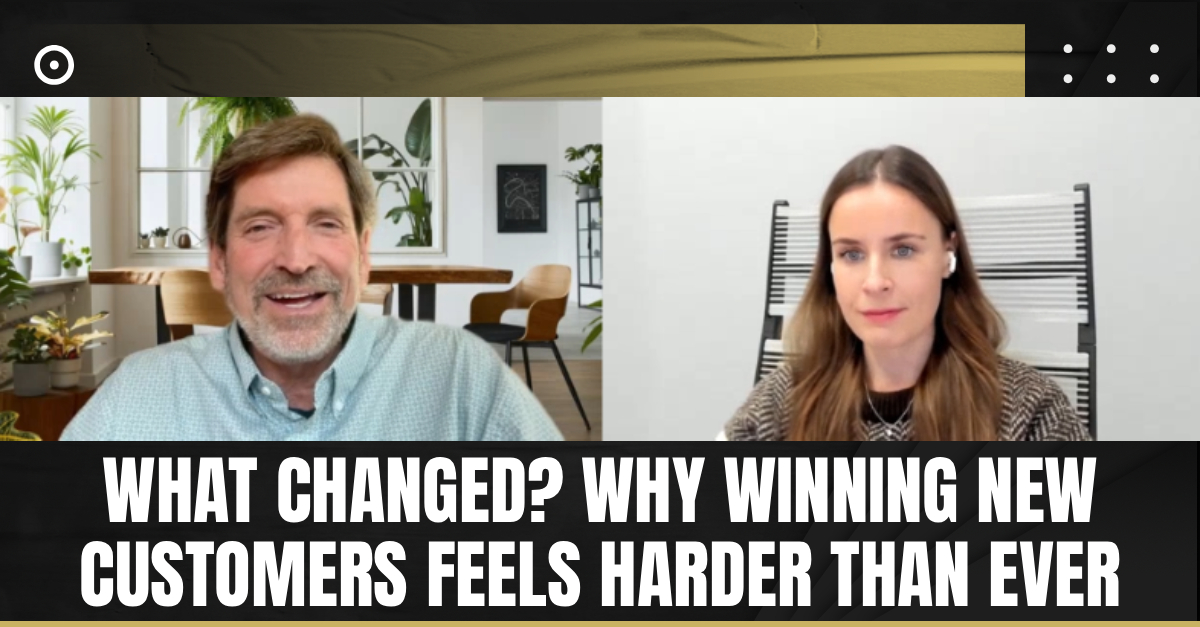
Tetiana Gorbunova, Chief Sales Officer at Jooble, introduces her sales leadership journey across multiple roles and transformations. She shares how leading more than 40 sales professionals requires focus, structure, and a clear team direction. She explains what it takes to operate across six countries while staying consistent in execution. She sets up the episode focus on what is changing in B2B sales and how leaders should respond.
“Today, the level of certainty is gone. Instead of building rigid, linear plans, we now have to plan aggressively, but with built-in flexibility and lots of chip points and metrics because, as a C-level, it’s our core responsibility to operate in uncertainty.” – Tetiana Gorbunova
Tetiana highlights how volatility, attention overload, and faster buying shifts are changing how teams win new customers. She recommends building flexible plans with clear checkpoints, running short tests to learn fast, and using real customer dialogue to stay relevant. She also explains why ICP clarity and saying no protect focus, delivery, and revenue.
Follow Tetiana Gorbunova on LinkedIn
Follow Steve MacDonald on LinkedIn
[Transcript]
[00:00:05] Steve MacDonald: Welcome everyone to the C-Suite Sales and Marketing Perspectives Podcast. I’m Steve MacDonald, your host, and today we’ve got a really interesting guest and conversation. We are going to be talking about why winning new customers feels harder than ever. What has changed and why, and how do we need to adapt to that?
[00:00:21] Steve MacDonald: And to do that, we have Chief Sales Officer, Tetiana Gorbunova. Now, Tetiana, you oversee a team of 40 different salespeople. I think you said you operate in 66 different companies or countries. You speak Dutch, you have a Japanese dog, you have a very international lifestyle and flavor here. What I would love to do is hear a little bit more about you and your background before we get started.
[00:00:50] Tetiana Gorbunova: Yeah, hi Steve. Happy to be here today. Thank you for the invitation. I’m excited about today’s topic, and I’m happy to give a short introduction about myself.
[00:01:03] Tetiana Gorbunova: I have quite a lot of experience in sales. In December of the previous year, it was about 14 years that I have been in sales, and more than 10 years in leadership positions. I have had different roles in sales. There were lots of different transformations inside the company and across the whole sales department that I have led.
[00:01:25] Tetiana Gorbunova: And as you already mentioned, now I have more than forty people in the sales department, and we operate in six countries. It’s not easy, for sure, but I think it has been a long journey, and I’m very happy where we are today as a team because we can maintain our customers and make them much more successful. But today we are going to discuss what’s going on in B2B sales, where everything is going, and how to deal with that.
[00:02:01] Steve MacDonald: Well, let’s start out with, there’s a lot to deal with there. The first thing is that we are living in a time of more economic volatility and uncertainty. Yet we still have to plan, we still have to forecast, not only for ourselves, but we have to do that for our clients in order to serve them. How does that impact you as a Chief Sales Officer when you’re looking at growing the business? How do you deal with that volatility?
[00:02:28] Tetiana Gorbunova: That’s a really great question. You know, Steve, if I compare how we planned even five to seven years ago versus today, the difference is dramatic.
[00:02:41] Tetiana Gorbunova: Back then, forecasting one or two years ahead was quite realistic. You could model economic trends, understand the situation of the market, understand the dynamics, and make fairly stable assumptions about how your industry would evolve. But today, the level of certainty is gone. We operate in a world where both the global economy and individual industries are changing at an unprecedented speed. Microeconomic shifts, geopolitical tensions, technological breakthroughs, and new business models can reshape entire markets in a week, and that affects every single business, regardless of the sector.
[00:03:27] Tetiana Gorbunova: So, sure, long-term planning hasn’t disappeared. It’s still important and it should be. But its nature has changed. Instead of building rigid, linear plans, we now have to plan aggressively, but with built-in flexibility and lots of check points and metrics, because as C-level, it is actually our core responsibility to operate in uncertainty. I really love the idea of seeing the elephant in a fog. That means understanding where the industry is likely heading, even if the path isn’t clear, and preparing the whole organization for that direction.
[00:04:10] Tetiana Gorbunova: So, for me personally, long-term growth planning today is less about precise predictions and more about building resilience, adaptability, and strategic optionality. We have to ask, what is our plan, and how fast can we adjust if the plan breaks? And ironically, that is what makes sustainable growth possible in these volatile times.
[00:04:39] Steve MacDonald: You know, listening to you there, and tell me if this is a takeaway that I should be taking away or not. To adapt to constant change and constant volatility in the market, where you say things can change, new technologies, AI, adaptations of AI, all kinds of things on a daily and weekly basis can change.
[00:04:59] Steve MacDonald: What that means for me is, we all have to spend a lot more of our time in the market and looking at what’s going on, and how our customers are adapting to it, how it’s impacting their needs, their challenges, what they’re seeing, how they’re adapting to it. Like we have got to do a lot more research than we have ever had. That’s kind of my takeaway from what you’re saying there.
[00:05:23] Tetiana Gorbunova: Yes, sure. You know, from one point of view, it is more research. But at the same time, you have to realize that research is super important, but you’ll never have enough data to make some decisions. Never. It will never happen. And that is a big mistake, and I see, frankly speaking, on a regular basis, how different people, teams, and companies make this mistake. Unfortunately, they look for all the data just to be sure they are going in the right direction. But now, when everything changes so fast, it’s important to move fast and to work as a startup, even if you are a super big corporation.
[00:06:07] Tetiana Gorbunova: So that is why, for sure, it’s important to cover risk and to see what’s going on in the market. But at the same time, it’s better to go and run a super short test, get real data, and then understand, “Okay, this hypothesis was wrong. Okay. Okay. But now we have real data. We have some experience. So now we will go in the other direction,” and make more microsteps, instead of collecting, collecting, collecting data, and then using it to make a great forecast that will not work because everything will change in a week.
[00:06:45] Steve MacDonald: So, you know, we live in a world where we have more data than we have ever had before. I mean, we are drowning in data, and I just wanted to ask, how important is it to take that hard data and the tests and the things that you’re talking about, but balance it with the conversations that you’re having with customers, the conversations you’re having with prospects, the things that are going on in the industry, and the conferences and the experts and the analysts? I mean, that’s a whole new level of information that is constantly being updated, constantly changing.
[00:07:22] Steve MacDonald: How important is it to balance the data with what’s going on in the industry too, you know, this volatility? When I said research, I was almost just thinking about how we need to be really good students of our markets, our customers, our prospects, and how they’re thinking and what they’re doing at a level that we have never had before. Because when you started, it was all about product and price. If we had the better product and we had the better price, we had a sales story and we could close deals, and it’s just not that way anymore.
[00:07:58] Steve MacDonald: So, I’m just wondering how the amount of data, the amount of volatility, and the need to be in tune with the market has changed. And how do salespeople, when you’re talking to your 40 plus people on your team, how are you overseeing them and telling them how they have to be in touch with the market and up to speed with the market, and how important that is?
[00:08:27] Tetiana Gorbunova: Yeah, that’s a good question. You know, for sure we work with lots of data because we collect data from lots of customers across lots of different countries. We also see what’s going on in the market, but at the same time, we have to understand that, okay, we have some data, but it’s already historical data. And for sure, it can be that we just don’t have one more piece of the puzzle that our customer has. So, it means that, for example, our customer can see the situation from another perspective. So, that’s why it’s always a dialogue.
[00:09:04] Tetiana Gorbunova: So, we always say that, for example, you see, we have this historical data. That’s why we give you this piece of advice. We see that this way will work better just for you. And for sure, we are always open to hear what is the voice of the customer because it can be that, for example, since we work in the job industry, and it’s very dynamic, it depends not only country by country, but also by job segment. And that’s why, for sure, we don’t always know what’s going on in some industries, in some countries where we do not have dozens of customers.
[00:09:41] Tetiana Gorbunova: And it can be that sometimes our customers can also be a source of truth for us. And that’s why we are always open to hear the voice of our customers. It’s super important to understand that, okay, one customer tells us today that the situation is not as we thought it was, taking into account our data. And it also means that we should be ready to change our approaches, to be open to other points of view. And it’s really highly important.
[00:10:12] Steve MacDonald: You know, it’s interesting, you talk about the voice of the customer. McKinsey came out with a study a couple of years ago, and they said less than 15 percent of respondents in their study said that they consistently incorporate customer input into their decisions. And less than 23 percent say that they regularly engage with their customers to ensure that their offerings deliver real value, and they called this the great disconnect.
[00:10:36] Tetiana Gorbunova: Yeah, you know, it can be for sure. It depends because we have customers we have worked with for years, like more than seven years we have worked together. And sure, we understand that customers always have their goals. They would like to make lots of optimizations, to cut costs, et cetera, and to get the best performance ever from all vendors. And we also understand it.
[00:11:03] Tetiana Gorbunova: Sometimes, for sure, it can be that, for example, we have to work more like advisors, or as a guide, just to let our customers know that you see the situation looks like this. And we cannot compare, for example, the situation that we have today with the situation we had one year ago. For example, if we are talking about prices, budgets, or something else. Sometimes we even understand that customers also understand that. And here we go into discussions. Sometimes we just have to highlight that we see what’s going on because we have lots of data. And that’s why, for example, we cannot go in some directions or change some sets of campaigns, et cetera. So, it depends on the situation and on the customer.
[00:11:52] Tetiana Gorbunova: But anyway, for sure, we conduct annual surveys. We ask our customers not only about how happy they are with performance and our service, but also about what they think about the market. Who they see as the best players in our industry, because it’s also important for us to hear and to see from another perspective. What do they see?
[00:12:18] Tetiana Gorbunova: And we also take into account what type of customers give us these answers because it’s also important. Some big customers can have information about one segment, and smaller customers can have information about other segments. And it also means that the truth is always somewhere in the middle.
[00:12:42] Steve MacDonald: You know, it’s interesting. The whole conversation has been about how so much is happening, so much data is out there, so much to learn from the customer, and so much is constantly changing. We have to be flexible. That is the exact same environment that we live in, that our prospects and our customers live in. They’re dealing with the same thing.
[00:13:01] Steve MacDonald: So, here’s the question. How do we stand out? They’re overwhelmed, right? They have more data. They have more access through AI and research and information. They can check us out. They can check our competitors out. They can see the trends in the industry. How do we stand out in that environment where they’re feeling the same way we are, just from their point of view?
[00:13:26] Tetiana Gorbunova: Yeah. You mean like how to drag attention in this environment. That’s a good point. You know, I’m starting from a super simple example from my own life, and I see your life as a regular person with an email inbox and phone. Every single day, we receive dozens of messages, newsletters, webinars, discounts, et cetera, et cetera, et cetera. Even with all these super smart filters we have in email inboxes and messengers, like separating personal emails from this mass outreach, it doesn’t really solve the problem. I mean that mass outreach is getting smarter too. And what does that lead to. Even if I’m actually waiting for some super important message, it can easily get lost in all this noise. And that’s exactly what’s happening with the customers.
[00:14:17] Tetiana Gorbunova: When companies send even perfectly crafted messages, like personalized, visually appealing, with a super great presentation, with all pain points covered, still the recipient may never see it. Not because the message is bad, but because attention has become the crisis resource today. So, the challenge today is no longer just what you say, but where you say it, when you say it, and how. All of this forces companies to be much more intentional about customer communication and to check maybe four key points.
[00:14:57] Tetiana Gorbunova: First of all, what channels to use for your specific customers. How often do you contact your customer, just to be sure that you don’t do it five times per day, and also to check that customers do not feel overwhelmed with too many messages. And the most important point is to check that your message actually delivers value. That is the most important part.
[00:15:22] Tetiana Gorbunova: That’s why knowing your ICP becomes critical, to have a very deep understanding of what really hurts your customer and what success looks like for your customer. Why your specific solution or service will help them become better, more successful, and more profitable. To sum up, you just have to check that your message clearly answers, “Why should I care about this right now?” And if there is no answer for that, it will just disappear in all this noise I mentioned before.
[00:15:58] Steve Macdonald: You know, you drew a really clear picture there in creating value by understanding the true challenges and problems of our customers. It sounds so basic, right. But if I look at my own email inbox, I get all kinds of emails from McKinsey, Deloitte, Forrester, Gartner, like all the big consulting firms, and Forbes, and everything. The vast majority of them are white noise because they’re talking about many different subjects, conclusions, or insights across a broad spectrum of the industry. When they talk about something I really care about, then it stands out. And it almost feels like they’re talking directly to me.
[00:16:45] Steve Macdonald: I’m very big in ABM, account-based marketing, go-to-market strategy, and focus. So, when they’re talking about that, I listen, I stop, I open, I click. It’s almost like what I took away from what you’re saying is that the way we stand out is by being really valuable and important to a very specific subset of the entire market, the people we truly want to influence.
[00:17:10] Steve Macdonald: Let’s be good at creating value for that very tight focus. I can’t tell you how many CMOs, CROs, CSOs, and CEOs tell me, “We don’t have a good definition of our ICP.” Again, back to a very basic point. If we know exactly who we are trying to address and close deals with, then we have a much better path to be relevant to them and understand their challenges. We can avoid wasting time on irrelevant research and instead focus where it matters most.
[00:17:48] Steve Macdonald: So, when you were talking about how to create value for those people, it seems so basic, but it’s so important. It’s so important. What are your thoughts.
[00:18:06] Tetiana Gorbunova: Yes, Steve. I absolutely agree. You mentioned a very important point about being selective. It’s also important for companies to understand that their service and product are designed for a very specific segment, and that they do it really well. We conduct custom development research, internal interviews, collect data, and go deep into understanding the real problems of these companies and people, especially since we are talking about the B2B segment. This approach is much better than saying that your solution is for everyone.
[00:18:48] Tetiana Gorbunova: I’m sure you know many examples across industries where big companies tried to expand into too many segments, including luxury, premium, and mass markets, and it was not successful. Why. Because they believed they could work with everyone.
[00:19:15] Tetiana Gorbunova: For B2B companies, it’s the same. You have to understand exactly who your product is for, and then focus on serving that segment well. When you have that clarity, your communication via emails or other channels becomes much more relevant. You can truly address the real pain points of those companies. And then people will open your message because it reflects their real challenges. Otherwise, they will ignore it and send it to the spam folder.
[00:20:00] Steve MacDonald: So, I have to ask you this question because this idea of being selective, I know across your team you have deals that are coming to you all the time that you’re looking at, and you’re saying, “That’s not our customer.” So, the power of the word “no,” balanced with the fact that I also know you have very intense short term quotas, right? Like, I’m sure you go into board meetings and everybody’s like, “Well, how’s this quarter doing? What does next quarter look like?” It’s almost like all they care about, right? So, it’s hard to say no. But tell me, what is the power, in your mind as a Chief Sales Officer, of saying no to the wrong deals? Why would you do that?
[00:20:48] Tetiana Gorbunova: Yeah. Steve, I just had the same situation a couple of days ago because I also joined one of our meetings, and I heard that we now have several potential customers, and the potential revenue is super small. Then there are lots of things this customer would like to receive from us. I understood that it would be a super hard, super complex customer, and I’m not sure that we would deliver value. Starting from this point, I understood that we had to stop and be honest, first of all inside our team, and then tell the customer, “Sorry. Now, we can stop everything because we understand that we just can’t deliver. We can work on a free basis. You can receive candidates from us. That’s okay. But we are not going to start a premium campaign because unfortunately, it can happen.”
[00:21:48] Tetiana Gorbunova: But on the other hand, fortunately, it’s important to say no at the right time, because if we don’t, then this customer will start working with us. He or she will be super unhappy because we can’t deliver value or we can’t deliver the service according to what this customer would like to receive. That’s why in a couple of months, we will get the situation where we will have to stop the campaign anyway, but we will have spent lots of time and focus from different teams on this customer, and I don’t like this situation.
[00:22:26] Tetiana Gorbunova: We even had a situation a couple of years ago when I made a policy about who we would not work with. Then I brought this idea to the board meeting, and I had several arguments explaining why we had to stop cooperation with current customers, and why we would not work anymore with the customers described in the policy.
[00:22:53] Tetiana Gorbunova: It was a really good decision because after that, I realized that my team had much more time to focus on the prospects, and that my customer success team could make everything possible to make these customers really successful and more profitable, and it really worked. After several years, I see that the revenue we lost then cannot even be compared with the time we now have to spend on the customers we want to have and work with. It just cannot be compared.
[00:23:30] Steve MacDonald: You know what I love about that is you could say, if we have a really good definition of the ICP, why do I need a policy that says these accounts are excluded? But it almost takes it to a whole other level. Without you having to be the bad guy all the time, and without your team coming to you and you saying, “No, that’s not right. You didn’t listen.” It’s just like, “No, look, there’s a reason why.” And you took it to the board, and it verifies and validates that the board wants fast returns. By taking it to the board and getting their agreement, what that validated for me was that the power of saying no is a revenue accelerator because it refocuses your entire team. It refocuses all the different departments. It stops all the waste and churn from bringing in the wrong customers.
[00:24:19] Steve MacDonald: So, whether it’s early stage deals, we’re working on the right deals, or whether it’s customer success, we’re able to increase our NRR, net recurring revenue, and reduce churn because we’re only bringing in the right people. So, it’s like supercharging the ICP and saying, “Not only is this our definition, but let’s go one step further. Here’s a policy of who exactly isn’t in our ICP.” I think that’s brilliant. That’s my number one takeaway from our conversation today.
[00:24:49] Steve MacDonald: I love it. I love it. You know, Tetiana, we’ve talked about so much. We haven’t even gotten into about half the conversation we wanted to cover, but I have to ask you, from your perspective as a Chief Sales Officer, and speaking to an audience of B2B C suite executives and ABM, account based marketing, go to market leaders, if there was one thing that you wanted them to take away from our conversation today, what would that be?
[00:25:16] Tetiana Gorbunova: You know, I think that nowadays, and taking into account everything we already discussed, everything moves very fast, like changes in the economy and industry, et cetera. I would like to emphasize that adaptability and openness to something new are the most important survival skills for companies and for everyone, for the whole C-level and for each employee, because now it is not just like nice-to-have skills. These skills are really important because there are two different types of changes. Super big changes that we can see, like changes in the economy and in industries. About such kinds of changes, we usually read in the news, in social media, et cetera.
[00:26:09] Tetiana Gorbunova: And at the same time, there are lots of these micro changes that are not so easy to see, but they happen almost every day in companies, like how we work in teams, some approaches, some cross-functional collaborations, et cetera. And that is why this ability to be flexible and to be open to learn, and learn, and relearn, is super highly important. And in case you do not have such people in the organization, it will be very hard to move fast and to adapt to everything that is going on in this super fast-changing world. I think that it is the most important.
[00:26:54] Tetiana Gorbunova: For example, in my company at Jooble, we have internal values. And for example, when we are searching for new people to join our organization, we have several interview steps, as I think almost every company has. But the last stage is a values interview. We just check if there will be a match between the candidate and the company. And one of these values is openness to new things, to learn something new, because we understand that it is important for us not only to be sure that this candidate will be good in this very role, but we also understand that maybe tomorrow the expectations can change a little bit. But in a year or in a couple of years, they can change significantly, and the situation in general can change really significantly.
[00:27:46] Tetiana Gorbunova: It means that this candidate will have to learn something new and learn something new almost every day because, for example, our product will change, our competitor will change something, et cetera. Even we can change the ICP, for example, and we will also have to learn lots of information about how these types of customers work and what their pains are, et cetera.
[00:28:09] Tetiana Gorbunova: So, that is why it is super important. And what I see is that there are still big corporate companies that just cannot move so fast because the mindset is a little bit different, because maybe it is from another generation of the corporate world. It gives me the answer why, for example, in some industries, we can see some company unicorns that just come into the market, and even within years, they have super great results, like millions or billions of revenue per year. And it is just because they can move fast. That is okay for them to work in this uncertainty. They feel great. They are open to go into something new because they are open to learning something, to testing something, and that is why it is important. So, that is why I think that this is really a survival skill for companies and for every employee.
[00:29:09] Steve MacDonald: Well, I have to tell you, I wish we had another couple of hours. But you know, the mission of this podcast is to bring together different insights, perspectives, and experiences from all over the world, from C-suite executives, on how we can have success in our ABM go-to-market motion. And I think that you were an amazing part of what I would call the rising tide of insights that we can all take away. I wrote down at least three different things that were new that I learned today, and I just wanted to say thank you for coming on and being a part of this today.
[00:29:42] Tetiana Gorbunova: Thank you, Steve. Thank you. From the beginning, it was also very interesting for me to think about these topics because, as we already mentioned several times today, every single test matters. And sometimes it is really important just to have a break and to make an overview, to discuss something, and to highlight what is important, to discuss the points that are on the top of our minds. So, thank you for this conversation. It was really great and interesting. I also made several notes for myself, so it was really useful for me. Thank you!