
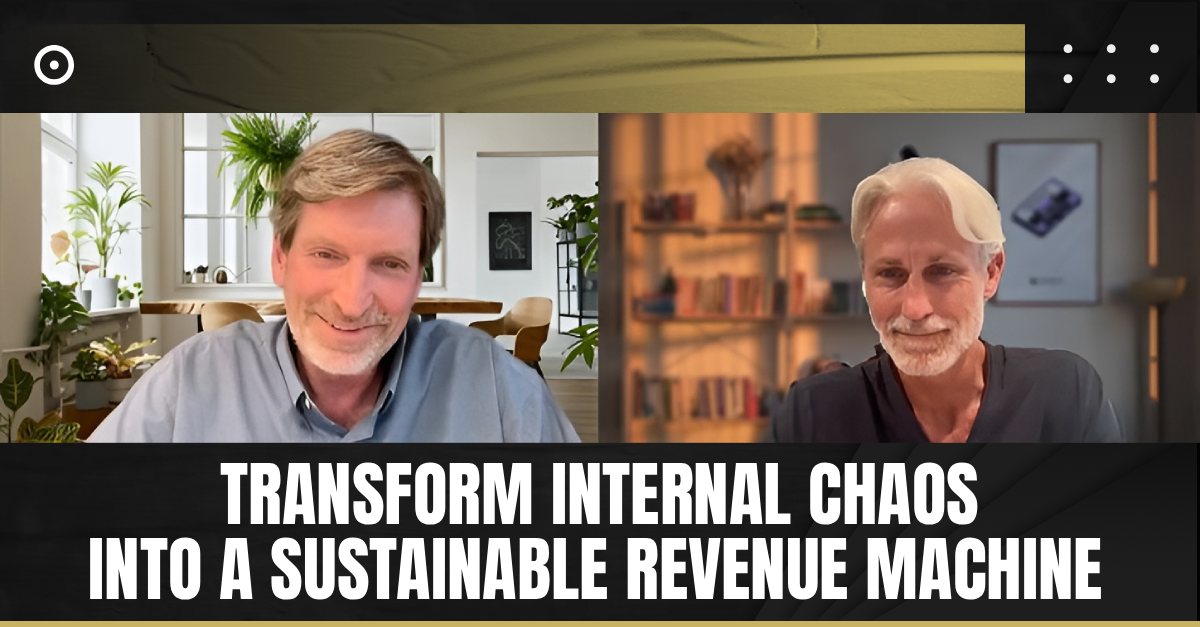


Episode #220:
Chris Green, Chief Revenue Officer at FreshRealm, explains why process beats outcome chasing in turbulent companies. He shows how accurate and timely communication aligns boards, founders, and teams. Chris connects customer conversations to sharper ICP focus and growth path choices. He closes by emphasizing that relationships are the true compounding asset.
“The key is accurate and timely communication of what’s happening, what you’re thinking, and what you’re going to do about it. Today, change is constant and happens at a rapid pace. So, communicate as often as we can and in a meaningful way. It’s the human element of turning a company into a revenue machine.” – Chris Green
Chris explains how to cut through chaos by setting precise rhythms, reporting what is happening and what will be done next, and creating space for future-focused customer conversations that sharpen ICP and roadmap choices. He shows leaders how to align boards and founders, rally teams around purpose and relationships, and sustain momentum through frequent, meaningful communication that builds trust and turns scattered effort into a consistent path to revenue across functions and in the face of changing market conditions today.
Follow Chris Green on LinkedIn
Follow host Steve MacDonald on LinkedIn
[Transcript]
[00:00:00] Steve MacDonald: Welcome everyone to the C-Suite Sales and Marketing Perspectives Podcast. I’m Steve MacDonald, your host. Today we have a very, very interesting guest we have on Chris Green. Now Chris, part of what makes you interesting is A, you’ve been able to survive being a CRO in four different organizations, and that in and of itself is a major accomplishment.
[00:00:22] Steve MacDonald: So congratulations there. On top of being a dad of four, married, avid runner, all these great things. But what we’re gonna talk about today is the battle you’ve gone through many times, and I think you and I talked about this before, there’s rarely a problem that comes up that you haven’t addressed, right?
[00:00:42] Steve MacDonald: And what we’re gonna talk today about is transforming internal chaos, misalignment internally within the organization, specifically at the C-suite. How do we transform that into sustainable revenue engine, right? That’s a big topic, so I hope you’re ready.
[00:01:00] Chris Green: We’ll see. We’ll find out, Steve, quickly.
[00:01:03] Steve MacDonald: Before we get started, I’d love to just have you explain a little bit more about your background please.
[00:01:09] Chris Green: Sure. I decided to go down an entrepreneurial path. I made that decision, I guess as any entrepreneur would say, about 22 years ago when my wife and I were first starting our family and she declared we are gonna stay in South Florida. So for me, the first problem I had to solve is how am I going to build a career in South Florida?
[00:01:29] Chris Green: And, you know, progress through, at that time, the corporate ladder, right? So that was the very first problem I probably started solving, and that took me down this path, like I said, starting 22 years ago at this point.
[00:01:39] Steve MacDonald: Well, that problem solving capability, let’s put that to work here.
[00:01:44] Steve MacDonald: The first thing I’m gonna do is, you know, there is such an atmosphere of hurry up but then go nowhere syndrome inside of most companies. And when we say hurry up and go nowhere, right? It’s not like we’re not people that are intelligent. We’ve progressed through our careers, we’ve had exits, right?
[00:02:06] Steve MacDonald: We’ve done amazing things. But part of that hurry up and go nowhere is we lots of times have different directions that we all think we should be going, and I’d love for you to kind of unpack that in a way, and then we’re gonna talk about potential solutions as well.
[00:02:21] Chris Green: Sure. So for me, when you talk about that, Steve, what I hear, what comes to mind is the founders I’ve been privileged enough to work with as well as the boards or PE firms that have backed those companies I have been a part of. And the reason that comes to mind is typically, I think that’s where a lot of people feel the pressures from, or hey, hurry up and get a result, or get an outcome, achieve an outcome.
[00:02:46] Chris Green: And for me, what I’ve learned or what I’ve taken away in my experiences is look, you have to have a process, and you have to celebrate the process, and you have to really understand what’s going on in the process because you can never control the outcome, right? And so my focus has always been, okay, how do I have a great process in place to be able to give ourselves the best chance to win essentially, right?
[00:03:06] Chris Green: And I take that back even to, you know, my youth where I was competitive in sports. And the coaches would always tell you, look, you can’t control the scoreboard, but you certainly can control what happens on every play, and how hard you play, and how well you execute whatever play they’re asking you to. And I think that same thing is true in every company I’ve been a part of. It’s like there’s gonna be challenges along the way. There’s going to be things that come up that are unexpected. I think the key is communication, accurate and timely communication, right?
[00:03:47] Chris Green: Of what’s happening, what are you thinking, and what are you gonna do about it? It’s one thing to tell me what’s happening. It’s another thing to tell me, hey, here’s what I’m thinking to do about it. So I think that’s bringing the solution to every problem as part of the process that I’ve found to be key.
[00:04:02] Chris Green: And then communicating that amongst your team, amongst your board, amongst your founder, whoever it may be. All of those things are part of it, Steve, for sure.
[00:04:12] Steve MacDonald: So complete agreement with what you’re saying here, right? Cause we live in an environment where it is always chaos, it’s always transforming.
[00:04:21] Steve MacDonald: Our ICP is always in flux and changing. There is an environment that is always changing. I’ve talked to so many C-suite executives, they’re like, the five-year plan’s a joke. We don’t even do these anymore, right? Like, who can tell what’s going on? So the thing though about identifying the problem, we can never stop doing that and articulating solutions.
[00:04:41] Steve MacDonald: It’s almost like there’s so many problems. We’re constantly problem solving and so many solutions, every department from everybody. We’re all smart people, right? We’ve risen up in our careers to the point where we don’t have to ask anybody, like we know this is what we need to do. But when everybody has that here’s what we need to do mentality.
[00:05:01] Steve MacDonald: We got a bunch of leaders with a bunch of different directions, right? How do we bring that together? And in fact, you and I talked about this, there’s a study that, you know, I’ve talked to so many C-suite executives and I asked them the question about what the greatest challenge to long-term sustainable growth is.
[00:05:19] Steve MacDonald: And they say internal alignment. So in this always problem solving, always having to have solutions, how do we stay in alignment?
[00:05:29] Chris Green: Look, you bring up a huge topic, right? Especially in privately held companies, you know, I think so often anyone who starts a company starts off with a clear vision of what he or she may want.
[00:05:42] Chris Green: And they believe that’s the mission, and the objective is consistent with that throughout the lifetime of the company. I think that the more success every company has, the further sometimes it gets away from that original mission. Or the founder or C-suite may no longer understand that everybody else in the company doesn’t really connect yet with the purpose or mission of the company.
[00:06:07] Chris Green: Usually, that again comes back to communication. It’s like, you know, people wanna be a part of something that matters today more than ever, right? And how do they understand what the company’s there for, what the company’s there to produce, other than just giving them a job? It’s really making them a part of that process.
[00:06:26] Chris Green: And you know, every company I’ve been a part of, there’s been a gap where a CEO or a founder or the C-suite in its entirety will feel like, oh yeah, everyone knows. No, no, no. And then you go and you do a poll. You know, someone from HR will typically send out a random poll and ask people a series of questions that can see if they actually connect or understand it.
[00:06:51] Chris Green: Not nine outta ten times, but ten outta ten, Steve, people come back and they don’t understand, or they’re not connected to it yet, and there’s a misalignment. You’re right.
[00:07:01] Steve MacDonald: The misalignment starts at the top. But you know, there was a gentleman that we had on the podcast, and he had a PhD, and he was a Chief People Officer, and he proved the formula.
[00:07:13] Steve MacDonald: We all know, we all had Shake-On. Is that an engaged employee equals engaged customers equals revenue growth for the company. And what you’re talking about, he did a thesis on this for his PhD, and what you’re talking about, that communication, it keeps the company in the same direction, but it keeps them in the know.
[00:07:37] Steve MacDonald: Right. We’re not gonna be engaged when we have no idea really what the direction is. And that sounds crazy, but you illustrated it well, ten outta ten times, right? We can’t over-communicate the mission, the direction enough. And that’s my takeaway from what you’re saying. Is that a good takeaway?
[00:07:57] Chris Green: I think that’s right.
[00:07:58] Chris Green: I’ve recently been reading, you know, how Amazon is going through a transition right now. Even Jeff Bezos led it one way, and now Andy Jassy is leading it a little bit different way, and people are seeing the changes and then acting accordingly to what they think may be appropriate based on what they’re seeing the vision or the mission of the company to be.
[00:08:19] Chris Green: And that’s not unique to Amazon. It’s true in almost every company, right? Whatever actions are taken leave an impression on people as to, hey, how should the rest of the company work? And therefore, how should they fulfill their responsibilities within that framework? So that tone has gotta be set at the top, it’s gotta be set every single day consistently.
[00:08:39] Chris Green: People are watching, people are learning and listening to what you say, what you don’t say, what you do, and what you don’t do, and then acting how they think is appropriate from there.
[00:08:51] Steve MacDonald: You know, you brought up Amazon, and it reminds me of something. They’re allotted as one of the most customer-obsessed companies in the world, right?
[00:08:59] Steve MacDonald: Right. They have this empty chair policy, and it used to be during, you know, like in physical meetings, there’d be an actual empty chair. Now there’s a virtual empty chair. But about eight months ago, I interviewed a CX executive from Amazon, and that policy or that vision is still alive.
[00:09:16] Steve MacDonald: And it’s like you could be in an operations meeting, you could be in a marketing meeting, a sales meeting, and that chair represents if the customer were here with us today, how would they be directing our thinking and the decisions that we’re making? And so when we talk about misalignment, what that tells me when I hear that is there is only one voice of authority in the business, right?
[00:09:40] Steve MacDonald: And it’s the customer. And if there’s anything that aligns an organization, it’s the challenges of the customer, right? Truly their challenges and their needs. So yet the McKinseys of the world, I was reading a study, only about 15% of companies have a dedicated voice of the customer program. So it’s the kind of thing that through our normal business processes, we are in interaction with our customers, sales environment, customer success environment, right?
[00:10:10] Steve MacDonald: But that deep knowledge and understanding of a voice of the customer or surveys that go out, how important is that for creating this internal alignment, like starting with the definition of the ICP itself?
[00:10:24] Chris Green: I think it’s extremely important, right? There’s nothing more important than to hear from it.
[00:10:27] Chris Green: However, I’ll throw a twist in there, maybe even a challenge, right, Steve? It’s like, I think if companies start off by defining the wrong target markets, meaning going after and getting the wrong customers, you could be listening to the wrong voices too. Right. Only because your product or your service may not fit or may not be best for that target market. But because you’re a young company and you’re trying to serve everybody, right?
[00:10:57] Chris Green: That’s very typical. You expand a product capability set or you expand a service capability set and you say, oh, I can do that too, right? Because you want to grow your business. That’s not necessarily growing your business the right way though, right? And that’s part of like the strategic planning a lot of teams I’ve been a part of talk about, is what are the right ways to grow?
[00:11:18] Chris Green: A huge part of that’s okay. What are we good at? What are we uniquely good at that we can bring to the market that’s valued in a different way than anyone else? And defining that becomes extremely important too, right? And then defining the markets and the segments within those markets that are best suited for the products or services that we have to offer, and we’re extremely valuable to offer. That’s important so that you can truly then go get that voice of the customer the right way.
[00:11:51] Steve MacDonald: Absolutely. We can’t spend enough time defining who that customer is and then listening to that customer. That’s right.
[00:12:00] Steve MacDonald: We had a woman, she was a three-time B2B CMO. She is a value accelerator advisor with Goldman Sachs. And her perspective is that as C-suite executives, we need to be spending at least 20% of our time talking to the customer, that we’ve become very disconnected from the customer themselves, yet we’re leading the charge for the organization.
[00:12:23] Chris Green: I’ll tell you what, I say this, you know, all the time. My favorite time in business is—it’s almost like when you’re young and playing sports. When you’re in the game, that’s the best time, right? Yeah. Nothing else matters. It’s almost like a place of zen. I feel that same way whenever you’re in front of a customer. It’s okay.
[00:12:44] Chris Green: All the other problems, all the other challenges, or whatever may be going on in life, no longer matter for that period of time. The only thing that matters is being in front of them. So it’s one of my favorite things to do—being in front of a customer, listening to them. How are they defining their goals, their objectives, their challenges?
[00:13:01] Chris Green: What solutions are they considering? And having that conversation—that two-way conversation—between them and our team members. I think that’s like a perfect place.
[00:13:11] Steve MacDonald: It’s a place where innovation starts too. It is. I mean, you know, we think we have proxies for those conversations because we have more data about our customers than we have ever had.
[00:13:23] Steve MacDonald: Right. And we can live behind that data. And we’re not saying data’s bad—that’s not what I’m saying at all. But I’m asking your opinion, right? It’s easy to hide behind that data and say, “We know. We have all these intent signals. We have so many signals coming at us from the marketplace, indications of what stage they’re at and what they want.” But what’s the balance between that and actually having the conversation that you’re talking about?
[00:13:50] Chris Green: I mean, my argument back whenever I’m told that exact thing—you hear that often: “Oh, we know everything about the customer.” Well, do you know what they’re thinking about their future for their company?
[00:14:01] Chris Green: Right? Have you had that conversation? Like, what are their thoughts? What are they considering as the next thing for them? And I think that’s typically an open topic that’s not addressed. It’s more, “Hey, this is what’s going on today, and we have a lot of data to show us what’s happening right now.” But what’s next?
[00:14:21] Chris Green: How are you gonna solve that? What are you looking at that you’re concerned with? These are things that sometimes seem uncomfortable, maybe, or not urgent—but they’re absolutely critical in importance. And I think that human element—it’s almost kinda like working with AI, right?
[00:14:38] Chris Green: AI is great for 70%—or some percentage over 50 probably. It can do a lot of creation, but it doesn’t solve everything. You need a human. You need that interaction, that conversation.
[00:14:52] Steve MacDonald: You’re right. Human-in-the-loop is like a big thing in AI. So you and I can coin customer-in-the-loop. Customer-in-the-loop.
[00:14:59] Steve MacDonald: I like it. Customer-in-the-loop. Absolutely. We gotta have the customer in the loop. Alright, we’re gonna trademark that. You and I—we’ll start a new company. Okay, so one of the things I wanted to kind of transition this to is from that—this absolute focus on the customer. Everybody needs it, because you have a point of view that everyone is a salesperson in the company.
[00:15:20] Chris Green: I do. I think everyone has to be. We cannot afford to not have everyone being a salesperson in a company. Everyone should be able to have that 30-second conversation with their friends, their family, their neighbors, people at a cocktail or social gathering of some kind: “What do you do? What is the company you’re a part of—the place where you spend the majority of your life?”
[00:15:41] Chris Green: What’s their purpose? What are they here to accomplish? What are they here helping society solve? Right? We all should have that speech—that communication ability—and understand it. I think it goes back to what you and I were talking about before: is everyone clear on what the mission of the company is?
[00:16:02] Chris Green: Right. And that’s what it really should be to me. “Oh, we are a… I don’t know, accounting firm.” No. What are you here to solve? What does that do for people? And I think that’s how people connect best, in my opinion.
[00:16:17] Steve MacDonald: It’s amazing. I run a podcast in the HR talent industry, and people want—like you said earlier—they want to have a purpose.
[00:16:28] Steve MacDonald: They want to be at a company that they feel has a purpose, and they want to be a part of that. It’s a reason why they want to get up and be a part of it every single day. Right? And so if you feel like that, you’re gonna become a natural salesperson for the company.
[00:16:41] Chris Green: A hundred percent. Look, I don’t know somebody who doesn’t go home to their family or friends, and their family or friends don’t ask them, “What do you do?”
[00:16:50] Chris Green: “What is it that you do?” Right? And I think the day of telling somebody, “I’m an analyst,” or “I’m a C-suite exec”—that’s boring, right?
[00:17:00] Chris Green: My kids tell me all the time, “Dad, you’re somebody who’s on the phone all the time listening to people and solving problems.” That’s what I do.
[00:17:08] Chris Green: At the end of the day, that’s what they tell me I do—because in a kid’s view, it’s very honest and very clean. And I said, “You’re absolutely right. I have to listen more than I talk, and I get to help people solve problems. That’s a privilege that I enjoy.”
[00:17:31] Chris Green: And you get that—or you gain that privilege, from my perspective at least—through years of experience making mistakes, seeing other people make mistakes, learning from those things, and being able to share those experiences with people today. It’s an absolute privilege. So that’s what I try to explain back to them: it doesn’t start that way. You have to learn first, you have to experience things first.
[00:17:52] Steve MacDonald: You know, a bunch of stuff in there I would love to talk about that you just said, but one thing in particular—you said, I have to listen more than I talk. And if you look at surveys and results from Gong, who research thousands and thousands of sales calls, the rep talks two-thirds to three-quarters of the time.
[00:18:14] Chris Green: It’s not good. I mean, look, I haven’t dated in a long time, but I understand in any relationship, I want to know about you. I want to know what’s going on—who are you, what have you done, what do you want to do? What are you doing right now? What’s most important on your mind?
[00:18:32] Chris Green: That same conversation is super important with all the humans we’re interacting with at other companies. Just because we’re at work does not make that any different. You know, there’s an old saying: People don’t care how much you know until they know how much you care about them.
[00:18:50] Chris Green: It’s very true. And you have to be genuine about it. It can’t be something you’re just doing because you were told to do it, or because you read it in a book. That doesn’t make any sense and it never works out. But if you genuinely care, then you’re gonna genuinely ask questions. You’re not gonna talk about yourself.
[00:19:06] Steve MacDonald: Oh, you keep dropping these things—I love it. People don’t care about what you know until they know you care about them. Right? That’s a quotable moment. I just wanted to call that out. I love that. And I love that listening and getting to know them.
[00:19:22] Steve MacDonald: That ties right back to what you were saying before—that’s getting to know the customer. That’s the voice of the customer. The true voice of the customer. Because if we just talk at them about what we do, they’re only gonna reflect back our conversation. But if you’re willing to be open-ended a bit and ask the questions and just listen—ooh, the amount that we can learn, right?
[00:19:44] Chris Green: For me, Steve, that’s no different—you know, I have to just take a second and maybe digress—but like the conversation we started earlier about internal chaos. Right? Why do we have that? I think it starts with not taking the time to get to know each of our colleagues that we work with.
[00:20:01] Chris Green: And it’s like, “Oh, this person’s just coming in to fill this role.” Well, you don’t know if that person’s the future CEO of the company or not—and it shouldn’t really matter. But who are they? Why are they here? What do they want to accomplish? How can I help them?
[00:20:19] Chris Green: Those are the things going through my mind that I want to understand. Like, I was listening to a Chief of Police talk maybe two weeks ago here in Miami. And the chief has been there longer than I’ve even been at work—quite some time at this point. And he was saying, “Look, I don’t hire people, I hire their families.”
[00:20:43] Chris Green: And I think that was a really important point. He’s like, “I want to know all about their families, because this is a way of life they’re choosing, not just a job.” And I feel like a lot of that sometimes gets lost in corporate—I’m just gonna use the term corporate America. And it’s really true.
[00:21:05] Chris Green: People are giving up their time and energy every single day to help accomplish a mission that somebody else started. Okay, well, who are these people? Who are the people around them? Get to know them. Understand where they’re coming from, where they want to go, and where they are today. And I’ve found if you can do that, it becomes a lot easier to connect the mission of the company.
[00:21:29] Chris Green: And a lot of that alignment chaos goes away too, because people all of a sudden give the benefit of the doubt to everything they hear or see—in a positive way—versus maybe another avenue.
[00:21:41] Steve MacDonald: You know, this makes me want to ask a question that you and I haven’t even talked about before. But like—
[00:21:46] Chris Green: Brilliant.
[00:21:47] Steve MacDonald: —words like mission, values, culture. These are things that—like mission and values—they can be a plaque on the wall, a page on the website, right? It’s like the word value: “You’ve gotta sell value.” Okay, let’s break that down.
[00:22:00] Steve MacDonald: How important is it? Retaining the right people—we know it’s the top performers that drive everything in the company, right? We could have the best product, the best service, but if we don’t have the right people to execute, it doesn’t really matter. It’s why PE firms, VCs invest in the people first.
[00:22:11] Steve MacDonald: What brought this up is that police officer’s thinking: “I’m investing in that family. I want to know that family.” So—how important, for our conversation today, is the kind of culture that you have inside of the company that not only attracts the right people, but retains the right people?
[00:22:40] Chris Green: I think it’s everything. I mean, you know, my wife teaches our kids, your vibe attracts your tribe, right? That’s what she says all the time, and I think it’s really true.
[00:22:49] Chris Green: Who are you? What energy are you putting out there into the universe? I’m gonna get a little bit, you know, wacky on you maybe for a second, ’cause that’s kind of part of my mindset in life too. But I believe if you’re not taking care of yourself—physically, mentally, spiritually, just your overall self-health—then how can you possibly have the right energy in the universe to attract the right kind of people?
[00:23:13] Chris Green: For me, that’s running. For me, that’s surfing. For me, that’s exercising. For me, that’s spending time with my children. If I don’t have those things, then I can’t be a good version of myself. And therefore, I will naturally attract something less than I want to attract to the company or to whatever I’m a part of.
[00:23:36] Chris Green: And I think that’s true for all of us, right? Yet we don’t think about that. Like, oh, are we putting our employees in a position where they have to commute two hours each way and work 12 hours each day, five days a week—and yet we expect them somehow to be the best version of themselves? How’s that possible?
[00:23:56] Chris Green: I don’t believe it is. It’s not. Or you’re gonna attract a certain type of person who can do that, and then we wonder why there’s not alignment or there’s chaos or the energy or the culture isn’t there.
[00:24:09] Steve MacDonald: Yeah, and all these employees—they’re interviewing us these days. In the other podcast that I do in the HR and talent acquisition industry, they’re like, oh my goodness, culture. Go back 10, 15 years ago, nobody even talked about culture as impacting the ability to acquire the right people, the right top performers.
[00:24:22] Steve MacDonald: And now he says it’s almost everything, right? It’s almost everything. So I wanna get to two more questions. They’re the two most important questions that I’m gonna ask today. So here’s the first one: what haven’t we covered? Our topic is dealing with all this chaos, right? And how do we turn that chaos into a sustainable revenue machine? What do you wanna have time to talk about that we haven’t talked about yet?
[00:24:57] Chris Green: I think we’ve touched on the human element a lot. I think we probably have to touch on appropriate expectations and budgeting. I think as part of turning a company into a revenue machine, that’s critical. You know? Critical topic. I don’t know—anything else on your mind, Steve, that we haven’t talked about yet? I’m trying to think as well.
[00:25:18] Steve MacDonald: Yeah. You know, I mean, I think you’re right—the human element, the alignment. But how do we stay in alignment, right? Because if we work to get there—we’re humans, we are resistant to change. We just are. And so we want to live in a known environment. But in business, that’s just not the case.
[00:25:39] Steve MacDonald: It’s changing all the time. COVID pulled the rug out from all of us, right? AI’s changing everything. The self-service B2B buyer journey is changing everything. So the norm is chaos and change. And so—not only get in alignment, but how do we stay in alignment? Let’s just say we can get in alignment. How do we stay in alignment in that kind of environment?
[00:26:07] Chris Green: I think first it comes with accepting that change is constant. We have to accept that. That is true—it always has been true. It’s just that the rate of change has significantly increased, I believe.
[00:26:19] Chris Green: But change is the constant. At least in my lifetime, I’ve never seen it not change. It just changes a lot faster today. So I think for all of us, talking about why things are changing, what alternatives are possible for us as a company, as a group—what are those possible alternative paths we could take?
[00:26:42] Chris Green: As we see these things continuing to happen, or with these pending changes, what are the possibilities? I think having open and honest conversations with people—acknowledging that change is happening, acknowledging and discussing potential alternative paths we could forge forward with, and soliciting and being really open to input from the company: Okay, what about this idea? What about this direction?
[00:27:00] Chris Green: I think all of that together is the key. Right? You mentioned earlier I’m a father of four. If I’ve had any success in life, hopefully it’s raising good kids. That’s the most important thing to me. And I think one of those things that I’ve found is communication.
[00:27:22] Chris Green: And it comes back to bringing them together at a dinner table. You know, we eat at a kitchen countertop a lot on bar stools, ’cause it’s just easier than a dining room table. We’re not formal like that. But having them come in and out—and sometimes actively participating, sometimes just listening to the conversation—and having that on a regular basis is meaningful.
[00:27:51] Chris Green: And anyone who’s ever raised teenagers, especially a teenage boy, I would say they don’t communicate a lot. There’s not a lot of words. It’s a [00:28:00] lot of grunting and a lot of like head down, right? But I think they’re still taking in a lot of what’s happening. And I think that same thing’s true in a company.
[00:28:10] Chris Green: It’s having regular sit downs, and I’m gonna say sit downs, but conversations about all that’s going on. People want to know, people want to hear. And just as the rate of change has increased, the rate of communication has to increase too. It’s no longer a monthly or quarterly town hall, right? That was good when change was slower, but today change is constant and it’s fast. So how often do we need to communicate? As often as we can, quite frankly, like in a meaningful way too.
[00:28:45] Steve MacDonald: I’ve never met anybody inside an organization that said, “Stop. You’re communicating too much. You’re bringing me into the fold too much.”
[00:28:51] Chris Green: Right. And that doesn’t mean more email. More email is not the answer. No. Right. Or another Slack channel, or another, this channel, that. No, no, no, no, no. This means [00:29:00] like real conversations throughout the organization. I don’t care how small or how big they are. You know, which comes down to, again, being able to have people that are part of it because your vibe is correct, because you’ve cared about them in the onboarding process and learned about them throughout the life of their career with you. It makes it a lot easier to keep those communication channels open.
[00:29:23] Steve MacDonald: So, I wanna ask my last question, and this is the toughest of all. Are you ready for this one? We’ve covered a lot of territory, right? And our poor human brains can only take in and retain about two or three things at a time.
[00:29:38] Chris Green: That’s for sure.
[00:29:38] Steve MacDonald: So I would love to have you prioritize and say, if there was one thing that you wanted the audience that’s consuming this podcast today—the one thing that’s the most important to take away from dealing with all that chaos and creating a revenue machine for the organization—what do you want them to take away?
[00:29:59] Chris Green: That’s easy [00:30:00] for me. That’s actually the easy thing. Relationships are the best part of the entire journey, right? There is not… I don’t remember how much revenue here or how much EBITDA there. Those things I can read about. What I do remember are the people I’ve gotten to care about or who have cared about me along the way, and those relationships that I’ve formed.
[00:30:21] Chris Green: So I think the easiest part for me is: look to your left, look to your right, meet, go get to know two or three people in your company, and do it as often as you can. And I don’t mean get to know what their title is. I mean get to know them as a human, as a person that you genuinely care about without any expectation in return.
[00:30:42] Steve MacDonald: Well, that’s brilliant. I’m gonna tell you my one takeaway from our conversation here today is we spent 99.9% of the time talking about things that we need to do internally in order to create that company that has huge growth potential. Like our biggest [00:31:00] obstacles for growth—and this is what all the C-suite executives have said that I’ve talked to—it’s the internal challenges. If we want a scalable revenue machine, we gotta look here first, right?
[00:31:11] Chris Green: I think that’s absolutely correct, Steve. It’s always us, right? Who’s your biggest competitor in life? What’s your biggest challenge in life? It’s yourself. And I think the same thing’s true of companies.
[00:31:22] Chris Green: We stand in our own way, and we can also solve our problems quicker than anything else. But we’ve gotta work together. Everyone is a part of that solution. And if they’re not, then they probably shouldn’t be part of the company, right? Like, they should probably do something else that they can contribute to in a meaningful way.
[00:31:39] Steve MacDonald: Well, I just have to say, you know, the mission of this podcast is to bring different perspectives and insights from all of our years of experience as C-suite executives, and how do we share it with each other, our peer community, right? And if we do that right, that’s the rising tide that lifts all boats. And I just think you were a tidal wave [00:32:00] lifting boats.
[00:32:01] Chris Green: Well, I hope so, Steve. That was fantastic. I hope it helps. I really appreciate the conversation and really have enjoyed being here with you today.
[00:32:10] Steve MacDonald: Well, can I ask, ’cause I know people are gonna have questions for you—is it appropriate that we give a direct link to your LinkedIn profile?
[00:32:16] Steve MacDonald: Sure. That way people could reach out.
[00:32:18] Chris Green: I’m happy to have those conversations.
[00:32:20] Steve MacDonald: Fantastic. Well, Chris, thank you. Thank you so much for coming on and sharing, and I have a feeling there’s a series that we could be doing here. But I just wanted to say thanks for coming on today.
[00:32:31] Chris Green: Absolutely. Thanks for having me, Steve. It’s great to be a part of your team and your podcast series. So, much appreciated.