
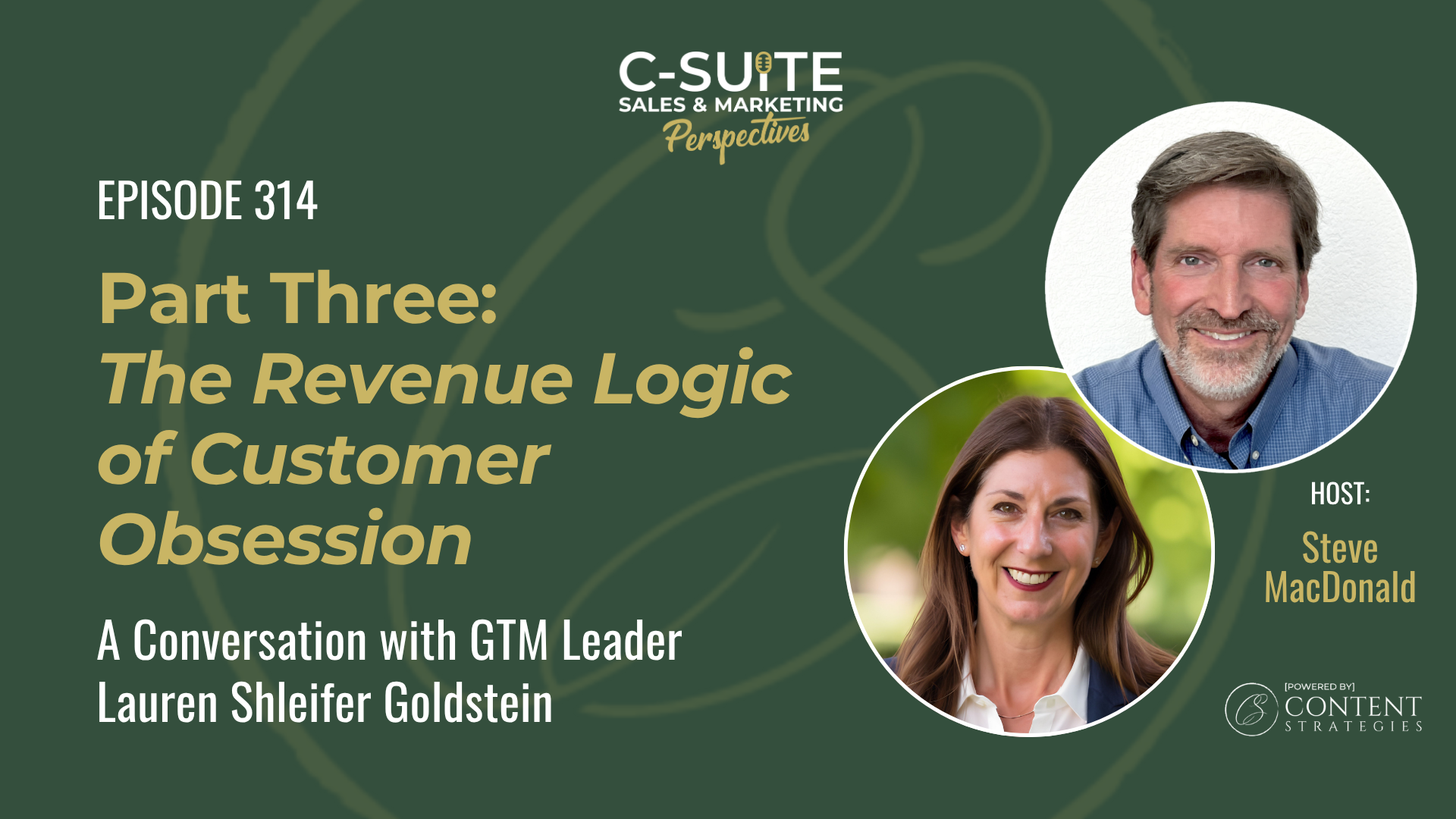


Episode #314:
GTM Leader Lauren Shleifer Goldstein explains why customer obsession is the foundation of sustainable business growth. She shares practical strategies for aligning teams, building trust, and using customer insights to improve decisions across the organization. Lauren also reveals why people, processes, and customer understanding matter more than technology alone.
“Trust is built by understanding what success looks like, and then making sure there’s a plan to deliver that. In SaaS or recurring revenue, it’s not just one time; it’s every day, every month, every year. Trust and customer obsession are, from my perspective, linked concepts. They’re not separate.” – Lauren Shleifer Goldstein
Lauren’s insights demonstrate that customer obsession is not a marketing initiative or a technology investment. It is a company-wide commitment to understanding what success means for customers and delivering on that promise consistently over time. Organizations that embrace this mindset are better positioned to create trust, strengthen alignment, and achieve lasting revenue growth.
Follow Lauren Shleifer Goldstein on LinkedIn
Follow Steve MacDonald on LinkedIn
[Transcript]
[00:00:05] Steve MacDonald: Welcome, everyone, to the C-Suite Sales and Marketing Prospectus Podcast. I’m Steve MacDonald, your host, and today we’ve got a very special guest on, Lauren Goldstein. Now, Lauren, you are a very special person. You have a fantastic background. I don’t want to just say you’re defined by your profession, but you’re a Chief Growth Officer at Winning by Design, which is a B2B go-to-market consultancy, which gives you an incredible purview into what’s going on in the marketplace, where companies are struggling, and where they’re having success.
[00:00:36] Steve MacDonald: You were a former Chief Revenue Officer. You co-founded Women in Revenue, so you get feedback from peers in your community and colleagues all the time on what it takes to be successful today. Correct. And, on top of that, you’ve got a whole personal life outside of that, Adventure Queen, boy mom, all kinds of good stuff.
[00:00:58] Steve MacDonald: But what I would love to do is have you expand on that a little bit before we get into the topic today, which is the revenue logic behind customer obsession. But if you wouldn’t mind expanding on your background first.
[00:01:11] Lauren Shleifer Goldstein: Absolutely. Well, you definitely did a great highlight, Steve. And I would say my mom and dad would be proud, so thank you. But, um, you know, there is something in what you shared in terms of that connective tissue between customer obsession and revenue. And I love the phrase “revenue logic,” but it really comes down to knowing your target audience and having that through line between understanding what motivates them and the organization’s revenue.
[00:01:36] Lauren Shleifer Goldstein: And I’d say some of that correlates with my personal life, too, whether it is raising boys and really understanding how to motivate and incentivize them. And I actually got a very rewarding call from my son this morning that proves that those nuggets that you plant, and understanding them, will pay off later.
[00:01:51] Lauren Shleifer Goldstein: Um, but it also came through, I’d say, about eight or so years ago, when there was an opportunity to start Women in Revenue, and I’ll talk a little bit more about that later. When we realized that not everyone understands how to really connect some of your skills, some of your network, and some of what you’re really good at, your highest and best, to something that will really be valued by an organization.
[00:02:14] Lauren Shleifer Goldstein: So much of what Women in Revenue is built on is this concept of mentorship. So I think there are a lot of through lines between revenue and creating value for organizations. But whether it’s raising boys, whether it’s helping create a mentorship platform for 10,000 women with Women in Revenue, or whether it’s bringing it together to add value to the customers that I work with day in and day out, that’s something that really gets me excited to engage every day in the world that we live in.
[00:02:40] Steve MacDonald: I want to set the tone here, the context a little bit, because there are some stats out from very recent reports that were done. Like Forrester. In 2024, they conducted a customer obsession study and found that only 3% of businesses are actually customer-obsessed. Yet ask any one of us, “Are you customer first? Are you customer obsessed?” Absolutely, right? You know, we all are. Nobody would ever say that they’re not.
[00:03:06] Steve MacDonald: It’s the exact opposite, and customer-obsessed organizations have 41% faster revenue growth and 49% faster profit growth. They retain clients 51% better than their competitors. There’s real revenue logic to being customer-obsessed.
[00:03:26] Steve MacDonald: But when we go into the boardroom, very few people are asking about, “Hey, how are you all doing in terms of understanding the customer? How are you doing on aligning behind your ICP? How are you doing in terms of making sure that information, those insights, are leading to how you’re making strategic decisions to grow the business?”
[00:03:48] Steve MacDonald: The last one I’ll say is that I think in 2023, McKinsey had a study that said less than 15% of companies use the voice of the customer to make strategic decisions. Now, I know you have a ton of opinions, so I’m just gonna leave it at that and have you open this up.
[00:04:06] Lauren Shleifer Goldstein: The thing is, the good news with these stats is that it leaves a lot of opportunity for organizations like Winning by Design, or some of the places that I’ve come from, like Annuitas, to really lean in and help companies, because there are so many challenges with companies looking at those obvious either gaps in what they’re doing today or opportunities that they have to do it better.
[00:04:25] Lauren Shleifer Goldstein: Before I answer your question, I do want to share two stories. Very early in my career, when I was at Babcock Jenkins, we were working with some of the top 100 technology companies in the world. And I remember at the time I was doing demand marketing, and we would generate all these really good leads.
[00:04:44] Lauren Shleifer Goldstein: That’s back when demand gen and lead gen were so important. And we would then pass them over to the sales organization to follow up on. And we’d circle back a week later, a month later, six months later to see how those leads were being followed up on. I will not name names, Steve, but this is someone who I think you have been around in your past as well.
[00:05:07] Lauren Shleifer Goldstein: None of the leads had been followed up on. And when we started to dig in and understand why, sales and marketing weren’t aligned. Classic problem, right? Case in point. Fast forward to even, you know, the last weeks and months, one of the things that we get a lot of at Winning by Design is a lot of pattern recognition.
[00:05:24] Lauren Shleifer Goldstein: Simple things like looking to see what customers churn and understanding why can help really unlock where those opportunities are for the customers who are getting value from what you offer to them. So I’ll just pause there for a second and see if you want to lean in. But I thought the antithesis is really an opportunity for companies to pause and really understand where the value comes from.
[00:05:45] Steve MacDonald: Well, you said something in there. You said that demand generation and lead generation used to be more important. And I talk to CMOs every day. And I talk to CMOs who feel like they have imposter syndrome. They feel like they don’t have a seat at the table. They feel like they’re as good as their last lead.
[00:06:07] Steve MacDonald: They feel like they represent one of the biggest cost centers in the company. When you said that, the flip side is that other things have become more important. And that’s what I’d love to start out with, right? Yeah. The buying journey, how we influence buyers, how early we’re out there, how we build trust. Like, so much has changed.
[00:06:31] Steve MacDonald: How would you start us down that path, right? You started us out by saying that lead generation and demand generation, yeah, used to be more important. So I’ll let you take it from there.
[00:06:40] Lauren Shleifer Goldstein: Yeah. Yeah, I will qualify that and say it was definitely an early concept for engaging buyers. Yet we’re so much more sophisticated today.
[00:06:49] Lauren Shleifer Goldstein: Just a quick story, and then I’ll go back to answering your question. But I actually ran into my former CEO from Babcock Jenkins, who taught me a lot about this back in the late 1990s, like I think 1998. And I met him when he was at a Portland Ad Association event, and he was talking about this new technology that he had created to help profile and create personalized experiences for people on a website, and then also create very targeted and personalized experiences in email.
[00:07:20] Lauren Shleifer Goldstein: Now, this predates Marketo. It predates Eloqua. And trust me, I think he would have rather been the inventor of those solutions than on the services side. But what it really taught me is that there is a currency, and I love to call it the through line, between brands and buyers when the brands really start to understand what that ongoing need is.
[00:07:40] Lauren Shleifer Goldstein: So, when I think about lead generation, that’s like flipping a name over the fence. When I think about buyer engagement and really understanding what buyers’ needs are, understanding what makes them successful, both from a rational perspective, you know, in terms of what helps their business, as well as from an emotional perspective, what helps them personally. When brands start to do that and really have this kind of two-way dance or engagement, that’s where there is a true through line between insights and revenue for an organization.
[00:08:09] Steve MacDonald: So, let me pick up on that, insights and revenue, really. When we say “customer obsession,” it can mean a lot of things. It could mean the experience, the service. But the driver at the very beginning is insights, and what they truly need, and what we offer, right? In the end, they’re our North Star. That’s who we serve. If we don’t serve them well, it’s to our peril, right? So everybody believes in insights. Yet here’s something that’s interesting that I had a conversation about the other day: we have a tech stack component for almost everything.
[00:08:45] Steve MacDonald: Where’s our tech stack component? Where’s the operational layer for insights? Insights that align with how we address the objections that kill deals in our pipeline. Insights that align with challenges and pain points. Insights that align with how we better sell and close deals. There are so many different layers of insight. Where are they? We come out of, like, example CAB meetings, and we’re doing high fives and belly bumps because we learned so much. We gotta do this again and again.
[00:09:18] Steve MacDonald: But what ends up happening is that the next day, maybe it’s told to somebody else in the company.
[00:09:22] Lauren Shleifer Goldstein: Nobody can get within a week. Yeah.
[00:09:24] Steve MacDonald: It’s in a sales meeting. A month later, maybe it made it into a PowerPoint deck. Two months later, it’s almost hard to find. Yet those insights are what drive the entire company. Why do we not have an operational layer to bring insights together? We have AI now. Yeah. We can do it, right? Yeah. Why don’t we?
[00:09:52] Steve MacDonald: I think that there are two parts to it. It’s not a matter of can we? As you’ve just stated, of course we can. For instance, within our organization, as we’ve been redefining some of our product offerings, we’ve taken dozens of call recordings from initial meetings and done primary research in a very short order.
[00:10:12] Lauren Shleifer Goldstein: Used our conversational intelligence tool, plus Claude, to really understand what those insights are. And I think organizations are hopefully starting to get better and better at that. That’s one component of it. But the other piece of it is that you need to then really socialize those across the whole organization.
[00:10:29] Lauren Shleifer Goldstein: ‘Cause if just the person who sat in the CAB meeting is the only one who knows, how about the rest of the organization? How about your sellers who are on the front lines? How about your product marketing team? How about, really, every single person in the organization needs to be privy to those insights because, as we know, alignment is one of the killers of success in an organization.
[00:10:52] Lauren Shleifer Goldstein: So I think those two have to really work in concert with one another. I’m gonna throw another old school anecdote, Steve, but when I’ve seen it done really well, I’ve seen things like posters. This is perhaps not as relevant if teams aren’t in the office, but life-sized posters of who the ICP is, and not just getting at what their demographic or psychographic information is, but really what success is for them and their team? What’s the impact that makes them successful? I do think that socialization and alignment is often a key missing component.
[00:11:25] Steve MacDonald: And just to make the point, internal alignment is the number one challenge inside of B2B companies. My own studies across over 100 different C-suite executives, by far, are the number one. You said number one throughout the hundreds of companies you’ve worked with. I’ve had other go-to-market partners on, working with Fortune 500, mid-market, absolutely. And internal alignment, get hold of this. Executive teams that are internally aligned have 2.4 times the revenue growth of non-aligned teams and 2 times greater profitability.
[00:12:01] Steve MacDonald: What you’re bringing up and what you’re talking about isn’t a throwaway line. This is the number one challenge. And we were talking back and forth. We can look at it one of two ways. Either we are our own greatest blockers, our own greatest challenges for sustained growth, or we have the greatest opportunity ourselves.
[00:12:23] Steve MacDonald: It’s not dependent on anyone else. It’s not dependent on the technology or the products that we’re delivering. It’s dependent on how we come together as a company. And the old adage that VC firms and PE firms invest first in the team, high-performance teams, the company, and the product separately. It goes right to what you’re saying here: we have to be high-performance. We have to be aligned. What’s so difficult about it? Why aren’t we?
[00:12:54] Lauren Shleifer Goldstein: It’s a really good question. If I had totally cracked the code, I think I would set up my own consulting shop to help teams achieve better alignment. But I think that, when you consider the yin and yang of understanding ICP, what I will say is that teams that are really obsessed with their customers and aligned around who their ICP is are the teams. That does act as a really important forcing function, right? Yeah. When everyone in an organization understands what impact it has on those customers, and not just in the pre-sales process, by the way.
[00:13:26] Lauren Shleifer Goldstein: I’d say more important, or at least equally as important, after they’ve become a customer, is making sure that impact is delivered, especially in a SaaS or recurring revenue business where so much of your ability to generate revenue from that organization happens after that initial sale.
[00:13:45] Lauren Shleifer Goldstein: So when teams are really aligned around this concept of impact, which does correlate directly to who their buyers are and what those buyers value, those are the teams that will naturally become more aligned. Again, I think there are many other ways to drive alignment, but if I had to pick one thing people really spend time thinking about, that would be it.
[00:14:07] Steve MacDonald: So aligning around the customer and being customer-obsessed requires a deep understanding. Like, to me, obsession means a never-ending drive. I’m never done learning, right? And I’m never done being curious. I have it on my to-do list every single day. It’s a top priority, right? What does customer obsession mean to you from the perspectives of a Chief Growth Officer and a Chief Revenue Officer, in terms of whether optimizing for customer obsession is, in effect, optimizing for revenue growth? And I’d love to just hear your perspective on customer obsession and how you tie it directly to revenue growth.
[00:14:56] Lauren Shleifer Goldstein: Yeah. There’s a great author whose book I actually have on my shelf to reread over the summer: Will Guidara, author of Unreasonable Hospitality. And if I mispronounced his name, I apologize. But he really is this amazing expert. He’s a restaurateur who was able to get his restaurant, Eleven Madison, to be literally the top restaurant in the world.
[00:15:16] Lauren Shleifer Goldstein: And it was not because the food was the best. It’s because they really listened to exactly what their customer wanted. They found certain moments in the experience with their customer that surprised and delighted. And at the end of the day, it’s having insights, but it’s also, I think, especially in our world of recurring revenue, I’ve said it earlier in this conversation, and I will say it again, it’s understanding what that emotional and rational impact is for your buyer and for your customer.
[00:15:43] Lauren Shleifer Goldstein: And by emotional, again, really understanding what success or failure means to them personally, and understanding the rational side, which is there’s definitely some sort of efficiency or productivity or cost savings or time savings gains that that organization gleans from the service or product that you offer. I hate to say it, like, it’s not hard. It’s pretty straightforward and simple, yet it’s often overlooked.
[00:16:09] Steve MacDonald: The idea of not overlooking- there’s a term that gets thrown around a lot called customer proximity. Staying close to the customer. I had a gentleman on; he was a four-time B2B CRO, and he talked a lot about customer proximity. And he said, “Steve, but when I say you’ve got to have a lot of conversations with the customer,” he said, “those that are outside of the sales environment.” And he said, “Tremendous learning from the sales environment.”
[00:16:38] Steve MacDonald: But I think his point was that today, buyers are waiting longer and longer to want to talk to us. They’ve already put the shortlist together. They’re in a validation mode. They’re in a confirmation mode of decisions they’ve already made, and can you fulfill those decisions? Yes. Is there more to learn?
[00:16:56] Steve MacDonald: Absolutely. We can play that role. But he was talking about the conversations that happened earlier as they’re forming their opinions, as they’re designing how high a priority this pain point is to me, the emotional risks involved, right? What do you think about his idea of customer proximity, but being proactive in getting conversations that are outside of the sales conversation, that are designed to be earlier stage?
[00:17:29] Lauren Shleifer Goldstein: If I understand the outside of the sales conversation, on one hand, if we’re talking about being provocative and thought leadership oriented, helping for solutions where there may not necessarily be a known need, or they may be breaking into a new category, I definitely think there are ways to be provocatively engaging with a customer to help, like, unlock that mindset. So, absolutely. I’m not gonna be able to think of a great example off the top of my head. But there are many, many brands that have been very successful at bringing to light a problem in the market they’re purpose-built to solve, and really showcasing its value to their customer base. And yeah, being out in a thought-leadership environment and really setting the conversation, versus competing at the end when a buyer is 70% of the way through their journey, for sure.
[00:18:23] Steve MacDonald: So if a buyer’s almost completely through their journey, I think it was 6sense. Bain did some studies on this as well, McKinsey, that on average, the short list, when it gets formed on day one, four out of five, four or five vendors are put on it. 95% of the time, one of the winners is on that short list. We gotta get on the short list, right? Getting on the short list, in your mind, how does trust play in? The brand is being seen as a legitimate player in the marketplace.
[00:18:55] Steve MacDonald: What are the things that help us get on the short list, that maybe when you were talking about lead gen, demand gen before, what are the things that help us, that we’ve got to do in advance to get on that short list, to have the opportunity to close deals?
[00:19:11] Lauren Shleifer Goldstein: Yeah. I always think proof that you can deliver what you promise. You know, I think that’s always a winning approach. For instance, I’ve always believed in doing references early in the sales cycle. Introduce someone to a customer and let them hear it directly from a customer. I’m not a believer in leaving the reference check as the last thing that happens, ’cause I think they’re super high value. So that may be a tactical answer to your really thoughtful question. But I really think that so much of the value sellers can offer in the buying process is letting the buyer explore the answers to their questions, really understand what those questions are through pattern recognition, and be able to serve up solutions early on. Not to wait to be asked, but to be proactive in knowing what likely challenges are.
[00:19:57] Steve MacDonald: One of the words that gets thrown around about getting on that shortlist and doing work in advance is building trust. Forrester came out at the end of last year and said their big prediction this year was that trust is the currency to get in, close deals, and retain clients. On top of that, they literally said to C-suite executives, “The number one thing that you need to do, you have demand gen programs, brand building programs. We have programs to develop all kinds of things in our go-to-market strategy. Where is your trust development program?” And they actually recommended for CMOs that it’s the number one thing that they should do. Where does trust play into all of this in your mind?
[00:20:39] Lauren Shleifer Goldstein: You brought it up in the last question as well. And again, I think about just the thousands of B2B buyers that we’ve worked with on behalf of our customers over time. I do think that trust that the impact will be delivered is really critical. And again, I think that it’s simple. Understand what success is, understand what impact looks like for that customer, and make sure you are deeply focused on showing them what that looks like in their scenario by showing them what it looks like for other customers you’ve worked with.
[00:21:10] Lauren Shleifer Goldstein: I think, at first, trust is built by understanding what success looks like, and then making sure there’s a plan to deliver that. In SaaS or recurring revenue, that’s not just one time, but that’s every day, every month, every year. It’s over a very long period of time. And I think that trust is still a really important ingredient, but it’s linked. Trust and customer obsession are, from my perspective, linked concepts. They’re not separate.
[00:21:34] Steve MacDonald: So you said something earlier that I made a mental note that I wanted to come back to. You made sure to say that we need to understand both the emotional and rational reasons why buyers make decisions, and there are lots of studies that talk about how, in B2B, big deals, enterprise deals even, the majority of the decision-making is based on emotion. The risk. These are big decisions. These can be career-making decisions, right? Yeah. And what’s interesting, we never really think about it this way because we’ve all been buyers.
[00:22:06] Steve MacDonald: As the CGO, you’re a buyer, right? I’m sure you added to your tech stack. You did all kinds of things as the CGO. But that was not your defined role. You’re not a full-time buyer. Just thinking about our buyers in different ways. They have full-time jobs. Being a buyer is not one of them. They’re not professional buyers. How do you think about just thinking about the buyer and knowing that the emotion is at least 50 percent of this decision making criteria? What do we do differently knowing that?
[00:22:37] Lauren Shleifer Goldstein: I think that, in an enterprise sales environment, which tends to be a lot of where I’ve spent more time than not, it’s not just an individual buyer; it’s many. You’ve got multiple people in a sale, so I think that’s really where I see some of the best sellers shine: they’re able to map out and get underneath the emotional and rational impacts for our champion, the economic decision-maker.
[00:23:04] Lauren Shleifer Goldstein: I’d say, to a lesser degree, to the individual user, but there are still multiple people that are involved, and that is where you see your best sellers shine. They understand what success looks like, and they’re able to, again, paint the picture, confirm that the solution will deliver upon that, offer proactive references that will get beyond, build confidence and trust in what’s being purchased.
[00:23:26] Steve MacDonald: So I want to make sure that I’m allowing you to answer all the questions, even the ones I haven’t even asked, right? Previously, in our last conversation, you talked a lot about the use of technology, and that technology is not a strategy itself. What did you mean by that?
[00:23:42] Lauren Shleifer Goldstein: Um, it’s something that I have felt deeply for a very long time, which is it’s very easy to get caught up in bright, shiny object syndrome and, oh my gosh, if we just buy this CRM or this automation platform or this AI platform, that is going to help us propel our success.
[00:24:00] Lauren Shleifer Goldstein: I don’t know if I’m the only one who said it, but it is one of my favorite sayings, and that is technology is not a strategy, and that organizations really need to make sure they’re back to basics in some cases. There needs to be process well defined. People need to be trained. And even in the age of AI today, I think there are some really interesting experiments happening, but those experiments are not necessarily yielding results or productivity. They’re just interesting.
[00:24:29] Lauren Shleifer Goldstein: But the organizations that are really utilizing AI are having an orchestrated set of tasks that are being completed that are actually adding value to the business, either in terms of insights or productivity, and they’re yielding the ROI. So I would say to anyone listening, or the executive suite, just make sure that if you are looking to purchase technology, or if you have technology that you’ve purchased, really make sure you’re clear on what the strategy is, how you’ll utilize it, how it interacts with other systems, who it’s adding value to. I think that’s a really important piece that hasn’t been touched on yet.
[00:25:05] Steve MacDonald: So now I’m gonna ask the most difficult question, which is that we’ve talked just about so much here, right? If there was just one thing that you wanted the C-suite executives who are gonna be consuming this podcast to remember, what’s the single most important thing you want them to take away?
[00:25:23] Lauren Shleifer Goldstein: You’re asking hard questions, Steve. I mean, look, we’ve talked a lot about the fundamentals of people, process, technology. We’ve talked about the importance of alignment and customer obsession. So let’s assume that we’ve hit on all of those, and that, in fact, those are really important. I’m gonna take a moment, since you asked, and share something that is very near and dear, and that is about the importance of mentorship in an organization. I think that, whether there is a formalized way to find mentorship within the organization or you seek outside resources, like, for instance, we do have a nonprofit called Women in Revenue. If you wanna check it out, it’s womeninrevenue.org. It is a 501(c)(3) nonprofit that is actually funded by many of the technology companies that are household names to all of us.
[00:26:10] Lauren Shleifer Goldstein: I look at what we do as a team sport. There are no heroes in this business, and I think that mentorship and really finding a community and a network for your teams and yourselves to collaborate with is so important. It’s how we grow. It’s how we have a growth mindset. I know personally I’ve mentored dozens and dozens of women, but even recently I said to someone on my team who is much more an AI native than I am, “I’d love your help. There’s so much I have to learn, and I wanna understand how you’re thinking about solving this type of problem or that type of problem.” And I think that mentorship goes two ways, and I think it’s something that everybody in an organization should have access to.
[00:26:50] Steve MacDonald: I have to say, I agree 100 percent. I think we’ve come at it from different angles. I think staying tied to a community, learning from the community and what they know and what they’ve done and what’s failed and what hasn’t and what they’ve tried, and that’s the same thing, I think, behind customer obsession, is an obsession in our own profession, right?
[00:27:12] Steve MacDonald: The mission of this podcast is to bring different voices together. So, a very different way than you’re doing it with Women in Revenue in your community, but I applaud you for that. I just wanted to say thank you for being part of this community and for bringing your expertise and insights to the entire world of C-suite executives.
[00:27:32] Steve MacDonald: We interview C-suites from all over the world, from Europe, the US, India, Australia, you name it, and I call it the rising tide that lifts all boats. And I thought you, absolutely, were just an amazing part of that rising tide today. So, Lauren, thank you so much for coming on.
[00:27:48] Lauren Shleifer Goldstein: Thanks for having me, Steve. It’s been fun.