
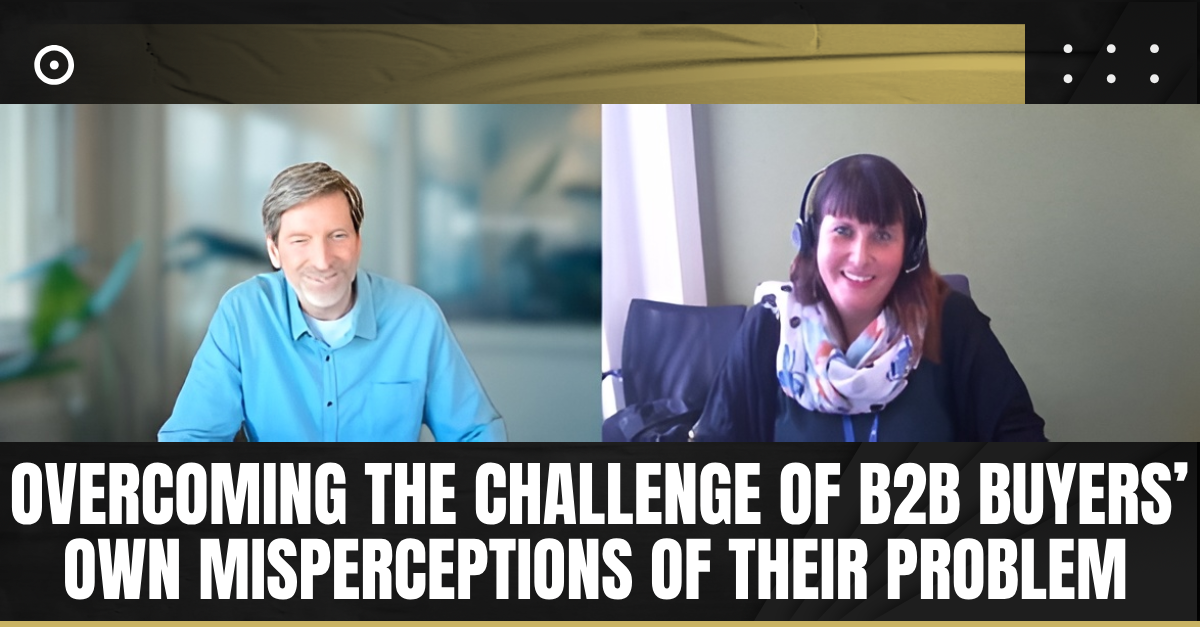


Vera Huebner, Chief Marketing Officer at Frankfurt School of Finance & Management, discusses re-educating B2B buyers in detail. Her insights explain how reframing challenges creates urgency and builds trust. She underscores the importance of positioning the brand as a trusted advisor before engaging in sales. Her message motivates decision-makers to rethink their approach and seize growth opportunities.
“When speaking to a customer, you need to reframe their problem. Show them that they are facing a business risk and that you’re offering an opportunity to avoid it. That’s how you shift their perspective.” – Vera Huebner
Leaning into her experiences, Vera uncovers the transformative power of reframing challenges in both personal and professional settings. Through candid storytelling, she illustrates that adversity can spark reinvention, and that genuine curiosity fuels meaningful growth. Her perspective offers a compelling blend of resilience and leadership, guiding audiences to recognize hidden opportunities in every obstacle.
Follow Host Steve MacDonald on LinkedIn
Follow Vera Huebner on LinkedIn
[Transcript]
[00:00:00] Steve MacDonald: Welcome, everyone, to the C-Suite Sales and Marketing Perspectives podcast. I’m Steve MacDonald, your host, and today I guarantee we’re going to have a really interesting conversation—a conversation we have not had on the podcast yet. It’s all about how we overcome the challenge with our B2B buyers when their own perceptions of their challenges and problems aren’t linked to reality.
[00:00:24] Steve MacDonald: We are constantly trying to reframe the priorities and the problems that they have because they’ve been living with them for a long time, and they tend to deprioritize them. So, on today is Vera Huebner. Vera, you are an expert. You are a CMO. You’ve spent a huge portion of your career in sales, doing exactly that. But how do we come together as an organization in total and help address this challenge? That is a big part of what we’re going to be talking about here today.
[00:00:52] Steve MacDonald: But before we do that, I want to dig into your background a little bit. I introduced you professionally, but personally, you shared something with me a few minutes ago. When you were younger, at age 16, you got kicked out of school twice. You were a little bit of a “bad girl.”
[00:01:10] Steve MacDonald: You also have a huge heart. I’m just going to turn it over to you and maybe let you spend a minute here giving us a little bit more of a random perspective on yourself, and then we’ll dig right in.
[00:01:19] Vera Huebner: Okay, perfect. Thank you so much for having me on this podcast, Steve. I’m super excited to be here. Thank you for the nice introduction.
[00:01:26] Vera Huebner: I think maybe I should explain a little bit more about why I got kicked out of school twice at the age of 16.
[00:01:34] Vera Huebner: I didn’t want to go to school. I didn’t see the point in getting an education at the time. Because my mom didn’t want me to leave school without a degree, she refused to sign me out. So, I just played truant until I got kicked out. Then, she employed a lawyer to get me back in, and I played truant again until I got kicked out once more.
[00:01:56] Vera Huebner: Eventually, at 16, I left school. I worked for two years and then realized that education isn’t so bad after all. I went back to school. It was a tough learning curve, but I guess I wouldn’t be where I am today if that hadn’t happened.
[00:02:18] Vera Huebner: You also mentioned that I have a very big heart, and that is very true. Some people might call it a helper’s complex or helper’s syndrome. I try to help as many animals in need as I can around the world. So, whenever I travel, you’ll probably see me walking around with a big backpack full of cat food, water, and little bowls that I put out to help street cats and street dogs in the various countries I visit. So yeah, that’s pretty much me—a rebel with a heart, I guess.
[00:02:42] Steve MacDonald: You know what’s really ironic about all this? Despite getting kicked out of school twice, you are now the CMO of the Frankfurt School of Finance and Management—a university.
[00:02:53] Vera Huebner: Well, I did say that education suddenly made sense to me when I didn’t have access to it anymore. So, I am a huge fan of learning, education, and particularly lifelong learning, which is what we offer here at Frankfurt School. Some people just take a little longer to realize that, I guess.
[00:03:11] Steve MacDonald: Well, speaking of education, the theme we’ve started here is about reeducating our buyers. We help them understand the complexity and scope of their problem, how important it is, how near-term it is, and how solving it can significantly help their entire company.
[00:03:25] Steve MacDonald: There’s a lot of reeducation happening there. I would love to define this misperception problem from the perspective of when you were in sales. Let’s start there.
[00:03:47] Vera Huebner: A very big part of being in sales is, of course, talking with and establishing a relationship with your customers or potential customers. What I often found, and still find, is that people aren’t aware of their actual needs. These only become apparent when you start talking about where they want to go, their vision, their ideas, their purpose, and the mission of their company. Suddenly, they realize, “Hang on, we’re missing something.”
[00:04:33] Vera Huebner: It’s a bit like a gap analysis, where you gently guide your customer towards that moment of realization: “Hey, we’ve got a gigantic need here, and there’s this lady who wants to help me fill that gap and address that need.”
[00:04:42] Vera Huebner: Now, the problem with that is that it often requires change. The easy solution is to throw money at it by changing the budget plan. But it’s not always as easy as I just made it sound. Especially in the education space, where I am now, I think it’s very important to make customers understand that, in today’s world, it’s crucial to keep your workforce up to speed with ever-changing technological advancements, bigger demands, globalization, and internationalization.
[00:05:11] Vera Huebner: Often, I find that companies lag behind and then wonder why they’re not ahead of the game anymore. That is something you need to make them understand in that first initial talk, before you even go into “How can we help you?” It’s more about saying, “Hey, we have a problem.”
[00:05:28] Steve MacDonald: I love the fact that you started your explanation with the word relationship.
[00:05:33] Steve MacDonald: In order to change perceptions, educate, and be an advisor, you have to create the relationship upfront. But is that just the job of the salesperson, or is it part of the holistic go-to-market strategy that we have?
[00:05:47] Vera Huebner: It starts way earlier than sales, right?
[00:05:51] Vera Huebner: Ideally, the marketing and branding strategy comes before the actual sales process. We position ourselves as trusted advisors, authorities in a particular field, and problem solvers who can help customers address their needs. Whether in B2C, which is slightly easier, we can tell a student, “Come to us because we teach you what you need to know in order to become successful.”
[00:06:16] Vera Huebner: We also need to position our brand, our school, as a thought leader and innovation leader, and as someone they can trust in companies, in corporations, that we can help them upskill their workforce in whatever shape or form they need. That starts way sooner than sales because the first thing you do is position the brand.
[00:06:36] Vera Huebner: You say, this is who we are. We’re a thought leader. We know what we’re doing. You can trust us. And then ideally, you generate leads. But if you don’t, then you send out your sales force. I have some amazing salespeople here, and they can build upon that knowledge that has already been established with the company, with the corporation, with the customer. Hopefully, they can start establishing that trust that we, as a marketing team, have already instilled in the customer in the first place. So yeah, it’s all about relationships. But building a relationship in sales is very long-term, right? It’s not something where you bang out one advertisement and everyone comes running. That’s not how it works anymore. It might have been the case 20 years ago.
[00:07:19] Vera Huebner: But nowadays, you have to build trust and a relationship over various touchpoints across the customer journey. That starts with marketing and branding, with positioning the brand, and then it moves into the sales space.
[00:07:33] Steve MacDonald: There was a study that came out just over a year ago that identified a trust gap. It said that 74% of B2B buyers don’t trust the customer evidence that we present to them. Everything we do to package up—look at how we create value for our clients, for our customers—right? They’re not buying it. That’s three-quarters of B2B buyers, which probably leads into why over 80% of them are waiting until the very, very end before they even want to talk to us, right? Because they want credible, authentic, third-party—whatever you want to call it—ways for them to evaluate and make decisions.
[00:08:10] Steve MacDonald: So this idea of being that trusted advisor, building that relationship—it’s gotten a lot harder to do, right?
[00:08:19] Vera Huebner: Yeah, it definitely has. Now, I think in the educational space, we are still fairly lucky. There is a lot of competition, obviously. There are over 10,000 business schools in the world nowadays.
[00:08:33] Vera Huebner: There are quite a few ways for us to establish trust—the initial trust or the initial interest. Let’s call it a genuine interest in our brand, in Frankfurt School as a brand. We are one of only 129 schools out of 10,000 that are actually triple-accredited, which is very important nowadays in the education space. This is the type of fact we can present.
[00:08:57] Vera Huebner: Now, coming back to what you’re saying, it is much more about building that trust on a personal basis, on a personal relationship. We can throw a lot of facts out to the customer and say, “Hey, we’re the best and the greatest. We’re the most trustworthy, and here are some stats.”
[00:09:15] Vera Huebner: But what they really need to know is: who else trusts us? So I think what we need is a really, really great sales force that can establish relationships. But we also need to make use of our massive alumni network. We have about 110,000 alumni all around the world who have gained something from us. I hope all of them had a fantastic time and have gotten ahead in their careers by studying at Frankfurt School or by earning an executive education certificate, a degree, or a diploma.
[00:09:51] Vera Huebner: So I think establishing trust can be done in various ways. One way is to throw stats out there, but then you need to establish a personal relationship. You need to ensure that you are liked and positively recommended by people within your network. What’s also super important—and again, this is why I say we’re lucky to be in the educational space—is that we have a fantastic, very knowledgeable, very well-known faculty. We have about 100 faculty members here at Frankfurt School on our Frankfurt campus, and they are already trusted thought leaders in their space, right? They conduct fantastic research. They teach. They are true authorities in their own fields.
[00:10:31] Vera Huebner: So we have this kind of “bunch of flowers” of great things that we can tell our customers about. But the question is always: at what point do you get them to trust you so much that they say, “Yes, we’re coming to you”?
[00:10:46] Steve MacDonald: We can’t underscore it enough—trust is the foundation for everything.
[00:10:50] Steve MacDonald: That’s why we learned in school that brands are trust marks. You know, Gartner—”trusted advisor.” Right. There’s a reason why that’s in there. I think one of the ways that we can build trust is if we can credibly help change the perceptions of their problems. If we can do that in a way that really makes sense.
[00:11:10] Steve MacDonald: We are adding value to them. So we need to redefine the problem, right, in order to create that urgency. If we do it the right way, we’re actually educating them. We’re helping them. I’d love to get your thoughts on that.
[00:11:25] Vera Huebner: Yeah. I totally agree. When you speak to a customer, you need to reframe their problem. You need to tell them, “You are running a business risk here, and I’m giving you the opportunity to avoid that.” That’s how you reframe their problem. In our case, the problem often is: “I have a great workforce, but I need to make sure they can enter the next period with me in this industry,” whatever industry we’re talking about.
[00:11:49] Vera Huebner: The way I can tell customers that they have a problem and that it is about them staying up to date in their business is by tying it to their costs and revenue. How much return on investment do they get by upskilling their workforce? How much more efficient do they become? How much more productive do they become?
[00:12:11] Vera Huebner: It depends on the industry, of course, but overall, you can always argue that if you upskill your workforce, they will be much more productive. Therefore, you have a much more positive output and, hopefully, in the long run, a return on your investment. I think what is always a good argument to have when you talk about reframing the problem in the first place is to talk about the competition and how far ahead they are.
[00:12:36] Vera Huebner: I think that’s one very important part because, as we talked about earlier, we live in a highly competitive world. There are 10,000 business schools out there. I need to be different. I need to be better than 9,999. Essentially, I want to be among the top business schools.
[00:12:54] Vera Huebner: So if I put that into my customer’s perspective, they have competitors in their field. They want to be the best. If I make them understand that with their skills gap—in my case, it’s a skills gap, right? Because we’re talking about education here—they are running the risk of being left behind by competitors who are ahead. That normally gets their attention.
[00:13:16] Steve MacDonald: I love that. So very directly reframing the problem in a way that, if addressed correctly, becomes a competitive advantage for them and their business.
[00:13:28] Vera Huebner: The second part, of course, is to create a sense of urgency. You’ve mentioned it earlier, right? You can’t wait another five years until everyone else has overtaken you. You need to take action now, and that is something we need to tell our customers. We need to tell them this is happening right now. I think this is where we might be talking about this a little bit later, but complacency comes in, right?
[00:13:50] Vera Huebner: Companies get so used to certain ways of working that they might not even realize they have this skills gap or this educational gap [00:14:00] within their company. You need to make them aware that, hey, this is happening right now. The world is changing so crazily fast; you need to change with it. You and your workforce need to be up to speed.
[00:14:12] Vera Huebner: To have that ability to persist in this world. I think what’s also important is that you need to speak to the right people. You need to speak to the executive level about this because this sense of urgency can only really be upheld if you speak to the decision-makers directly. Otherwise, it gets lost in the chain of command, essentially.
[00:14:32] Steve MacDonald: So I’d love to have you tell us a bit of a story because we remember things in a story form 22 times better, right? If you could tell us the story of the skills gap that you address, and it’s around executive-level training. The perception is, “Oh, I’m just gonna train somebody who’s gonna leave my company.”
[00:14:54] Steve MacDonald: “My budgets are decreasing. Why am I gonna put additional money into something that I don’t even know what kind of return [00:15:00] I’m gonna get?” But there’s a significant competitive advantage to training your executives and your teams. So tell us a little bit about what your problem is and how you’re addressing it because that’s gonna give us the story of how we can see it playing out, right?
[00:15:15] Vera Huebner: So I think the biggest issue really is—and this is where the whole customer journey with us should be starting—we do not have enough professionals who are trained in certain areas or industries for us to cover all the employment needs. So we don’t have enough people that could come in, which means that the existing workforce needs to be trained in a way so they can withstand the changes within society and the economy right now. Here at Frankfurt School, we actually used to be a banking academy. So we’re very much coming from that area of banking.
[00:15:52] Vera Huebner: I think banking is a very nice example to use because, in banking, there are certain skills and capabilities that need to be trained and retrained. You need to keep doing certifications. You need to keep being retrained in order to be able to do your job. This has to do with a lot of regulations—banking regulations, right?
[00:16:13] Vera Huebner: These are often Germany-wide, but they can also be EU-wide, for instance. So banks have to make sure that all of the people who work within their area are trained in a way that they know all the newest regulations. We all know Germany is quite heavily regulated. So there are new laws coming in, new regulations, and while we are offering a huge array of those, I say must-have certificates,
[00:16:38] Vera Huebner: Of course, it now becomes ever more important to also train people in things like AI, technology, and blockchain. This is all finance-related, right? But this is something that people need to understand in order to be able to bring the company they work for forward. That is something we offer in our Executive and Professional Education Department.
[00:17:02] Vera Huebner: So we offer regulatory training, which is compulsory—probably also compulsive, but mainly compulsory—and therefore obligatory for people to take. But we also offer those skills that are just necessary right now to fill gaps within the workforce that you can’t otherwise fill. So it is way more beneficial for customers to upskill their own team rather than onboarding new people that they might not even find, right?
[00:17:31] Steve MacDonald: Thank you. I understand now the story of how you turn it around, right? Because the common thing would be, “If we need the right people, we’ll go to the market and just find them,” right?
[00:17:55] Steve MacDonald: A, they’re not there. B, you have people on your team who have proven themselves, who are dedicated. Those corporate athletes, as we used to call them—you know they can succeed if they just need a little bit more training.
[00:18:00] Steve MacDonald: They’re gonna be your superstars. Our high-performance teams are the most important thing inside of our organization. That’s why VCs and private equity companies look at the team that they’re gonna invest in before the idea first. So you’ve just reframed the whole problem for them.
[00:18:13] Steve MacDonald: Thank you for that story. It’s incredible. An important part of a story also is telling what’s happened with our clients, right? How that redefined problem that you just articulated incredibly well.
[00:18:28] Steve MacDonald: Part of the story is then, well, what are the benefits? What are the outcomes in relying on past relationships with clients? Tell us a little bit about your thinking on that.
[00:18:39] Vera Huebner: So I think what’s super important is very, very strong relationship management because you need to know every step of the way if something is working for the client or not.
[00:18:48] Vera Huebner: If you do that right, if you do that well, then you will have very loyal customers who know the benefit and value of what you’re providing for them, whatever that is. And if you play your cards right, these customers are very happy to recommend you to their peers, to other corporate clients, right?
[00:19:10] Vera Huebner: So, recommendation is a huge operational strategic lever, I guess, that we use, right? We use existing relationships. We figure out these customers are super happy with what we’ve provided so far. So not only does this provide us an opportunity to upsell, obviously, because we want to keep that relationship going, but we can also ask for testimonials.
[00:19:34] Vera Huebner: We can ask for recommendations. We often ask customers if they want to come in and talk to our students, which gives them exposure and the opportunity to recruit students from us. So, build a network, build a super strong network, and expand the benefits that you give to the customer.
[00:19:52] Vera Huebner: I think that’s the crux of this. With existing customers, as I said, this is fairly easy as long as you are close to them. You can also speak to lapsed customers. We have customers, and I think this brings me back to our initial point where we said people or customers become complacent.
[00:20:11] Vera Huebner: They know they have a gap, a lack, or an issue with something, but they don’t have the time or the capabilities to deal with it at the moment. They might have already been our customer a while ago, and then it just fizzled out. So reconnecting with these customers, who technically already know the benefit, is also quite a good way of getting them back on board because you need to remind them of the benefits they already had.
[00:20:31] Vera Huebner: That’s the other part. But I think new business is the hardest. New business really is the hardest because there, you can’t remind them. You can’t really rely on recommendations alone. You need to establish why we provide a benefit to them in that particular space. And that’s the hardest part.
[00:21:01] Steve MacDonald: You know, you brought up something really important there. For any organization, whether it’s a school of business or a traditional business in the sense we think about it,
[00:21:09] Steve MacDonald: 30 to 40% of new annual revenues should be coming from existing customers. We should be expanding the opportunity. So this whole conversation today about reprioritizing the problem—it’s not just with new logos, right? We spend a lot of time going after new logos. But this relationship and redefining the problem and how we could expand the relationship and help them is significant.
[00:21:28] Steve MacDonald: In fact, that 30 to 40% number is significantly underrepresented. If you read up from Forbes articles and things like that, it should be more. When you do cross-sells, upsells, and recommendations to other organizations, the new revenue flow that comes in from that network of existing customers is much more like 70 to 80%.
[00:21:55] Steve MacDonald: So what you just said there about harnessing the voice of the customer, working with them, networking with them—boy, that can’t be understated.
[00:22:06] Vera Huebner: No. It’s so important to have these people, these customers, on your side. They need to essentially become an advocate for you.
[00:22:14] Vera Huebner: That’s the idea of relationship management—of successful relationship management. Your customers need to be so happy with the service you provide that not only are they going to stay with you and give you more business, but they’re happy to shout about it amongst their peers, whom I might not have access to yet. Because yes, they might have seen an advertisement for Frankfurt School.
[00:22:35] Vera Huebner: Yes, they might have seen one of our YouTube clips, but nothing speaks louder than someone they know telling them how great we are. For me, that’s the essence of successful relationship management. You need to have customers who are so happy that they want to help you do the sales job.
[00:22:54] Steve MacDonald: That is harnessing the voice of the customer.
[00:22:58] Steve MacDonald: I want to talk about that a little bit because we mentioned that Trust Gap Survey, right? Where 74% of buyers don’t trust what we say about what we do for our customers. But if you’re hearing from the customer—the voice of the customer themselves—
[00:23:11] Steve MacDonald: You talk about YouTube clips and things like that. Not just a testimonial and a case study. Those case studies tend to be, by the time they go through rounds and rounds internally and the rounds and rounds at the client and then come back approved, very, very polished PR pieces, right?
[00:23:26] Steve MacDonald: They’re beautiful, but they’ve lost their authenticity. And so what you’re talking about here is hearing from the customer themselves, right? There was a three-time B2B CMO on about a year ago, and she said, “Steve, no matter what campaigns we create, whether it’s sales enablement, whether it’s marketing campaigns—no matter what we do—if the voice of the customer leads ours, it always works out better.”
[00:23:52] Steve MacDonald: It always performs better.
[00:23:56] Vera Huebner: It’s so important, especially in the B2B area, because [00:24:00] what we sell is essentially emotions, right? We sell fantastic products—all of us—and we sell on the back of our customers being happy. And if they are ready to take that into the world, that’s the best way of marketing our brand and marketing our product.
[00:24:18] Steve MacDonald: Absolutely. Here’s what I want to do—we’ve talked about a lot, and our poor human brains can only retain about two or three things at a time.
[00:24:27] Steve MacDonald: What I’d love to do is ask you, for anybody who’s taking in this podcast right now, what is the single most important takeaway that you want them to have?
[00:24:38] Vera Huebner: I want everyone to understand how important the personal relationship with your customer is in order to get them to help you market the product. You can do the best marketing, you can do the best branding exercise, but you need your customers on board, helping you to market the product.
[00:25:01] Steve MacDonald: Oh, I love that.
[00:25:02] Steve MacDonald: I love that. Yeah, yeah. You know, here’s what I know for sure—people are gonna have more questions. Is it okay if we give out a link to your LinkedIn profile?
[00:25:13] Vera Huebner: Yes, please do. And yeah—
[00:25:14] Steve MacDonald: So people can ask questions and get ahold of you.
[00:25:17] Vera Huebner: I am super happy to talk about any of this with people online, on Teams, Zoom, wherever.
[00:25:25] Vera Huebner: I’m super passionate about sales, and I love working at Frankfurt School. I love the products we sell here. And I know our professors don’t like when I call them products because they’re programs, but they’re also products, right? And I love talking about it. So anyone who has any questions, any feedback, any comments, or any suggestions on how we can become even better, please hit me up.
[00:25:51] Steve MacDonald: Fantastic. Thank you very much for sharing all of this. A fresh perspective and insights always help, and you’ve given us so much to think about today. I just wanted to say thank you.
[00:26:01] Vera Huebner: Thank you so much for having me, Steve. This was super inspirational, and I’m taking away a lot of food for thought as well.