
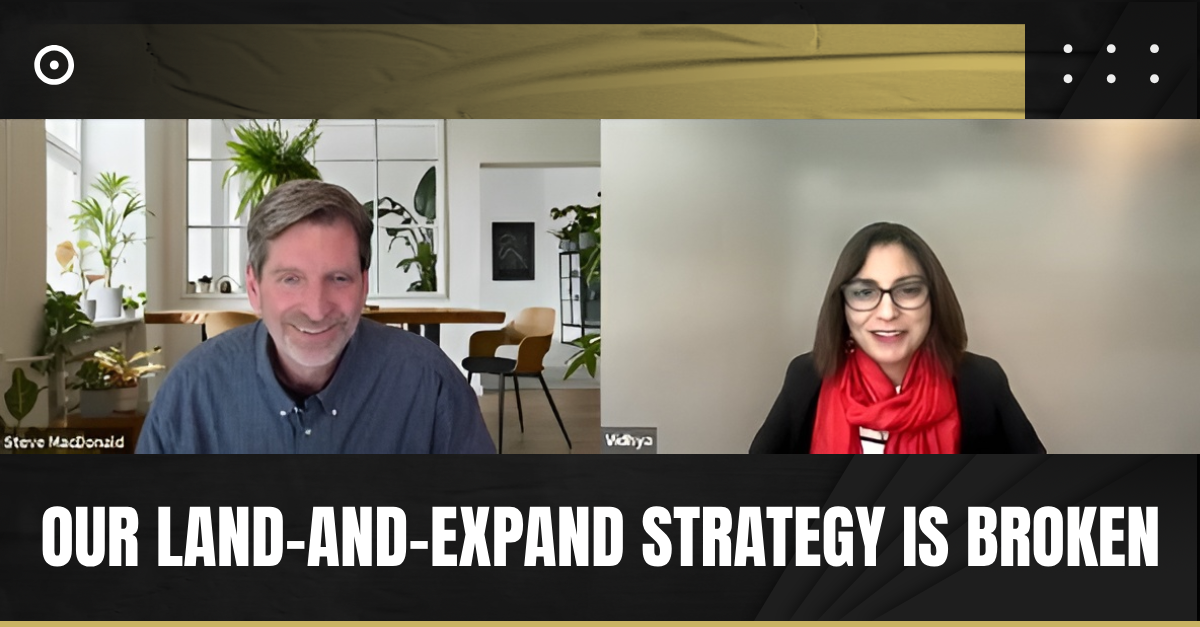


Vidhya Srinivasan, Chief Product and Marketing Officer at Magnit, discusses how companies miss massive revenue gains by fixating on new customer logos. She emphasizes the urgency of building greater trust with existing clients to expand deals more efficiently. She pinpoints the role of collaboration across sales, marketing, and product in guiding the entire customer lifecycle. She invites leaders to rethink land-and-expand as a long-term growth engine.
“It’s really important that people don’t think only about landing, because the company’s job doesn’t end once you land the customer.” – Vidhya Srinivasan
A thoughtful conversation that delves into how personal passions can fuel professional innovation, bridging multiple disciplines to deliver tangible client outcomes. Through her lens, we explore the synergy between marketing, engineering, and product leadership, highlighting the strategic importance of listening to customers at every step. Expect insights on unifying teams around shared goals and building deeper relationships that drive sustainable growth.
Follow Host Steve MacDonald on LinkedIn
Follow Vidhya Srinivasan on LinkedIn
[Transcript]
[00:00:00] Steve MacDonald: Welcome everyone to the C-Suite Sales and Marketing Perspectives podcast. I’m Steve MacDonald, your host, and today we have an exciting guest, Vidhya Srinivasan. Vidhya, you are the Chief Product and Marketing Officer at Magnit and have an interesting background. So, you’ve got a product marketing and engineering background that you bring together.
[00:00:21] Steve MacDonald: You’ve got a fascinating personal background. You live in Colorado, and of the 52 Fourteeners, you’ve climbed 13. You have a trip planned to Kilimanjaro. So that’s a very outgoing personality, and I’m sure you bring that to the business, too. I’d love to before we get started here—and our topic today is that our land and expand strategy is broken, and we’re going to talk a lot more about what that means and what that is.
[00:00:50] Steve MacDonald: But before we do that, if you wouldn’t mind just explaining a little bit more about your background.
[00:00:54] Vidhya Srinivasan: Sure. Thanks, Steve, for having me. I am very excited to be here to discuss land and expand strategy. It’s always the fun part of go-to-market for any company. Here is a brief background. Like you said, I’ve done many roles across the organization—started out as an engineer a long time ago, I evolved into product management, and somewhere along the line, I got excited about storytelling, which took me into marketing. So, my USP is the intersection of product, marketing, and engineering, and the ability to collaborate and work across the various functions to help customers with a go-to-market strategy.
[00:01:33] Vidhya Srinivasan: At the end of the day, it’s all about how we help customers through the journey and make them successful. I think my background certainly helps me drive that value to organizations and, ultimately, to customers in value creation. I’m a mom and a wife.
[00:01:51] Vidhya Srinivasan: And yeah, my husband and I do love hiking. I went to college in Colorado, so it’s undoubtedly a place close to our hearts. I went to CU, and my husband went to CSU, so from a football perspective, we have a pretty interesting contrast. But yeah, we like hiking and we are excited about potentially a trip to climb Kilimanjaro in a couple of years, after we get acclimated to that, as a preparation.
[00:02:17] Steve MacDonald: Well, fantastic. Let’s talk about why the land and expand strategy is broken. So, one of the things that CMOs know is that we have to be very pipeline-driven.
[00:02:28] Steve MacDonald: And one of the things that’s interesting about creating new annual revenue—Forrester came out with a study a couple of years ago and they identified that 73% of new annual revenue comes from existing clients. However, we spend about 98% of the time on new logo development. So that’s one thing—the amount of time and effort that we’re putting in one direction: new logo versus the land versus the expand strategy.
[00:02:53] Steve MacDonald: The other one is that it’s getting harder and harder to conquer new logos, and we all know that it’s five times easier—whatever the stat is, right?—to expand an existing client relationship. But one of the biggest reasons is the buyer today—the B2B buyer—is waiting longer and longer even to want to talk to us, right?
[00:03:13] Steve MacDonald: They’ve already picked their top two or three. They mentally know who their winner is, and then they’re talking to the organizations. And a big part of that is because of the loss of trust. We’re the selling organization and will put ourselves in the best light.
[00:03:30] Steve MacDonald: Another study came out just over a year ago that identified that 74% of B2B buyers—74%!—don’t believe the customer evidence we present to them.
[00:03:41] Steve MacDonald: So it’s getting harder and harder to conquer new logos. What I just wanted to do is talk to you about how, as a CMO and a C-level executive in the organization, we’ve got to confront this B2B trust gap head-on. And just how do you think about that, and how do you approach that in your business?
[00:04:03] Vidhya Srinivasan: Yeah, it’s exciting. Most of the companies today go through this sort of balance in figuring out a new logo versus the land versus the expand strategy.
[00:04:13] Vidhya Srinivasan: I think I’ll start with the second part of your question, which is really the trust factor because it’s a critical part of whether it’s a cross-sell or a land aspect—making sure customers have trust in your brand, in who you are, and what you can offer for them.
[00:04:30] Vidhya Srinivasan: So I think—I don’t want to show my age in this process—but, 20 years ago, right? If you had asked, the sales process was very much a relationship. You went to the customer site, built that relationship, and worked to build that trust so that you would be awarded the opportunity to deliver value for the customers.
[00:04:51] Vidhya Srinivasan: But I think over the past 10–12 years, this notion of meeting the customers where they are, meeting the prospects where they are, is certainly a big part of how things have evolved. As a result, a big part of that includes tools like G2 Crowd—people know about that, right?
[00:05:09] Vidhya Srinivasan: There’s IT Central Station for IT software decisions, and there’s big analyst firms like the Gartners and Forresters of the world who have the customer voice represented in what they share with the buyers in the industry. So I think that’s a big testament to customers, buyers, or prospects. However, you think about them—leaning on their peers.
[00:05:34] Vidhya Srinivasan: What are some prominent analysts talking about, and what is the direction of the outside-in perspective instead of just listening to the companies trying to sell you stuff? So, I think peer-to-peer is undoubtedly a compelling phenomenon that’s just happened over the past 10 years, which has changed how we engage the prospect and how we engage the customer.
[00:06:02] Vidhya Srinivasan: So digital marketing is undoubtedly a big part of that growth. Leveraging tools like 6sense, right? Knowing the buyer’s intent and being able to leverage those insights to approach them where they are. So I think that’s a big part of why the traditional approach to selling and marketing is not gonna work, right?
[00:06:25] Vidhya Srinivasan: You gotta meet the buyers and customers where they are in the journey that they are in. That’s number one. I think the balance of the land and expand, or new logos versus cross-sell—I believe it is essential that every company, every organization, has this notion of new logos because, obviously, you want to show the growth in your customer base, your install base. But at the same time, I think the prioritization and balance of what that will be year after year needs to be thought about from accurate customer retention and expansion of that customer trust and advocacy, right? Even more a contributor to the company’s success than just a new logo. So, I could go on for another 10 minutes about this, but people mustn’t think about landing because the company’s job doesn’t end when you land the customer.
[00:07:25] Vidhya Srinivasan: So it’s not just the buyer’s journey. It needs to transcend into a customer journey immediately and that’s where companies are struggling because they think of it as, oh, I’ve landed, that’s the buyer’s journey, I’ve caught them and you end up being a shelf software,
[00:07:43] Vidhya Srinivasan: Not knowing whether they’ve used it, not giving them the value creation they expected, and you lose the trust in that process. So yeah, I’ll pause there because I think it is an essential balance that customers need to strike—and not very well done in many organizations today because the focus is the land strategy for the most part.
[00:08:07] Steve MacDonald: You’re right. Once we have certain KPIs set, there are so many things that it drives business activities. And if the KPI—one of the biggest ones in most organizations—is how do we bring in more new clients, right? How do we build our pipeline? That’s what our executive team meetings, our sales meetings, our marketing meetings with sales are all geared around: how do we get more people in and close more deals in the pipeline, right?
[00:08:32] Steve MacDonald: So that drives activity. But you had two—like, you had many excellent points—but I wrote down two in particular that I wanted to ask you about. The first one was that we could get lost behind the numbers. We are so overly familiar with our clients, but we don’t understand them deeply.
[00:08:52] Steve MacDonald: You went back a few decades to when we talked. We talked to customers and a lot of CMOs, as soon as they come on board, they’ll first get on and talk to 10, 15, 20, 25 different customers—’cause it’s not a sales environment, it’s a deep learning environment.
[00:09:10] Steve MacDonald: But we can’t keep that up because there’s so much to do. So, it ends up falling by the wayside. So, this idea is that we have to talk with our ICP, and we have to understand them. And so here’s—I want to get your opinion on this—is that most companies feel like they talk to prospects and customers all the time.
[00:09:31] Steve MacDonald: They’ve got a sales group and a customer success group. But Gong came out with a study, and they said that literally, the sales rep—after analyzing thousands and thousands of sales calls—talks two-thirds to three-quarters of the time. It’s not a deep listening environment,
[00:09:48] Steve MacDonald: ’cause the prospect discusses what the sales rep was introducing. And there’s a shield up there—we’re being sold to. So we’re not unloading, unleashing, and divulging our significant challenges; we’re there to learn, right? And reveal as little as we can as the buyer.
[00:10:04] Steve MacDonald: And on the customer success side, our priority lots of times is putting out fires, answering questions, and cross-selling and upselling—a sales environment again. You would never say, I’m going to design a customer conversation, a deep listening program, and run it through processes that—guess what?—have something different in mind in terms of their original design. So, how do we get these conversations? How do we enable that to happen in our business?
[00:10:35] Vidhya Srinivasan: This is a very close-to-heart conversation for me because I think this is the conversion from the buyer’s journey to the customer journey conversation.
[00:10:45] Vidhya Srinivasan: Again, if you look at companies who do this well, there’s this notion of value-based selling. And when that happens, this notion of customer journey kicks in right at the point of sale. You start talking about what this journey will be like working with us, okay, customer. Let me talk to you about what this journey will be like.
[00:11:07] Vidhya Srinivasan: You talk about the maturity and how we get them to drive the value; we told them we would while working with them. So that’s the value-based selling. But then it should evolve into value creation, right? For the customer. So I think the way successful companies have the right.
[00:11:29] Vidhya Srinivasan: roles and KPIs and accountability across field key roles—I would say, from a sales perspective—how you comp the salespeople, not just at the point of sale, but the success of the customer and the journey. So how you comp them throughout that period is critical. And then having the proper account reps and the CSMs—Customer Success Managers—in the process to help with that maturity, I think, is even more critical for them to get to what we’ve sold them the value to be.
[00:12:05] Vidhya Srinivasan: So the conversations are not just at the point of sale and the point of renewal. Because most companies forget it, and it’s two points—and it’s six months before renewal—everybody kinda gets into this very anxiety mode trying to say, oh, we need to… But then, half the time, you find that the customer didn’t get the value that we promised at some point during the point of sale.
[00:12:26] Vidhya Srinivasan: So I think those are probably the critical roles—from a CSM to an account rep—and the collaboration across sales and the customer success or customer service functions that needs to happen. And the marketing component—where we can come in and help do customer marketing, right?
[00:12:48] Vidhya Srinivasan: We talked about demand gen and prospects and all of that stuff. Now we need to tell the customer, with the right testimonials and peer reviews—working, saying, hey, you’re a customer in this industry. We know another customer who has done the same thing. Why don’t we help you sort of talk to them?
[00:13:05] Vidhya Srinivasan: So there’s an aspect of it—advocacy and building trust through customer marketing—that you could do. And also tell the customer, hey, by the way, you are here, but for you to get to this level of maturity, here are some additional capabilities available. Did you know we can help you?
[00:13:21] Vidhya Srinivasan: So that’s where the customer marketing function could connect the dots across these and be more of a neutral party. And not be the person being seen as selling to the customer, but sharing and bringing in the right people to share peer reviews or best practices as another customer with them, right?
[00:13:43] Vidhya Srinivasan: So that’s where some of these things have to come together. But that will come together if you think about this as the customer journey—with us helping every part of that journey—instead of just the point of sale and renewal. So I think that needs to happen.
[00:13:59] Steve MacDonald: A Chief Customer Success Officer from an enterprise company came onto the podcast, and she said, Steve—she was doing exactly what you’re talking about. The whole goal was: how do we support, help, and add value to the existing customer relationship?
[00:14:17] Steve MacDonald: She said, to the point where they would call us up just to spitball ideas, just to run things by us, right? And she said the people on my customer success team, they had attributed to them an annual $2 million in new revenue. The sales team had annually attributed to them an additional $200,000 in ARR.
[00:14:42] Steve MacDonald: What a difference. And this idea, again, going back to the land and expand, we have a tremendous opportunity to develop. We have a tremendous opportunity to create those relationships with our customers. And there shouldn’t be a CFO or a CEO out there that isn’t in the SaaS world or looking at NRR, Recurring revenue—how do we get that number up? And that is—how do you do that? It’s through the success of your customers, right? Everything we’re talking about here comes back to the basic financials of building a long-term, sustainable business. I wanted to ask you about that because we tend to work in short cycles. Markets have rewarded short-term success. And the way that even our sales team is usually set up is like quarterly quotas. Like, you go to the board meetings, and one of the first things that’s talked about is how this quarter turns out.
[00:15:42] Steve MacDonald: What’s the next quarter look like? So, you had a very specific opinion about how we need to start changing that dynamic internally and resetting expectations that have a bit longer horizon—and why. And I just wanted to ask you about that.
[00:15:57] Vidhya Srinivasan: At some point, we all turn into this coin-operated machine, right? So it boils down to the comp and what we are incentivized by? And again, it comes to some of these core organizational functions, like salespeople. It’s not the point of sale. They will not be compensated just for booking a $2 million deal. Their compensation needs to align with the customer’s success in some form. So, I think really thinking about the comp structure and the incentivization of not just the sales team or the CSMs or CS teams, but also, how can we bring marketing to be accountable, right?
[00:16:40] Vidhya Srinivasan: To do certain things. Because there are a lot of functions that we don’t really think about in terms of accountability. Because when you think of bookings, you think about sales. And when you think of expansions, usually you think about, okay, it’s the CS team, right? Or the account reps who are focused on renewals.
[00:16:57] Vidhya Srinivasan: So, I think there is probably more accountability that could be shared for the organization, and the functions within the organization to work closely for joint success and ultimately better value for the customer and customer success. So I think there is an aspect of—we need to start thinking differently in sort of the incentives and the comp models. So that’s number one. I think the second part is really figuring out, from a customer perspective, the trust aspects. Because it’s not just us saying what we are going to do for the customer, but how do we build sort of customer testimonials, right?
[00:17:38] Vidhya Srinivasan: As an example, this has happened many times over the years in my career. You have a sales—you have a contract that’s redlined so many times across the customer and you. The net is, you do have the aspect of saying, okay, customer, if we deliver value to you, you will agree to be a customer testimonial for us, right? Or a reference for us.
[00:18:00] Vidhya Srinivasan: Most of the time, the process, it’s X-ed out, right? Because people don’t wanna say it. Because sales is, “I just want to close this deal. I don’t wanna deal with this.” But I think those happen in the sales process, where sales is, “How can I close this deal—ASAP so I can show success?” So I think the sentiment and the behavioral patterns that happen—and I’m sure every CMO or every salesperson will probably listen to this and say, “I know this happens every day to me.” So, the customer trust part, which is where we started, right?
[00:18:34] Vidhya Srinivasan: It can only be validated by the customer and the ability for us to be in a place where a customer volunteers and wants to be your voice and represent your company is something that’s truly important for customers to get there. If we think about companies like ServiceNow or Salesforce, think about that.
[00:18:58] Vidhya Srinivasan: The reason they’re great is because any customer working with them would be willing to, at any point in time, get on a plane, come to something. So I think the aspect of incentives—again, thinking about it broadly—is how can marketing be made accountable? How can CS be made responsible?
[00:19:18] Vidhya Srinivasan: How can finance be made accountable? Because we do have pricing conversations where finance comes to the table, right? There’s a deal—go/no-go—aspect of things. So I think all of those aspects need to be thought through by companies and not just go back to saying, “Okay, we need a pipeline from marketing, sales is gonna close the deal, and then put it over the wall and it’s CS’s problem.”
[00:19:40] Vidhya Srinivasan: That must be demolished completely and thought through. It’s for people going together across four different functions with success—that’s joint success—and goals that are MBOs, right? Business objectives that all those executives are agreeing to.
[00:20:00] Steve MacDonald: One of the things you said in there was that these silos, right? It goes from marketing creating leads, they go over to sales. It’s this handoff. It’s like a baton race, right? And then the deal closes and the baton passes over to customer success. And I had on the podcast the gentleman who’s a CRO and his CMO, and he was CRO of the year last year. And he said, “We just did away with that”—exactly what you’re talking about.
[00:20:27] Steve MacDonald: So we are no longer compensated in the sales department for closing deals. And marketing is actually compensated for deals that close and go into customer success, right? There is very much a long-term perspective. And they also focused very heavily—they said that their company culture was over 50% of their success, because—
[00:20:59] Steve MacDonald: They talked about how we attract the right people and we retain the right people when we have a very strong, healthy company culture. And they went into that in big ways. But we all know this is a relationship-based business.
[00:21:14] Steve MacDonald: You talked about coming together as a team. This is what reminded me to bring this up—this idea of a culture. Like, there has to be an environment where the team can come together is incentivized to come together.
[00:21:30] Steve MacDonald: There’s not a fear of failure. There’s emotional security, right? We’re all in this together. And departments actually erode that because you’re a part of them. And this company had done a very good job of tearing those departmental walls down. And when you started talking about this, that’s what came to my mind—coming together as one team.
[00:21:54] Vidhya Srinivasan: Yeah. We have to erase this notion of a CYA culture, and we have to check ego out the door, right, when we come to work. Because at the end of the day, we are all trying to hit the same goal—we just have different roles to play in getting there.
[00:22:07] Vidhya Srinivasan: So I think it’s very important. “Culture eats strategy for breakfast”—that’s a golden saying to me. And it’s important that the culture unites us and doesn’t make us worry about, “Okay, who’s the star of the show?” It’s not us—the star of the show.
[00:22:22] Vidhya Srinivasan: The star of the show should always be the customer and the outcome you’re driving, right? So I think really making sure that, as I said, the intent is to ask: how do we come together as one team and help drive success for the company—but ultimately be united in driving that customer transformation journey—is where I think the fun should be for anybody invested in driving value.
[00:22:48] Steve MacDonald: So I have another question, and that question is—we’ve covered a lot in the podcast—but if there was, for the C-suite, B2B, C-suite audience that’s watching this podcast, if there was one takeaway that you wanted them to have, what would that be?
[00:23:07] Vidhya Srinivasan: I think definitely plays an important part in influencing a collaboration culture to drive the year’s goals. I’m just generalizing as “goals for the year,” but we all know when we think about—it, I’m a marketer at heart—you’re thinking about targets.
[00:23:24] Vidhya Srinivasan: For the year, we are always thinking about: how are we gonna get there? And influencing that culture—as C-level people, we all have the power to do that. That starts with us, ensuring that we check the ego at the door and figure it out. I don’t care who’s taking credit for what—at the end of the day, we just need to come together and get this done.
[00:23:45] Vidhya Srinivasan: So I think that’s a big part. And we all need to lead by example and work at that C-level. And then the second part I would say—I know you asked me for one, I think that’s an important one—but the second subset of that is really the teams. How we really set the goals for the teams is gonna be a big part of it, because as we all know, “coin-operated” is how things happen, even though we don’t want to say that’s how we operate.
[00:24:10] Vidhya Srinivasan: People go back to say, “That’s how my bonus gets given to me,” so that’s how they’re gonna be. So really thinking about the comp and goals for your organization, and what success means that drives the joint goal, is a very important aspect of what we need to think about in that process.
[00:24:28] Steve MacDonald: You brought it back up again—the culture aspect. I’m so glad that you did. There was a CISO, so Chief Information Security Officer, and he said, when I take on a new role, the number one thing I do is assess the team’s culture.
[00:24:43] Steve MacDonald: He said it’s more important how we make decisions as a team than the actual decision itself. Because he knows you’re going to keep the highest-performing people if they’re engaged, they’re collaborative, they feel their voice is heard. They’re not afraid of making recommendations. They’re not afraid of saying, “I don’t know if that’s a good idea,” even if it came from you—the Chief Information Security Officer.
[00:25:09] Steve MacDonald: It’s that kind of environment that you’re talking about. So I think it’s a great way to end this episode in terms of a takeaway: breaking down barriers, breaking down siloed teams, and bringing us together as one team with one common objective. Because we do have one customer, and they are the highest authority in the business.
[00:25:28] Steve MacDonald: So we do have a very focused goal that we can rally around. I’m really sure that there’s going to be additional questions that people have. Would it be appropriate that I gave out a link to your LinkedIn profile, so if people wanted to, they could reach out to you with questions?
[00:25:42] Vidhya Srinivasan: Absolutely. Anytime.
[00:25:44] Steve MacDonald: Fantastic. The mission of this podcast is to bring C-suite perspectives together on macro issues that are facing our long-term growth and sustainability as organizations. And I just want to say thank you for helping create that mission here today. I really appreciate it.
[00:26:00] Vidhya Srinivasan: It’s been a pleasure, and thanks for having me, Steve. It was fun talking about, as I said, one of my favorite topics that I live every day, I feel like. But thank you for having me. Appreciate it.