
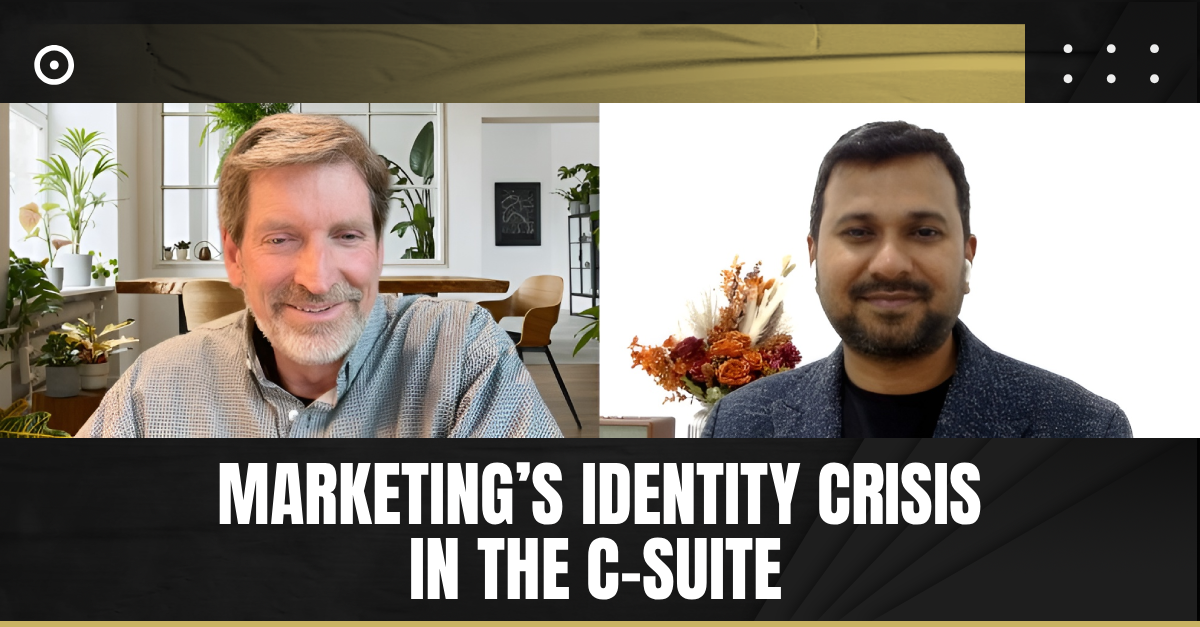


Episode #252:
Anand Sankara Narayanan, Chief Marketing Officer at Finance House Group, explains why marketing faces an identity crisis in the C-suite. He argues that marketing has not clearly defined its value within organizations. He breaks down marketing as a discipline built on customer psychology, data, and persuasion. He shares practical ways leaders can defend strategy and build internal trust.
“Market your department internally very well. You need to give the reasons, the problem’s foundations, the insight, the idea, the execution, and the results you will get. If that is explained clearly, then half the problem is solved. Half the battle is won internally for the marketing department and the marketers.” – Anand Sankara Narayanan
In this episode, Anand breaks down why marketing credibility often breaks down in leadership teams and how CMOs can rebuild it with clarity. He explains marketing as both science and persuasion, then shows how customer insight and disciplined decision logic help earn trust, reduce interference, and connect brand building with measurable revenue outcomes.
Follow Anand Sankara Narayanan on LinkedIn
Follow Steve MacDonald on LinkedIn
[Transcript]
[00:00:05] Steve MacDonald: Welcome to the C-Suite Sales and Marketing Perspectives podcast. I’m Steve MacDonald, your host, and today we have a very important conversation, not only if you’re a Chief Marketing Officer, if you’re in marketing, you’re in sales, you’re the CEO. We’re gonna be talking today about a marketing identity crisis in the C-Suite, and by unraveling that, we’re really trying to answer the bigger question, which is.
[00:00:28] Steve MacDonald: What is marketing’s role, and how does it contribute to the overall success of the business? And how should we be thinking about, as non-marketing people, working with the C-Suite executive in marketing and vice versa? And to do that, we have a special guest on here, Anand, and I’m not gonna attempt to pronounce your last name. I’ll have you do that in just a second.
[00:00:50] Steve MacDonald: Anand, so you’re the Chief Marketing Officer at the Financial House Group, and I’ll let you explain a little bit about who they are. You have a very big passion for personal finances yourself, just in your personal life, and I’ll let you talk a little bit more about that.
[00:01:07] Steve MacDonald: You also did something that’s more common in the United States than the rest of the world, which is you came from an agency background and moved into an in-house position. And I think it’s interesting because having both sides of that equation just gives better perspective overall. And we’re gonna benefit from that today as well.
[00:01:26] Steve MacDonald: But if you wouldn’t mind, I’d love to just have you kind of expand on your background a little bit more before we jump in.
[00:01:32] Anand Sankara Narayanan: Yes. First of all, thank you, Steve. Pleasure to be here on your podcast to talk about the different topics that we’ve lined up for marketing. And yeah, my full name is Anand Sankara Narayanan, and like you said, I’m Chief Marketing Officer at the Finance House Group in the UAE.
[00:01:48] Anand Sankara Narayanan: So Finance House Group is the largest non-banking financial services company in the UAE, having a diverse set of product portfolios, from consumer finance, corporate finance, insurance, investments, wealth management, asset management, digital financial solutions, et cetera, catering to a diverse set of clientele.
[00:02:07] Anand Sankara Narayanan: So like you’ve rightly said, I started my career from an agency background. So starting and working with an advertising agency, understanding how creativity works, how the communication part of the marketing pillar, which is one of the marketing pillars, works from the agency side, handling clients across the world.
[00:02:29] Anand Sankara Narayanan: I paid Citibank, from the US to UK to Australia. That’s where I developed my passion for personal finance and investments, right? And Nippon Paint, Beverly Hills Polo Club, and a lot of big media brands. So from there, I developed a passion for marketing to understand what happens on the other side of the business, how decisions are made, how things are moving.
[00:02:56] Anand Sankara Narayanan: From one department or another department, who initiates the campaign needs, and what is the need for them to do this versus that. So that curiosity kind of led me to where I’m sitting today.
[00:03:09] Steve MacDonald: Great. I would love to get your thinking on this, and the first one is I’d just love to have your perspective. You and I talked about before the identity crisis that marketing has in the C-Suite, and I’d just love to have your perspective on what you see as that identity crisis.
[00:03:25] Anand Sankara Narayanan: True. So marketing as a function has not done enough marketing on its own. We do marketing for other products, other businesses, but marketing as a function has not marketed itself clearly to other disciplines. Unfortunately, that is the beginning of the whole identity crisis that got widened and widened and widened, and this is the only discipline where anybody can come and start working on it from day one. It doesn’t require any practice.
[00:04:00] Anand Sankara Narayanan: It doesn’t require any prerequisite degree to even start that. A construction firm will not let you plan a landmark building without you having an architectural degree or an engineering background, right? A hospital will not let you practice medicine and test on patients without you having a qualifying degree.
[00:04:22] Anand Sankara Narayanan: So this is the only department or discipline, unfortunately, where anybody can come and practice and learn along the way, and there is no one right or wrong answer in this discipline. Again, there are multiple right answers to the same question. There are multiple wrong answers to the same question. Things are being proven day in and day out.
[00:04:42] Anand Sankara Narayanan: So unfortunately, our department or the discipline is very fluidic in nature because it involves human beings. It’s very fluidic. There are no laws of marketing that need to be followed, like the laws of physics or laws of engineering, where there’s only one output, one input, one answer. This discipline doesn’t have that.
[00:05:03] Anand Sankara Narayanan: So that led to a bigger identity crisis as we grow every day. With the explosion of AI, an explosion of new media, things are kind of getting exploded. Ten years back, digital marketing as a domain never existed. Today, it’s all digital marketing. Ten years back, social media marketing never existed. Today, it’s like social media marketing. So it’s like marketing versus social media marketing, digital marketing versus social marketing.
[00:05:34] Anand Sankara Narayanan: It’s kind of getting digressed and dissected day in and day out, with different voices having different opinions. That is leading to a lot more confusion in the discipline.
[00:05:48] Steve MacDonald: I love the way you framed this, right? So not only can anybody kind of come in and do this, but everybody feels like marketing is the one department that they can comment on, right? That they can give input on. Usually, as CMOs, we don’t tell a CRO how to operate his sales team or her sales team. We don’t normally do that.
[00:06:11] Steve MacDonald: Of course. Yes. But we get comments from everybody. Yes. Everybody’s an expert on marketing. While at the same time, you know, whether it’s demand gen marketing, you know, product marketing, social media marketing, I mean, it just. The amount of different choices and ways into the marketplace and the complexity that’s happening.
[00:06:32] Steve MacDonald: The amount of data that we have coming in, the way that our ICP is constantly changing and complex, it is a moving ball. And so we don’t necessarily get recognized that we have to be executives that are literally inside of the center of that moving ball, right? We’re expected. And then AI on top of that, like you said.
[00:06:55] Steve MacDonald: So I talk to CMOs all the time, and CEOs and CROs, and I constantly get CMOs, not on the podcast, but in our conversations in and around that, who feel like they have an imposter syndrome, that feel like they’re looked upon just as a cost center, that they’re only as good as their last lead.
[00:07:13] Steve MacDonald: They don’t feel like they always have a seat at the table. In fact, they’re like, what? That meeting happened, I wasn’t even invited, right? You know? So I’d like to have you kind of start now to dissect that, and how do we address this? If we just call it a marketing identity crisis, how do we start to address it?
[00:07:32] Anand Sankara Narayanan: So it begins with having absolute clarity on why we do what we do. The comment, and like you said, like every department has a say on what marketing does, is because the outcome that comes from marketing, which is like a piece of content or any communication campaign, is what is being commented on and feedback is given.
[00:07:58] Anand Sankara Narayanan: At the face value, it is being accepted and say it’s coming from another C-suite leader, so we gotta accommodate and all of that. Then you are letting others dictate what you want to do. The main reason is because the absence of absolute clarity on why we do what we do. Marketing is not content creation.
[00:08:16] Anand Sankara Narayanan: It’s the ways in which you want to express. It’s the means. It’s not the end, right? So behind the piece of content, marketing goes through a combination of arts and science. It’s a multidisciplinary approach that happens. Science, which is based on customer psychology, understanding the pain points, business needs, market needs, your data, your analytics, and with your budgeting and finance.
[00:08:45] Anand Sankara Narayanan: With this budget, with this goal, what is my ideal channel and the marketing activity that I can do that is going to give me maximum impact and ROI? That’s one decision. And the other decision, now this campaign is set, what do I say and how do I say it? That’s persuasion. That comes from the creative part, from the art part of the marketing.
[00:09:08] Anand Sankara Narayanan: Once the science is figured out, that’s the foundational layer. On top of it is what the art layer that sits, and the combination of that is the outcome that people are seeing in the external world. That’s what people are commenting on. Change this, increase the logo, we need to change this color, we need to change this word.
[00:09:26] Anand Sankara Narayanan: So if marketers don’t have clarity on why they did that particular campaign, why they chose this word versus that word, this color versus that color, or this channel versus that channel, if they never had that scientific foundation that made them make the decision, they will obviously take feedback and accommodate.
[00:09:49] Anand Sankara Narayanan: Everyone’s wishlist, and it becomes like the least common denominator, unfortunately, like the average output. But on the other hand, if you know clearly what you did, you go and defend and explain it clearly. This is why we are doing it. This is the reason we chose this. If we do it at least four or five times, then every department will say marketing knows what they’re doing.
[00:10:14] Anand Sankara Narayanan: Let’s leave them alone. Let them do their job. We will give our requirements and our challenges. It’s their task to come up with a solution to solve this business challenge through marketing. If that happens, then this every department coming and walking over every work that comes out of the department will never happen.
[00:10:34] Steve MacDonald: Right. You know, I love kind of the way you started all this, which was, as marketers, we don’t market ourselves internally. But you could look at it as the rest of the C-suite and all the whole sales department, right? The customer success department, the people that work for us in our marketing department, the go-to-market teams. They are all our internal customers.
[00:10:58] Steve MacDonald: If we don’t satisfy our internal customers. And the reason why I know this is so important, I asked you this question too. We had a prep call for this, right? And I always ask every C-suite executive that comes on, what are your two greatest challenges for creating long-term sustainable growth?
[00:11:12] Steve MacDonald: The number one challenge, number one by far, was internal alignment. We just interfacing as different departments and all having a unique, and well-thought-out and articulated plan that we all know and we’re all traveling on. That is not something that happens on a regular basis, and we have to really fight to do that.
[00:11:34] Steve MacDonald: Now you put on top of that everything that you were talking about, about the misperceptions of marketing and what it does and what it is, and that I can comment on it at any point in time, and you know that it comes down to a logo or a word or a this or that, right? It’s not hard to understand how we got here.
[00:11:55] Steve MacDonald: But we have to have a systematic way of saying, okay, if that’s the environment we live in, those are the internal customers. They have their needs and they have their problems that we’re trying to help overcome as well. We need to really think that through. We didn’t have a plan for that.
[00:12:12] Steve MacDonald: Right. On top of everything else that we do. And you talked about how marketing is a lot psychology and diagnosis, and so I’d love to hear, kind of as we start to move into what’s the solutions for this, what did you mean by that?
[00:12:29] Anand Sankara Narayanan: Yes, like I had mentioned, marketing is a combination of art and science.
[00:12:34] Anand Sankara Narayanan: It’s a multidisciplinary function. It’s not design, it’s not content, and that’s the end expression of the work that you’re doing in the background that starts with understanding your business, understanding your customer. Who’s the ideal customer that you’re going behind? What is the pain point that your product is solving for them?
[00:12:57] Anand Sankara Narayanan: And in what way it makes their life better. If you understand the emotions and the decision-making pattern of the customer, then you know what channel to use, when to target, how to target, and what to say, right? That’s the expression, end expression. But before that, understanding consumer psychology, human psychology.
[00:13:19] Anand Sankara Narayanan: Is one of the most fundamental prerequisites if we need to be successful in marketing. If we can’t understand our customers, how are we gonna market it to them? It’s like, it’s two teenagers going on a date. You need to persuade the other person to come with you. Correct. So this is mass persuasion that we need to do.
[00:13:39] Anand Sankara Narayanan: With our customers by understanding their behavior, their likes, their dislikes, and then position yourself in such a way that they will start noticing you. They will start developing trust over the period of time. Then they will buy you in the first handshake. They’re not gonna buy from you, right?
[00:13:57] Steve MacDonald: No. No, not at all. Yes.
[00:13:58] Anand Sankara Narayanan: So that is why this question that we were also talking about, consumer psychology and diagnosis, is so important as a starting point. That’s the background foundational work that other stakeholders never get to see. And if you do it and you bring it to the limelight, bring it to the table, and say, like, we spoke to like 200 of our customers.
[00:14:21] Anand Sankara Narayanan: This is why they chose us. We spoke to similar prospects. This is what they’re suffering with at that moment, and they don’t know the solution, and our product is an answer to that. That is why we need to do X, Y, Z. And if we do that and show the background work, bring it to the limelight, that is marketing. The marketing work to our internal audience. If that happens, this trust starts building.
[00:14:49] Steve MacDonald: I love how you brought up the word trust. Literally in the last couple of weeks, Forrester put out their 2026 predictions, and building trust was number one. It was the number one recommendation for how we grow our B2B businesses, is that foundation of trust. And if you put that together with this focus on understanding the emotional side, the psychology, the core business needs of our customers, it was, uh, McKinsey who came out with a study a couple of years ago that said most companies.
[00:15:27] Steve MacDonald: Even though it’s the greatest pathway to ideation and innovation, don’t execute well on a voice of the customer program. And you think about that, like based on what you just said there, right? We have to have a deep understanding of our customers. That is 100% the highest voice of authority in our business, right?
[00:15:51] Steve MacDonald: It is also one of the greatest sources of building trust. They want to know we get them. We understand them. So how important is this customer understanding, the voice of the customer? I’m gonna put you on the spot for a minute, if you like. Say, on a scale of one to 10, one, it’s not important at all.
[00:16:11] Steve MacDonald: Who cares? Who cares what the voice of the customer, right? 10, it’s absolutely vital to the growth of the business. Like how would you rate it and why?
[00:16:20] Anand Sankara Narayanan: I would definitely put 10 on 10 for this. We have to start. Our starting point is the voice of the customer. If I don’t know my audience, how am I going to market it to them?
[00:16:34] Anand Sankara Narayanan: Doesn’t matter. It’s internal audience or external audience. You need to understand that if you have other C-suite executives, if you have an important chairperson in your board, or if you have a new C-suite CEO who’s joined your organization, you’ll go and understand their traits of working.
[00:16:52] Anand Sankara Narayanan: What do they like? What do they not like? How is their style of working? And you adapt to that environment. That starts happening only by understanding your audience. Same way for your external customers or prospects. Doesn’t matter whether it is B2B, B2C, the foundations of marketing are exactly the same.
[00:17:11] Anand Sankara Narayanan: Marketing should represent the voice of customers inside the organization. We are the live wire between the external environment and the prospects and the customers and the internal audience. So marketing should feed information and insights to the product team, to the customer service team, to understand what we are understanding and studying from the market that helps them in revising their goals, their plan of action, and their strategy.
[00:17:44] Anand Sankara Narayanan: So this is definitely the most important function of marketing. Only if you have a voice of customer, you understand what do they need. Insights get generated, and one of the role of marketing department is insights generator. That’s the science part of it, not the art part of it. If you have to come up with a campaign, I need to know what is the insight that I am getting from there.
[00:18:10] Anand Sankara Narayanan: On top of it, I can build my marketing campaign and position my product, right? This works very evidently in consumer businesses, especially in food and FMCG products. The marketing function works so well following the foundational work diligently to execute what they want to execute. If I have to give you an example that everybody can easily understand, take Snickers, right?
[00:18:37] Anand Sankara Narayanan: Snickers runs a worldwide campaign, and their campaign is exactly the same in every country in the world. It doesn’t change. And it started from one basic human insight, which they discovered, that you are not you when you are hungry. So you go and have a Snickers and quench your hunger and be yourself again.
[00:19:01] Anand Sankara Narayanan: Right? You go rogue when you are hungry, right? You snap at people. You are not in a good mood when you are craving for food, when you are hungry. So that is a universal insight that they could gather only by understanding the customers, studying the human psychology. Without that, it is difficult to do.
[00:19:22] Steve MacDonald: I love that, and it transitions over to the B2B world, right? Where the audience here is, are all B2B marketers, but we have to understand the insights. And two things that I thought about while you were talking there is, in a B2B company, we don’t typically have Chief Customer Officers, Chief Experience Officers, right?
[00:19:44] Steve MacDonald: And so everybody is kind of picking up knowledge. Sales is picking up knowledge in the sales pipeline, and customer success is talking to customers, and marketing. We have our own insights, and we have all kinds of reports, and we’re talking to customers as well, or we should be, but who’s uniting all that?
[00:20:02] Steve MacDonald: That’s the most important voice in the business. And Gartner, Forrester, McKinsey, Deloitte have all made recommendations that in a B2B company, the Chief Marketing Officer should be the one that is also operating as the Chief Customer Officer, because there has to be somebody that’s bringing all those insights together.
[00:20:24] Steve MacDonald: That’s how important all this is, and important to building trust with the customer. Building campaigns, building sales enablement materials that help sales sell, customer success upsell, cross sell, and less churn, right? So here’s my question, I guess, is if that voice of the customer is a 10 outta 10, then shouldn’t it be a 10 outta 10 in our veracity for gaining that voice of the customer and operationalizing it so all the teams actually know and can use it?
[00:21:02] Steve MacDonald: And it’s not just in the head of a few people. How do we do that? Like, how do we make it so important that everybody can understand and tap into it?
[00:21:11] Anand Sankara Narayanan: You are very spot on with this question, and especially in the B2B world, where everybody is working in different directions with their own set of goals.
[00:21:23] Anand Sankara Narayanan: It’s a very siloed approach. Who’s uniting all of them better, presenting as a voice of customer? And rightly put, yes, the head of marketing or the marketing chief has to be one person who is a live wire between all the departments and relaying this information of the voice of customer, or the insights that they generate, the pain points that they understand.
[00:21:48] Anand Sankara Narayanan: Without having a systematic approach or a program in place, in an auto mode that functions like any other department, this will not happen on its own, right? Like sales is doing sales kind of tasks, third generation pipelines, your marketing qualified leads, your sales qualified leads, the initial demo board. They maintain the pipeline so religiously.
[00:22:18] Anand Sankara Narayanan: The product team, they have their own sprints, roadmap developments that they’re doing on their own set of goals.
[00:22:26] Anand Sankara Narayanan: We don’t have a dedicated team in place to gather the insights. And there is one team, which you have rightly pointed out, which is a customer success team. But actually, it is not doing the exact work that represents the word customer success, because customer success team is used for inside sales, cross-selling, upselling, and they do service.
[00:22:43] Anand Sankara Narayanan: They’re like a service agent between the B2B corporate and the customer and the client, whoever you want to call it. So they speak to the customer, but their approach is only based on if you have a problem or bugs to be solved. Yes, I will get it solved for you.
[00:23:02] Anand Sankara Narayanan: Or do you have this problem? I have the next product in pipeline. I can upsell, because it’s been given a task to cross-sell and upsell as targets. Correct. That’s what they do.
[00:23:16] Anand Sankara Narayanan: But if you also task them as one of their KPIs and KRIs to include is speak to the customer and represent his problem into our organization, identify opportunities, and see what we can do.
[00:23:28] Anand Sankara Narayanan: Not to upsell, but to build a whole new product pipeline based on intelligence that you are gathering from the customer segment. They are exposed to the target market on a daily basis, right? If that exposure is used intelligently to gather insights, to mine those insights, that’s a gold mine for the B2B organization.
[00:23:55] Steve MacDonald: I have to tell you, I love everything we’re talking about here, and it makes me think that there’s also preconceived notions of what marketing does that I wanted to ask you about in two kind of different categories.
[00:24:08] Steve MacDonald: One is long-term brand building, building trust behind the organization and what we’re known for.
[00:24:17] Steve MacDonald: The other is short pipeline generation, and the general perception is that you have to do those separately. That they can’t be done together. And if you spend a lot of time and effort and money on brand building, you’re sacrificing short-term demand gen pipeline generation.
[00:24:43] Steve MacDonald: And I’d love to get your thoughts about what you think about that.
[00:24:43] Anand Sankara Narayanan: Yes. So this is another biggest pain point for the marketing community within any organization, short-term versus long-term, brand versus demand. There are debates that have happened on multiple forums about this topic, right?
[00:25:00] Anand Sankara Narayanan: So I explain this with an analogy that people can easily understand. And before I start into that analogy, one of the important aspects of marketing’s job is having bifocals.
[00:25:17] Anand Sankara Narayanan: You have a long-term vision, and you also have a short-term vision. Both need to be balanced at the same time. Bifocals, right? And this is the only department where you need to have your head in the cloud and feet on the ground.
[00:25:34] Anand Sankara Narayanan: You need to dream by having your head in the cloud all the time. You should also have your feet on the ground, running and executing and implementing that.
[00:25:43] Anand Sankara Narayanan: So you are connecting both extremes. And unfortunately, both extremes have to be handled in parallel. You cannot leave one for the other. So an easiest example for the business community to understand is, uh, I’ll take the medical analogy. Businesses are having issues, right? Which is like they’re in current pain. They need some solution.
[00:26:06] Anand Sankara Narayanan: Imagine they’re like humans. They’re going through some pain. They need immediate solution, and marketing as a team at that time, they cannot go and say, I will do brand building for you and I will do this for you. It’ll start giving you results in 10 months. Then the objective is lost. I’m having a short-term pain now.
[00:26:28] Anand Sankara Narayanan: I don’t need your multivitamin supplement, which is my brand building. I need the painkiller now, which is my demand generation and pipeline management. So today, immediately, I need the painkiller to fix my pain so I can walk and I can crawl and I can do my everyday activities, right?
[00:26:58] Anand Sankara Narayanan: But the biggest problem or mistake that business leaders miss is now it is solve my choice problem. Why don’t I use it the next day and the next day and the next week and the next month and the next year? I’m focusing only on the painkillers, which is demand generation. It is tactical. It is not strategic, so then you are only focusing on the painkiller and short term. You are completely ignoring your long-term health, which is brand building.
[00:27:21] Anand Sankara Narayanan: And for your human body, which is your multivitamin supplement, you need to have your immune system healed and grown over a period of time. It doesn’t happen immediately. You need to consistently give your supplements to your body and system to develop the immune system. That will take two years and three years and four years.
[00:27:40] Anand Sankara Narayanan: Same thing is brand building. It takes three years and four years and five years of consistent efforts for your brand to become strong. But that doesn’t solve your today’s problem. But if you ignore that and you think only painkillers is solving your problem, your human, one of your body parts could be rotting inside.
[00:28:02] Anand Sankara Narayanan: You don’t know. Beyond a point, your painkiller will not work, right? So you need to always balance the painkiller versus a supplement story.
[00:28:11] Steve MacDonald: I love that. I love that analogy, and I’ll take it one level beyond that, which is I had a CMO on the podcast who said, so literally, if we do the branding right, it takes cycles away from the sales process because instead of the individual salespeople having to spend a lot of time to build credibility, right?
[00:28:35] Steve MacDonald: The brand builds credibility in the marketplace. And that credibility turns into trust. And we are not gonna buy from someone. And we still are people buying from people. We’re not gonna buy from somebody we don’t know or trust. And so building that trust, back to like the Forrester 2026 predictions, focusing solely on trust, we can’t give up that vitamin supplement. That is our, is the way that we build trust in the marketplace.
[00:29:06] Steve MacDonald: Without trust, we are a relationship-based business, right? All B2B is relationship-based. Without that trust, without that brand building, we don’t have the very underpinnings of success for our company. And so I wish we had another hour and a half because we’ve talked about so much already and we have so much more to talk about.
[00:29:25] Steve MacDonald: But I would love to ask you one last question, and that is that if there was one thing that you wanted people that were the CMOs, CEOs, CROs, or head of sales, head of marketing, that are, you know, customer success, that are gonna be consuming this podcast, if there was one thing that you wanted them to remember and take away, what would that be?
[00:29:49] Anand Sankara Narayanan: Market your department internally very well. That is one thing I would tell to every CMO out there or every aspiring marketing leader out there. Explain with absolute clarity on why you do what you do. Very simple. If you think I’m working on a campaign, no, that is not the answer of why you do what you do, right?
[00:30:13] Anand Sankara Narayanan: You need to give the reasons, the foundations on the problem, the insight, the idea, the execution, and the results that you’re going to get. If that is explained clearly, then half the problem is solved. Half the battle is won internally for the marketing department and the marketers.
[00:30:35] Steve MacDonald: I think those are great words of wisdom, and I have to say, I know one thing’s gonna happen. People are gonna have questions, and is it appropriate that I give out a link to your LinkedIn profile so that people could reach out and ask you questions?
[00:30:49] Anand Sankara Narayanan: Absolutely, no worries.
[00:30:50] Steve MacDonald: Fantastic. Well, you know, we covered so much territory here, and the mission of this podcast is to bring different perspectives from C-suite executives all over the world that we’re all trying to do the same thing. We’re trying to move our B2B businesses forward, and we’re trying to.
[00:31:07] Steve MacDonald: Understand the dynamics and the issues and the complexities and the trends and the challenges. And if we can all share with each other, then that’s like the rising tide that lifts all boat. And you were an amazing part of that rising tide today, Anand. I just wanted to say thank you for coming on.
[00:31:21] Anand Sankara Narayanan: Thank you, Steve.
[00:31:22] Anand Sankara Narayanan: It’s an absolute pleasure to be on your podcast, and what you’re doing is such a noble cause for the entire marketing community and for the B2B world. We’re bringing in different perspectives to strengthen, enrich, and educate the community so we can all do better in the business. So thank you for what you’re doing.