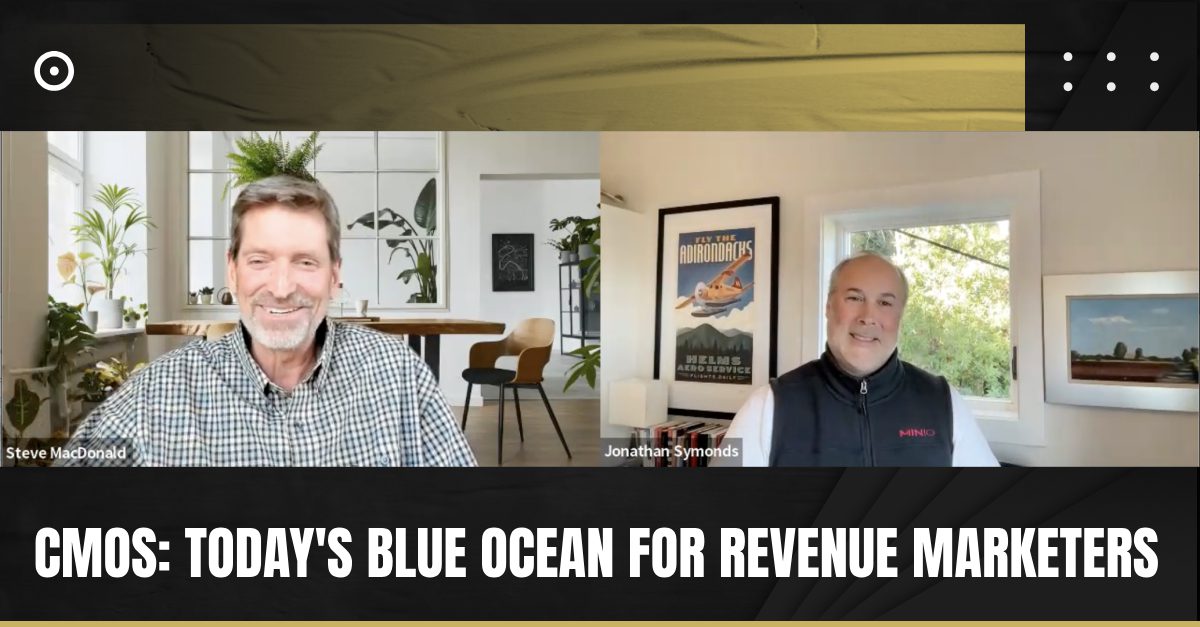


Jonathan Symonds, 2x B2B CMO, highlights the power of thought leadership as critical to embracing a self-serve buying model. By creating high-quality content, B2B companies can engage their target audience earlier in the buyer’s journey while building strong trust-based relationships.
“You’re not trying to radically transform buyers in a single piece of content. What you are trying to do is get them to think differently by reframing the conversation.” – Jonathan Symonds
Jonathan outlines how thought leadership content allows them to “reframe” the conversation, elevating and clearly differentiating themselves from competitors and establishing themselves as trusted authorities in their industry. And if done correctly, it creates content that serves as a perpetual seller in the self-serve buying world.
Follow Jonathan Symonds on LinkedIn
Follow host Steve MacDonald on LinkedIn
[TRANSCRIPT]
[00:00:00] Steve MacDonald: Welcome everyone to the B2B C-suite Marketing Perspectives Podcast. I’m Steve McDonald, your host. And today we’ve got a really interesting conversation because we will talk about this trend.
With B2B buyers, the goal is to want more and more of a self-serve buying experience. It’s a growing rate. The percentage is growing and growing in terms of how many of them don’t actually want to connect with an actual salesperson. And Jonathan Symonds here is the CMO, a two-time CMO with seven years of experience as a CMO.
But importantly, you’re working right now with a company, MinIO, and you’re a hundred percent inbound. So there is no sales department. And so you’ve been forced to make decisions and start doing business that is equated to where all B2B CMOs need to think through in a very, very deep way in terms of how they are adapting to the trends in the marketplace.
So Jonathan, if you don’t mind, maybe expand just a little bit on your background in MinIO. And then we’ll jump in and start with this 100 percent inbound buying process you’re working with.
[00:01:21] Jonathan Symonds: Yeah, absolutely. Well, first of all, thank you for having me, Steve. I’m a big fan of the podcast and have watched many of them over the last year or so and really enjoy it.
My path to the CMO role is a little bit non-traditional. I started my career in politics. I worked in the State Department for Secretary Baker and Legislative Affairs way back then. Then, I actually ended up going to business school, where I spent a lot of my time taking finance and accounting classes.
I was doing very well in the marketing classes and spending a lot of money to go to business school, so I figured I would spend that on the things I wasn’t very good at. That led to a very short stint in finance, but my passion was really in marketing, and I came back to that pretty shortly thereafter, and I’ve been in marketing ever since.
So, that’s my path here. Our journey at MinIO is really interesting. As you mentioned earlier, we’re a hundred percent inbound. We don’t have any commission salespeople at MinIO, and it’s a great way to build a company because it’s very efficient, but it’s not necessarily for everybody.
We could do it because, ultimately, philosophically, we would always be open source. That created no friction between our audience and adopting our product. And so that open-source model was very, very helpful in that regard. The other part was that we were going to market primarily through developers to start with.
And the Gartner stat says that 75 percent of B2B buyers don’t want to talk to a salesperson. Well, I can guarantee you with developers that numbers like 99%. We needed to build a content machine that allowed them to really learn the MinIO way and learn the MinIO way.
Allowed them to come across that buying journey themselves to adopt our product to evangelize it internally, and ultimately convert to a commercial customer down the road for that organization. And so that’s really what we’ve done. It’s product-led, it’s developer-focused, and it’s inbound-driven. It is a new model.
And again, it’s a very efficient way to build a business. And it’s one of the reasons that MinIO has been able to be profitable and achieve its valuation.
[00:03:35] Steve MacDonald: So what I want to explore right away here is one of your most important ICPs is the C-suite, right? So this isn’t an inbound-only model that is just for developers because many companies that are watching here are saying, well, I’ve got ICPs that are much higher up in terms of their seniority in the company.
They’re harder to get to, right? There are buying committees. When you get up to the C-suite level, all kinds of things come into play, yet you still have a hundred percent inbound process. Can you explain that difference in terms of how you think about inbound when you’re moving upstream from a developer to the C-suite?
[00:04:24] Steve MacDonald: Yeah,
[00:04:24] Jonathan Symonds: it’s a great question. And it’s a challenge that, that we’ve absolutely had to tackle. Ultimately, the way we see the world is we see users and buyers, and buyers are in the C-suite, users are on the developer side, and we have to develop content for that entire journey.
And so what we’re trying to do is basically create thought leadership pieces that get at that, that kernel of truth, that creative tension that allows us to engage the C-suite in addition to developers to the point where they’ve heard about MinIO in their organization because, they know what’s getting run, but it allows them to engage and become more expert and more familiar and become brand advocates themselves. And so we’re looking to cover that entire spectrum. And it’s a delicate balance. But it’s one that we’re achieving at this point.
[00:05:16] Steve MacDonald: Now, because this is such a staggering number. Obviously, a hundred percent inbound process requires a lot of content, right? And all B2B marketers know we need to create tons of content. But give us an understanding of the kind of consumption, like visitations you get to your website, and then, therefore, the kind of cadence and refreshed content you need to produce regularly.
[00:05:46] Jonathan Symonds: so I just ran some numbers, I mean just from the last year. We did a little over 1. 1 million unique to MinIO. And that includes our documentation, which includes the core website, which does not include YouTube and other channels. But that resulted in 1.1 million page views. So, an extraordinary amount of page views for a company in the storage business. So, it’s a very specific type of audience. And that means you have to create a lot of content, right? Because you have to keep content fresh for that audience, and you must continue to find different vehicles for your messages.
And those vehicles can’t be the same, right? Not everything looks like a nail, so you must always use a hammer. We’re looking for different ways to approach that. But to give you a sense of what that looks like from a content perspective, Just in October, we did 21 blog posts.
We did six videos. We did one animated video. We had two new web pages. We did half a dozen ABM pages specifically for customers that we’re targeting again, covering that whole buying persona. And that doesn’t include bylines. It doesn’t include podcasts. It doesn’t include even just the new documentation that we put out there.
That gives you a sense of how focused we are on this engine of content. On a day-to-day basis.
[00:07:11] Steve MacDonald: And you mentioned something we were just talking about right before we hit the record button: the number of different channels you’re also filling that the one blog post is just the start of the journey.
Can you give us just kind of without revealing your secret sauce or anything, but how many different channels are you actually putting the same piece of content into in order for it to be the kind of thing that is available and accessible for everyone?
[00:07:42] Jonathan Symonds: We joke that every single piece of content that we create should be able to live its best life and then some. To do that, the blog or the YouTube channel is the starting point.
And then you have your standard social, and in our space, it really is X and LinkedIn, as are the two primaries. But there are probably another four to six channels beyond that that we intentionally fill, re-syndicate, or try to re-byline almost every piece of content for because we’re trying to reach the broadest audience possible to teach them about the MinIO way.
Again, when I say the broadest audience possible, I don’t mean everybody. But the people we care about, we’re very intentional about finding those sorts of people who would consider them niche places to re-syndicate our content. But they are very powerful for us because we end up being the best-performing content on those sites because those are our people
[00:08:43] Steve MacDonald: So you had mentioned that to create all this content and have it work right, it’s not the quantity of content. It’s the quality of the content. And so you talked about what we all know we’re trained on in Marketing 101 classes: you really have to know your audience, right? But your goal that you talked about was creating content, knowing that audience more than anyone else, so that the content is a perpetual seller. The one bit of context I’ll put around is that marketing plays a much larger role in the sales process in a world where all B2B marketers are going more and more to this self-serve buying.
So everybody listening here thinks I need to get more inbound. Because I need to get earlier in the buyer’s journey. I need to get conversations that are happening earlier. So, what are your thoughts on this notion of a perpetual seller in the self-serve buying world?
You mentioned that content has to be perpetually selling.
[00:10:04] Jonathan Symonds: Yes. So it’s a very interesting challenge. And again, without a sales team and without any friction between our end user and the adoption of our product, and because object storage is a very horizontal use case by design, we’ll find ourselves pretty much everywhere, right?
So we’re software-defined. It’s not an appliance. You can just download it and run it. It’ll run on your laptop. It’ll run in the lab and so forth; because of that, our buyers and the people who adopt our product over time are everywhere. And so we need to be able to create content that enables them to move themselves down that buying process by themselves whenever and however they want.
So, an interesting stat is that MinIO’s busiest time on the website for documentation for pricing calculators for the pricing page and other content on the blog is between one and three in the morning. And we’re based in California. You would think it would be somewhere in the middle of the day in the United States, but it’s not.
It’s really the end of the day in Asia. It’s the beginning of the day in Europe, and that’s two-thirds of the planet. That’s, therefore, going to be the busiest time just by making sense in terms of looking at the logic of it all, and so we’re trying to create everything they need to be able to serve themselves, to get smart on the MinIO way.
To understand the concept is such that when they do come inbound, they have all the information. There are a lot of stats that I just saw from some research from 6Sense that talked about how by the time they reach out, they’ve done 70 percent or more of their work. And so we want to drive that number even higher, such that when they reach out, we are their first and probably their only touch because they’ve already made that selection.
They’ve already downloaded the software. They already run it. They understand what the capabilities are, and they may have questions about the buying process or getting past a certain phase in their mind. That’s the first time we’ll see them, but we want to give them the tools to get there before they even come inbound. Now, at some point, they will talk to somebody on the business team, but it’s not going to be a commissioned salesperson who’s out there knocking on their door.
[00:12:21] Steve MacDonald: So you mentioned something in there. You mentioned frictionless, but there is friction in terms of competition to MinIO, right?
So there are other choices, if there weren’t a MinIO in this world, the developer world would still work right now. You’ve got a unique solution that you’re bringing to the audience, but in terms of frictionless, you had mentioned earlier that you’re trying to move into a bluer ocean.
And for anybody who hasn’t read the book, they should, right? The Blue Ocean Strategy. Where a red ocean is red from the battle of competition, where the blue ocean is where you redefine the industry, you redefine the marketplace. Therefore, you redefine bluer waters, a bluer ocean. So, part of that lack of friction is your ability to redefine.
And you and I had talked about reframing the problem, right? Reframing then the opportunity and that you’re accomplishing that through content, thought leadership content. That reframing of the conversation and what’s happening. Can you tell us about that and how important that is to your overall content strategy?
[00:13:44] Jonathan Symonds: Yes. So we’re big fans of Blue Ocean Strategy here as well. And frankly, as a challenger brand, it was almost an imperative for us because the storage industry is an immensely crowded industry, and there are plenty of giants in it. Our primary competitor is AWS S3. You cannot choose a bigger competitor coming out of the gate than AWS S3, but there are also IBM’s in there, NetApps in there, and Pure Storage in there. There’s Dell EMC.
There are dozens of major players. So, from the get-go, we needed to carve out a content and use case strategy that allowed us to operate in an uncontested space. And so we started to focus from a content perspective. Those things allowed us to climb the ladder out of this very messy mosh pit of storage competitors.
One of the areas that we did that was through performance benchmarks. Performance benchmarks gave us the credibility to discuss different types of use cases you couldn’t use for object storage. Things like analytics, things like AI, things like machine learning as opposed to the standard archival stuff.
And so we built content that allowed us to start to climb that ladder, and then we talked about things like being the cloud native and the cloud operating model. And again, staking out space where by the time we had defined these requirements for this work. When you were done with that list, only two competitors stood for things like being truly cloud-native.
And it was MinIO and AWS S3. So we basically eliminated everybody else through content by saying, here are the first principles. And you will agree with the first principles because you are in a technical role or you are a developer. Then by the time you’re done agreeing with that, you’ll realize that none of the other vendors in the space can actually serve that need for you.
And so, that allowed us to basically carve out this uncontested space and operate in it for a long time. Now, we’re finding more and more of those competitors have adopted that same messaging. But the nice thing is that their products haven’t been able to meet the messaging. So it’s actually worked out well.
We wanted them to come on our turf to fight the battle we wanted. And again, content was the driver of framing that conversation. One other thing is that there is a lot that comes through what we call thought leadership content. Thought leadership content can be both for buyers and for users.
And we talked about that a little earlier in the podcast. So, what is thought leadership? The thing that defines thought leadership content is this: there’s a nugget of contrarian in it. It’s not oppositional, right? It can be controversial, but it’s not intentionally so. This is the concept of creative tension.
It has to be educational. There has to be something that’s given from a thought leadership perspective. It has to be informative, it has to be defensible, but it also has to be familiar, right, you can’t go too far. There has to be a bridge from here, where I operate today as a buyer, and here, where this future state is that I want to get to. But it can’t be so far that you can’t actually get there. It has to be close enough that there’s a bridge that can be built with logic and content and with a fairly good argument,
[00:17:25] Steve MacDonald: The last three minutes of what you’ve just said, I think, is an MBA’s worth of learning because every single company out there is trying to redefine the market in a way that positions them in a unique way, as the best solution. And what you just went through defined the first principles of what needs to be done.
You’ve got a unique point of view, right? That’s got that healthy dose of controversy in there. And then you say, because of that point of view, we believe in this and this.
And you walk them through all that. Also, the more you can get outside validation from your audience that they agree with that, the better. When you say it, it means this much. When your audience or ICP says, I agree with that, it means so much more. Because you’re the seller, right? So, their peer community agreeing with these first principles has tremendous value for you.
That is reframing the conversation in a very healthy way. And that’s what gets thought leadership content noticed, it raises the eyebrow slightly. It says, what? That’s interesting. I haven’t quite thought about it that way. That makes good sense. And you take them along this journey, the buyer’s journey.
This has been incredible in terms of what everybody needs to do with their thought leadership: reframing the conversation in a very healthy way. so that you bring the buying base along with you, and that’s difficult. That’s really hard to do. And you did it where nothing is more competitive than the storage industry. And so if you can do this in the storage industry, the takeaway is that anybody in your industry can do it, too.
But what would your recommendation be to the CMO who’s now listening to this saying, absolutely, I want a bluer ocean. I want to reframe the conversation. How do they start this process? How does it? How should they start thinking about this?
[00:20:09] Jonathan Symonds: I think, ultimately, to move somebody from the status quo, which is really what you’re trying to do with thought leadership content. You can’t be writing the status quo. So, we talked about this concept of creative tension.
And I think. The other thing you mentioned, which is an important point, is that you need to move their perspective and reframe the conversation. And it doesn’t have to be a huge amount. Think about if you lie on the floor and stare at the ceiling or then you get up on a stool. You haven’t changed your worldview that much. But you certainly changed your perspective enough to look at your room differently than you did previously. And that’s what you’re trying to do. So again, you’re not trying to radically transform them from a single piece of content. You are trying to get them to think differently.
They might consider themselves that their incumbent solution doesn’t do this, and I have a need for this, and so that’s a fairly generalizable set of frameworks. One of the ones that we use here, and I challenge the people on our side to think about, is this concept of Differentiated first. Defensible second, and then the third is Translatable.
And so what do I mean by that? Differentiated gets at this concept of reframing the problem. What’s slightly different about this? It could be object storage that’s fast. It could be object storage that can run on a drone. It could be anything that basically is differentiated and gets you thinking about the problem differently.
The second is if you’re trying to move somebody, you have to be defensible. And so you have to build content that is ironclad because you’re going to have other people in a crowded industry that attack those principles. You need to be able to defend them so they can repeat the experiments that you showed for these benchmarks.
They should be able to repeat what it is that you’ve shown them that they can do now, so that defensibility is a big piece of it. The third piece is this concept of being translatable. And so that means really being accessible. So, as we said and talked about earlier, Seth Godin says, shun the nonbelievers.
You want to have an audience that’s wide enough to consume what it is, but no wider than that. Right. And so you want it to be accessible. You don’t want it to be so narrow that you can count it on two hands. But you want it to be narrowed enough that they know it’s for them. And if you can achieve all three of those things with your thought leadership content, you’re going to be able to create better content because those things are hard to do.
There’s tension there, but you can do that.
[00:22:46] Steve MacDonald: There is so much conversation here about reframing the conversation and using content to do that. If I were just to ask you a question, on a scale of 1 to 10, how important is content to you and MinIO in terms of the overall growth and success of the company, where 1, it’s not important all, 10, it’s vital to the growth and success of the company. How would you rate it and why?
[00:23:15] Jonathan Symonds: Can I say it’s a 14?
[00:23:17] Steve MacDonald: You can, it’s, it’s your answer.
[00:23:21] Jonathan Symonds: It really is a 14. So, ultimately, I learned this pretty early in my career. When I had my first really senior role in the marketing department, I learned that content is the engine of value creation.
And so, in the business that I’m in today, content is the engine for the entire pipeline. So, that’s a very different set of responsibilities, but it is the engine of value creation here are things like messaging, and there are things like SEO, and there are other things, but these are all tactics.
At the end of the day, your content strategy will define how people perceive you. It is the brand, right? That’s the brand that they interact with on a day-to-day basis. Your voice, your ability not to be over the top with what you say, you want to basically cultivate that voice for the audience that you’re talking to.
You want to be confident but not arrogant. You want to be authoritative but not overly opinionated. All of these things play into your brand interactions.
[00:24:28] Steve MacDonald: I just want to get your take on this. It’s a one-liner. It’s from a three-time B2B CMO. And when she talks to her CEO and her CRO and how she explains the brand, she literally says, “Today’s brand is tomorrow’s demand.”
[00:24:50] Jonathan Symonds: I think it’s a great way to think about it. As they taught us in business school, a brand is a promise, right? And your ability to live up to that promise is really, really important. They say trust arrives on foot and departs on a horse.
The concept is that you’re building this trust. Because that trust will be what they buy later, they’re buying trust. They’re buying a belief that you’re going to deliver on what it is that they can’t, what you say you’re going to. I’m very fortunate in that the leadership of MinIO is building a long-term brand.
And so they’ve given me the freedom to do these things intentionally. I’ve never been pushed to do things in a way that doesn’t make sense. We’ve always had conversations about what’s the right way to do this. And so it’s been a great partnership.
[00:25:55] Steve MacDonald: Two things came to mind when you were talking about the brand. A survey came out, and basically, it said a sense of connection to the company is as important as what the company itself does. That’s the power of the brand, right? You talked about this kind of unique background at the very beginning, where you took a lot of accounting classes. You went to work at Price Waterhouse Coopers.
So, in this talk of thought leadership about building expertise and brand, you also have to be very data-driven as a CMO today. What do you think about it regarding the numbers and support for building that brand and reframing the conversation? Everything that we’ve been discussing here today, how do you think about it in terms of the numbers, attribution, and return on investment?
[00:27:03] Jonathan Symonds: Yeah, there are very few parallels for me in this role, maybe JFrog or Atlassian, where they really started out with an inbound model-driven approach. And then, ultimately, they became more traditional regarding their sales focus.
So there aren’t a lot of, in the market parallels that I can go look at for KPIs and things like that. So, we’ve really built a lot of our own metrics around what community adoption looks like. What does conversion look like for that?
We built a sophisticated listening system to know who’s using us and in what capacities. Particularly for large enterprises, because that’s where we want to focus our content from an ABM perspective is the people who are adopting us in mass, right, where we can see that we have become the standard in that, in that developer cadre, and then we want to, elevate that conversation up to the C-suite.
We’re also starting to work from the C-suite down as well and try to explain to them this is the way. We look at a lot of data, and I look at a lot of data. I’m in a spreadsheet probably two hours a day, to be honest with you. And because that allows me to really have a good grasp of where we need to focus our content strategy.
Because content strategy comes from where we see an interest, what use cases, and what we should write about. If I’m looking at not only our CRM, which is HubSpot, and saying, all right, what closed and what was the use case there? But I’m also looking out and if I can see it in our data, where, what pockets of usage, and then what kind of use cases. We’re always looking at that because it informs the content strategy.
[00:28:54] Steve MacDonald: Yep. That’s one of the biggest things. We all have our educated guesses on what the best content will be, the best themes, and the discussions we can have around particular topics, but looking at the data, this is something that marketers learned a long time ago.
We have to be testing everything that we do. And that data is the test data, right? So you’ve gone through, and you’d have assumptions on we need to go down this direction. Right. And it just didn’t pan out in terms of the engagement rate. Some that we didn’t think would work actually did great. And that’s what we dive down deeper into. And we continue. We create the theme that goes behind that content.
[00:29:39] Jonathan Symonds: I think that’s an area of risk that I see for a lot of my fellow CMOs, particularly in the tech business, is that you have very, very strong technical founders and there is a tendency for egocentric distribution error because they’re, they are developers, developers surround them, and that audience is something that they know inherently, but it doesn’t necessarily mean that all their instincts are right. So you have to run these experiments. You have to look at the data to make those determinations. One of the great things about developers, developer founders, and technical founders is that data will sway them. So you come back and say, by the way, I know you thought this was what it was, but this is what it actually is. And here’s the data to support that.
[00:30:28] Steve MacDonald: I, really wish we could just keep going on another hour or so, but what I want to do is, because there’s been so much that we’ve covered so far, if you could just boil it down to what is the one big takeaway that you would have for the B2B CMO audience that is watching this right now that you’d want them to leave with and remember. Well, I think,
[00:30:55] Jonathan Symonds: Seth Godin also said another great quote that marketing is this generous act of helping somebody solve a problem, and it’s their problem. That’s really from a content perspective.
What we’re trying to do here, and if you think about it from their perspective, really not your perspective, but their perspective, what do they need to be better at their jobs, you’re going to be a much better marketer than if you say I’m going to talk to you about my company speeds feeds features and so forth.
And you think about what they want to consume, you’re going to be more successful in this. That’s an empathy mentality that you have to have. To be successful in content marketing, otherwise, you’re talking to, as opposed to having a conversation.
[00:31:49] Steve MacDonald: That makes perfect sense. And everything, by the way, has made perfect sense.
[00:31:54] Steve MacDonald: But I know there’s been some eyebrows lifted, right? And some follow-up questions. If people wanted to get ahold of you and ask you a question, would it be appropriate that we give a link to your profile on LinkedIn? Would that be a good way to get ahold of you?
[00:32:10] Jonathan Symonds: Yes. And listen, one of the great things about joining a startup is it’s your first name and then the name of the company.
So it’s jonathan@min.io, and you can email me there if you want to.
[00:32:22] Steve MacDonald: Fantastic. Well, Jonathan, thank you for coming on. I actually feel like we’ve gone through an MBA course here today, all in about half an hour’s time. So, thank you very much for sharing all your insights.
[00:32:33] Jonathan Symonds: Absolutely. It’s been fantastic.