
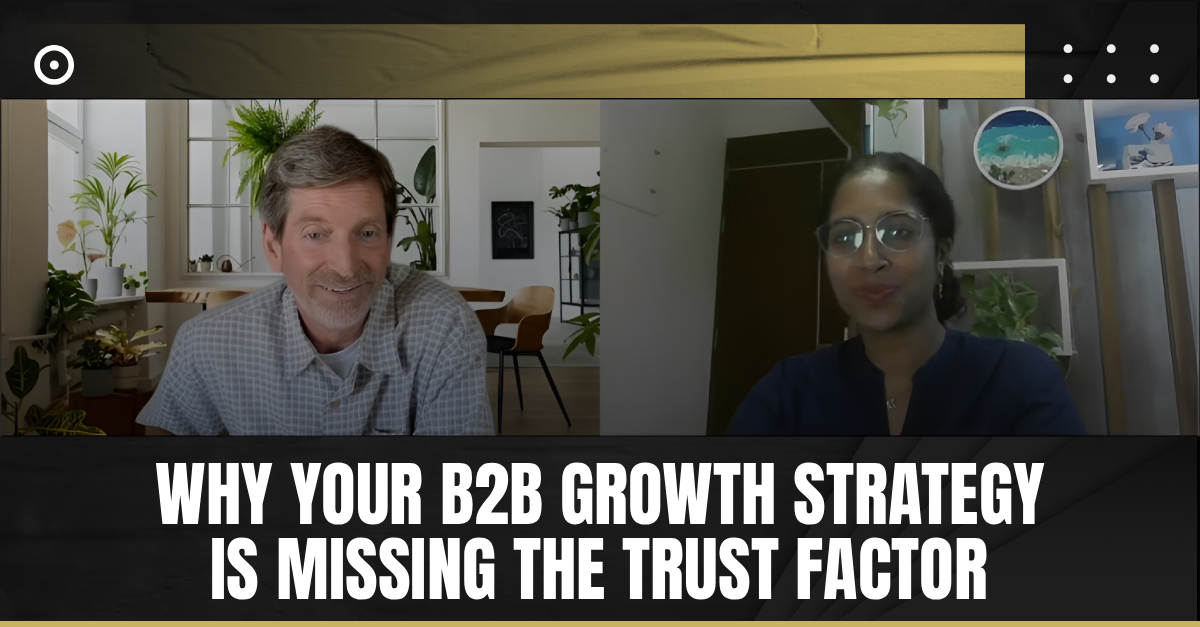


Episode #218:
Shirin Hameed, CMO at Detroit Engineered Products, explains why trust is the missing link in B2B growth. She shows how post-sale experiences create loyalty. She urges authentic alignment across teams. She shares practical ways to maintain consistent messaging.
“It’s not the product itself that you’re selling, but you are selling a longer relationship with the client. We are enabling mutual success. The more you succeed, the more we grow together.” – Shirin Hameed
Shirin shares why trust after the sale drives real growth. She explains how alignment, feedback loops, and consistent messaging help buyers feel confident in long-term value. You will hear actionable ways to turn post-sale experiences into loyalty, expansion, and measurable revenue impact.
Follow Shirin Hameed on LinkedIn
Follow host Steve MacDonald on LinkedIn
[Transcript]
[00:00:05] Steve MacDonald: Welcome everyone to the C-Suite Sales and Marketing Perspectives podcast. I’m Steve MacDonald, your host, and today we have Shirin Hameed on. Now Shirin, you’re a Chief Marketing Officer at Detroit Engineered Products, and it’s really interesting because you actually started your career out as an engineer.
[00:00:23] Steve MacDonald: And I love that because I love the way that you think. In all of our previous conversations you have such clarity in terms of how you thought about the challenges that we face as Chief Marketing Officers and growing our businesses, and we’re gonna use some of that clarity today.
[00:00:39] Steve MacDonald: Because we’re gonna be talking about why your B2B growth strategy is missing the trust factor and how important that is. I also wanted to just mention that there’s an amazing side to you other than your engineering side, but you are also an artist and you even have some of your pieces on the back wall behind you. But I’ll let you explain, maybe before we get started here, a little bit more about your background and then we’ll dig in.
[00:01:09] Shirin Hameed: Thank you so much for the introduction, Steve. I appreciate it and I’m really excited to be here on your podcast. Like you said, I come as an engineer and in the B2B space I’ve got about 15 years of experience behind me, and I started off at the agency side working on press releases.
[00:01:27] Shirin Hameed: In the good old days when press releases were a physical thing you used to hand over in dockets, and have moved over to the client side. I mainly deal with engineering companies. I worked for companies like Tatas to National Instruments and now at Detroit Engineered Products, and it’s been a great journey so far. I’m really excited to share anything you want to know about the journey with you.
[00:01:49] Steve MacDonald: Fantastic. So I’m just gonna jump right in because the idea of really having kind of a whole missing link or a gap in developing trust behind our brands, and we all know our brands are trust marks, right? We know we’re supposed to be trusted advisors to our clients. And so it’s not like the word is a foreign concept to us, but you don’t have to look any farther than the recent LinkedIn Edelman Trust Barometer study that came out.
[00:02:06] Steve MacDonald: One of the things that they said, and they do a worldwide study over 32,000 respondents, is that 61% of them, these are our buyers, think that we are being intentionally misleading.
[00:02:35] Steve MacDonald: 61%.
[00:02:36] Shirin Hameed: 61. That’s huge. But can we really blame them? As marketers we know all the tricks, we know the punches we throw. So can we really blame them? And how do we avoid them feeling that way while we throw our punches, right? I think that’s the key juggling act that we have to play over here.
[00:02:56] Steve MacDonald: Absolutely. And just to kind of accentuate that so that we lay the foundation here for the conversation, there was a different study that came out that said 74% of B2B buyers don’t believe the customer evidence that we present to them. So how we package up what we do for our clients and what we could do for you, they’re not buying it, right?
[00:03:18] Steve MacDonald: This is why the self-service B2B buyer journey is growing and growing and growing. They’re waiting longer and longer and doing more and more of their research before they ever want to talk to us. And if they do want to talk to us, they have their top choices already in their mind, right? So this is a big issue for us.
[00:03:38] Steve MacDonald: This is an issue that we can’t just sit back on. In fact, I think it was Forrester recently in one of their surveys, and then the analysis out of it, that said this is the number one thing that CMOs should be focusing on: building a plan to create trust behind the organization. If we don’t have trust, we don’t have anything that’s like a built-in relationship dynamic, right?
[00:04:04] Shirin Hameed: Absolutely.
[00:04:04] Steve MacDonald: So I want to talk to you about something you mentioned right away: we lose trust because we tend to focus on just getting the customer. But as CMOs we really need to focus on the post-sale journey, right? This isn’t just a customer baton pass. Customer success has that, we’re onto the next one.
[00:04:30] Steve MacDonald: Tell us a little bit about your thought, beyond product sales, about building customer journeys and partnerships and why that’s so important.
[00:04:42] Shirin Hameed: That’s a great question, and I think you’ve established it really well in terms of the start point being the sale, right?
[00:04:48] Shirin Hameed: Because at the start of your journey, whether you’re in marketing or in sales, you believe that the end of the journey is the sale. You do all of this to get the sale, but the fundamental shift that you realize as you go up the value chain, especially in the B2B industry, is that the sale is not the end point.
[00:05:09] Shirin Hameed: It’s actually just the start of a much deeper relationship. It’s not the product itself that you’re selling, but you are selling a longer relationship with the client. And that is something that we often lose focus of, that the real work in a journey begins after we sign that contract.
[00:05:29] Shirin Hameed: Now we have sold the product. Now does that product actually achieve the goal that we set it out to do? Do our clients actually get the value that we committed to them? That kind of narrative we build with the customer is what will help the customer see us as a partner and not just a vendor.
[00:05:50] Shirin Hameed: So for B2B companies, embedding ourselves in the customer journey where we are not selling a product but selling a relationship, we are enabling mutual success. The more you succeed with our products or services, the more we grow together. And that is a crucial part that marketing can play with sales.
[00:06:10] Shirin Hameed: You know, that ongoing engagement, the continuous feedback loop, co-content creation opportunities to keep the conversation with the client going, all of those things in building that relationship is something that marketers can really help with over and beyond that initial sale, the transaction that has happened.
[00:06:30] Steve MacDonald: So I love this because we really do need to shift the narrative from, it’s not just about getting in new logos, right? It’s not just about growing the pipeline. I think with Forrester too, they said for B2B organizations, 73% of our new annual revenue needs to come from existing customers. 73%. So if we’re looking at it from a C-suite perspective, right?
[00:07:00] Steve MacDonald: And how are we creating long-term sustainable growth in our business? We’re focusing on things like NRR, we’re talking about making sure that we have high customer loyalty, low churn rates, and that takes an absolute focus on the existing customer, not just from one department but from the company.
[00:07:20] Steve MacDonald: And I’ll tell you, I had a conversation a couple of months ago, and it was a Chief Customer Officer that was on the podcast. His customer, who was a CISO (Chief Information Security Officer), had just gone through an evaluation of 14 different companies to hire that were part of the tech stack he was building out. And he said they all answered the RFP.
[00:07:48] Steve MacDonald: They all said they checked every single box. It was a complete sea of sameness, right? He said, here’s what I wanted to know, and it goes exactly to what you’re saying. I just wanna know what it’s like working with you. What’s the experience gonna be like working with you after I hire you? That’s the number one thing he wanted to know.
[00:08:06] Shirin Hameed: Absolutely. And that’s the number one question that we hear from our clients as well, right? And that’s a huge differentiator that we talk about, which is how to make sure that there’s value added over and above the product that we are selling. So quite often we sit across the table and the sales pitch is made, and the first thing the customer will come back with is, all of that is good.
[00:08:29] Shirin Hameed: All of that is fine. But I’ve heard the pitch before. I’ve heard other companies say the same thing. Where are you guys different? What are you really bringing that’s different to the table over and above that? And here’s where honesty comes in, which is where if you can say on the table that yeah, maybe a product is similar.
[00:08:51] Shirin Hameed: There’s a little bit here and there that they don’t know that we do. But at the end of the day, it’s my team that makes all the difference. My team will show up when you need it. My team will take what it does to get the job done, and if you as a person can mean it, if you as a company can mean it, if you as a product can deliver that, then the deal is done authentically. If you’re able to say that and stand up to it, that’s a great position to be in.
[00:09:17] Steve MacDonald: You know, the story that you just painted for me in my head, I was like, they just want to know that you’re invested in us, right? It’s not, you made the sale, so now we’re gonna get regulated to a different team and it’s gonna be handed off and hopefully it all works, right?
[00:09:36] Steve MacDonald: They wanna know that you’re there with them step by step. That’s the feeling that I got from what you’re saying there, and you’ve mentioned another word.
[00:09:45] Shirin Hameed: People want to be heard, customers want to be heard. They want us to not be another checklist. So I think customers want you the way you want to be part of their narrative. Customers also need to be part of your narrative, right? It’s a narrative that you build together and jointly build success.
[00:10:06] Shirin Hameed: I think that is something that a lot of companies are not focusing enough on. And that story that is jointly built is a very, very important growth engine for companies. In fact, the day after we spoke, there was a report from McKinsey that came out that said the cost of retaining a customer is one third less than acquiring a new one. So you can save 66.6% of resources upfront just by making sure your customer succeeds.
[00:10:35] Steve MacDonald: You know that’s so funny because how many times are we in meetings thinking about how do we become more efficient at this? How do we do this better, faster, so that we can save time, resources, money?
[00:10:48] Steve MacDonald: The biggest efficiency gain that we can have is making our customers happy, right? And McKinsey’s number puts a KPI on it, right? Like it puts a hard number on that. Oh, I love that. I love that. I also loved something you said earlier: if we can show up authentically. And I wanted to know what you meant by that, because you called it out specifically.
[00:11:18] Shirin Hameed: So at the end of the day, I think what’s happening of late, with all the data there, companies are beginning to deliver similar products. The differentiator in the products is not as much, the feature sheets look similar. With AI coming, the gaps in your marketing team versus my marketing team are also reducing.
[00:11:39] Shirin Hameed: Right? A lot of gaps that used to be there are getting covered up. But really the key differentiator that’s gonna last for the long term is authenticity. And authenticity is not just limited to a brand. I believe authenticity is a single biggest differentiator across the table, right?
[00:11:58] Shirin Hameed: Whether it’s in relationships, if you’re authentic in a relationship, that’s gonna work. If your brand stays authentic to the company, it’s gonna deliver. If your team stays authentic to the values that your company stands for, they’re gonna deliver, they’re gonna sustain. So all of these, I think, are what can stand out in the long term, and that can really deliver value.
[00:12:19] Shirin Hameed: It’s not about doing quick buck fixes. It’s not about doing these small, small wins. It’s about keeping your eye on the ball, playing the long game, staying authentic to your brand, staying authentic as a person, and delivering consistency with that as time goes.
[00:12:36] Steve MacDonald: I couldn’t agree more. You can smell it a mile away when somebody’s not really, uh—
[00:12:41] Steve MacDonald: Authentic with you, right? They’re not invested. They’re trying to spend as little time as possible. They’re trying to get through the meetings, get onto the next. The authenticity really is a banner that just says, I’m here and I’m listening, and I’m ready to do what it takes to get the job done. Right? And let’s roll up our sleeves and let’s get in and do this together. That you can be counted on. I’d love to look up the actual definition of the word authenticity, but—
[00:13:09] Shirin Hameed: I’ll give you an example, at least in terms of experience we’ve had. One of our sales cases—and this is when we had introduced our product development services as a company at DEP, where basically the idea is you come up with an idea and we’ll create a solution for you. We’ll create a product for you. And I wish I could tell you the name of the company, but it’s a huge agricultural company. And they came to us with like a really wild idea. So I was there when the sales guy was briefing the team, and he said, “Okay, here’s the idea.”
[00:13:39] Shirin Hameed: And the product development team goes, “What did you promise?” And he says, “I didn’t promise anything. I just said, we’ll do our best and we’ll get back to you with what our best can be.” And it’s not saying, “Hey, we’ll do the works.” It was such a simple thing to see, and not everyone would have the guts to say that.
[00:13:57] Shirin Hameed: And I’m so proud that the team could build this particular product. The product is in manufacturing now. We are building the third product for them. We are designing the third product. It’s a multimillion-dollar deal, and all out of something as simple as, We’ll give it a shot. I’m not promising anything. I’ll give it a shot.
[00:14:15] Steve MacDonald: Wow. Yeah, because mostly what we hear is, “Yep, we can do that. No problem.” Right? And everybody says that.
[00:14:23] Shirin Hameed: And yeah, it takes a certain, you know, amount of guts and a certain amount of confidence to say, My team’s good. I think they can figure it out, but I’ll let you know. I think that is authenticity if you ask me. You know, that’s not salesy. A salesy approach would be, Of course we can do it. We’ve been doing it for so many years. We are so good at it. We’ve done so many things before. That would be salesy and, you know, the thing you can smell a mile away, which I shall not name.
[00:14:52] Steve MacDonald: Well, so you know—what you’re talking about here is making the most of the interactions we have. Yet there’s this self-buying journey, self-directed buying journey, self-education that happens.
[00:15:05] Steve MacDonald: They’re learning more and more about us without asking us because they are worried: Are we being intentionally misleading? Are we misrepresenting who we truly are, what we do, and what they can expect from us? So in that kind of a world, what do we do? Like, how do we control the narrative when they’re doing so much of the research themselves?
[00:15:30] Shirin Hameed: That’s a very, very pertinent question today, right? When I started off my career, there was this linear marketing flow that we went through, which was awareness → evaluation → consideration → decision. But today, that’s just not the case. And thanks to AI, and thanks to the more educated customer, by the time the person reaches your table for the pitch presentation, they know as much about your product as you do.
[00:15:59] Shirin Hameed: They have done the research. They have researched you. They have researched your competition. They have researched the differences between you and your competition. And you don’t know at which point in this cycle they are anymore. They’re just jumping in at all different points now. And as a marketer, my job—our job—is to make sure that every touchpoint that they jump in at is giving the same message.
[00:16:25] Shirin Hameed: Whether it’s a review, it’s a third-party article, it’s a demo, it’s a white paper—anything we put out there, anything someone else puts out there—it stays consistent and it stays authentic, to repeat that part. Because end of the day, they will notice if they come across discrepancies, and you lose the trust right there.
[00:16:45] Steve MacDonald: Such a good point, because a big part of controlling that—so we ask every C-suite executive that comes onto this podcast the same question: What are your two greatest challenges to creating long-term, sustainable growth? You know what the number one answer was? Misalignment internally as the greatest challenge.
[00:17:08] Steve MacDonald: So it blew me away at the beginning, right? ‘Cause I thought, challenges are usually that stuff outside of our walls, right? That is, you know, the trends, the COVID, the competition—stiff competition. We very rarely point the finger at us. But what you’re saying is, if we don’t control and we don’t have alignment—our own internal narrative of what we’re saying and about what we do—then it’s gonna come out in a number of different ways.
[00:17:35] Steve MacDonald: We need to at least control the things that we put out there that are part of the research that they do. That we have a consistent message, a consistent point of view into the marketplace. It’s one of the biggest factors that creates the challenges—when we are inconsistent in what we say about ourselves.
[00:17:57] Shirin Hameed: No, absolutely. In fact, when you were talking about the inconsistency part, one of the things that stuck with me from last year: Forrester put out the projection survey for the year 2025 in last December, and this figure really blew me away. Do you wanna take a guess at what percentage of marketing leaders surveyed believed that their current team structures will help them meet their revenue goals next year?
[00:18:24] Shirin Hameed: So what is the confidence level I have that my team will meet next year’s revenue growth? You know what the number was? 82% believed their teams are not capable. Only 12% believed that they were capable, and out of that, only 7% felt that they have the right skills and competencies in place. I was staggered by that number. I was very proud of my team, because my numbers are way higher than that.
[00:18:58] Shirin Hameed: I was blown away, absolutely, by that number.
[00:19:01] Steve MacDonald: So what do we do? You just threw a big elephant into the room, right? So, if we don’t have confidence within our own team and within the company, we’re not aligned. We’re talking about a lot of internal insecurity here and a lot of internal challenges and problems that we need to address, right?
[00:19:24] Steve MacDonald: Like, how do you think about that? You know, I’m gonna put you on the spot here a little bit, because what are the solutions here? How do we gain greater confidence internally within our own teams and within the company that we can get the job done?
[00:19:38] Shirin Hameed: It’s just about aligning everyone, bringing everyone to the same table. This is something that I cannot stress enough: teams cannot be working in silos. You cannot have the sales guy doing their thing, the engineering team doing their thing, the support function doing their thing. There has to be a space for all of them to come to the table, have an open conversation about what’s going on in the market,
[00:20:02] Shirin Hameed: and build something together—build the narrative together as a company—so that all the different touchpoints are saying the same thing. The customer is seeing the same thing. And we all believe not just in us, but in each other. Because working in silos, honestly, is the biggest reason why you don’t know what the other person is doing—so you don’t know whether you can trust them or not, right? That’s the bottom line. If I know what you do, I know whether I can trust you or not. It’s that simple.
[00:20:30] Steve MacDonald: To add to this, I’d love to get your opinion on it. So amongst all these C-suite executives I asked, What are the greatest challenges to creating long-term, sustainable growth? Number one, internal alignment.
[00:20:41] Steve MacDonald: Number two—and I bring this up because it’s gonna get connected to number one here—they said, a lack of really deep understanding from the voice of the customer. And when I asked about it, the reason why that was a challenge and a big problem is that, if we don’t understand, then not only do we not know how we’re meeting their challenges, but that voice of the customer is the number one way that we align teams internally.
[00:21:11] Steve MacDonald: They’re the highest voice of authority. It’s not the CEO. It’s not somebody on the board. It’s not us. It’s the customer. And if we can truly understand, and use the customer as our divining rod, our directional north star, then it helps us align. Because we’re all where we are in our careers ’cause we’re pretty smart people, right?
[00:21:36] Steve MacDonald: We can make independent decisions. We know what to do—and we do—and we all end up running off in different directions. But if we focus on that north star of the voice of the customer, it helps that alignment. And I would just love to get your point of view on that—what your thoughts are.
[00:21:53] Shirin Hameed: That’s beautiful, what you said. And it’s extremely timely, it’s coming at a good point because this is something that we’ve been talking about at DEP as well. One of the things I championed this year is—so we took from voice of the customer, and we didn’t want to limit it to the customer. So we initiated this meeting called Voice of the World. And every month we get all the stakeholders in a room.
[00:22:19] Shirin Hameed: I make sure that there are representatives from all the departments—whoever’s market-facing, every person who’s customer-facing, product-facing. And we start the meeting with no charts, no graphs, just nothing. Just saying, “Okay, what have you learned?” It’s as open-ended as it gets, right? You all get five minutes each.
[00:22:38] Shirin Hameed: Let’s just go around the table and talk about: What did you see different out there? What new are they being exposed to? What interesting thing did you hear? As open-ended as it gets. And we’ve got some of the freshest opinions and some of the freshest ideas from there. You know, just no spreadsheets, no data—just people across the table talking openly beyond numbers, beyond everything.
[00:23:06] Shirin Hameed: And that voice that comes from there—that’s what you’re talking about. That’s the voice of the market, of the customer, of the prospect, of the world really. So that’s an initiative I’m actually very proud of championing, and I think it’s going splendidly so far.
[00:23:19] Steve MacDonald: I love that idea. I love that idea. And that’s the goal of what we’re trying to do here in this podcast: share really good ideas that help, right?
[00:23:30] Steve MacDonald: If we all share those ideas, that’s like the rising tide that lifts all boats. You know, if we can learn from each other. Thank you for sharing that. I would love to ask you one last question. And this is the toughest of ’em all, because we’ve covered so much territory, right? That meeting, learning what’s happening in the market, learning what’s happening with our customers, helping that align and build trust, right?
[00:23:59] Steve MacDonald: That’s what we’ve been talking about. But our human brains—we only remember about two or three things at a time. If there was one thing that you wanted people to take away from our conversation here, the most important thing, what would that be?
[00:24:16] Shirin Hameed: So I’m gonna go with: build loyalty, whatever it takes. Stay authentic, make sure your teams are authentic, make sure your product is authentic. I cannot stress this enough—you know, it has to be authentic and consistent across the board. And the third would really be to internally align all the teams.
[00:24:38] Shirin Hameed: You know, you have to get them on the table. You have to make sure that all the teams are speaking the same language, they’re all approaching something a certain way. It cannot be people working in silos anymore. That has got to go.
[00:24:51] Steve MacDonald: Yeah. Yeah. And if you had one recommendation on that internal alignment—because it is such a big issue—everything you said, all three, are very important. But to start down the path of…
[00:25:06] Steve MacDonald: ‘Cause we’re the Chief Marketing Officer—we’re not everything, right? But if we want to try to help lead this path, or maybe we’re a CRO, or maybe we’re the CEO, right? What’s the most important thing to start down that path to getting alignment inside the company?
[00:25:23] Shirin Hameed: So I’ll tell you what’s the biggest deterrent, or the biggest obstacle, to having that path—it’s what you just said: having those different terminologies out there.
[00:25:35] Shirin Hameed: Which automatically says, “Hey, this is my job. Hey, this is your job.” End of the day, all your jobs are to ensure customer success. It’s that simple. You know, the minute someone says that, it doesn’t matter what department you’re from—we are all here to make sure the customer succeeds. Let’s sit down together and see what it takes to get it done, right?
[00:25:54] Shirin Hameed: Titles are beyond that. I mean, it shouldn’t matter. So it’s: get everyone on the table, have an open conversation on what needs to be done, and get it done. You’re here for the same thing.
[00:26:03] Steve MacDonald: Because now that we have a customer success department, right, it’s easy to say that’s their job. It’s all of our jobs.
[00:26:10] Steve MacDonald: You could be in product development—it’s your job to make sure that, you know, because we can—I’m not gonna pick on product people—but we’re all very intelligent people and we can get a product roadmap that we are in love with, that’s out of sync with helping the success of our customers.
[00:26:29] Steve MacDonald: Right? And what are the features, and what are the ways that we’re making it easier to use our products and have the impact greater? So we are all part of customer success.
[00:26:41] Shirin Hameed: Absolutely. I can’t tell you the times I’ve heard our product development say, “Hey, we’ve got this really amazing feature. You know, it does this and it does that, and it’s got this shiny button, and it’s got all these dropdowns.” And at some point, someone in the room needs to say, “All that’s great, but does the customer really need it?”
[00:26:59] Steve MacDonald: Exactly.
[00:27:00] Shirin Hameed: So I think that’s what it’s really about—getting everyone on the same page, on the same table.
[00:27:07] Shirin Hameed: And at the end of the day, the sales guy is gonna be like, “All that’s great, but can I really sell it? Can I really, you know, mark up my price because this feature exists?” So it’s very, very important. And I cannot stress enough the importance of having everyone aligned at the same table, speaking the same language.
[00:27:25] Steve MacDonald: I have to say that—we’re gonna have people with questions, and I would love to give out a link to your LinkedIn profile so people could easily reach out and ask those questions if that was appropriate. Is that okay if we do that?
[00:27:37] Shirin Hameed: That’s all right with me. Sure.
[00:27:40] Steve MacDonald: Alright. I said it before: our goal here is to be the rising tide that lifts all boats, and I think you were an amazing tide coming in, lifting all the boats today.
[00:27:52] Steve MacDonald: So I just wanted to say thank you. And I would love to have you back on the podcast at some point too.
[00:27:57] Shirin Hameed: Thank you so much for having me, Steve. I really enjoyed our time together, and I hope you got what you were looking for out of it.