
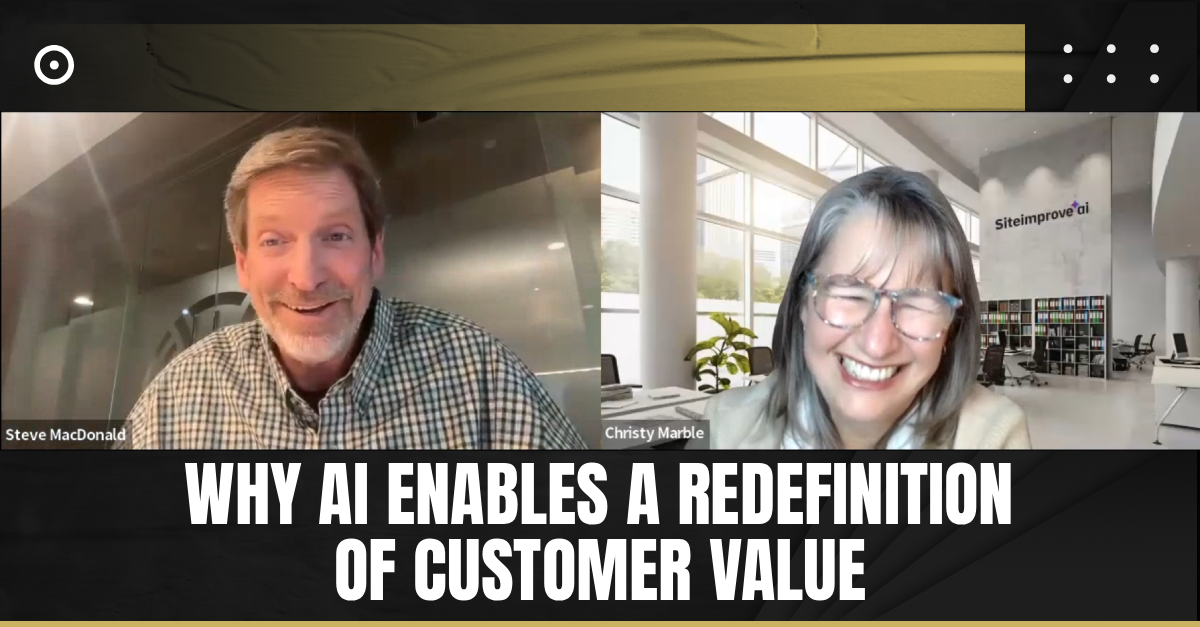


Episode #254:
Christy Marble, Chief Marketing Officer at Siteimprove, explains why AI is changing what “value” means in B2B. She argues that buyers want outcomes, not tools, and that AI makes it easier to deliver those outcomes. She also shares how agents and orchestration can connect systems to create seamless experiences. The result is faster execution, clearer value, and stronger alignment with growth.
“Use AI to deliver the value for your customers that you’ve always wished you could do. You’ll differentiate and you’ll win.” – Christy Marble
In this episode, Christy explains how AI is shifting B2B value from features to outcomes. She breaks down why orchestration matters in complex tool environments, how buyer behavior is moving toward answer engines, and why leaders must connect growth, CX, and revenue in a measurable way.
Follow Christy Marble on LinkedIn
Follow Steve MacDonald on LinkedIn
[Transcript]
[00:00:05] Steve MacDonald: Welcome everyone to the C-Suite Sales and Marketing Perspectives podcast. I am Steve MacDonald, your host, and today we have a really interesting guest. We have a four time B2B SaaS CMO here, Christy Marble. Christy, I am going to have you explain in just a minute a little bit more about your background, but we are going to talk quite a bit today about redefining.
[00:00:27] Steve MacDonald: Customer value, and how what we do to define and create value for our customers in a day of data and innovation and AI, how that has changed, and how the requisite for that and the perception of what we should be doing from the clients to us has been changing. This is a really interesting conversation, but you and I almost lost time to do the podcast because we kept talking about our personal lives. You and I both grew up in Washington State, or you at least live in Washington State now, on an island north of Seattle, and you have a hobby farm.
[00:01:01] Steve MacDonald: You actually have a sanctuary for animals, and I am going to let you maybe explain a little bit more about your professional background and your personal background just a little bit, because it is fascinating. Then we will dive into the topic here today.
[00:01:14] Christy Marble: Sure, sure. Yeah. You and I were talking a little bit about the juxtaposition of being a chief marketing officer and having the opportunity to travel the world and talk to amazing people in all the big cities where it is high tech and modern and you are all dressed up.
[00:01:27] Christy Marble: You come home on the weekends. In my case, I am on a farm often, which hosts an animal sanctuary. So I am out in my galas, kind of walking around, looking at the animals, at least, or making apple cider in an old apple cider press with my kids or with the neighborhood kids, or doing things like that.
[00:01:44] Christy Marble: So that juxtaposition of the modern city life and then the coming back to maybe a hundred years prior and being a little grounded, I guess, brings some humility. That is kind of my personal life. On the business side, I have had the opportunity to do consumer marketing and advertising and eventually financial services. Eventually, that was living on the West Coast, living in LA, and then moving back to my roots in the Seattle area, which is how I really dug deep into the software space and had the opportunity to it.
[00:02:13] Christy Marble: To do work with a lot of SaaS companies. The space that I really like to focus on, and the beauty of SaaS and now AI, is the ability in the B2B space to make a huge difference for the consumers of my customers. So it is all about the human element of who is actually using our customers’ products and making that world a bit better for them.
[00:02:38] Steve MacDonald: Well, fantastic. I will dive right in, but I will have to say something. I think your lifestyle, because I have a small farm too, I love getting out and getting my mucking boots on and fixing a railing or something like that because I have been on the computer all day. It seems more natural sometimes to do that.
[00:02:55] Christy Marble: Absolutely.
[00:02:56] Steve MacDonald: Here is what I would love to do. I would love to start us off with what I think we were talking about before in our conversations, the AI value equation and reframing literally how we serve our clients. I would love to get your perspective on that.
[00:03:10] Christy Marble: Yeah, in this world of AI, there are all these things that go on where people are talking about the pace, or they are talking about being concerned about whatever is the concern today.
[00:03:19] Christy Marble: But I really see it, and at Siteimprove definitely, we really see it as an opportunity to change the game and use it to accelerate the pace that we do business, because we really have to embrace this new pace. One of the things that we like to think about is how do we use it to pivot from thinking about offering tools. We are all B2B marketers, right?
[00:03:42] Christy Marble: It is a really huge opportunity for us to think about, instead of delivering this tool or this software, whatever we are doing to customers and letting them figure it out, to really double down on focusing on the outcomes that our customers need to deliver with that.
[00:03:57] Christy Marble: AI really helps us accelerate that beyond just the kind of go figure it out motion of maybe the old software days of old where we sold into it and then it would have all sorts of resources to train people. With AI products driven by AI and agents, we tend to be out ahead of our own IT teams and we are being pitched things in the market that we are just going to have to be able to run with and go in order to keep up and compete.
[00:04:25] Christy Marble: I think that is an opportunity for us as B2B marketers to really be repositioning our products in the market to really be outcomes. That age old trouble, or challenge, of how you talk about outcomes instead of the tools and the features and functionalities. Today, we can make it so much easier by making sure that our products are talking to that, and through the GenTech capability and GenTech orchestration. It really is a game changer for us, from what was that first SaaS API ecosystem to now the AI potential of an ecosystem.
[00:04:59] Steve MacDonald: You said a number of things I want to follow up on there, but you talked about a focus on outcomes versus a focus on tools or technology. In the end, and I have been in SaaS, a two time SaaS founder, you are a four time SaaS CMO.
[00:05:16] Steve MacDonald: We can fall in love with our platforms, we can fall in love with our technologies, and we can talk about it like our kids all day long. But the truth is, really what our clients want to know is what is it going to do for me. We almost want them to take our technology for granted because it is just doing so much great stuff for them.
[00:05:36] Steve MacDonald: We are now living in a day and age of AI and agents. You started to talk about the impact of that on the delivery of the outcomes. If you could connect those dots, if you do not mind.
[00:05:48] Christy Marble: Sure. If you think of all of us, and I will talk to CMOs, but also anyone in business who is needing to connect the dots using SaaS software, which we do. Right now, I will probably quote the wrong number, but there were more than 15, maybe more than 18,000 different pieces of technology in the MarTech 2000, right. Two thousand, five thousand, eighteen thousand. How many pieces of software are there out there?
[00:06:09] Christy Marble: That is a marketing nightmare. It is an IT nightmare. It is a finance nightmare. With AI, it becomes even more micro. So for those of us in B2B, first, we could be spending all our day just buying software. Then do we ever implement it. Do we ever use it. Certainly, I am sure many, many CMOs out there can think of software that they bought and they are not using it to the full potential.
[00:06:29] Christy Marble: What we really need to be doing as B2B software providers in this era of AI is we need to be using agentic orchestration for the first time ever, not just bi directional, but maybe multi directional opportunity to use agents to have safe but open APIs where we can be connecting the solution set together, all these micro software and services together, so that our customers can deliver the outcome that they need to, and we can make that seamless for them on the backend.
[00:07:06] Christy Marble: That is something we have really been focused on, which is how do we orchestrate that experience with all the other types of solutions that we need, or software, to help, I will say marketers, help the CMOs have the full solution that delivers the outcome that we need.
[00:07:22] Christy Marble: Because what do we need. We need to be found on the internet. When our potential customers do find us, we need to be able to get them to an opportunity to shop, to learn, and to eventually buy. We need to do that seamlessly, and they are doing that in many different places. That requires many different tools for us.
[00:07:42] Christy Marble: I really see this agentic period of AI and the ability to run agents and really orchestrate agents around customer experiences to be the game changer for companies now. The faster that we can do that, that requires collaboration. That is not just breaking silos down inside of our own companies.
[00:08:00] Christy Marble: That means we have to be breaking them down between us and our partners as well, building that orchestrated experience for our customers so they can achieve the outcomes that they need to achieve for their businesses. Think about them like that rather than what this cool feature functionality is going to do that we uniquely deliver.
[00:08:18] Steve MacDonald: You just touched on such an important thing, one of our biggest challenges we have all had, but one of our biggest opportunities, and it is around data. If you were to go today and put it into ChatGPT and say, why do businesses not use the LLMs correctly, in that top five list is always data fragmented, siloed data. We know inside of our organizations, we feel it every day, that we have fragmented, siloed data. Now the data is exploding through these APIs. So not only has that become much greater of a challenge, but at the same time, what you are saying is that is one of our greatest strategic opportunities.
[00:08:58] Christy Marble: Definitely.
[00:08:58] Steve MacDonald: Because we solve SaaS problems for our clients. I know in the world of SaaS, the thing that we always worry about is we never want anybody to open up an empty dashboard, right? It’s like, oh, there’s nothing in here. Right? So it’s incumbent upon us to make sure, and is this what I’m taking away, a big part of the value that we can be creating for our clients is ensuring that we’re orchestrating the right data strategy for them, not just the right technology for them as well.
[00:09:25] Christy Marble: It definitely is one of the things that we focus a lot on, for instance, both on the accessibility side but also on the AEO side, which is, are you being found? Are customers being found where your customers are? With AI and with today’s big data, it used to be in our marketing world we only had the data inside of our own CRMs, and we’d need to enhance our own CRM, and then we would use that data to push out. We don’t need to push out anymore.
[00:09:51] Christy Marble: We still do, right? That’s part of the journey. But we can also now receive the signals about what our prospective customers and our existing customers are doing out in the wild. We can go reach them where they are so that we can deliver that frictionless buying experience, and not just a buying experience, but a customer experience because we need to get to value.
[00:10:16] Christy Marble: What is the value? The value is whatever that problem was that we had. We need to solve it and we need to be delivering whatever is the outcome that we need to solve that problem with in the first place. I live a lot in the world, and have been for years, of growth, so I need to achieve growth.
[00:10:33] Christy Marble: Likely, if someone is selling me a product, I need to be able to drive customer growth, drive experience growth, drive anything that is going to be delivering, again, those business outcomes for my companies, which usually are about revenue growth and pipeline growth, serves revenue growth.
[00:10:53] Christy Marble: I don’t want pipeline that doesn’t drive revenue growth. I only want the specific pipeline that is going to drive revenue growth. That’s my ultimate outcome. That’s what anyone who’s talking to me needs to be able to demonstrate, how that ties into the growth of the company, whatever company I’m at, and certainly Siteimprove.
[00:11:14] Steve MacDonald: Absolutely, we want to focus on pipeline that drives revenue growth, and leading up to that you put into the same sentence the importance of customer experience and creating value. McKinsey did a study a couple years ago. They interviewed over 400 highly profitable companies, the largest return on shareholder value, and they determined that CX was the number one differentiator in the
[00:11:36] Steve MacDonald: market today, right? Creating this frictionless, seamless customer experience is not a throwaway line.
[00:11:43] Christy Marble: Yeah, a hundred percent.
[00:11:43] Steve MacDonald: CX is at the top of the heap in terms of how we create value and therefore then how we grow our businesses, right? So this whole thing is about redefining how we create value and how the data, and the AI and the agents, the old saying, garbage in, garbage out.
[00:11:59] Steve MacDonald: You can have the best agents, the best AI tools, right? The best feature set, AI, agentic AI. But if it doesn’t have the right data, it doesn’t know what to do. I just wanted to underscore this whole section of what we were talking about here. Right. Data important. Alright, I’d like to move on. So.
[00:12:15] Steve MacDonald: You talk about intelligence at scale and agents as the multipliers, and agents as thinking about them more and more as team members, which brings up all the fears of everybody, right? That you’re going to be replacing team members. But you talked early on about human in the loop. Agents, multipliers, team members, your point of view.
[00:12:38] Christy Marble: When you think about this responsibility or the concern that people have about AI, I look at it, I have never had a marketing team who doesn’t have more to do than they can get done. There’s always those guilty things that you’re just not getting done. We see a lot in our space, for instance, on the accessibility, if you’re running a digital strategy on the accessibility side of it.
[00:12:59] Christy Marble: Everyone wants to make sure that they have highly digitally accessible content, their website, their mobile apps, their forms, however people are buying things from you, their PDFs, to make sure that they are super friendly and usable by everyone. But if you’re not required by compliance to do that, many, many companies just have it backburnered. We’re going to get to that, we’re going to get to that. It’s going to require headcount. I need an accessibility expert to be able to do this for me. In today’s world, you don’t. That’s one of the beautiful things about AI, and specifically agentic AI.
[00:13:36] Christy Marble: Now, you don’t have to have that expert, because AI can deliver that level of expertise for you, and you can have a content person who can now be working with a solution that uses agentic AI to consume the content that you’re already producing and ensure that it is delivered in an accessible format. So now you get to up your game, you get to up your performance, you get to do that thing that you’d always backburner, because I’m never going to be able to get a headcount that’s expert on that.
[00:14:06] Christy Marble: You no longer need that headcount. You can get that guilty thing that you were never getting done, done. Maybe it’s something that’s very purpose driven for your company. That’s just one example of all those things on our list that we can never get to, that we can never prioritize. It’s a huge opportunity for us to reprioritize and determine what are those things that we really need to do to move fast, and how can we get those done with the resources that we have.
[00:14:30] Christy Marble: It’s very fun for people to be working, especially people in software marketing, to be working with the newest, most sophisticated tools and solutions that have agents that can deliver things for you really fast. You still have to triple, double check them. Make sure that you have the ability to ensure that they are delivering the right truth. Truth and productivity. Those are some of the things that I think are really powerful with agents, is those things that used to be luxuries or that we were never going to be able to get to, that we knew were really important for us to drive performance, we can now get to with the resources we have and run more efficiently.
[00:15:06] Steve MacDonald: The idea of the team using, and you’re right, we all have a list this long of the things that we want to be proactive at that we never have time to get to. So it’s like hallelujah. The other thing is we all know that high performing companies have high performing teams. If AI could help our teams be higher performing and happier, we say it’s fun.
[00:15:26] Steve MacDonald: We’ve all had that sensation of, dang, I’m really good now that I can use this. That impressed me what I just did there. There’s a sense of accomplishment of what we can get done in a day and what we don’t have to spend time doing that we don’t like to do.
[00:15:39] Steve MacDonald: We can spend more time doing the things we know we need to do, we like to do, or are accountable for. That is a polar opposite of we should be scared of AI and is it going to replace us? That’s right. I think that’s a really important part of this. That adopting agentic AI agents into our workflows, into our business is really just going to help. I think we’re probably not going to have a lot of these conversations a year from now. Because yeah,
[00:16:06] Christy Marble: because it’s going to be second nature. The things that you wasted maybe time on in the past. I think of one of the most transformative things for me probably in the last six months is just using AI to transcribe my meeting notes and get the actions done so that I can send them out right away.
[00:16:20] Steve MacDonald: It’s a game changer, and there’s another level of this too. We used to have to train our teams, individuals and people. You’ve got to tell things two, three, four, or five times. My wife might say it might even be more for me. But when we train our agents,
[00:16:38] Steve MacDonald: it’s done. Yes. And we tweak it and we perfect it so that now, like those AI notes, you can have those exactly the way Christy Marble wants to see her AI notes. Yes. And you’ll get it the same way every single time, right? Absolutely. Yeah. It’s training the perfect team in a lot of ways.
[00:16:58] Christy Marble: One of my favorite things are some of the things that used to just be like, I’ll use brand police in marketing, right? Yes. Who has to be the brand police and the direct response people, the people who are sending out the things, who really need to drive pipeline or revenue goals. They were always like, “Oh no, their messaging is off brand.”
[00:17:15] Christy Marble: And then you had the people in the brand team. There was always that friction between them, and so then you had to have someone in brand that was policing someone else’s content. Those are the horrible jobs. Who wants to be the police for someone else? And then going back and always giving them the negative like, “Grammar’s bad. Oh, this is bad, and you’re off brand.”
[00:17:30] Christy Marble: You don’t have to do that anymore because now you can put your brand standards into briefs, into your agents, and you can be producing or reviewing content that everyone produces. You can self-police your own content to ensure that you’re on brand. It’ll highlight through the tweaks. It’ll suggest the tweaks for you and still review those. The need for that brand police, you can actually empower everyone to produce materials that are on brand.
[00:18:00] Christy Marble: When you think of the culture of a team, that makes a human difference as well as a predictivity difference, and it’s not just the marketing people. Other people who are producing content for the company can also deliver on brand every time.
[00:18:13] Christy Marble: Some of those things are just so powerful that they, again, your job’s now more fun. You don’t have someone telling you you’re doing things wrong, because you don’t have to anymore. You can check it as you go. That shift left has been talked about since the eighties, now becomes more meaningful to everyone who’s working inside of AI enabled companies.
[00:18:34] Steve MacDonald: I’d love to flip our perspective, 180 degrees now, onto our buyers. Ultimately, hopefully our clients. You talked about, we have AI driven buyers these days, and what did you mean by that?
[00:18:48] Christy Marble: One thing that I did, let me step back on that. In the last 10 days, there’s all this buzz, so this is going to sound quaint. If someone listens to this in a couple years, it’s going to sound kind of quaint to people. But there’s all this buzz about X percent of traffic coming to websites is coming from the GPTs or answer engines, and people are no longer doing this, and they’re no longer doing that. It was all kinda that business language of these percentages and things.
[00:19:12] Christy Marble: So I was like, I know what I do now. It’s different than what I did a year ago. I was a big search for a word, search for a string of words, but I’m not really going directly to ChatGPT or something anymore. I’m still going to Google.
[00:19:24] Christy Marble: I’ll admit I’m going to Google, but I’m answering a full question in Google. My kids, when I was working with them on things, this was a couple years ago, they’re like, “Mom, why are you typing things in? Just verbally tell Google.”
[00:19:34] Christy Marble: So, when my kids search, they’re actually asking Google, even if they’re creating a, you know, they’re using their voice to ask Google things.
[00:19:41] Christy Marble: So I was like, “Well, I can already see that generational difference between how my kids search and how I search. So, let me just go ask my network.”
[00:19:47] Christy Marble: I just went out to LinkedIn and did a poll, quick poll, and I got a significant number of responses that surprised me, which is, in my network, the people that saw this, or people shared it and saw it.
[00:20:01] Christy Marble: I got, I think, over 90 responses, and 50% of the people that responded said that they now go directly to a GPT, so to ChatGPT or Perplexity, and ask the question there first. And then people gave in the comments the reasons that they do this. These are professionals on LinkedIn who are likely connected to marketers. Maybe they’re developers.
[00:20:27] Christy Marble: More than 50% of the people, and this changes like in a year. I didn’t ask them last year, but we know that people weren’t even massively using these GPTs more than two years ago, for sure. It’s just the leading edge.
[00:20:38] Christy Marble: So now more than 50% of the people said that when they’re going to search for an answer, and they’re going to find something for business or for personal, because whatever you’re doing at home, you bring it to work. You do it at work too. They’re going directly to ChatGPT. And then the others said they still go in, but they ask, I want to say 30%, get the numbers right, but they ask now a full question, a prompt, when they’re searching.
[00:21:00] Christy Marble: So people’s behavior is rapidly changing. This is much faster than when you think of the iPhone. The uptake on the iPhone, where we thought, “Oh, we wouldn’t have apps. We won’t use the apps.”
[00:21:11] Christy Marble: There’s no reason I’ll ever need to listen to music or to take pictures on my phone. I call people on my phone. And now, all the things that we do. We track our health. We track our steps. We do things that we never imagined. But that took a series of multiple years. I’m talking just a year.
[00:21:26] Steve MacDonald: Oh yeah.
[00:21:26] Christy Marble: That, that many people have changed their, and why? Because it’s so much more of a frictionless experience. What does that mean for us as businesses? If we need to reach people where they are, and we do, we’re going to need to get really good at making sure that our message is going into the AI engines. We can’t sit back and think, “Oh no, we’ll do it when we’re ready.” We’ve got to, we got to be ready now.
[00:21:55] Steve MacDonald: Right now, yes. I got to tell you, I wish we had two hours, because this is fun. But what I would love to do is ask this question. The title here was about how we have a greater responsibility now than ever for value creation for our clients. I just wanted to give you an opportunity to summarize what you want us to know about that.
[00:22:21] Christy Marble: The days of going to look for a tool that does this thing for me are behind us. That is not a thing that buyers are going to be wanting, to speak to a person, to talk to a salesperson, or to talk to a BDR about. They are going to, and they already have and already are, doing a lot of research.
[00:22:44] Christy Marble: They are asking a whole bunch of questions. Even with one question, the answer engines are going out and asking probably 30 or 40 for every question that you load in, and that is how they are getting a comprehensive answer for you.
[00:22:56] Christy Marble: Trying to bring people to talk to a person, by the time they talk to a person, they want a person who can really understand the business challenge that they have and talk to them about how they can solve their business problem, or they are going to get on another call with another company.
[00:23:18] Christy Marble: For us, as companies, by the time they either come to our website or by the time they are talking to people inside of our companies, BDRs, AEs, customer service people, our teams need to be prepared to talk about their real business challenge and how they are going to be able to solve their business challenge with the solutions that we deliver to market.
[00:23:40] Christy Marble: It really has accelerated that pace of our need to be able to talk about that, but it also means how we develop and deliver products to market, we have to do that as well. We have to design our products to, if you want to call it a proof of concept, and when we are doing our product development, we have to be doing that with the value in mind.
[00:24:02] Christy Marble: Our innovations need to be really addressing these complex business challenges that people have, and they are complex. That is where I come back to agentic orchestration, because there is almost nothing that is in a silo.
[00:24:16] Christy Marble: Any value proposition that we have is going to be tying into their other systems, the other systems that hold their data, the other systems that can collect their data. The fact that people are shopping out on the web, or that have really complicated even mechanical or robotic programs, if they are manufacturing something that is a tangible good that they are delivering, they are not automated, they are automated, right? They are also facilitated by AI.
[00:24:42] Christy Marble: Coming back to that orchestrated ecosystem and thinking not just about ourselves, but about the whole value chain. That is the reality of the day to day that all of our customers live in, that I live in, that you live in. There is a whole bunch of different software that has to work together for me to be successful.
[00:25:01] Christy Marble: It is on all of us to make sure that our software works and talks to the other software. Those would be the companies that will win.
[00:25:08] Christy Marble: Just like the early days of the ecosystem and SaaS, where we got really excited about first unidirectional and then bidirectional APIs, now it is the potential for AI to orchestrate across multiple systems, and for agents to be working not just agent to agent, but agent to multiple agents, to achieve solutions for us and results for us. It is one of the most exciting things that I see out there, but also one of the most complex challenges for all of us to solve as businesses.
[00:25:38] Steve MacDonald: If you had to boil our entire conversation here down to one takeaway that you wanted your peer community to take away from our conversation here today, and a short, single minded kind of thought, what would that be?
[00:25:58] Christy Marble: I would say use AI to achieve the things, to deliver the value for your customers and your prospective customers, that you have always wished you could do. Look at AI as your potential to improve the value you deliver for your customers, if you can do it that way. You will differentiate and you will win.
[00:26:21] Steve MacDonald: That is an amazing takeaway, and I got to tell you, we are going to have a lot of questions on this. Is it okay if I give out a link to your LinkedIn profile, that people can just reach out and ask questions if they have it?
[00:26:32] Christy Marble: Absolutely.
[00:26:34] Steve MacDonald: Well, Christy, the whole goal here, the mission of this podcast, is to bring different perspectives from C suite executives all over the world, different experiences, perspectives, insights on the most important challenges and opportunities that we have going today. I call that the rising tide that lifts all boats. You live on an island. You were a really important part of that rising tide today. I just wanted to say thank you for coming onto the podcast.
[00:27:00] Christy Marble: Thank you for inviting me.