

Episode #224:
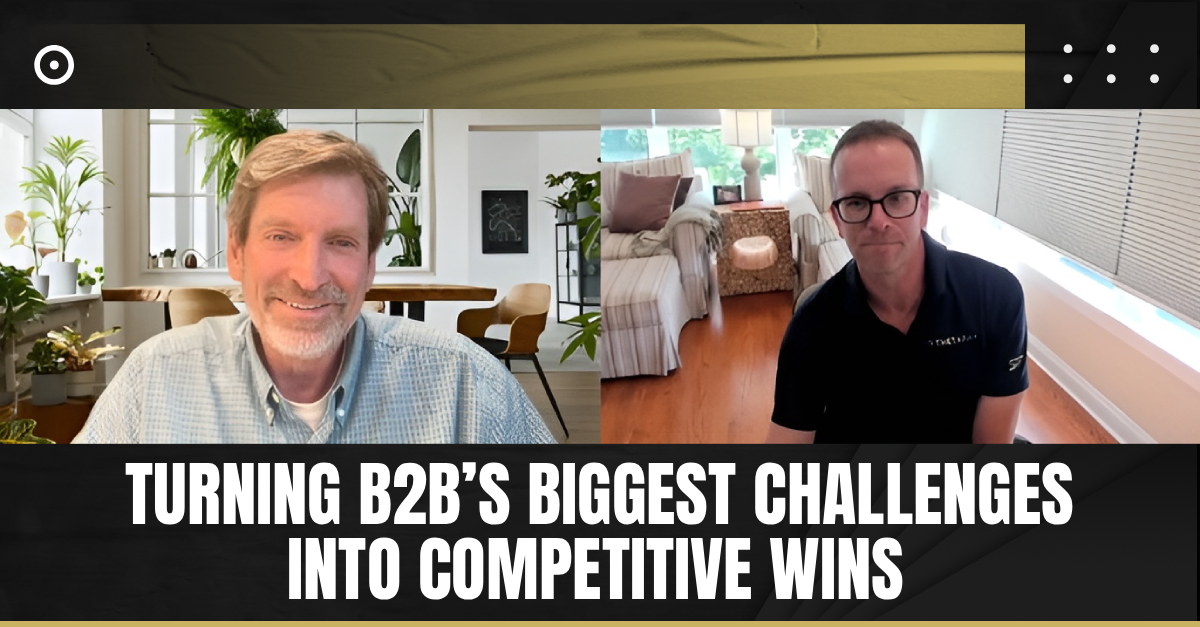
Brian Gilman, Chief Marketing Officer at ThetaRay, explains why AI has equalized claims and intensified a B2B trust gap. He shows how quickly getting into the room with C-suite buyers reframes discovery around business outcomes. He details why alignment across product, sales, and finance prevents roadmap drift. He closes with a practical lens for activating authentic customer voice.
“As a buyer, I’m more likely to evaluate you as a vendor if you can better articulate what you’re going to bring to my business above and beyond just technical specifications, and if your solution can help impact those inherent risks in the business, you provide significantly more value.” – Brian Gilman
Brian shows how M&A rigor and an outcomes-first mindset help executives cut through AI-fueled sameness. He explains why quickly getting into the room with the C-suite re-centers discovery on measurable business value. He also highlights how cross-functional alignment protects roadmaps and accelerates adoption in complex deals.
Follow Brian Gilman on LinkedIn
Follow host Steve MacDonald on LinkedIn
[Transcript]
[00:00:05] Steve MacDonald: Welcome to the C-Suite Sales and Marketing Perspective podcast. I am Steve MacDonald, your host, and today we have a very special guest, and I would say one of the best topics that we have had in a long time. Brian Gilman is on, and now Brian, you are the Chief Marketing Officer at ThetaRay. You actually started out in economics, which I think is fantastic, and we will see that as you talk today and how you think about things.
[00:00:28] Steve MacDonald: You have worked in the telecom industry for years. You also, interestingly enough, you and I share this, we both have adopted kids internationally. Domestically, you have adopted out of foster care. I think it just speaks tremendously to your heart and how you can look so calm when you have nine kids in your household.
[00:00:50] Brian Gilman: Work stress does not really mean that much to me when I have to come home and then deal with the kids in volumes.
[00:00:55] Steve MacDonald: I love understanding that background. We are going to talk today about turning B2B biggest challenges into competitive wins. But before we dive into that, I would love to have you maybe expand a little bit more on your background before we get started.
[00:01:12] Brian Gilman: Sure. As you said, I am currently CMO for a company called ThetaRay. We are an AI-powered financial crime compliance platform. So think of your traditional AML platforms that have served the needs of banks and fintechs for years.
[00:01:24] Brian Gilman: We leverage our own homegrown, developed AI platform to help evolve that market forward in a way that has not been seen in a long time. In terms of legacy rules-based systems. Prior to that, as you mentioned, I have been in the marketing leadership positions of many different businesses spanning AI, telecom. My career has been.
[00:01:45] Brian Gilman: An interesting one. I am not a traditional marketer. As you said, I was an economics major, started my career in investment banking and mergers and acquisitions. So I have a bit of a different style, a bit of a different approach and mindset when it comes to sales and marketing.
[00:01:59] Steve MacDonald: Part of what I really appreciate about the way that you approach this is that you, from an M&A background, look at the marketing function, you look at the executive, a C-suite seat in that function in terms of how it develops value, not only for the customers, but for the business, right.
[00:02:16] Steve MacDonald: And that exit in mergers and acquisitions, and so, as marketers, we need to understand a lot more about the economics of the businesses that we are helping to manage and grow. So I am going to get right in, and I am going to ask you something that I think is one of the biggest issues that we face in the B2B world, especially in an ABM model, where it takes months and months to work on and close rather large deals, and it is called the trust epidemic.
[00:02:46] Steve MacDonald: And I am going to cite a stat or two, like out of the most recent LinkedIn Edelman Trust Barometer, where they looked at over thirty two thousand respondents worldwide. One of the most telling facts that came out of that was that sixty one percent of those respondents believed that, as business leaders, we are being intentionally misleading, intentionally.
[00:03:09] Steve MacDonald: A totally different study showed that, for the B2B buyer, seventy four percent do not believe the customer evidence that we present to them, and we wonder why there is this self-service buyer journey that is going on where they are waiting longer to even talk to us. Here is my question. What does that mean to you as a Chief Marketing Officer.
[00:03:33] Brian Gilman: One. I understand. I understand the data behind that. I think the number is a tad misleading. I do not think that companies are necessarily intentionally misleading customers. What do I mean by that. We are at the beginning of a massive technology.
[00:03:51] Brian Gilman: Evolution, revolution, depending on what you want to call it, with AI. AI, in my opinion, has been one of the greatest advances that I have seen in my career in technology, along with the internet, the mobile phone, you know, it is in those lines of big technology evolutions.
[00:04:07] Brian Gilman: That has been great for business in terms of advancement, in terms of knowledge, in terms of all the things that we know and love about AI. But as a sales and marketing executive, it has been this great equalizer as well. And what do I mean by that. It has allowed for companies to spin up very quickly, sometimes overnight. I wake up every morning and someone lobs me over a new logo that says, hey, these guys look and smell an awful lot like us.
[00:04:35] Brian Gilman: It is not factually inaccurate because a lot of the capabilities that AI has allows for quick advancements and things, but it also allows for, as you and I discussed in our prep calls, a lot of bullshit bingo where you can spin up a company very quickly, and they can say the same things, and it may be nothing more than an LLM license with a visual design tool that can claim to build out virtual assistants overnight.
[00:05:01] Brian Gilman: There is no technology behind it. There may not even be a customer base behind it. And so, while it is factually accurate, some of the things that they can offer to the market, it is misleading because there are levels to the game, you know what I am saying. There are companies that have.
[00:05:17] Brian Gilman: Homegrown built AI. ThetaRay, we have built our own AI stack from scratch over years of development. We have data scientists, we have our own algorithms, which makes what we have very unique in the marketplace, but we have a lot of these startups that claim the same things.
[00:05:31] Brian Gilman: And so it is not intentionally misleading, but it is misleading by default. And I do think that it has made marketing very difficult, and it has led to a culture of not trusting a lot of what is out in the market.
[00:05:45] Steve MacDonald: That is something that, like, our brands are supposed to be trust marks, right. That is kind of like a marketing one hundred one. B2B is a relationship based business, and you talked about the fact that we have more ways to understand our customers, so therefore more ways to position ourselves correctly to these customers. Digital signals, right. Intent signals. We have more data than we have ever had before.
[00:06:11] Steve MacDonald: But you said something to me that was really interesting. You said we have to get our feet on the street more. We have to go out, and we have to have face to face conversations with our target audience. Tell me your philosophy or thinking behind that.
[00:06:24] Brian Gilman: It has been an evolution in the companies I have been in. I have been in. PLG led motions in terms of our business go to market. My most recent two leadership positions, very high cost ARR types of deals. When you are implementing a financial crime compliance platform, that is not something that is like light up your seat license for nineteen dollars a month.
[00:06:44] Brian Gilman: As a result, I find that the marketing waterfall needs to break a little bit, because when you are selling high price platforms to buyers, you are generally dealing with a different type of buyer persona. I could be a director in a marketing organization and asked to light up some MarTech platform that I did my own research on, and it is going to cost us a couple hundred bucks a year.
[00:07:12] Brian Gilman: I will sign off on it tomorrow, is it going to help us be faster, better, more efficient. Sure. We will take a flyer on it. Usually there is a thirty day out on that contract, no harm, no foul if it does not work. Getting back to the trust, sometimes at a lower price point, trust is not even all that important.
[00:07:26] Brian Gilman: If it says it can do something, I will take a flyer on it, if there is an easy out and it is not going to cost me a lot. But when we are talking about regulated industries, or even not regulated industries but higher ticket price solutions, things that are going to take.
[00:07:40] Brian Gilman: A long time to implement, potentially a high level of customization, I need to be able to get in front of that customer as fast as humanly possible. Why. We said earlier, we were just talking about the lack of trust, and it is because I am getting bombarded daily. I am a C-suite buyer as much as anyone else is.
[00:07:59] Brian Gilman: The platforms I buy are not necessarily several hundred thousand dollars, but I am constantly getting my phone ringing nonstop. I have spam blockers on my phone, they still get through. They look like local numbers. I pick it up, hi, I am so and so at such and such agency, and I am like, foiled again.
[00:08:15] Brian Gilman: This happens all day long. Email, text messaging, and at the end of the day I shut off to that, as a C-suite buyer, because I do not have the time in my day, and I know that most of these companies do not do what they say they can do. And when I know I am getting bombarded by these things all day, I am not doing the same level of research if I am a C-suite officer.
[00:08:35] Brian Gilman: So my target buyer at ThetaRay is Chief Risk Officer, Chief Compliance Officer. They are not doing Google searches. They are not doing research in the way that a traditional marketer to a person in R and D who is looking for some product management platform is. I may have one shot at getting an introduction into that customer.
[00:08:52] Brian Gilman: So the typical buyer journey of doing a whole bunch of research, you know, it used to be, I forget the research firm that said that most buyers will do eight to thirteen or eight to eleven different touch points with a business before ever wanting to engage with them. In my world, that is no longer the case, because if I am dealing with a C-suite, I have to get to that meeting immediately, because I know if I can get a meeting with that customer to do a demo, to talk technically about my product and why it is different than the rest of the BS bingo that we just discussed, I know that my success rates and my close rates will increase dramatically.
[00:09:29] Steve MacDonald: And it is because you have got that one-on-one time. There was a component to that, getting out and targeting and having the one-on-one conversations. There was a learning component and, and I want to frame it a little bit because, you know, we did this study and we talked to over 50 different B2B C suite executives and asked them what their two greatest challenges to creating long term sustainable growth were.
[00:09:55] Steve MacDonald: The second was a lack of deep understanding of the customer’s voice. And so when you talked about getting out and, feet on the street, face to face with a customer, there was a massive learning component that helped the entire buyer’s journey. From there, if you could explain that a little bit.
[00:10:19] Brian Gilman: It is interesting because one of the things we did not just discuss before when we talked about the evolution of AI, I think something else has really laid an additional level of challenge when it comes to market positioning for a company. It has been this ease of use. AI is part of it, but it is, even before AI, it was the introduction of the cloud and SaaS where the buyer’s journey.
[00:10:43] Brian Gilman: Before that, earlier on in my career when it was hardware and software where, you know, which was. Custom coded a little. There were more unique features. Product. My background as a marketer early days was in product marketing, and product marketing early days was a very critical component of any marketing organization.
[00:11:03] Brian Gilman: I would argue. Product marketing has evolved and I do not want to say that it is less important, but I think the function has changed. It is less around the technology. If I am a hardware provider. I have to market this. I do not have another phone with me, but the specs of this and this look very different, and I would market them differently.
[00:11:24] Brian Gilman: It is speeds and feeds and bits and bytes, and it is, you know, video clarity, camera pixelation, all of those things that I am marketing to a customer. The Cloud SaaS has changed that because it has made the development of the platform less important because implementation is via the cloud.
[00:11:41] Brian Gilman: It is a lot easier. It is more, you know, customization of product is significantly easier in the cloud than it was, you know, when you were traditionally buying an off the shelf software product. And so, this is why it is incredibly important to get in front of that customer, not only to understand, and this gets a bit to discovery because we need to understand.
[00:11:59] Brian Gilman: What are the challenges that the customer is trying to overcome, because that is going to be more important than any individual capability that I am going to claim on mine, which, you know, oh, circling right back 360 comes right back to the same, probably the same specs, the same checklist that most of my other competitors are going to have.
[00:12:19] Brian Gilman: What is their business challenge? What is the value that my product brings, and what is the output that we expect to have delivered to them? And I do not think that we, as leaders within businesses, are doing enough discovery to understand more about the business that they are operating. What are the challenges that business is facing? And how can my product solve that need better, faster, more efficiently than my competitors?
[00:12:43] Steve MacDonald: You are bringing up a really, really good point there. And I like the way you said that, it is not like product marketing is not important because it has a very specific role within the buyer’s journey, but getting in front.
[00:12:58] Steve MacDonald: Of these customers and having that face to face does not happen these days with product marketing. It happens because you have something of value to offer to them, and you are seen as an expert in the industry. You are in the middle of the conversation, you know their challenges. You are talking to them about, I always think about it this way.
[00:13:21] Steve MacDonald: Vendors talk about the challenges that they solve directly, and they might, and they are really important, but they might be this much of this set of challenges that the persona that you are reaching out to has, they need to know that you get this. And that you are helping them solve this.
[00:13:40] Steve MacDonald: So vendors talk here, partners talk here. And so McKinsey said it in a study, they said only 15 percent of B2B companies actually activate the voice of the customer. Yet in this world of this trust crisis that we are in, the customer’s voice actually means more than ours. We had a three time B2B CMO on, and she said, Steve, the campaigns, the enablement materials, everything that we do, when the voice of the customer proceeds ours, our works better.
[00:14:11] Steve MacDonald: And so I would love to just understand a little bit more from your side on, how do we activate the voice of the customer? How do we get the voice of the customer and how do we execute on the voice of the customer more as B2B organizations?
[00:14:27] Brian Gilman: I think it is better discovery. Marketing can bring people in the door. But at the end of the day, once we get to that meeting, it cannot be, here is my product, how can we shoehorn it into your platform? It is, here are your problems that you are dealing with. And so I am going to give an example, and it was a seminal moment in my career. This is when I was back in the video conferencing industry.
[00:14:53] Brian Gilman: Video conferencing, prior to Zoom and Riverside and all these great SaaS based platforms. When we talk about the Great Equalizers, were talking about room-based systems, cameras, codex in a room, and you had to have one piece of hardware to connect to another piece of hardware. It was at the time a very technology driven sale.
[00:15:13] Brian Gilman: CEOX comes in and says, I want to buy video conferencing so that I do not have to travel from New York to San Francisco to Hong Kong. Here is why ours is better than theirs. We can do 10 80, p 60 versus seven 20 P 30, you know, all the frame rates and whatnot, and it will be TV quality. CEOX goes and buys his three units.
[00:15:35] Brian Gilman: He does not travel from site to site to site. Notoriously, the vendor comes back. We go into our sales pitch six months later. What else can we sell you? Nothing. Why did it not work? No, it was great. It was like being on television. Well, then why can we not sell you anything else? I am not traveling anymore, but the system sits dormant.
[00:15:54] Brian Gilman: The rest of the 95 percent of my time, when I am not on calls with San Francisco and Hong Kong, this gets to discovery. And so at the time, you know, as I said earlier, there were two primary companies in the video conferencing space. I will not name names, but most people who know, who know the industry, know the two companies.
[00:16:11] Brian Gilman: We were locked in a war with an incumbent vendor, and the incumbent vendor we would be the company now is at, would do really, really well selling into an enterprise. And many times the CEO of our competitive company, who was much larger than us, would take the customer out, and a lot of times would give away the video conferencing systems to get the business.
[00:16:31] Brian Gilman: Why did they give away the video conferencing systems? That does not make any sense. Well, this vendor was really strong in networking hardware. They did not care about the video conferencing endpoints. They cared about the bandwidth that the video calls brought to the network, which meant a hundred thousand dollars in video conferencing sales would bring several hundred thousand dollars in networking equipment, which makes them stickier than the video conferencing would otherwise.
[00:16:52] Brian Gilman: So how did we change the narrative? We brought in a team of experts who came from industry. I said earlier my background, I came from banking. I understood finance, was to come in and have a different conversation with customers, and it was to. Not only sell the intended need of what the customer is coming for, but the unintended need that they may not have known, allow me to go in as an industry expert.
[00:17:15] Brian Gilman: I do not carry a bag. I do not have a sales number over my head. Let me talk to your head of HR about how they retain and how they recruit employees. Let me talk to your head of r and d who may be outsourcing some of their development overseas about how we can improve development cycles. What you have done is you have taken.
[00:17:32] Brian Gilman: An intended need, which the use case is only the 5 percent of the day. And you are now talking about mass adoption of video, about how video can impact your overall business. It can help drive cost out of your business, how it can improve revenue of your business. It could reduce time to market for products that you are developing.
[00:17:48] Brian Gilman: What we found was. Once we got under the hood of the car and we started talking to customers, and we started doing research, and we would go in and we would tear through annual reports, we would look at the risk factors in their 10 K, which is where companies will try to avoid class action lawsuits later if their numbers do not look good, to say, well, we told you there was a potential problem there. Those are all problems that we should be looking at, because that is where the inherent risk in the business sits. And if your solution can help impact those inherent risks in the business, you provide significantly more value. And we started walking out our competitor out of a lot of these deals.
[00:18:25] Brian Gilman: Because they were hung up on driving a bandwidth deal, and we now started saying, yeah, you could spend a hundred grand over here, but that same a hundred grand can now impact your business by five x. It is a much different conversation and leads to true value, which is a much different sales proposition to any customer who is looking to any vendor.
[00:18:46] Steve MacDonald: And you had to have the point of view where I’m going to get in, I’m gonna understand the business of my customers and their true challenges beyond the video, the bandwidth connections, right? [00:19:00] Your competitors were left in that world. You were looking at this, you were looking at the greater challenges, the greater problems that they had to.
[00:19:08] Brian Gilman: And this by the way, I didn’t mean to cut you off.
[00:19:10] Brian Gilman: It’s important because it’s not only important in those large deals. Yes, it’s required when you’re in large deals because that’s the value. But if you can’t open even for smaller companies, I think this is important because this isn’t just a, high class problem. Any company who’s going to come to me in marketing even with a couple hundred thousand, a couple hundred dollars a year solution, what’s the value that it’s going to bring to me?
[00:19:37] Brian Gilman: Don’t just tell me about how you can use AI to do something. What’s the value that I get out of that? What is the return I’m gonna get by either not having to hire another head or. The greater efficiency I’m gonna get with other tools that I have in my platform, am I gonna do a discovery as much in like a PLG LED solution?
[00:19:56] Brian Gilman: No, but me as a buyer, I’m more likely to evaluate you as a vendor if you can better articulate what you’re gonna bring to my business above and beyond just technical specifications.
[00:20:08] Steve MacDonald: So here’s the next evolution of the question and in the conversation that we’re having right now, and that is that there was another McKinsey said, I’m quoting McKinsey a lot today, but they literally said there’s no one inside the B2B company that owns the customer.
[00:20:26] Steve MacDonald: That owns the voice of the customer, understanding the customer, articulating the needs of the customer to the rest of the company. It happens in silos and bits and pieces, and the voice of the customer comes through a sales lens when sales is talking to the customer or it comes through a product. Success lens when it’s coming through there comes from a marketing lens, but that we need one leader.
[00:20:53] Steve MacDonald: Now, their point of view was that it should be the Chief Marketing Officer, so I wanted to just lay that out on the table and say if it’s this important to the level that you’re talking about it here, then it should rise to the level of importance. So somebody should be in charge of it, right.
[00:21:09] Brian Gilman: I agree. As a marketing leader, I think it depends on the type of marketing leader that you have. As I said earlier, I come from a very product centric. Background. And so my ability to speak to product in addition to sales is different than somebody who may be more of a brand leader.
[00:21:28] Brian Gilman: In which case that may not be the same person. It may need to come from sales or it may need to come from product, but I think misalignment is more common than we would like to admit. And I think that part of it is, a lot of times companies will chase, and by chase, I mean they’ll go after something that may be misaligned for where their product is and they’ll start to build something because they have a whale on a hook.
[00:21:52] Brian Gilman: That may be a sales led discussion, oh, we got this customer and we can land this huge deal. Product can’t really do what it does. Can we go and force something that’s unnatural as a business, in which case we start to change the roadmap and start to build for a bigger fish. But that one bigger fish may not necessarily.
[00:22:12] Brian Gilman: The hook wet we built may be too big for a lot of the smaller fish, who was our, who’s really within our, wheelhouse of who wants to buy us. And so yeah I don’t know that it needs to be a singular voice, but I think that there at least needs to be significant conversation between sales, product marketing at a consistent basis to bring in the voice of the customer.
[00:22:31] Brian Gilman: To ensure that, you know, we don’t get too big for our britches because I think that, especially for smaller companies, we wanna shoot for the moon and shooting for the moon doesn’t always mean building for something that’s outside of your parameters, because that could also be. Instant death for your business ’cause you’ve now over architected something for a market that may have zero appetite for what you just built. For the one customer who said, I want this.
[00:22:57] Steve MacDonald: So you brought up something that is a huge topic in what you just said. You brought up alignment between the different departments and in this study of asking these 50 B2B C-suite executives, what are the greatest challenges to creating long-term sustainable growth?
[00:23:15] Steve MacDonald: Internal alignment was by far the number one challenge. And what’s interesting here is number one challenge was internal alignment. Number two challenge was lack of a deep understanding of the customer. The number three challenge was the balance between short and long term. And you talked about like a marketer that has a branding perspective versus a marketer that has a product perspective versus a CRO that has a quota over his or her head, right?
[00:23:44] Steve MacDonald: So this idea of alignment. The prevailing thought has been from the C-suite executives is that the voice of the customer is the alignment factor, right? That is the most important, highest authority voice in the business. So I just wanted to throw that out and ask for your, thoughts on this, because if misalignment is such an a huge, issue for us and challenge for us internally that we have to solve, what’s the best way that we go about doing that? And does the customer voice have a big role in that?
[00:24:21] Brian Gilman: I think where some companies get caught up is that it’s not voice of the customer. It’s voice of the customers. And I think that’s where people get hung up. Because in the scenario I gave earlier where companies get sidelined and what they had as the roadmap.
[00:24:34] Brian Gilman: Because a singular customer who falls outside of. What their target is, shifts that roadmap. You’ve now actually gotten away from the voice of the customer. You’ve gotten away from the voice of the customers, and you’ve gone to the voice of a customer, which is a big problem because I hate aging myself like this.
[00:24:52] Brian Gilman: And when I talk out loud, it scares me sometimes. I feel like the old guy on the porch right now, but when we went back to like hardware versus the cloud, we used to have three year roadmaps and we had to have three year roadmaps because hardware is difficult because you have to build out new form factors.
[00:25:09] Brian Gilman: You know, and then anytime you want to go and change a device, that is a long term process. You said earlier, I used to work in the telecom space, when you wanted to go and functionally change the design of a handset. You had to have a three-year roadmap. And because of that three-year roadmap, when you change the handset, then you have to change all the inner workings of the handset to get stuff to fit inside the new handset. SaaS.
[00:25:34] Brian Gilman: You can change your roadmap overnight. Not literally, but you get my point comparatively. And what I find is that three year roadmaps are now one year roadmaps. And part of that is necessary because things like AI and SaaS, whatever, have really collapsed the speed at which technology is impacting industries.
[00:25:54] Brian Gilman: And so having a three year roadmap is kind of a joke, because for me to say where this industry or any industry is gonna be in three years, with the pace of AI and how it is helping things work or not work in terms of development, is a joke. I have a three year roadmap and I say, I am gonna stick to this for three years.
[00:26:11] Brian Gilman: I am lying to you. Keeping a year roadmap sometimes gets blown up in six months because of something else that has come up into the market today. But there is certainty in that three year roadmap in terms of staying true to who you are. The problem that we run into now is because we have the ability to build faster, more efficiently, whatever, we get influenced by these things that will cause companies to reach.
[00:26:37] Brian Gilman: They reach because, ooh, there is a whale. This could change the trajectory of our business. And then you cannot back out of that. Because what happens is that, if I had built a mid-market solution that has minimal implementation time and it is more out of the box, less customization, but now I had to go and build something for a Fortune 500 or a Fortune 100 or a Fortune 50 customer.
[00:27:01] Brian Gilman: The level of customization that customer is going to need, the amount of time it is gonna take to implement into that environment, with all the customization that needs to get done, I have now created a box that is so big. That the mid-market solution that everyone else wants, they do not want something that is gonna take six months to implement.
[00:27:20] Brian Gilman: I am gonna go to the next guy who can take my individual use case and implement it in 30 days at a cheaper price point.
[00:27:27] Steve MacDonald: Absolutely. And that goes back to AI writing code and what we can do on a dime. Now, Brian, we have talked about so much here, and our poor human brains can only retain about two or three things at a time.
[00:27:41] Steve MacDonald: So what I want to do is I want to ask you, as the last question, if there were one takeaway where your peers in the C-Suite are watching right now, what is the one thing that you want to make sure that everybody takes away from our conversation today?
[00:27:58] Brian Gilman: I think the most important thing in today’s environment, there is a lot of silo building even amongst the C-Suite, and some of that is because we all have our own set of KPIs that we need to go and hit. And sometimes we put on the blinders to get through our own KPIs and forget to talk about, get to talk to our peers about the things that we just spoke about.
[00:28:21] Brian Gilman: If we are not all in the same car, driving in the same direction, that is when things go awry. You know, I have been at very large businesses which have structure and are less likely to deviate from a certain course. In recently, and in previous companies I have been in more scale ups, and that is where you will find decisions going like this.
[00:28:42] Brian Gilman: And it is not always stay the course, but it is, if you are gonna deviate off the course, make sure that you are all in the room together and talking about pros and cons and why this is the right thing for the business, not why this is the right thing for a customer, which may.
[00:28:56] Brian Gilman: Fundamentally transform your business. That is where things get hard to un-architect, and so architecting things is not difficult. It is unwinding those things that have been architected where things get really messy. And so, conversation between sales, marketing, product, finance, what is the implication of everything that we just discussed to our business model?
[00:29:19] Brian Gilman: How is this gonna impact our, you know, if all of a sudden we have significantly changed our product to move up market, what does that mean in terms of leads that need to be derived, what does that mean in terms of delivery of product and impact on cash coming in, these are all things that need to be discussed.
[00:29:36] Brian Gilman: It is not as easy as just to say we want to go after this one opportunity. That one opportunity has so many downstream impacts, and that is where, you know, we as leaders need to make sure that we have thought through all of the pros and cons and dotted all of our I’s and crossed our T’s before we go and make that decision.
[00:29:55] Steve MacDonald: I gotta tell you, I love that you highlighted it as the number one thing, because it is the number one thing that is keeping us back. And what is important is that all of these challenges that we talked about, the top three, they are all internal. Are we doing what we need to do to understand the voice of the customer internally?
[00:30:16] Steve MacDonald: Balancing long-term versus short-term, right, these are not things that we are looking at and saying. There is another company, there is another competitor, there is another COVID coming our way, these are things that are all within our control. That is the good news, I guess, from all of this, and here is what I do know.
[00:30:36] Steve MacDonald: What is gonna happen is there are gonna be people that have questions after listening to the conversation here. Is it appropriate for us to give out a link to your LinkedIn profile so people could reach out and talk to you?
[00:30:47] Brian Gilman: Absolutely. And please feel free to connect with me there.
[00:30:51] Steve MacDonald: Fantastic. Well, I just have to say that the mission here of this podcast is to bring your voice and the voice of your peers in the C-Suite together so we can learn.
[00:31:01] Steve MacDonald: We all have different insights and different perspectives and different experiences, and if we could share with each other, that is the rising tide that lifts all boats. And I think you were an amazing part of that rising tide today. Brian, thank you for coming on.
[00:31:14] Brian Gilman: Thank you, Steve. I appreciate it.