
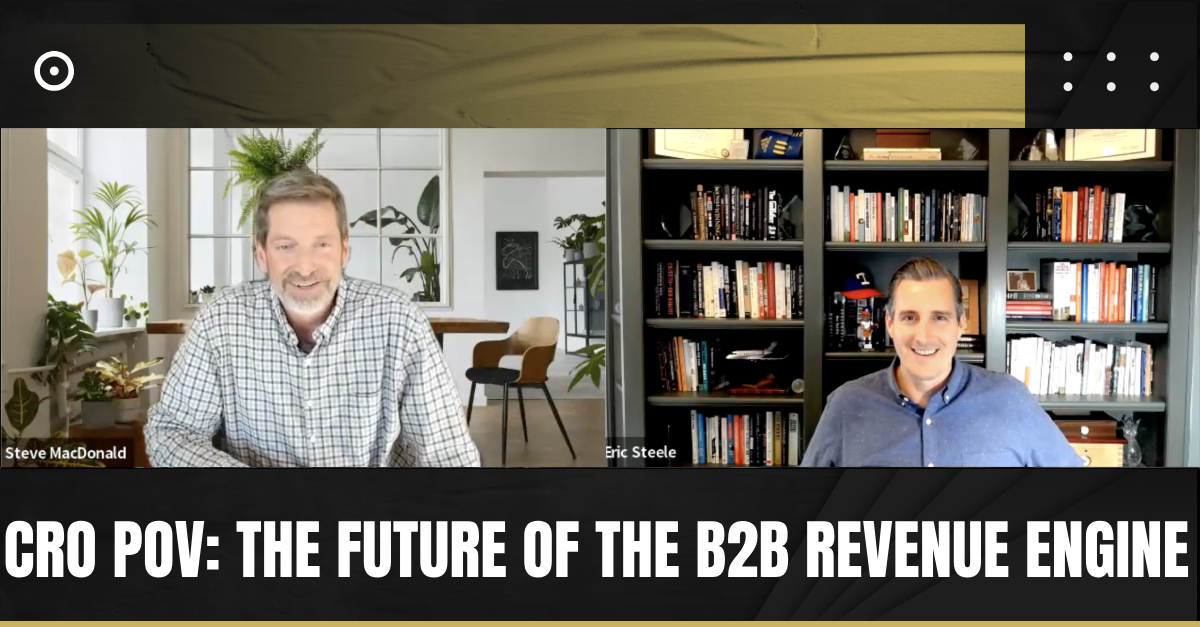


Eric Steele, the CRO at Source Advisors, discusses one of the most important subjects impacting the B2B companies today: the future of the B2B revenue engine. Eric also draws upon his insights from 15 years at Forrester and explains the increasing importance of total alignment and brand equity in a company’s growth. He highlights the necessity of understanding and serving the customer at a higher level, the role and importance of revenue operations, and the significant role people, leadership, and personalities play in aligning a unifying vision.
“The future of the B2B revenue engine is total seamless alignment, with sales, marketing, and customer success as one team, one dream, common metrics, common goals, and a common vision.” – Eric Steele
Total alignment in the revenue organization means having one customer and one vision for serving, retaining, and growing that customer. It requires breaking down silos and eliminating competing agendas. The revenue engine should operate as one team with common metrics, goals, and vision. This alignment is crucial in meeting the high expectations of B2B buyers who expect sales reps to be knowledgeable about their business, lead with insights, and understand the outcomes their business can achieve by working with the company, strengthened by the brand.
INTERACTIVE VIEWING OPTIONS: Review the full episode video, summary video, YouTube short, and two articles from this podcast: [Click Here]
Follow Eric Steele on LinkedIn
Follow host Steve MacDonald on LinkedIn
[TRANSCRIPT}
Introduction
[00:00:00] Steve MacDonald: Welcome everyone to the C-Suite Marketing Perspectives podcast. I’m Steve MacDonald, your host. Today, we’ve got one of the most important subjects we’ve ever really taken on in this podcast. And to do that, we have some help here from Eric Steele.
[00:00:20] Steve MacDonald: Now, Eric, you’re the CRO at Source Advisors, but what we will be talking about today applies to basically anybody in the C-suite role here. Anybody that’s supporting the overall go-to-market revenue engine that you’re creating inside of the company. The title is right: the future of the B2B revenue engine.
[00:00:43] Steve MacDonald: So I would love to have you explain more about yourself. I know that you spent a lot of years, 15 years at Forrester, digging into that sales and marketing and customer success alignment and creating the future of that revenue engine for B2B companies. So you’ve got a lot to talk about, but you could expand more on your background and what you’re doing now at Source Advisors.
[00:01:14] Eric Steele: Sure. Steve, thank you so much. What a great opportunity to chat with you. Yes, I am the CRO at Source Advisors. A great company that’s been around for over 40 years, helping CPAs and their clients navigate the ever-increasing complexity of taxes and helping them unlock cash flow to generate growth.
[00:01:39] Eric Steele: And so we help clients in various areas: R& D tax credits, cost segregation, energy services, state and local tax. Prior to this, I spent about 15 years at Forrester, which was a wonderful time because I was surrounded by the likes of Mary Shea, James McQuivey, and Andy Hoare, analysts who were really on the front lines of predicting the future of B2B marketing, B2B sales, the empowered consumer, the ever-changing B2B buyer.
[00:02:12] Eric Steele: And during that time, I got to work with hundreds of our clients and many, many great analysts to understand where customers are headed, and all of it pointed to total alignment in the revenue engine. Like B2C buyers, B2B buyers are now completely in the driver’s seat.
[00:02:40] Eric Steele: They are often more knowledgeable about your service and pricing than sometimes, maybe, a newer sales rep is at the company. They’re doing enormous research before you even have that first call and have high expectations. B2B buyers expect a sales rep, once they do talk to them, to know their business, to lead with insight, to understand the outcomes that their business could achieve working with that firm, and to pivot to talk about anything they want to talk about.
[00:03:12] Eric Steele: And that’s from some great research that Mary Shade did back at Forrester. At the time, she had said that 74 percent of the sellers that embody those traits would win that deal if you will. And it showed how consultative, value-leading, and insights-driven you needed to be as a sales rep.
The Future of the B2B Revenue Engine
[00:03:36] Eric Steele: Now, that’s several years ago. That’s only continued to be perpetuated and grow. And so my core belief and this is also shared by Warren Zenna, who I know is a mutual friend, and Warren heads up the CRO Collective, which I’ve been a part of. Warren’s vision aligns with what I believe in the revenue engine’s future: total seamless alignment for sales, marketing, and customer success: one team, one dream, common metrics, common goals, and a common vision.
[00:04:14] Eric Steele: that’s where things are headed. At Source Advisors, what is so incredible is Chris Henderson, our CEO, and BB Investment Partners, our private equity sponsor. They had the foresight to want to build that here. And so I walked into a situation at Source Advisors where my remit is sales, marketing, and customer success.
[00:04:39] Eric Steele: And I stand alongside an incredible team: Layla Rayburn, Sarah Richardson, Dave Murphy, Joe Sullivan, Michael Warady, Penny Bell. There’s a group of us, Josh Henry, who make up this revenue engine, Sean Bartlett. We’re in lockstep, and it is all about our company goals and our client’s goals, putting them first and achieving some scalable growth.
[00:05:07] Eric Steele: So that’s a lot, but kicking it off there.
[00:05:13] Steve MacDonald: So, a couple of really important things, right? Because sometimes we hear something so much that it loses meaning, right? As a salesperson, having the trusted advisor status, right? I want to educate and pivot, like you talked about.
[00:05:30] Steve MacDonald: Having that expertise that the seller looks at you as somebody that can help them in their career in their jobs and the problems that they’re facing every day, even if that expands beyond the scope of the products or services, the tech that you might be representing, right? That’s what they want.
[00:05:50] Steve MacDonald: And so this trusted advisor status, we hear about that all the time, and we can’t downplay it just because of its familiarity, right? And it’s important that we’re doing it.
[00:06:01] Eric Steele: Oh, it’s essential. And that trusted partner, trusted advisor status has to go through the whole funnel, right? It is the trust that you establish through your marketing and the brand equity.
[00:06:18] Eric Steele: And it’s the trust that’s established in an initial conversation with an SDR with a sales rep. It’s the trust throughout that entire process and through the delivery of the service and the continued relationship. And that’s not easy. And I think you must have great people and a clear vision of why that’s important.
[00:06:40] Eric Steele: And at Source, what’s so amazing and really one of the reasons that maybe the driver for why I wanted to be here is in the DNA of the company for 40 years is a just inherent, just passion to do right by the client. It’s like we are here to serve the client. We want to help them make sense of complicated issues.
[00:07:05] Eric Steele: We want them to grow their business. It is just in the DNA of the place. And it’s cool. Many folks at our company have been with the company for 30 years, 25 years, and 20 years. A lot of boomerangs left and come back, and at the root of a lot of that is that the company puts the client first. And because of that, the trust gets established and is maintained pretty strongly.
[00:07:32] Steve MacDonald: Well, this is the second big takeaway from your introduction on the future of the B2B revenue engine. You talked about total alignment. What do you mean by that?
The Importance of Sales and Marketing Alignment
[00:07:44] Eric Steele: Yeah, great question. I think total alignment in the revenue organization, revenue engine, means that there is one vision for how we serve, retain, and grow that customer, and each step along the way, marketing, sales, sales enablement, revenue operations, the SDR engine or outreach engine, client success, each step along the funnel, there is a common vision for what we’re doing, why we’re doing it, where we’re headed, what the goals are. And so, no silos in terms of competing agendas, no silos in terms of goals that are out of alignment with each other. Our team has recently gone through our 2024 planning.
[00:08:46] Eric Steele: And we have very specific, really five OKRs as a group, as a revenue engine that is very specific to our business and serving our clients. And it’s not like a marketing goal and a sales goal. They are goals for our company that we each have a part in, and all aim to serve the client and grow the business.
[00:09:14] Eric Steele: And so I think the start of it is just no silos, no competing agendas, just a totally aligned revenue engine. Pat Lencioni, a great scholar, and his books, The Five Dysfunctions of a Team and The Ideal Team Player are some great business books. But Lynch Yoni has a quote: if a team is rowing together, truly rowing together, totally aligned, rowing together, they can beat any competition in any industry at any time.
[00:09:52] Eric Steele: I think he’s right. A lot of times, when a company may fall, there isn’t that alignment, particularly within the revenue engine. We see that. That’s a common challenge that a lot of times it’s siloed off.
[00:10:13] Steve MacDonald: I love that analogy, by the way, the rowing.
[00:10:14] Steve MacDonald: My father beat the Russians in the 1950s. He was on the crew. They competed, and they beat the Russians. It was like one of the biggest things that happened.
[00:10:24] Eric Steele: They made a movie about this. Didn’t they?
[00:10:27] Steve MacDonald: I don’t know if it was about that competition, but it was a big deal.
[00:10:30] Eric Steele: Right. I’m getting my rowing films confused. They should make a movie about that. That’s awesome.
[00:10:38] Steve MacDonald: But one of the things that you’ve done at Sourced Advisors is that total alignment is ensured because you are in charge of marketing and sales and customer service. So there’s no competing C-level silos that are happening.
[00:11:00] Steve MacDonald: How important is creating this alignment? And what’s the analogy for the CRO that has a CMO counterpart? And they have equal stature in the C-suite. How do they come into alignment? How do we take what you’ve done and what you’ve learned and apply it across the board?
[00:11:25] Eric Steele: Steve, it’s a great question, and I’ll start by saying it. Yes, having a leader whose remit is sales, marketing, and customer success helps advance that alignment faster. I am extremely lucky to have very talented leaders, Layla Rayburn, my counterpart with marketing, Sarah Richardson, and all the folks I named before, with whom we have great respect and great trust with each other.
[00:12:06] Eric Steele: I will say that even if I were not leading the function, achieving that alignment would be no less important. And I think it can be done through building strong relationships, building trust, having an influence leadership style where, just like any company, I think when you’ve got cross-functional departments, spending the time to understand what’s important to that person, how it ties to the broader company vision, and doing the hard work to get the relationship aligned and built.
[00:12:47] Eric Steele: But having the structure in place certainly helps. It helps because there’s clarity about it and, not to say that a CRO whose focus is entirely just sales couldn’t also establish alignment. Absolutely, they can. And it’s a great goal to pursue because, ultimately, it will serve the customer better.
[00:13:14] Eric Steele: That’s what it’s all about, right? It will have ramifications that will ultimately touch the customer, which will ultimately help the company grow.
[00:13:24] Steve MacDonald: I have this analogy. And there’s no reason competing C-suite individuals can’t come together in alignment and have one go-to-market plan.
[00:13:32] Steve MacDonald: Here’s the analogy. If we can do it with our wives, we can do it in business, right? The takeaway here is no matter what, as long as there’s one plan, it doesn’t mean that somebody’s on the outs and somebody else is on the end; it just means that we’ve collaborated to come to accomplish the overall goals, which is the growth and success of the business, right?
[00:13:58] Steve MacDonald: We’re all there to do that. So that’s a really important takeaway. But I will ask you one of the biggest roadblocks to having this happen. So, lots of CROs are chief sales officers, right? Because that’s their primary role. And you’ve got quotas over your head that are very short-term, right?
[00:14:21] Steve MacDonald: But then you’ve got marketing, maybe a CMO, SVP, VP of marketing, and they have to help support that, right? But they’re also trying to help, like we were talking about at the beginning, that trusted advisor status, right? The expertise of the company, right? That has that halo over everything that we do. How do you reconcile that?
The Role of Trusted Advisor in Sales
[00:14:43] Steve MacDonald: And I know you talked a bit in our previous conversation about the death of the transactional B2B salesperson. That is a part of the answer here. But that’s what keeps total alignment traditionally happening in B2B organizations. How do we reconcile this kind of short-term, long-term focus?
[00:15:06] Eric Steele: Steve, it is such a great question. It’s at the root of why this is hard, right? Because we’re in business. We have growth goals. Woody Allen would say that if we’re not growing, we’re dying. And it’s like the shark analogy. Sharks always have to be moving. Right. Growth is actually really healthy.
[00:15:32] Eric Steele: Everyone wants growth. You want to be in an overachieving organization that is exceeding goals. So all of that is good. Quotas are good because I share a school of thought that one really important way to measure customer experience is revenue, right?
[00:15:57] Eric Steele: If we are delivering on the brand promise and delivering great service, we expect to see that organic revenue growth. Quotas are one way to measure that. By nature, having those quotas gets us into that short-term sprint. I have to achieve this. I have to run through a wall to get that.
[00:16:21] Eric Steele: And the way to think about this could be, as you look at quotas, recognizing that there will be input and support across the funnel from marketing, client success, and SDRs. There will be a certain element that is self-generated by a rep. Having a clear-eyed view of the contribution from that revenue engine will help that individual or that group overachieve the quota.
[00:17:00] Eric Steele: And that’s a way that we certainly are looking at it right now, which is different than that. Hey, there’s a salesperson over here. Good luck. Go take down the quota. However, like we have goals as a company, this aligned revenue engine supports each of those goals segmented out by those individual reps or teams.
[00:17:23] Eric Steele: And there’s a lot of support and help getting them there. And that could be a transition to that total alignment in the future. What does it look like? Gosh, I mean, I don’t know. I’ve been selling my whole career and started out making thousands of cold calls and the old-school approach.
[00:17:54] Eric Steele: And at the end of the day, there will always in B2B sales be an element of individual accountability and contribution, and that’s probably healthy. And I think that as we get to total alignment in the revenue engine, we’re going to see an acknowledgment of the other pieces that are going to play in that space to help that individual achieve, and there will be a shared accountability could be a way to look at it. But to your point about the depth of a B2B salesman, there’s great research; it was back in maybe 2011 or 12 that Andy Hoare wrote looking at over the next, I think, 10 to 15 years, the prediction that transactional sales folks would go the way of the dinosaur, the Dodo bird.
[00:18:54] Eric Steele: As B2B buyers become more empowered, the transactional rep no longer has value in that new ecosystem. Andy was right if all that individual was doing was sharing a price and getting a contract signed. The research was right back then because we have seen not a loss of a bunch of sales jobs, but we have seen the other part of his research, which is an increase in consultative sellers in that modern B2B seller. Who, now at their fingertips, have intent data and different insights that they can call on to lead with value to understand the client’s business and show how the rep’s firm’s service can help them achieve certain outcomes.
[00:19:46] Eric Steele: And we’ve seen certainly an uptick in the professionalization of that role. And that’s a great thing. That’s pushed people to grow and stretch their capabilities, and it’s been great for clients. Customers benefit from that, too.
[00:20:06] Steve MacDonald: You talk about shared accountability. There’s a way for sales to look over, say marketing, and say, hey, We’re feast or famine here, right?
[00:20:16] Steve MacDonald: You’re on a salary. No matter what happens, you’re going to get your salary. You’re going to be okay. Right. But we’re just lugging it out here. And so some of that shared accountability is interesting in how that happens?
The Importance of Brand Equity
[00:20:32] Steve MacDonald: But on kind of the opposite end of the spectrum here in terms of the short-term, as one revenue engine, and you’re looking at all of that and all of your background at Forrester and everything, you also have a really solid view of how important brand equity is. And it plays into the overall growth of the company.
[00:20:58] Steve MacDonald: Talk a little bit about that.
[00:21:00] Eric Steele: Yeah. It’s a really good one. Brand equity is the first and potentially most important piece across this funnel in that aligned engine. It is the promise of the brand articulated through marketing. And certainly, in a business like ours, where we have been known over the past 40 years as Source Advisors and trusted as a go-to for complicated tax-related issues, we de-risk many of our clients’ decisions. These are very challenging decisions, and in a business like ours, an industry like ours, what the brand stands for is essential. Layla Rayburn and the marketing team have done a stellar job of bringing to life those inherent values of the brand. But it’s critical. We talk about how education is one of our roles for our clients.
[00:22:12] Eric Steele: For CPAs, you must maintain your CPA license through a certain number of CPEs, and continuing professional education. And a big part of what we do is to help structure CPEs for our clients to get that continuous education. And I mean, Steve, every day, literally every day there, there are slight changes or nuances in tax code and things that are difficult to stay in front of. A few weeks back, there was an announcement about a moratorium on the employee retention credit. And what does that mean? And what are the implications of that? And so, brand equity has meant being a source of value and important educational material for our clients so they can continue their growth and be a go-to for complicated issues.
[00:23:02] Eric Steele: And so that brand equity, that brand promise, then really moves along the funnel and as we reach out to clients, reaching out with something of value to show them or reveal to them some insight we might’ve picked up related to their business that would be compelling, that would maybe have them take a call.
[00:23:37] Eric Steele: And all the way through that funnel of our relationship, work to ensure it’s totally defensible. And we have a phrase we use: start right to end right. And Greg Bryant, who’s one of our managing directors, coined that from his practice within cost segregation.
[00:23:56] Eric Steele: It permeates how we work with clients. We may not be the fastest or the cheapest you’ll ever work with. But you’ll get the best work that is totally defensible and right. We will start right to end right. And we find that that promise and delivering on that means a lot to our CPA clients where that’s their life. That’s their livelihood: they have to be accurate. They have to be right.
[00:24:28] Steve MacDonald: It’s interesting because I love the start right to end right. I had a CMO on the podcast a couple of months ago. And this whole conversation we’re having started about the importance of brand equity.
[00:24:41] Steve MacDonald: And she said today’s brand is tomorrow’s demand. Do it right. And when you said start right to end right, that’s what I thought. And so she went on to say if we establish that brand and the promise you’re talking about, you’ll always have the latest and the right education and thinking to make sure you’re making the right recommendations to your clients.
[00:25:09] Steve MacDonald: Right. So that takes, she said, cycles away from the sales process because the individual seller and salesperson don’t have to build up all of the trust as a trusted advisor, right? They come in as an organization that has built-in trust.
[00:25:31] Eric Steele: That’s absolutely right. It’s air cover.
[00:25:36] Eric Steele: And especially now, as discussed earlier, the empowered buyer. With B2B clients and prospective clients having more information at their fingertips than ever. Absolutely. I love that phrase that the brand today becomes demand in the future.
[00:25:56] Eric Steele: That’s spot on. And it’s not just that brand. It’s across all channels. The brand is online, and it’s the thought leadership, and it’s how you’re presenting in a strategic way. But it’s every in-person interaction.
[00:26:18] Eric Steele: It’s the events that you put on, it’s the materials that you’re sending. Frankly, it’s even with sales folks in the field. They are brand ambassadors, right? The way we sell must be on brand and is a differentiation point, right? We talk a lot about how we differentiate and do it as much as what we do, and that’s a representation of the brand, too.
[00:26:49] Eric Steele: And just thinking about the brand all the way through the funnel is essential. Layla and I spent a lot of time. She has a real passion for the brand, creating brand equity, and being strategic, preemptive, and not reactive. And has done some awesome work and supports the whole funnel in shortening the sales cycles.
[00:27:17] Eric Steele: And many times, we’ll talk to a client who says, yeah, it’s the first time we’ve spoken with you, but we certainly know you, right? We know who you are, which is great to hear.
[00:27:30] Steve MacDonald: So that goes back to, you would mention thought leadership and what you were just saying there. And there was a quote that I loved.
[00:27:38] Steve MacDonald: I’ve adopted it as our company mantra, and it says that content marketing solves problems. Thought leadership sparks conversations. And you mentioned initially that our goal here is to get earlier and earlier. All that research you did at Forrester and the self-serve B2B buying process has continued.
[00:28:02] Steve MacDonald: They do so much research before ever talking to you. So our goal has to be, how do we get earlier in that journey of their research and spark conversations earlier? And you don’t do that by talking speeds and feeds, product features, and product marketing, right? All very, very important. If we create conversations earlier in the buyer’s journey, that will be added value, educational thought, and leadership content.
[00:28:30] Eric Steele: Steve, a great example of that this year is for a while over a year, the R&D tax credit, which is one of the offerings that we provide clients, has been a little bit in flux because of something called 174 amortization. It’s created a lot of questions and confusion for all CPAs and their clients regarding what to do with the R&D tax credit and the implications that it could have. From the start, our position has been to focus on helping our clients understand 174 amortization and navigating it, almost putting aside the deal.
[00:29:19] Eric Steele: Don’t worry about that right now. Let’s help our clients understand the change, its implications, and what they need to know to protect themselves and their clients. And that was a focus in thought leadership and conversations in the field. As a result, the trust we built and the conversations it sparked helped us greatly in terms of our relationships and some growth.
[00:29:48] Eric Steele: The root of that was just stepping out and saying, how can we help our clients with this issue? And so that’s, I think, the brand that we really believe in or are trying to grow out there is look, we’re here to help our clients navigate complicated issues in an ever-changing legislative landscape, all the while with a shortage of qualified tax personnel.
[00:30:18] Eric Steele: We are here to help.
The Role of Content in Business Growth
[00:30:20] Steve MacDonald: And that help comes from the content you share and educate. So I have a question for you. And this wasn’t a question that I set up beforehand. So it’s a bit of a coming in from the side, but if you could rate this on a scale of 1 to 10, I’m asking you to rate it.
[00:30:38] Steve MacDonald: All right. How important is content to the overall growth and success of the business? One, it’s not important. Ten, it’s vital to the overall growth and success of the business. How would you rate that and why?
[00:30:57] Eric Steele: I rate it at least an eight, maybe nine. Particularly for us, it’s so critical. We’re in a space where the client, CPAs, by nature, are intelligent, detail-oriented, and have to get things right down to the penny. And so that is a key persona that is who we serve. Therefore, content and educational materials are vital to help them improve. And it’s the most important thing we can do regarding marketing brand-related activities.
[00:31:53] Eric Steele: So very, very important.
[00:31:55] Steve MacDonald: And now, if I asked you to put on your old, I was at Forrester for 15 years, and I was working with hundreds of B2B organizations, would that answer change at all?
[00:32:05] Eric Steele: Yes, a lot of companies do not emphasize that. The average company it’s one or two.
[00:32:16] Eric Steele: Maybe that’s changed since the pandemic, where you needed to find new ways to engage with the client in a virtual environment. But it is often an oversight. And look, it’s hard to do. You need to be qualified, at least in our space, deeply technical tax experts creating this content.
[00:32:44] Eric Steele: It can’t just be a plug-and-play thing. At Forrester, we were a big content company. The whole business is intellectual property, playbooks, frameworks, and content. So we lived that. And you had brilliant analysts who spent much time analyzing data and writing that content. But it’s an oversight for a lot of companies, and it’s a missed opportunity and something that I learned the lesson at Forrester of the importance of it.
[00:33:20] Steve MacDonald: So if you were making a recommendation to the audience here, CROs and CEOs and CMOs that are listening, and you said it was an oversight by most of these companies, what would you be recommending to them in terms of their investment in building that brand, that expertise, the content that you’re putting out on a regular basis?
[00:33:40] Eric Steele: Yeah, I would say it always starts with who is your customer, what do they need to be successful, what job do they have, what do they have to solve for every day, what the pain is, what’s the opportunity, what’s the thing around the corner. Deeply, deeply know them, and then begin to architect useful and applicable content that helps them with tricky situations that keep them up at night.
[00:34:15] Eric Steele: And then put the resources, time, and consistency behind all of it. Don’t let it be something you do one quarter and skip. It needs to be as frequent as any typical operational task in the company. It’s got to be embedded in the operating rhythm.
[00:34:43] Eric Steele: From a resources perspective, it needs to be resourced. It needs to be a dedicated individual that’s focused on it. And from an investment perspective, it’s, as you said earlier, that ultimately will become demand. And so, just recognize that this is not a cost center.
[00:35:04] Eric Steele: As we invest in it, it will increase demand generation and, ultimately, revenue. And so resource it and invest in it accordingly. But it always goes back to the customer and knowing them. Don’t just spray and pray, but make it really targeted so that it’s useful.
[00:35:32] Steve MacDonald: Well, I want to go on, but I’m going to give you a choice of how to wrap this up. What’s a point about the future of the B2B revenue engine that we haven’t touched on, or from everything we’ve discussed here, what’s the takeaway you want us to have?
[00:35:52] Steve MacDonald: However, you want to wrap us up here.
The Importance of Revenue Operations
[00:35:56] Eric Steele: Yeah, I guess to wrap it up, I would just reiterate that whether you are in a role like a CRO role, who has sales, marketing, customer success within your remit, or if you’re a CRO that is just focused on sales or even if you’re in another part of the organization, maybe you’re a sales leader, a regional VP, maybe you’re a frontline manager. Regardless of where you are, there’s a great opportunity to use influence leadership, align yourself with your counterparts, and work together in a collaborative way all towards the customer to help them have a better experience and to solve really complicated issues for them. There’s great work to do there, and it’s the best kind of work.
[00:36:48] Eric Steele: I think it’s the work that all of us in sales and marketing probably want to do and maybe in different environments weren’t given the opportunity to do, but you can use your influence to lead that change. So that’s one thing I would say, and then maybe something we didn’t touch on; I think about revenue operations a lot, and it’s vital. Josh Henry is our VP of rev ops and was the first hire I made when I came into Source. And I just can’t stress enough the importance of that function in the alignment of this engine, having air traffic control, having the infrastructure for insight.
[00:37:37] Eric Steele: If we talk about being connected and fast and customer-led and all the things that you want to achieve through that alignment, it starts, I think, with that foundation of revenue operations, and we are very lucky to have a great one at Source. It’s interesting; it always comes down to people.
Conclusion: The Power of People
[00:37:59] Eric Steele: Everything always goes back to people, people leadership, personalities, hiring the best people you can and getting them in a room together with a unifying vision with voice and dignity for them so they can give you feedback and you can give them feedback; having enough candor to tell each other the truth.
[00:38:26] Eric Steele: That’s where the magic is; it always circles back to people. So, even if AI eventually overtakes us humans, I still have faith in humans because there’s a magical alchemy in getting great people together around a unifying vision.
[00:38:47] Steve MacDonald: I love it. If people had questions and wanted to reach out to you, would giving them a link to your profile on LinkedIn be a good way to start?
[00:38:57] Eric Steele: Yeah, that’d be awesome. LinkedIn and my email address. Eric.steele@sourceadvisors. I would love to connect with anyone, especially if you’re our friends in the accounting space, and anything that we said today jumped out, and you think, gosh, I need some help with some of those complicated issues. Please reach out, and we’d love to chat.
[00:39:19] Steve MacDonald: Well, thank you for coming on and sharing all of this. There’s a lot of note-taking that is happening.
[00:39:25] Eric Steele: Oh, well, my pleasure, Steve. It’s always great to talk to you, and I learn a lot from you every time we talk, and also our friend Warren Zenna, who I can’t recommend enough.
[00:39:35] Eric Steele: So, thank you. Thanks for all you’re doing. I feel like you and Warren are kindred spirits and that there’s a common passion around the revenue engine and where this is headed. And it’s really great to talk to you. Well, thank you.
[00:39:48] Steve MacDonald: All right. We’ll have you back on soon.
[00:39:50] Steve MacDonald: How about that?
[00:39:51] Eric Steele: Awesome. Sounds good. Thank you, Steve.