
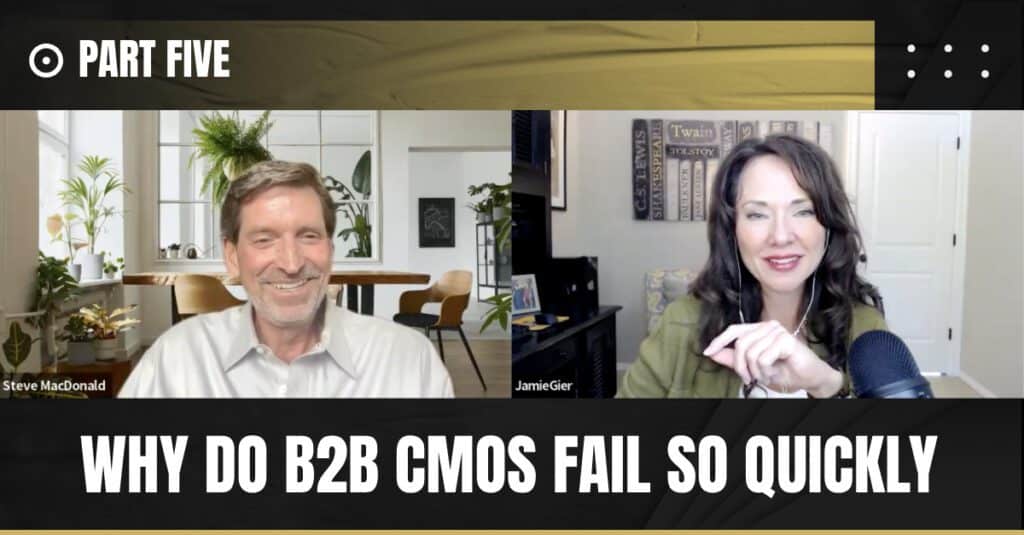
Expert: Jamie Gier
Interviewer: Steve MacDonald
Introduction
Introducing 3x B2B CMO Jamie Gier as she delves into the why and how of reversing the rapid turnover trend for B2B CMOs. Jamie covers topics such as “Stopping the friction, getting early wins, today’s brand is tomorrow’s demand, why your customer’s voice should be ahead of yours, and how to create your highest performing campaigns.”
Jamie also explains the need for a content strategy to provide valuable educational content. Jamie stresses the significance of customer voices in content creation and the role of relationships in building trust. She concludes by emphasizing the importance of setting expectations, getting early wins, and building a long-term marketing engine.
“Today’s brand is tomorrow’s demand, and CMOs must balance immediate results with a strategic focus on brand building and content creation. Content plays a key role in building trust and influencing purchasing decisions.” – Jamie Gier
The Difficult Landscape for B2B CMOs
One of the primary reasons B2B CMOs face such high failure rates is the complexity of their roles. Unlike B2C marketing, B2B marketing often involves elongated sales processes, multiple decision-makers, and extensive content requirements. For example, in Jamie’s healthcare tech industry, sales cycles can last 12 to 18 months, involving buying committees with 8 to 10 individuals, each having different roles and opinions. The need to educate and convince these stakeholders about the value of a product or solution adds to the complexity.
Furthermore, the B2B landscape is crowded with numerous technology vendors targeting the same audience with similar messages, leading to market and message confusion. B2B CMOs must navigate this landscape and develop comprehensive content strategies to build their brand and create demand for their products, which sets them apart from their B2C counterparts.
Balancing Short-Term Wins with Long-Term Strategy
Jamie suggests a dual approach to balance short-term wins with a long-term strategy. First, CMOs should work closely with the sales team to identify current friction points in the sales process and create content to address these issues immediately. This approach helps demonstrate the value of marketing in the short term.
Simultaneously, CMOs must develop a broader content strategy that targets different stages of the buyer’s journey, from awareness to consideration. This long-term strategy involves creating content that educates and guides buyers rather than directly selling a product. It’s about providing value and helping prospects solve problems, which takes time but builds trust.
“We could always live in the quarter and develop campaigns specific to the quarter, but the hard work is the patience to build the brand to get people to know who you are and to bring them along. And that’s not a quarter-by-quarter play.” – Jamie Gier
The Significance of Content in B2B Marketing
Jamie stresses the importance of content in B2B marketing, giving it a rating of 10 on a scale of 1 to 10 in terms of importance to the overall growth and success of the business. Content bridges companies and their audiences, especially in industries with lengthy sales cycles and complex buyer personas. Content, in various forms like case studies, eBooks, peer-to-peer testimonials, webinars, and podcasts, plays a pivotal role in educating buyers and guiding them through decision-making.
Moreover, content should not focus on overtly selling products but on providing valuable insights and solutions. Buyers want to be advised, not sold to, and CMOs should align their content strategy with this expectation.
“You don’t use content to sell, you use content to educate because that’s the content that people engage with most. You’re helping them think through how to solve a problem? How do I do my job better? And so it’s not about selling your product. It’s about adding value.” Jamie Gier
How To Create Your Highest-Performing Content
In content marketing, navigating the intricacies of different industries can be a huge challenge. Jamie provides a great example within healthcare, a vertical defined by its unique complexities and demands. Healthcare is a vast sector, with over 900 large hospitals and health systems nationwide within Jamie’s ideal customer profile. However, it’s essential to note that within these health systems, one encounters a multitude of departments, each governed by its own C-suite leaders and specialized teams. Each of these entities plays a pivotal role in the decision-making process, but their motivations and priorities differ significantly.
The common thread that binds these diverse departments is their shared commitment to enhancing patient care, albeit through different means. Efficiency and effectiveness are the shared goals, but the path to achieving them varies. This intricate web of stakeholders demands a nuanced approach to messaging. To complicate matters further, these departments are besieged by a constant barrage of vendor solicitations. In a typical day, a healthcare decision-maker can expect to wade through an avalanche of approximately 300 emails, all vying for attention.
In this environment, the educational component of content becomes paramount. It’s not merely about broadcasting a company’s voice; it’s about showcasing the voices of satisfied customers who drive transformative change within their organizations. These customers serve as advocates, sharing their experiences and insights on the technologies, processes, and talent they’ve employed to achieve superior outcomes.
In the healthcare content marketing landscape, the true champions are the customers themselves. This industry operates on a peer-to-peer model, where the power of referrals and personal endorsements reign supreme. Consequently, Jamie’s highest-performing content isn’t crafted in conference rooms; it’s extracted from the genuine experiences of customers. Their stories, shared on platforms like LinkedIn or through targeted marketing campaigns, form the cornerstone of Jamie’s content strategy.
While many marketers may proclaim the importance of customer-centric content, it’s not just a slogan for Jamie – it’s a quantifiable reality. Jamie has the data to substantiate this claim, underscoring content’s pivotal role in her company, where content marketing and customers’ voices are our most persuasive and compelling assets.
“Our greatest sales team is our customer base because it’s peer-to-peer, it’s referral-based. And so a lot of our content, our educational content, is simply capturing the voices of our customers and putting it out there into the universe. The customer voice should actually be out ahead of yours, not following, which is what we’re trying to do. So that’s where our customers become the referral.” Jamie Gier
Today’s Brand Is Tomorrow’s Demand
The trajectory from present-day strategies to future success can be long and tedious in business. Jamie emphasizes to her CEO and CRO that the groundwork for the next year’s pipeline was already starting to be laid the summer before or longer. Crafting a formidable brand identity is an arduous task that demands time and effort, yet its importance cannot be overstated.
The synergy between her Sales Development Representatives (SDRs) and regional sales directors hinges on brand recognition when they embark on prospecting and outreach endeavors. The familiarity of her brand profoundly influences their efficiency and effectiveness in opening doors to potential clients. By establishing this recognition in advance, she can help to significantly streamline their efforts, ultimately reducing the sales cycle and the need for repeated outreach attempts.
The rationale behind this approach is quite straightforward with Jamie – what actions can we take today to eliminate obstacles and ensure a smooth flow of deals through the pipeline? A proactive strategy is key to securing future demand.
“Today’s brand is tomorrow’s demand, and CMOs must balance immediate results with a strategic focus on brand building and content creation. Content plays a key role in building trust and influencing purchasing decisions.” – Jamie Gier
Given the intricate interplay of time, stakeholders, and tailored messaging, this principle resonates with everyone in her industry. The message intended for a Chief Financial Officer will inherently differ from that intended for a Chief Digital Officer. Therefore, her communication strategy must encompass diverse formats and channels to effectively reach and engage target audiences.
It’s important to note that this journey consists of parallel paths. While the long-term vision is paramount, you cannot disregard the need for short-term victories. Striking the right balance is pivotal. Marketers, in particular, must approach this duality strategically, as it is the bedrock upon which trust is built with the CRO and CEO.
Establishing trust is a multifaceted endeavor that necessitates long-term planning and a clear understanding of the early wins that will propel the company forward. Crucially, these early wins must align with the vision shared with the CRO, forming an agreement that paves the way for sustainable growth.
Conclusion: Aligning with the CEO and CRO
Successfully implementing a content-focused strategy on sales requires aligning with the CEO and CRO. Jamie suggests starting by addressing immediate pain points in the sales process to gain their trust. Simultaneously, CMOs should emphasize that building a brand and content engine is a long-term investment that will pay dividends now and even more significantly in the future.
By demonstrating the value of content in reducing friction in the sales process and laying the groundwork for future success, CMOs can secure support from their leadership team. CMOs should communicate that “today’s brand is tomorrow’s demand,” emphasizing the importance of both short-term and long-term efforts in achieving marketing goals.