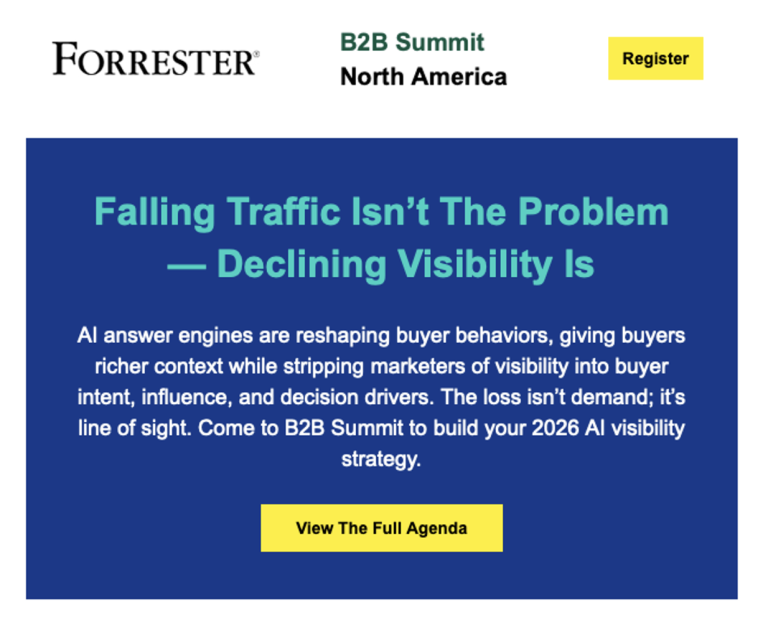
That matters.
Not just because Forrester said it, but because it used that message to promote one of the most important B2B events in the market. For B2B companies running an ABM go-to-market strategy, this is not a side conversation about SEO. It is a reminder that buyer truth, early trust, and stronger proof now sit much closer to the center of the GTM than many organizations still treat them.
Ask engine optimization in B2B is not just about showing up in AI answers. It is about whether your company is building the kind of buyer-grounded proof that earns trust early enough to shape discovery, shortlist formation, and buying-group belief.
“Buyers rely heavily on AI but reach out to external sources to validate its output.” — Forrester
That is the deeper point here.
The new focus on ask engine optimization is really forcing B2B companies to confront an older go-to-market truth: if buyer questions, buyer challenges, buyer objections, and buyer proof are not governing the way the company goes to market, AI visibility is not the root problem. It is just exposing one.
What does ask engine optimization really mean for B2B companies running ABM?
The easy version of AEO is about discoverability.
The harder, more important version is about credibility.
For B2B companies, especially those running ABM, the issue is not only whether your content appears inside an AI-generated answer. It is whether your company is becoming visible in the right way, with the right level of trust, early enough to matter.
That is a very different standard.
What makes a strong ask engine optimization strategy work is also what makes a strong B2B go-to-market strategy work: a consistent, operationalized understanding of buyer questions, challenges, objections, and the proof buyers need to trust what they are hearing.
Steve MacDonald, CEO of Content Strategies, puts it directly: “Buyers aren’t looking for more information; they’re looking for a perspective that reduces risk and helps them make better decisions.”
That is why AEO is not just a content tactic.
It is a mirror into the health of the GTM.
Why is AEO exposing weaknesses in the go-to-market, not just in content?
Because AI visibility is amplifying the difference between content that is merely present and content that is genuinely useful.
McKinsey says only 15% of companies consistently incorporate customer input into their decisions. And according to Forrester’s State of Customer Obsession Survey, only 3% of companies can be considered genuinely customer-obsessed.
Those are not just interesting statistics.
They suggest that many B2B organizations still lack a voice-of-the-customer discipline strong enough to inform business and GTM strategy. And if that is true, then weak AI visibility is often a symptom of a deeper issue: the company is still relying too heavily on inside-out messaging and not enough on buyer-grounded proof.
“What we must do is align around the voice of the customer. And if we did that, it’s the natural alignment factor nobody can argue with.” — Steve MacDonald
“Everything performs better when the customer’s voice leads ours.” — Jamie Gier, 3x B2B CMO
“The voice of the customer is a change management tool. It’s very different to hear or be told the customer is telling me this versus to hear or be told the leadership wants me to change it. So using the voice of the customer as a tool to make changes to your strategy, to your company direction is very powerful.” — Tracy Hansen, 3x B2B CMO and partner in a GTM Consultancy
That is not just a messaging point.
It is a GTM operating principle.
Why does trust before the shortlist matter so much?
Because by the time many vendors think the buying process has started, much of the real influence has already happened.
Forrester says B2B marketers tend to start too late. 6sense found that buyers place four out of five vendors on the shortlist on day one, and 95% of the time, the winner comes from one of those initial four.
This needs to be translated into one of the clearest business takeaways in the whole conversation:
“The biggest blind spot in most go-to-market strategies is assuming evaluation is where influence happens. In reality, influence ends when the shortlist forms.”
“We need to be a year ahead of any RFP. If they’re already in the final SQL stages, we haven’t had time to build that relationship, and we won’t win with our product or service alone. Early-stage conversations allow us to build a relationship to win the business.” — Chris Green, 2x B2B Chief Revenue Officer
That is why AEO matters so much to ABM leaders.
If AI answer engines are shaping buyer learning earlier, then the strongest response cannot be limited to search mechanics. It has to help the company build trust and relevance before formal evaluation becomes visible.
Why does the voice of the customer matter more in an AI-shaped buying journey?
Because trust still depends on what buyers hear, from whom, and in what setting.
When Steve MacDonald asked Ramya Kumaraswamy, the VP of Growth & Demand Generation for an enterprise company, about the value of executive access into ABM-targeted accounts, her answer went right to the heart of the issue:
“It’s not a sales conversation. It’s not a pitch.”
That distinction matters because the environment changes the quality of what gets said.
Steve makes the same point from the business side: “You don’t get the best voice-of-the-customer insights during sales conversations. That’s when prospects are most guarded and holding back.”
Ramya then explained why that type of access matters so much: “Executive access is very valuable because that’s the first of many conversations that we hope to have.”
That is the beginning of the AEO connection.
The point is not just to get seen.
The point is not just to get the meeting.
The point is to create a stronger next move.
When a company earns trust in a way that also produces public, buyer-grounded proof, it is doing more than relationship-building. It is creating the kind of credibility that can keep working across thought leadership, website content, sales enablement, proposals, and the wider buying motion.
What makes buyer proof more credible than vendor messaging alone?
“90% of B2B buyers say they completely or somewhat trust peers in their industry. 85% say they trust the customers of vendors in their industry.” — Forrester
This is where the Triad of Voices matters.
The Voice of the Business frames the issue and gives it strategic meaning.
The Voice of the Customer affirms it through lived experience.
The Voice of the Market independently validates it.
That structure matters because vendor language alone rarely carries enough trust.
Steve MacDonald says it plainly: “Buyers don’t always lack information. They lack peer confirmation and market validation. Sellers lack trust and access before buying activity begins.”
That is why this is more than a content conversation.
AI systems can summarize information. They do not remove the buyer’s need to decide what is credible. The business voice can lead, but it gets much stronger when the customer voice confirms it, and the market voice reduces perceived bias.
That is what turns content into proof.
Why does the broader buying group matter just as much?
“B2B buying has become more collaborative, more risk-sensitive, and more dependent on validation from trusted sources.” — Forrester
The first visible stakeholder is rarely the whole story.
Edelman and LinkedIn found that 71% of hidden buyers have little or no interaction with sales teams. Yet they still influence internal consensus and can slow or stop a decision.
That is why public, peer-grounded proof matters so much.
Ramya described it in very practical terms: “When you have these different kinds of touch points, you have ways in which you can influence a larger group within that account or within that company that has different roles.”
Steve’s version is shorter and sharper: “We don’t chase the buying committee. We enable insight to reach them.”
That is a better way to think about visibility in B2B.
The goal is not only to be discoverable by the person who typed the first prompt. The goal is to create proof that can move across the wider network of people who influence the decision after that first search.
What does an operationalized voice-of-the-customer program actually do?
This is where many companies still need something more structured than ad hoc customer listening.
A serious voice of the customer (VoC) program should help the company:
- Capture buyer truth outside sales pressure
- Organize it into usable intelligence
- Reinforce GTM positioning with peer and market validation
- Improve how the business answers objections
- Give teams stronger language, stronger proof, and stronger context
- Make that insight reusable across the entire revenue motion
That is where Voice-of-the-Customer-as-a-Service (VoCaaS) fits.
It is not just a content engine. It is a practical way to operationalize the voice of the customer across ABM, thought leadership, sales enablement, proposals, pipeline progression, and buying-group influence.
That is why Lori Stout’s conclusion is so useful here: “I don’t think you can say you’re customer-obsessed without a voice-of-the-customer program. It impacts every piece of the go-to-market strategy.”
That is the right level of claim.
Not that companies need one more marketing program.
But modern B2B companies, especially those running ABM, need a stronger, more operationalized voice-of-the-customer foundation than most currently have.