
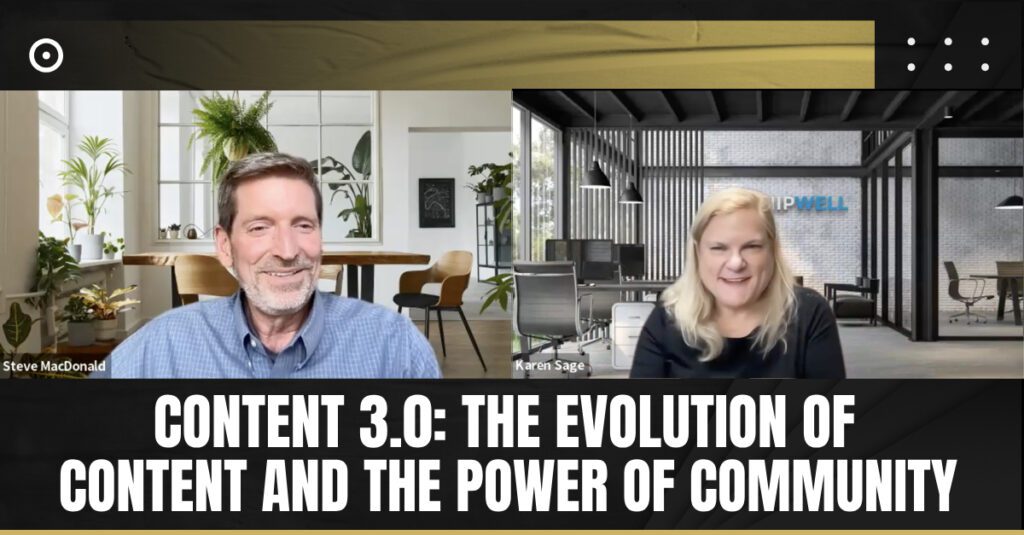
Podcast Guest: Karen Sage
Host: Steve MacDonald
Watch or listen to the full episode.
Introduction to Karen Sage
Karen Sage, a five-time B2B CMO and the current CMO at Shipwell, brings a unique marketing perspective with her math and engineering background. Known for her track record in guiding companies to successful exits, she discusses the evolution of content and introduces the concept of Content 3.0 in this podcast interview.
Steve MacDonald: Welcome everyone to the C Suite Marketing Perspectives podcast. I’m Steve MacDonald, your host. And today we have a really, really interesting conversation.
It’s about content 3.0. And if you don’t know what that is, that’s great. That’s why you’re here. We’re going to talk about the evolution of content and where it’s going. And leading that conversation is Karen Sage. Now, Karen, you’re a five-time B2B CMO, currently, the CMO at Shipwell, and one of the badges of honor you wear is that you’re known as the CMO of successful exits.
A lot of the companies that you’ve been at have had good exits. Tell us more about your background and Shipwell, and then we’ll get into this idea of the evolution of content and what content 3.0 is.
Karen Sage: Sure. I like to give people warnings about my background. I give two warnings that all my education is in math and engineering, which is very unusual for marketing.
Although it’s becoming more and more popular as it should, right? Given how digitally savvy you have to be. But also, too, that I’m an introvert. People are always surprised that I’m an introvert. I’ve known of a couple of other CMOs who are introverts, but we’re few and far between.
Steve MacDonald: Well, you don’t sound like an introvert when I’m talking with you.
Karen Sage: I turn it on, but I tell you, I’m like the best ghost at parties that’s ever, ever been known.
Steve MacDonald: Okay. I’ll remember that for our company Christmas party this year.
Karen Sage: Don’t take offense.
Steve MacDonald: Well, let’s get into this conversation because there’s always an evolution in our jobs, in the markets, right?
Content is an important part of what we do in marketing, not only from product marketing but all the way through thought leadership and establishing our expertise and that role as a trusted advisor and how that impacts the buyer’s journey at every stage. So, when we talk about the evolution of content, it’s an important subject.
Content 3.0 101
Steve MacDonald: Give us the content 3.0 101 from Karen regarding where you think it’s going.
Karen Sage: I think we’ve all realized that content is hugely important. Thought leadership, in general, is hugely important. There are other sorts of things going on in terms of trends that will make content very hard to reach and differentiate. You could even go as far as to say accurate, but trustworthy was probably a better word. And then the 3rd part of that is, how do you differentiate against all the other stuff out there?
So one of the huge changes is ChatGPT and the fact that you can generate content very, very easily now. And so everybody’s upping their content game because it’s easier and easier to produce. The flip side is other things in digital marketing, like the deprecation of third-party cookies and privacy laws.
Our ability to target and be very specific about who we target and get that content in their hands will be removed from a public sense. And what happens when you get lots and lots of content out there and the inability to target it? You have an explosion of content that needs to go through a revolution and change how we think about content.
Steve MacDonald: And you have a very specific way of thinking about that, right? Everybody’s got a content team. Everybody’s producing content. There was already a ton of it. It’s harder to personalize now and target, but we’re still getting a couple hundred emails a day coming at us.
In that environment, we’ve got to make a pivot in our careers, right? Like digital marketing. That was a pivot we all made in our careers. If there’s a pivot to be made here, you talked about content and community as a pivot point. Right. What do you mean by that?
Content as Community
Karen Sage: Content 3.0 is basically community. Content is a way to establish, set up, and provide a platform for community. When you talk about community, let’s talk about what that means. It’s about building authentic relationships, having discussions in very authentic and trustworthy places, and having that engagement in a way you feel comfortable. I’d go as far as to say safe.
Steve MacDonald: Yeah, and it’s all about relationships. We know that. Relationships drive the ABM world, and so that makes good sense from the starting point where we are right now. We have content that the company produces.
We have one sheets. We have all kinds of product marketing. We have case studies with all kinds of things that we create. Right? And they come from our point of view, and they come from us as the seller. Ultimately, we’re the ones selling our products, right? So, we must create thought leadership that brings outside perspectives, right?
So we’ll bring in industry luminaries and analysts. We’ll bring in our customers. We’ll bring in prospects. We’ll bring in all these different points of view, but what I liked about our conversation was no point of view makes better sense than the point of view of the community of the ICP that you’re reaching out to.
So that is the same people that are struggling with the same things that you are. They’re trying to understand the trends, trying to understand how to be innovative in their approaches and solving problems and mitigating risk, and that’s the education process of thought leadership, right?
Karen Sage: For sure.
Steve MacDonald: But it’s hard to do. So I like the idea of putting some of that weight onto the community where you bring it into the community of your ICP by drawing in those outside perspectives. But you talk about the concept of safe, a community that’s safe to share within. And you even gave me an example of when you’re mentoring somebody. Tell me a little bit about that, and please illustrate this idea of content inside of a safe community.
Safety is Key for Communities
Karen Sage: Sure. It came from when you have a community, or you have a podcast, or any kind of conference. Obviously, you have to filter what you say. When we call safe, you just can’t say how it is. People can interpret things in different ways.
If you take that to another level, if you’re having, for example, a mentoring relationship, you can expose yourself and tell the truth in ways that you may not be able to publicly. We had an example of a situation where you brought up marketing.
It’s a very challenging role. If I were in public, marketing would be the best thing, and I truly believe it, but there are some challenges. One is our short tenure. One is your relationships with sales, and some of the other people with a friction-filled relationship with marketing. And if I were in a conference, I would talk about that entirely differently than in a mentoring conversation and say, look, the reality is this. And here’s how you’re going to have to handle this. That disparity between representations of what’s the actual truth talks about this whole idea of that community wall and if you’re in it or out of it.
So, one example I gave you is when we talked about the CMO club. One of the reasons it was even established, called club CMO now, was that all these vendors would come up with conferences and things like that. The CMOs would come, and there was no way to have a peer-to-peer honest conversation.
And so what this organization tried to do was establish a safe place. Interestingly enough, fast forward. There are several different organizations I belong to having these peer-to-peer discussions. Vendors actually run some of them, and they say no recordings and cameras off. They understand the distinction between this lack of community and being open to everyone versus being open to a safe peer set.
Steve MacDonald: Here, a very important part of that safe community. It’s the kind of thing that I was thinking about when you were talking there: you’ve seen those placards and different things like nobody’s life is like what it really is on Facebook. We’ll put up what we want for public consumption.
Karen Sage: Totally. Show pictures of the food. And even if the food really sucked, it looked good, right?
Steve MacDonald: It looked good. So that makes perfect sense. This Content 3.0 revolution, I love it.
Gartner: A Community CaseStudy
Steve MacDonald: You’ve talked about a distinction about what, say, a Gartner does, these analyst firms, and everything else.
And they have a lot of content behind the community. But how is this different or the same as what a Gartner is doing?
Karen Sage: So, with Gartner, you would have a discussion. And there’s lots of content in that discussion, walled and for public consumption.
But what’s interesting about that content is that if you engage with Gartner, the next step of reading the content is meeting with the analyst. And that’s where the community comes in, and the brilliance of that model is that it’s a different level of discussion.
In that scenario, the research report was almost a teaser for the actually real engagement and very satisfying discussion that you would have one-to-one with that analyst. And so again, it’s Gartner as a community, but Gartner as a community of higher and higher value. The more you invest in it, the content is one thing, but it’s really a way in the door, it’s really that second level and enrichment that goes on that you provide that provides you the most benefit.
Steve MacDonald: Right, their business model is to create enough valuable content they put out for public consumption that you’re going to say, Hey, these guys are really important. They know what they’re talking about.
They know what they’re talking about. They are thought leaders, and I want more and am willing to pay for it.
But you’re talking about a B2B thought leadership strategy that promotes content that isn’t to paid communities.
Karen Sage: For the most part, there’s always money involved, right? Even in the CMO club, there are membership dues. Part of the reason why they can take or not take a vendor’s funding who wants to sponsor all the CMOs to dinner is that if you pay to belong to the community, you actually pay for your own dinner. So there’s always money involved somewhere. Right?
Steve MacDonald: But the point of it is to get people into a community where authentic conversation can happen, that’s a conversation that doesn’t happen on Facebook.
Karen Sage: That’s right. That’s right. And if it does, it’s filtered.
It’s a taster. It indicates the value of your conversation without necessarily that flavor that shouldn’t be shared.
Steve MacDonald: So you said something that might be a little controversial, which I love, and that is that all of a sudden, my hard-earned thought leadership content is the teaser. Right?
It’s the taster. I work hard on my white papers. I work really hard to get those webinars together. Tell me a little bit about your thinking there because there’s still value in all that. There’s value in all the public thought leadership that Gartner or Forrester puts out, right?
And they keep doing that. You don’t want ever to stop doing that.
Karen Sage: Those are training wheels; that content is an indicator of the value of further engagement, and the further engagement is community. And so what content has done for you there is basically enabled that community.
Steve MacDonald: That is music to the ears of other CMOs that are here listening. One of the things that’s beautiful about a community is when I had one for one of my businesses, a Facebook group that was just on fire. And I remember thinking to myself, this is the first time I’m adding value to my community without actually having to do a ton of the work.
Such value was being exchanged within that community in the name of my company. I just remembered thinking to myself. Wow. I worked really hard on that teaser stuff. Right? Yeah, that and actually because we struggle quite a bit. Thought leadership is not easy to create. Right. It’s one of the hardest things that we do.
So, having content evolve into a community where the community is a part of that shared value is a breath of fresh air in many ways, right?
Setting Up an Authentic Community
Karen Sage: Yes. It’s focused, authentic, it’s got a position, it’s got the value that you can take away, but yet part of it is on that, not physical. Part of it is in that intellectual mind meld that you had that carries on above the content and beyond, right?
Steve MacDonald: Right. And you get to be an orchestrator inside of that community, right?
Karen Sage: That’s right. And the value that you’ve provided is that takeaway. But even more valuable is the fact that you set up that conversation and that get-together, that mind merge.
Steve MacDonald: Right, right. Okay. So what everybody’s thinking at this point is it makes perfect sense. Where do I start, right? How do I think about this? And I know you’re also in the beginning stages of starting and thinking and implementing this. So what’s your advice? How do you take baby steps into this?
Karen Sage: Yeah, it’s a really good question, and it’s one that I faced here, and part of it was just there’s so much content out there.
Part of it was how to differentiate and figure out how to get to people and make that connection. But two, to make it in a place that values just the fact that you’ve defined that place, right? And so we’ve done things like, for example, we’ve looked at customer advisory boards as a key value proposition that we can begin to have discussions and leverage in ways that go far beyond what is ever produced from that relationship from a content standpoint.
The second piece, if you think about LinkedIn and setting up a community within LinkedIn, having people identify with that community has been huge because if you give good content, they know where to go. They know what emails and newsletters to open, giving them a much more engaged value proposition.
Steve MacDonald: And there was another value point that you mentioned earlier before we hit the record button. And that is that as we produce our thought leadership content in the content 2.0 world, what you’re talking about provides a platform to stay connected in that relationship. Right. Tell us a little bit more about that.
Karen Sage: So, yeah, it’s again that concept of a community and basically the fact that you have to do things to carry that community forward, and it doesn’t mean a one-on-one discussion. So we can have a one-on-one discussion right now. But then the event will be over, and then 6 months down the road, if there’s no engagement, that’s a tough call, right? What was the continued value?
Now, you and I could pick up the phone and have a conversation. Are you going to be able to do that with the hundreds of people that you’ve interviewed over the past few months? Probably not. But if you were to take in and aggregate and reproduce a lot of the intelligence that you’ve learned that’s in your head and these mind melds and put it into a form you can share. There’s a notion that you’ve provided continuing value, continuing community because of that value that keeps the light alive. For the community and that equation, right?
And it makes it so that when you send me an email, Hey, I remember Steve, we had that discussion. He always has good stuff. Let me open this, right?
Steve MacDonald: We know this world, and this ABM world, is all about relationships and keeping those relationships alive. And you work so hard to establish those relationships.
We need to work as hard at continuing that relationship. Yes. Yeah. Because those are our, we all know what’s in the business or personally, our network is one of the greatest values that we have. So I love that this community is really what you’re talking about, right? You’re talking about creating your own network as a company, right?
And in fostering that community and the relationships within that community.
Karen Sage: That’s right. And it’s got second order, third order value too. If you need introductions outside or to somebody else in the community, it really is a platform and the notion that you have this activity, but this activity could be so much more the more you push into it.
Steve MacDonald: Absolutely. So Karen, thank you. What I want to do is I want to spend a little bit of time, and I want to think through a little bit about, for right now, the companies that want to take baby steps but know that the thought leadership content that they’re creating right now is the here and now and today, right?
And I’m going to start taking steps towards this building community. What are your thoughts and recommendations on thought leadership and how companies should be thinking about creating their thought leadership on this never-ending need? Never ever goes away. What are your recommendations or thoughts on that?
Karen Sage: So, first of all, being authentic. If you’re creating content for content’s sake, you’ve missed it. That stuff may have worked, they used to call it clickbait or whatever. It never really provided value, but people felt like it would provide value.
So they engaged. Right? What’s more important here is if you’re authentic about what you’re providing and you take a stand, meaning that you’re not everything to everyone, but you have something to say that is unique to you.
It’s the second-order equation there. I think the third order is basically being able to set up ways to start establishing that community. Where do you start? Right? And I think there have been many communities started, right? And you could even think I talked about a LinkedIn newsletter like your podcast is a community.
Right? And it’s about how you take that engagement to the next level. And that’s the path to really benefiting from a community. And you’ll know that many vendors have started their own podcasts. They’ve started their own communities. You’re going to see more of that, right?
Community is the New Content
Steve MacDonald: I think so. Absolutely. Well, so this has been such an intriguing conversation. And I want to have a main takeaway for the audience. If there’s anything you remember from what we’ve just talked about here, what would it be in your mind?
Karen Sage: Community is the new content. It’s like content is old school.
It may get you in the door, but you have to do more than that to keep the conversation and the engagement going.
Steve MacDonald: Yeah. And when you say going like. Continue.
Karen Sage: Go on. That’s right to a continuous value.
Steve MacDonald: So you’ve given me a bunch of ideas. You’re right. My podcast has a community.
Darn, I should be taking better advantage of it. I would like to ask you to be my first community member. Oh. Yes. Good.
Karen Sage: Yeah. Yes.
Steve MacDonald: I like it. If somebody wanted to follow up with you and have a conversation, ask more about this; what would be the best way to get ahold of you?
Karen Sage: Be in my community.
Steve MacDonald: Your community.
There you go. See, and that wasn’t folks, that wasn’t a loaded question, by the way.
Karen Sage: So what’s funny about that is I have 15,000 subscribers or contacts on LinkedIn now. My LinkedIn, I get solicited every day. I decided years ago, do I accept everybody or not?
I should have said not. I don’t know. Some people think that the size of their content, the contact list, is their value. But in terms of me, it’s really being thoughtful, providing value, and starting in ways that I even look at how you and I got connected.
I mean, you solicited me. I noticed long before I actually picked up the phone. It wasn’t until you had reached out and had a friend of mine or former colleague of mine basically introduced you as part of a trustworthy person that’s allowed in my community. That’s when I engaged. So, be a part of my community.
You could try LinkedIn. I always accept LinkedIn invites. But if you have that value and people in my community that have that, they will make that connection for you. And that’s one that I pay attention to.
Steve MacDonald: Absolutely. And if you watch the podcast, I would just say maybe send Karen a LinkedIn connection request with Content 3.0 at the beginning of the note.
Karen Sage: That would be awesome. Then I’ll know.
Steve MacDonald: Well, Karen, thank you so much for being on and sharing this. This is a whole new way to think about what we need to be doing.
It’s not like we didn’t already have enough, but thank you. I appreciate it. Karen Sage: Well, thank you for having me. I enjoy talking to you; this is a great place for these discussions.