Warren Zenna, founder of The CRO Collective discusses why B2B Chief Revenue Officers (CROs) often face rapid turnover. He explores the structural flaws in B2B sales and marketing that lead to this issue and shares his experience, emphasizing the need for businesses to rethink their sales and marketing alignment approach.
In this insightful article, Warren Zenna, founder of The CRO Collective, explores the intrinsic flaws in the conventional structures of B2B sales and marketing that contribute to high turnover rates among CROs. He shares his extensive experience and unique insights into what truly constitutes a successful CRO and why it is essential for businesses to rethink their traditional approaches to sales and marketing alignment.
“Your organization has to be set up for your CRO to succeed, which is why even the most qualified CROs can fail. It often has nothing to do with them and everything to do with the environment they were brought into, which wasn’t set up to work for them.” -Warren Zenna
Key Takeaways:
CROs often fail because they are miscast as heads of sales rather than leaders of entire revenue operations.
Companies suffer from revenue misalignment due to siloed functions in sales, marketing, and customer success.
A CRO should oversee and align sales, marketing, and customer functions to optimize revenue generation.
Bringing in a CRO too early or without organizational readiness can fail.
CEOs must understand and support the strategic remit of CROs to ensure success.
From a podcast interview with Warren Zenna, Founder of The CRO Collective
The Role of the CRO
Warren Zenna argues that the core issue with the Chief Revenue Officer (CRO) role is its lack of a clear, consistent definition across organizations. Unlike other C-suite roles, the CRO’s responsibilities are often misunderstood, leading to misaligned expectations and frequent turnover. He emphasizes that a CRO should oversee the entire revenue operation, including sales, marketing, and customer success, rather than just acting as a head of sales. This comprehensive oversight ensures these functions work harmoniously, creating a unified revenue strategy.
Warren also highlights the critical need for alignment between sales and marketing, which are often treated as separate entities with conflicting agendas. He notes that the CRO’s role should be to break down these silos and promote collaboration across departments. Drawing from his experience, he illustrates how a disconnect between a company’s marketing messages and sales presentations can create confusion and erode customer confidence, underscoring the importance of a unified approach under the CRO’s leadership.
Preparing for a CRO: Organizational Readiness
Before hiring a Chief Revenue Officer (CRO), organizations must ensure they are adequately prepared. Warren emphasizes that a successful CRO needs more than just a title—it requires a clear job description, realistic KPIs, and interdepartmental coordination. Common mistakes include bringing in a CRO too early or without the necessary support, leading to inevitable struggles.
He also stresses the importance of conducting a thorough assessment of the company’s revenue operations before hiring a CRO. This diagnostic approach helps identify core issues within the market, processes, and teams, ensuring the CRO is hired to address specific, well-defined challenges. Once these preparations are in place, a clear mission and structured support system are essential for the CRO to drive long-term strategic growth, with collaboration across all customer-facing departments.
The Strategic Value of a CRO
The role of a Chief Revenue Officer (CRO) is essential in aligning sales, marketing, and customer success in the dynamic B2B landscape. Warren emphasizes that the CRO’s responsibilities extend far beyond sales, encompassing the entire revenue operation. He explains that sales are just one component of a broader revenue strategy, highlighting the need for a comprehensive approach.
He also stresses the importance of focusing on existing customers, as generating revenue through renewals and expansions is often more cost-effective than acquiring new clients. Additionally, he underscores the critical timing of hiring a CRO, warning that bringing a CRO on board before the company is ready can diminish its strategic impact, potentially pushing it into a limited sales role rather than overseeing the entire revenue organization.
Conclusion
Aligning your company’s revenue streams and ensuring a Chief Revenue Officer (CRO) thrives involves careful preparation before making the job offer. It is crucial to understand the full scope of the CRO’s role and set up your organization to support them. This preparation helps avoid common pitfalls that lead to high turnover rates among CROs.
Successful CRO integration requires more than just hiring; it demands positioning them to lead strategically rather than just managing day-to-day tasks. By addressing these core elements, companies can foster a supportive environment, promoting long-term revenue growth and organizational alignment.
ELEVATING CONTENT MARKETING STANDARDS RAISES A CRUCIAL QUESTION: Why shouldn’t the very act of creating thought leadership content also spark new conversations with in-pipeline deals, top prospects, and high-priority customers for revenue expansion? Or serve as the cornerstone for learning and applying voice-of-customer strategies? That’s the power of ABM Podcasting—engaging B2B buyers and customers in meaningful conversations that uncover essential go-to-market insights, support long sales cycles, reinforce your market perspective, build peer-level trust, and dismantle objections that kill deals.
Steven MacDonald is the founder of Content Strategies, CEO of a MarTech SaaS Company, fractional CMO consulting with leading B2B companies and former Director of Strategy and Client Service at top ten digital marketing agencies.
Steven MacDonald is the founder of Content Strategies, CEO of a MarTech SaaS Company, fractional CMO consulting with leading B2B companies and former Director of Strategy and Client Service at top ten digital marketing agencies.
Episode #349: Alysha McCree, Head of Marketing at FPT Americas, explains why simply claiming AI leadership no longer sets a company apart. She shares how ...
In this 2:19 video, Alysha McCree shares how her team learns to use AI through ongoing experimentation and peer teaching. They build documentation and prompt ...
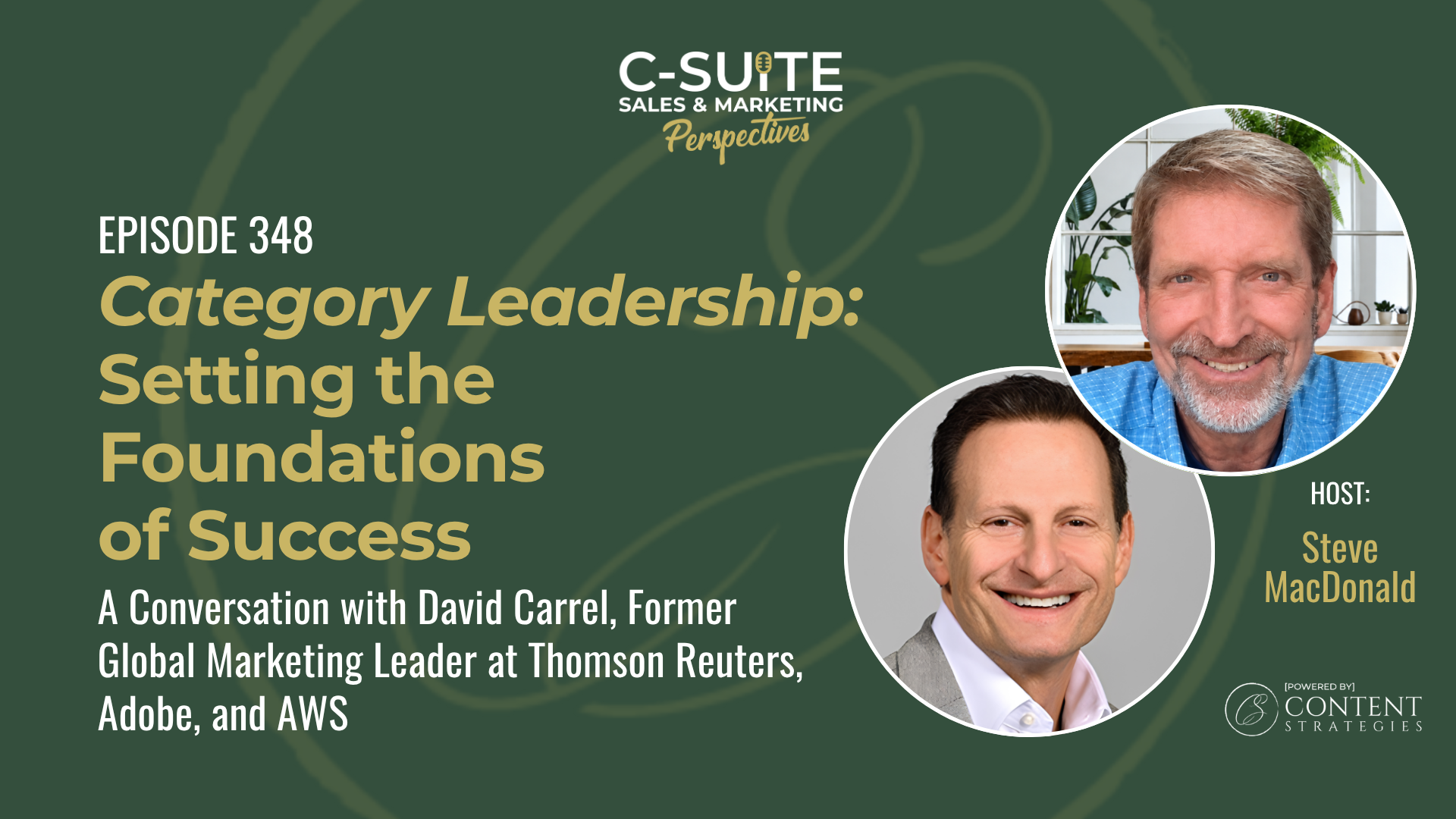
Episode #348: David Carrel, Global Chief Marketing Officer at Thomson Reuters, explains how category leadership goes beyond thought leadership to shape how a market thinks. ...
In this 1:54 video, Melanie Zmetek Naconecy de Souza explains why B2B customer understanding must begin with people. She shares how buyers bring priorities, challenges, ...
Episode #346: Ashley Deibert, a three-time Chief Marketing Officer, explains why customers are one of the most valuable growth assets B2B companies often underuse. She ...