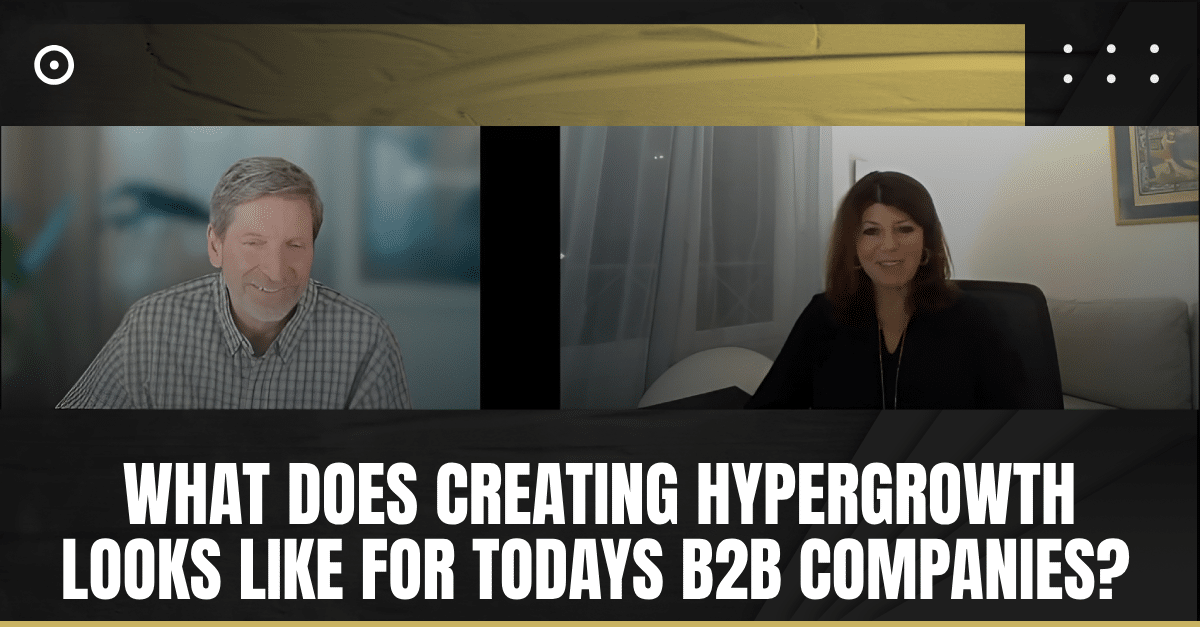


Peggy Studer, CMO at Klaxoon, explores the complexities of driving sustainable hypergrowth in B2B. She shares insights on cultural nuances, marketing technologies, and the balance between short-term wins and long-term growth. She emphasizes product marketing, brand building, and data-driven strategies and highlights team dynamics, customer voice, and adaptability as key to success.
“If you want to achieve hypergrowth, you have to be willing to open up and carefully examine things to see what works and what doesn’t. If you’re just going through the motions without a strategy that addresses a problem or need, it’s not really going to work.” – Peggy Studer
Peggy Studer highlights the importance of team dynamics, customer voice, and marketing fundamentals in driving hypergrowth. Rather than chasing short-term wins, she advocates for fostering innovation, data-driven decisions, and a customer-centric vision. Companies that embrace these principles achieve immediate success and build a foundation for long-term excellence.
Follow Peggy Studer on LinkedIn
Follow host Steve MacDonald on LinkedIn
[Transcript]
[00:00:05] Steve MacDonald: Welcome, everyone, to the C-Suite Sales and Marketing Perspectives Podcast. I’m Steve MacDonald, your host. Today, we have a very special guest, Peggy Studer. And Peggy, you are the CMO right now of Klaxoon. You’ve been in the C-suite multiple times as a CMO. You’ve run global marketing for companies.
[00:00:22] Steve MacDonald: You are actually very international in your DNA, right? You’ve lived in, what, seven different countries and five different continents? You’ve worked at multinational companies, and it’s interesting because you also help startups. You’re aligned in France with a top business school, helping startups get off the ground. You learn a lot from that, and they learn a lot too. So, you’ve got a really great background to take on today’s subject matter, which is: How do you create hypergrowth?
[00:01:00] Steve MacDonald: In today’s B2B companies, you know, with everything going on, what do we have to think about—especially as CMOs, but also as C-suite executives inside our companies who are helping to plan long-term growth?
[00:01:08] Steve MacDonald: So, before we dive right in, I’d love to give you an opportunity to expand a little on your background before we get started.
[00:01:17] Peggy Studer: Thank you, Steve. I’m delighted to be here today. Like you said, I’m currently the CMO of Klaxoon, which is a visual collaboration scale-up based in France but operating internationally in the UK, US, and Germany.
[00:01:33] Peggy Studer: I run all of marketing, meaning I oversee business insights, product marketing, content, communications, acquisition, and digital. It’s a full CMO role. I’ve been a CMO before, but initially, I grew up through product marketing, and I loved it.
[00:01:52] Peggy Studer: I was in product marketing for over 15 years because I truly believe it is the heart of the business. In product marketing, you tend to work with every section of the business. You work with finance, sales, product—everyone. Of course, in 15 years, product marketing has really evolved from the early days in tech.
[00:02:12] Peggy Studer: When I think back to my time at Agencia in 2003-2004, where I first started, compared to what product marketing is now, it’s completely different. Today, it’s a real, recognized discipline, yet there are still no formal studies or university programs designed to get you there. You kind of land in product marketing, and you need to be curious and have multiple skills.
[00:02:31] Peggy Studer: For me, it may still be seen as an unusual path to becoming a CMO, but I see it as a very natural one because, in product marketing, you touch everything. I really enjoy that. I still spend time on positioning, messaging—understanding how to sell and to whom—which is the core of serving the business as a CMO. If you don’t get that right, nothing else works.
[00:03:00] Peggy Studer: So, I spent many years in product marketing before evolving into a CMO role. I’ve worked in startups—like the early days of Agencia, which grew into a scale-up—as well as global multinational companies like CWT, which was a $21 billion company at the time. I like navigating both worlds.
[00:03:10] Peggy Studer: I like to think big, but I also like rolling up my sleeves and getting things done rather than getting caught up in corporate politics. That’s where my value lies—I can do both. I can bring expertise while also being hands-on. I can relate to people, and I think you need that in marketing because, no matter what company you’re in, you are working with every person in the room with you.
[00:03:41] Steve MacDonald: Marketing is the connective tissue inside a company. There’s no doubt about that, right?
[00:03:47] Steve MacDonald: I guess one of the first big insights here is that we really have to think about how we play that role because no one else is going to step up and do it. It’s never defined. You never take on a new role as a VP of Marketing or CMO and have someone tell you, “Okay, you are the connective tissue. You’re going to make sure everybody is aligned on the right insights and the right ICP.”
[00:04:00] Steve MacDonald: But if you could start us off here—what does hypergrowth mean in today’s market? How do you think about it? You’re doing it now in your own company, you’re helping startups, and you’ve done it many times over. When you take on a new role, how do you think about accelerating hypergrowth?
[00:04:32] Peggy Studer: Whether it’s growth or hypergrowth, the question is: How do you grow a business? Marketing is about serving the business. That’s how I see it. My biggest reward is when my team and I actually serve the business and deliver on our objectives. That’s the first mindset you need.
[00:04:55] Peggy Studer: To do that, you need tools, strategies, and assessments. The first step is diagnostics—understanding what’s working, where the opportunities are, and where the challenges lie. If you don’t understand that, you can’t fix it or make it grow. You need to be super clear on what you have so you can put the right strategies in place.
[00:05:54] Peggy Studer: You’re right that marketing has changed dramatically. It’s one of the C-suite roles that has evolved the most in the last 10 years. We’ve moved beyond just product and brand to include growth, digital, and acquisition. At one point, the CMO was expected to be an expert in all of these areas.
[00:06:00] Peggy Studer: Then, in 2022, things shifted. Funding dried up, companies started focusing on profitability, and the tech industry was hit hard. CMOs suddenly had to think differently about where to spend money. Budgets weren’t what they used to be, and they probably never will be again. The trick now is balancing short-term and long-term strategies. You can’t just think short-term anymore. You have to build something sustainable that will push through difficult times.
[00:06:32] Peggy Studer: That means evaluating everything: Do I need all these tools? Do I have the right strategies? Am I in the right markets? Do I have the right team? Should I keep everything in-house, or should I outsource expertise? Marketing has become so complex that every function requires deep expertise. No CMO can be an expert in everything, and it’s unlikely you’ll have in-house experts for every single area. So, where do I bring in freelancers? Where do I use agencies?
[00:07:11] Peggy Studer: As a CMO in the C-suite, you’re also responsible for company profitability. That’s a shift that’s happened over the last few years. Do I need to invest in massive events? Should I keep spending on paid acquisition? How do I build brand awareness in other ways? And content—content is a huge piece of this. Also, how do I grow my existing accounts? I already have customers—how do I expand my footprint within them? There are so many factors to consider when thinking about growth in today’s market, and we don’t know how long these conditions will last.
[00:07:57] Steve MacDonald: You know, you’ve had so many things in there that were important. I think one of the things is that, on one end of the spectrum, I have CMOs coming on and saying, “Steve, I have a bit of imposter syndrome here, right? How do I earn a seat at the table? How do I gain the respect of the CEO and the CRO?” And they naturally do, because that’s where revenue—the rubber hits the road—so their role is solidified. But ours is much more than lead generation. We’ve been asked to do that, but how do we step up and take on that role as it expands?
[00:08:32] Steve MacDonald: I think what you’re saying here is that our responsibilities are expanding, but how can we, as individuals, manage that? We don’t have all the expertise, right? None of us do. So, as leaders, we are only as good as our team. But what you just introduced, which I think is really interesting, is that we have to mold and expand the concept of what a team is.
[00:08:54] Steve MacDonald: It doesn’t have to be in-house. If we think everything has to be in-house, then we’re thinking about employees we have to bring onto the team and the costs associated with that. But we can get very senior people who have deep expertise in specific niches—everything from attribution to building our tech stack.
[00:09:14] Steve MacDonald: So, thinking about the team—how do I put together my team? Good leaders have high-performance members on their team. But is that internal? Is that external? I love that you’re thinking about hypergrowth and bringing together a collection of experts. It’s a combination.
[00:09:34] Steve MacDonald: Because it’s not going to cost as much to bring in an expert in a fractional way to round out that team. Is that a good takeaway from what you were saying?
[00:09:46] Peggy Studer: For sure. I focus on people first. A team is a collection of individuals, so I think about their skill sets. I think about what I need as a team overall.
[00:09:54] Peggy Studer: I don’t want a team of clones because that’s not interesting in marketing. You need creative people, you need data people, and you need visionary people, right? So, if I come on board, the first thing I do is have personal conversations with people to understand who they are.
[00:10:11] Peggy Studer: Do I have a team of clones? Do I have the variety I require? Then I look at the jobs—what exactly do they need to know? What do they already know? But I’m also matching that with what I know I need to achieve. If I need to supplement with more experts or training in some cases, I will. It’s the collection of people that makes us work.
[00:10:33] Peggy Studer: You mentioned imposter syndrome compared to the rest of the C-suite. I think a big part of our job—and I suffer from it, as I think every CMO does—is explaining what we’re going to do and ensuring that people understand we’re not always the expert in every specific area. Our role is to make sure we have the right people who are experts.
[00:10:52] Steve MacDonald: There are two areas of growth I want to get into. I also run a podcast in the HR industry, and we talk to a lot of experts about the importance of company culture—both company culture and team culture. One of the very first things it does for a business is attract the right people. Candidates these days are interviewing you as much as you’re interviewing them. If you’re going to attract high-performance team members who are going to stay—you won’t have to retrain them, right?
[00:11:26] Steve MacDonald: They will be loyal and major contributors to the team. So, we’ve got to think about our team culture and how it fits into the company culture. I interviewed a CISO—a Chief Security Officer—who said, “Steve, when I came into this new role, the very first thing I did—step one—was assess the culture of my team and make sure it’s a culture of emotional security and safety.”
[00:12:00] Steve MacDonald: A place where we can recommend, question, and challenge ideas without worrying about repercussions or politics. He said, “How do we create a team that is cohesive?” And I think that’s why VCs and private equity firms invest in the team first, before the idea.
[00:12:20] Steve MacDonald: The team is a higher priority than the actual idea. So, when it comes to creating hypergrowth, I love that you focus on the team. I’d love to hear your thoughts on the culture you like to create within your team and why it’s important.
[00:12:38] Peggy Studer: I value transparency, and I want people to be themselves. Of course, there’s workplace behavior that needs to be maintained—you can’t just accept and tolerate anything. But in marketing, you need to be creative. You want people to come up with ideas all the time. I may not be the best person to come up with the most creative ideas—that’s not how my brain is wired—but I will do everything possible to ensure my team has the freedom to surface ideas and speak their minds.
[00:13:00] Peggy Studer: I hired them to do that. They are the experts in their own domain, and I need them to be able to express their thoughts. I want them to know I expect them to come to me and say, “Hey, Peggy, I actually don’t agree with this,” or, “Shouldn’t we be doing this instead?” At the same time, collaboration is essential. This isn’t about individuality—it’s about the team. I want them to work together. Running a marketing team is like managing a well-orchestrated, well-oiled machine.
[00:13:36] Peggy Studer: If business insights aren’t doing what they’re supposed to and providing product marketing with what they need, and if product marketing isn’t orchestrating campaigns with communications, events, social media, etc., then it all falls apart. So, collaboration is absolutely necessary.
[00:13:54] Peggy Studer: But you also need to be yourself. If you show up wearing a mask every day and not being authentic, it doesn’t work. I truly believe that. I expect that from my teams, and I expect them to collaborate with other teams as well. I can’t talk about marketing without mentioning sales and product teams. These are probably the three most important: sales, customer success, and product. We need to be there.
[00:14:16] Steve MacDonald: In marketing, our first customer is really our internal teams.
[00:14:21] Peggy Studer: For sure, for sure. And I’d even push that a little further. I often say that marketing is like the United Nations, right?
[00:14:32] Peggy Studer: We’re the ones carrying the white flag. What we care about is the customer and the results. We’re the voice of the customer. That’s what matters, and that’s what everyone in a company should rally around. That’s how I see it.
[00:14:46] Steve MacDonald: So, you just introduced the next part of the hyper-growth model—we represent the customer, right? In one way, a lot of companies think about it like sales. Lots of times, it feels like they own it because they’re having conversations with prospects every single day, right? Customer success owns the relationship with the customer, and they’re having conversations with them. But the sales team is in a sales environment, and it was interesting—there was a study that Gong did, and they looked at over 4,000 sales conversations. What they found was that the sales rep talks two-thirds to three-quarters of the time, and it’s an environment where you’re selling, right?
[00:15:22] Steve MacDonald: So there’s a shield. If this conversation were me trying to sell you something, right, it’d be a very different environment. You’d be more guarded in what you’re doing. You would never design a learning program about your customers and run it through a sales process. That’s just not the way you would design that to happen.
[00:15:41] Steve MacDonald: You wouldn’t run it through a customer success process either. They’re trying to put out fires, answer questions, and cross-sell and upsell, right? They’re genuinely trying to learn, but you wouldn’t say, “That’s the way I would design a learning program about the customer.”
[00:15:56] Steve MacDonald: So when you say, “We own the voice of the customer,” that really is something that should be a priority—something we need to move up on our list because that’s the highest voice of authority in the business, right? It’s actually what most CMOs say gives them the right to have a seat at the table.
[00:16:15] Steve MacDonald: Because if you’re representing the voice of the highest authority, that trumps everything—it trumps the opinions and perspectives of everybody in the room. If you’ve heard of Amazon, they actually have an empty chair policy, which started before COVID, right?
[00:16:29] Steve MacDonald: But now, it’s a virtual empty chair, where they literally have an empty chair in the room—or virtually—that represents the customer. If the customer were in this meeting, how would that influence the decisions we’re making? That’s the voice of the highest authority. How do you [00:16:43] gather the voice of the highest authority? How do you get the voice of the customer, right? And be that expert, then share that within the company?
[00:16:52] Peggy Studer: I think that is essential if you’re talking about growth anywhere, right? If you have a product that there’s no market for, you’re never going to grow. So you’re either going to have to adapt by making sure you deliver to your customers what they want, or you’re going to die. There’s no question that customer success and account management want the relationship—the one-to-one, etc. But I think what marketing does is look at the bigger picture, right?
[00:17:17] Peggy Studer: It actually looks at it and says, “This isn’t about who’s screaming the loudest—which client is screaming the loudest, which account manager is screaming the loudest?” We look at the perspective and try to build trends. The trends can also come from outside, and that’s where everything around insights in a business—inside competitor watch, where the world is heading—comes in.
[00:17:38] Peggy Studer: Why is that going to impact customers? What are they going to want—not today, but in a year, in two years, in three years? All of that makes up the voice of the customer. I would never pretend to know a customer better than an account manager or customer success.
[00:17:53] Peggy Studer: No way. That is not what I’m trying to do. But I want to make sure I have the right relationship with the account manager that enables me to bring in some of these representative clients to the table and share what they need. There are so many ways to do that. You’ve got the tools. You’ve got the quick surveys.
[00:18:09] Peggy Studer: You’ve got the product advisory boards. You’ve got the one-on-ones. It depends on where you are, what you want to do, and what resources you have. But you have to have that pulse on what’s happening outside, for sure.
[00:18:21] Steve MacDonald: So, interesting question. What is the role? Because I like that you did this, right?
[00:18:27] Steve MacDonald: The understanding of customers means understanding their world—it’s understanding all their challenges. As a company, we may help out with this much of this, and we should never pretend that we handle everything for them, right? But if we’re going to be an advisor—if we’re going to be trusted—they want to know that we understand what they need to do to be successful, right? There’s that context of understanding the bigger picture.
[00:18:45] Steve MacDonald: And a lot of B2B companies focus on what we do and what we know, right? And so I like that you talked about knowing the broader perspective because that allows us to be like the Gartner trusted advisor, right?
[00:19:06] Steve MacDonald: To be seen not as a vendor, but more as a peer, as a colleague. That would be where we really want to be. That’s why a lot of CMOs come to this podcast and say, “Steve, when I start a CMO position, the number one thing I do is pick up the phone and start calling—start having conversations with our customers.”
[00:19:18] Steve MacDonald: And those conversations aren’t about handling a specific issue or cross-selling or upselling. It’s not that kind of environment at all. It’s a learning environment about them. How important, in your mind, is it that we constantly stay in touch with customers and understand this broader picture as part of the voice of the customer?
[00:19:45] Peggy Studer: It’s absolutely essential. But you know what’s funny about it? Customer organizations are very touchy about marketing speaking to their clients. It’s probably one of the hardest battles I’ve had in every single company—how can I get access to the client?
[00:20:00] Peggy Studer: You spend time explaining why, and if they don’t understand it, you still have to plead. “Well, I’ve got to be there,” or “I want to listen in.” This is where you either build that one-on-one relationship with the account manager or you don’t. It’s actually the hardest piece—because once you get to the client, they’re often very happy to talk to you.
[00:20:17] Steve MacDonald: It’s—
[00:20:21] Peggy Studer: Really, it’s quite interesting. I don’t think there’s been one company where I haven’t heard, “Well, yeah, or, you know what, we can’t get access to the clients. Peggy, how can we do it? Can you help?”
[00:20:31] Peggy Studer: You’ve got to talk to your peer. And I think it really is a struggle. Everybody values it, but it’s still a struggle. And I’ll just comment on one more thing you said earlier. I did this [gestures] where you’ve got to have the biggest picture.
[00:20:41] Peggy Studer: Yes. And I’m also going to do this [gestures] and say, “Okay, but where marketing plays a role is when you start looking at segmentation.” You start building trends within your customer base and seeing what matters. What are the use cases for this industry?
[00:20:55] Peggy Studer: What’s specific to them so you can actually go and target them—either with the materials you’re building or by ensuring we have the right product to meet their needs, right? So it’s big and small. And that’s what marketing does—we look at the big picture and make it smaller again.
[00:21:11] Steve MacDonald: So, I want to ask a question about something. I like the big and the small—and we have to, right? We’ve got to personalize. We have to understand smaller segments, and what do we do as a result of that? There’s no doubt about it.
[00:21:24] Steve MacDonald: Well, when you talked about the difficulty of even talking to customers—we’re constantly trying to produce content that lubricates the sales process, that lubricates the customer success process. Yet, we’re being told, “Don’t talk to the customer,” right? “Don’t bug the sales team; they’re really busy right now.”
[00:21:41] Steve MacDonald: So, here’s what’s interesting about this. In all the conversations that I have on the podcast, we have a call beforehand where we discuss what we want to talk about. I always start by asking everyone—CMOs, CROs, CEOs, Chief Growth Officers—what are the two greatest challenges to creating long-term successful growth? One of the key through-lines from all of their responses is that internal challenges are their greatest challenges.
[00:22:17] Steve MacDonald: We’re talking about hypergrowth, right? We want to talk about where the market is going, what the competition looks like, and how much funding we’ve secured because we have so much we can do. But the bottom line is, a lot of our greatest challenges are internal.
[00:22:36] Steve MacDonald: You reminded me of this because you just brought it up—these artificial boundaries. I learned this from a Chief Growth Officer, and he said, “Steve, this is the reason why,” and I copied him. He said, “On my email signature, I include #OneTeam.”
[00:22:52] Steve MacDonald: It’s because we are one team—sales, customer success, all of us together, right? We are one team. I put it in my email because I believe we’re also one team with our clients. It’s a good mentality. If we don’t break down those barriers… The reason those kinds of questions come up is that people don’t understand the benefit of allowing us to talk to their customers. And shame on us if we haven’t articulated or demonstrated that, right?
[00:23:25] Steve MacDonald: It’s incredible that we, as marketers, wouldn’t have access to our own customers—wouldn’t have access to our own sales team, for whom we’re doing all the enablement. Maybe that’s why the industry has rated over 60% of the content that marketing sends to sales as content they don’t use—they don’t even care about it.
[00:23:46] Steve MacDonald: There’s an article that came out in Forbes, and it talked about how they graded content across the industry. Do you know what grade they gave B2B content? A D-minus. Oh my goodness. Right? We have to break down these barriers, and these are all the things we’ve been talking about—whether it’s constantly talking to your customer, being one team with other departments, or how you build and shape the culture within your own team while working with external partners.
[00:24:19] Steve MacDonald: I talked to the head of customer relations at Avon globally, and he said, “I don’t think of our outsourced partners as outsourced—I think of them as part of our team. They are on our team. They may reside in a different office, they may get paid by a different company, but they’re still part of our team.” These are the mindsets that create hypergrowth, right?
[00:24:43] Steve MacDonald: Yeah.
[00:24:43] Peggy Studer: I love that you’ve unfolded this story. I have one more question for you. If there were one thing you wanted the audience to take away from our conversation today, what would that be?
[00:24:59] Peggy Studer: There are almost two things, right? One is—you’ve got to go back to the basics. If you want to achieve hypergrowth, you have to be willing to step back and say, “Okay, let’s really look at this diligently. What works? What doesn’t work?” Because if you’re just spinning actions without a strategy that addresses a problem or need, it’s not going to work.
[00:25:21] Peggy Studer: Then beyond that, the basics for me are brand and product marketing. These are fundamental in my world. Brand—because it creates long-lasting effects. In a downturn, it’s going to sustain you.
[00:25:38] Peggy Studer: Versus, if you turn off a paid ad campaign, it just stops—it disappears. So brand, product marketing, and content are critical foundations you need to get right in my world. And the fourth one is the team—you have to get that right. Whatever your team looks like—internal, external—you’ve got to get it right because you’re not going to do it on your own. Ultimately, all of this is about enabling the business.
[00:26:00] Steve MacDonald: Well, I know one thing for sure—people are going to have questions. I’m sure of it. Would it be appropriate for us to share a link to your LinkedIn profile so people can reach out to you?
[00:26:10] Peggy Studer: Yes, for sure. Absolutely.
[00:26:13] Steve MacDonald: Okay, fantastic. Well, Peggy, thank you. Thank you for sharing your worldwide experience—working with hypergrowth startups and more established companies. Some of these things we know innately, but we really need that reminder of what’s going to help create success. And a lot of it is internal.
[00:26:34] Steve MacDonald: So, thank you for sharing all of your perspectives. I really appreciate it.
[00:26:38] Peggy Studer: My pleasure. I really enjoyed this. Thank you, Steve.