
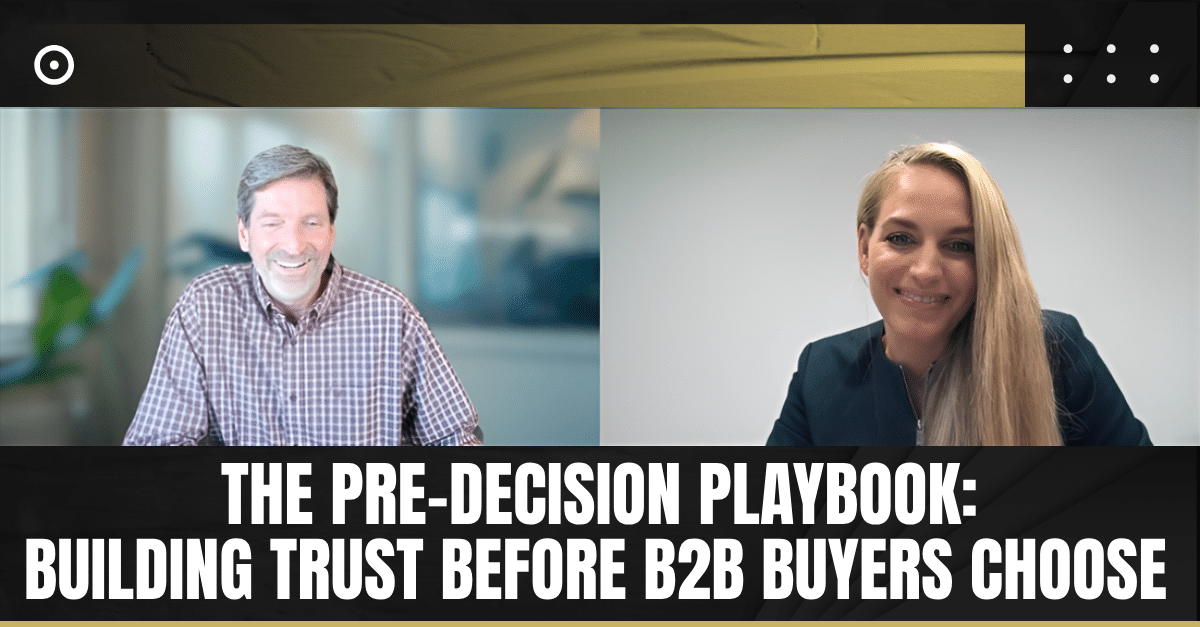


Emily Askham, CMO at Natixis Investment Management, explores the crucial role of marketing in building trust within the B2B financial sector. She highlights strategies for fostering credibility, including voice-of-the-customer programs and third-party research. The discussion also covers proactive problem-solving and CX-driven differentiation for long-term success.
“Most people will listen to you if they like you. But unless they trust you, they won’t do business with you. That’s why trust is the most critical part of it.” – Emily Askham
Reflecting on Emily Askham’s insights, trust emerges as the goal and outcome of sophisticated, customer-centric B2B strategies. Transformation happens when trust becomes measurable through enhanced customer experiences, increased referrals, and lasting relationships. This journey requires a collective effort, uniting cross-departmental contributions with a deep understanding of the customer’s voice and needs.
Follow Emily Askham on LinkedIn
Follow host Steve MacDonald on LinkedIn
[Transcript]
[00:00:05] Steve MacDonald: Welcome to the C-Suite Sales and Marketing Perspectives Podcast. I’m Steve MacDonald, your host. I guarantee you we’ll have a conversation today with Emily Askham that will expand quite a bit on the role of who we are as CMOs, what we can do, our contributions to the go-to-market strategy, and the things that we need to be thinking about. We’re going to be talking about the pre-decision playbook.
[00:00:29] Steve MacDonald: So, B2B buyers are coming to us already predisposed before they ever want to talk to anybody in the company. They’ve decided—or at least they’ve picked a winner. A lot of research has come out recently on that. We’re going to talk a little bit about it. But Emily, you are the CMO of Natixis Investment Managers, and you’ve been in the financial space for a long time. You’re an Australian who has lived in London for a long time. However, one of the things that I think defines you the most right now is that you are a CMO.
[00:00:59] Steve MacDonald: Chief Mom Officer—you have small kids at home, and I know that’s a really important part of your life. You’re passionate about that balance between work and life while being a C-suite executive at the same time. So, if I didn’t take all your thunder, I’d love to just have you maybe explain a little bit more about your background before we get started here.
[00:01:18] Emily Askham: Yeah, sure. Thanks, Steve, for having me on the podcast today. I’m really excited to be here. So, I’m Emily Askham, working for Natixis Investment Managers, and I’ve been in B2B financial services for over 15 years, working across pensions, insurance, and asset management. B2B is my domain.
[00:01:36] Emily Askham: Really excited to talk to you about that today. And yes, you alluded to the fact that I have two CMO roles—one as Chief Marketing Officer and one as Chief Mommy Officer, as my team likes to call it. I’m really passionate about showing people that you can have leadership positions, be a C-suite executive, and have that family life. And how do you bring those two together? That’s more of a personal passion for me. But yeah, that’s a little bit about who I am and what I do.
[00:02:02] Steve MacDonald: Fantastic. So, let’s just jump right in here. The idea of trust in B2B sales and marketing—why is it so important? Let’s start with the foundation there.
[00:02:13] Emily Askham: Yeah. Why is it so important? I always return to this one quote we talk about in the office: “If you don’t trust the people or the organizations looking after your money, then what’s left in the relationship?” It’s a big part of what we do. We have a huge responsibility for looking after people’s financial futures, managing their investments, and planning for their retirement.
[00:02:34] Emily Askham: Trust is so critical because we play such a key role in their lifestyles—not just in retail but also in the institutional space. Without trust, I say we have nothing. That is the statement I’d open with.
[00:02:49] Emily Askham: The harder part is how you build that trust that evolves. We’ve had some conversations about this—you build trust in B2B over a much longer sales cycle. For us, it’s between 12 and 18 months. So, how do you build trust before you’ve even engaged with a client or started a direct relationship with them?
[00:03:09] Emily Askham: That’s what I’m passionate about and where I see the role of marketing becoming much more critical. Recent research has shown that 87% of buyers classify trust as essential to their decision-making process. So, it’s something that we need to consider—how to build it and when to introduce it into the process.
[00:03:29] Steve MacDonald: It’s interesting because, many moons ago, when I got married, one of the first things my wife and I said to each other was, “If we don’t have trust in our relationship, we don’t have anything.” Right? And I think what you’re saying here is the same—without trust, there isn’t anything, especially in B2B, where we have these long sales cycles.
[00:03:43] Steve MacDonald: But I want to ask you—how do you build trust? What are the foundations of trust between companies in the B2B environment? If we can define trust, we can work backward and say, “Okay, now how do we start building it?” What is trust in a B2B environment in your mind?
[00:04:11] Emily Askham: Trust in a B2B environment means working with someone you can rely on—someone who understands you, listens to your needs and provides solutions accordingly. Sometimes, we become pretty transactional because we have products or solutions to sell. But we need to strip that back and truly understand who our clients are, what they expect from us, and how we can help them.
[00:04:27] Emily Askham: If we can provide a value-add or create a more personal experience for them, that will build trust. Without that foundation, we don’t have anything.
[00:04:50] Steve MacDonald: An add-on question—I believe that we often approach it too narrowly in building trust. As you mentioned, we focus on our products and services, proving how we can help clients by what we do. But to be a trusted advisor, don’t we need to understand our ideal customer profile (ICP) more broadly? They have challenges in their jobs that they want us to understand. They want us to know what success looks like for them in their careers and companies.
[00:05:35] Emily Askham: That’s a valid point. In B2B, particularly in financial services, we tend to push products because we have commercial targets attached. But the industry is evolving. We need to listen to our clients, understand their needs, and provide tailored solutions.
[00:06:06] Emily Askham: We also focus on value-added services. For example, in our world of investment portfolios, we introduced a free portfolio analysis service. Our independent financial advisor solutions team assesses a client’s portfolio, identifying strengths and potential overlaps. This adds value for them while also allowing us to understand their challenges better.
[00:07:03] Emily Askham: Even if we don’t have the perfect solution, we’ve still helped them recognize gaps and opportunities. That positions us as a trusted partner rather than just another product vendor.
[00:07:28] Steve MacDonald: So that free service—looking at their portfolio—is that their entire portfolio, or just the funds they’ve allocated to you?
[00:07:36] Emily Askham: Yeah, so we can look at all the portfolios, but we also just look at the ones associated with us. It depends on what the client wants or needs and how open they want to be with us. With Natixis Investment Managers, we are a multi-affiliate model. And what that means is that we have over 15 asset managers whose products we distribute.
[00:07:56] Emily Askham: So, that allows us an enormous breadth in terms of the product offerings we can capture. We have quite an extensive product range. But at the same time, we’re also open to looking at other products.
[00:08:08] Steve MacDonald: Here’s the point that I think is phenomenal about what you’re doing—and a key learning for anyone listening or watching. You stepped out of your traditional service model and said, “Hey, I need to know more about what you’re doing across all your portfolios, right?”
[00:08:26] Steve MacDonald: “I need to look at your risk tolerance, liquidity, compliance—all these different factors. We’re going to learn a lot if we can see more. We’ll be able to help you more and differentiate ourselves from other investment management firms.”
[00:08:42] Steve MacDonald: So it gives you a ton of insight into their business—what they’re doing and what they’re not doing—which positions you not just as a partner, but more like a peer or a colleague. Now, you have a perspective that other investment management firms don’t have.
[00:09:01] Emily Askham: It is a superpower. Another key point is that it starts to build relationships and trust with our clients. We get to know each other more deeply because we offer them a service beyond our products.
[00:09:16] Emily Askham: It never starts with the product. It begins with, “What are you challenged with? Where can we help?” Then we offer to conduct research or analysis for free if that would be helpful. So we’re starting on a goodwill gesture, which increases trust.
[00:09:30] Steve MacDonald: Everybody should think about this. I work with a client who is an outsourced talent acquisition company. But they also talk to their clients about workforce management—taking it to the next level. Obviously, the acquisition of talent requires transitioning into a high-performance workforce.
[00:09:50] Steve MacDonald: The key learning here is: don’t be afraid to step up and say, “Hey, let’s move the conversation up a level and outward.” Clients will appreciate that. You mentioned this as a superpower—are there other superpowers that B2B companies can leverage in their go-to-market plans?
[00:10:14] Steve MacDonald: One of the most incredible superpowers we have is the voice of the customer—listening to that voice. Expanding your service to look across the portfolio means entering conversations you wouldn’t have otherwise. How meaningful are customer conversations?
[00:10:44] Emily Askham: They’re critical. I also look after our client experience program and Net Promoter Score (NPS) program at Natixis Investment Managers. This has been incredible because I believe the customer drives everything.
[00:11:00] Emily Askham: Everyone talks about customer centricity, but it doesn’t make a difference unless it’s embedded in everything you do. We have our NPS scoring, which measures how satisfied our customers are. My North Star metric is whether someone would refer Natixis Investment Managers to a family member or friend.
[00:11:29] Emily Askham: You wouldn’t recommend anyone to your mom or dad unless you explicitly trusted them. So that’s a key indicator of trust, engagement, and likelihood to do business with us.
[00:11:44] Emily Askham: Another superpower I’ve seen work well is having client advisory boards. These allow us to test products, pricing, messaging, and overall experience. This builds trust because clients see that we value their input. If their experience with us improves, it also boosts our credibility.
[00:12:17] Steve MacDonald: So you put a lot of emphasis on understanding the voice of the customer—they are the highest authority in business. Every company claims to be customer-centric, but the degree to which they act on it varies.
[00:12:33] Steve MacDonald: Many companies say, “Our sales team talks to prospects constantly, and our customer success team engages with customers constantly.” But in a sales environment, prospects are being sold to, so there’s a shield. It’s not an open dialogue.
[00:13:00] Steve MacDonald: Research shows that in B2B sales, the rep talks two-thirds to three-quarters of the time. That’s a problem. Customer success teams are often putting out fires, answering questions, or trying to cross-sell and upsell—so it’s not an exploratory environment. You wouldn’t run a voice-of-the-customer program solely through sales or customer success.
[00:13:32] Steve MacDonald: On a scale of 1 to 10, how significant is a focused effort from the CMO in ensuring the whole company hears the voice of the customer?
[00:13:54] Emily Askham: It’s absolutely critical. But I would also say it’s not just the role of the CMO—it’s the role of everyone in the business. Limiting it to just one department, like sales or marketing, won’t be successful.
[00:14:09] Emily Askham: We run our program independently through a third party. This allows for qualitative research and open customer conversations about their pain points. The independent aspect is crucial.
[00:14:28] Emily Askham: My role is to take that feedback and drive action plans across the organization—whether in client servicing, sales, marketing, or communications. The goal is to enhance the customer experience.
[00:15:00] Emily Askham: If customers are willing to give us their time and feedback, we must show them how we act. One of the biggest mistakes we could make is gathering feedback but failing to implement changes. We must articulate what we will do with their input and share progress with them.
[00:15:09] Steve MacDonald: So all this comes back to building trust, right? If we listen to our customers through independent qualitative research, like customer advisory boards, opening up and saying, “Hey, we’re going to give a free service,” we will look at your entire portfolio and advise. And there’s all kinds of conversations there. You’ve got a pretty robust program. Then you say, “Put it into action,” right? So, how do we turn that into trust?
A study called The Trust Gap came out in January 2024. One of the key findings was that 74% of B2B buyers do not trust the customer evidence we present to them. So, knowing that, the job was just getting harder. That’s another validation.
I talk to a lot of companies, and I ask them this question—you know, I’m not going to ask you this live on a podcast—but I ask them how satisfied they are with things like their testimonials and case studies, the things that we traditionally put a lot of time and effort into. And they’re all okay. They tend to be polished PR pieces by the time we get done with them, which defeats the very purpose of building authenticity, trust, and bringing the voice of the customer forward.
How do we authentically represent what we do for our clients to help build that trust?
[00:16:33] Emily Askham: That is a tough question. There’s no single answer that will tick all the boxes here. Trust is so easily lost—one misstep, and it’s gone. It’s much quicker to lose trust than to gain it. Trust is something that is built over a long period.
Going back to our earlier point, the first thing I would say is that it’s about truly understanding your customers—understanding their needs and the value you can provide. One point I haven’t made yet is that 70% to 80% of a buyer’s interaction happens before the point of sale. So really thinking about using those touchpoints to build trust and reinforce your messaging is critical.
One concept we often talk about in financial services is transparency, which is a crucial factor. If you’re not transparent, you’re going to lose trust quickly.
A couple of things we do in the financial services space to build trust include carefully selecting who we partner with, especially in markets where we’re still growing. At a product level, we look at rating agencies—having an independent entity provide a rating that compares us to our peers helps establish credibility.
Sometimes, it’s that independent view that builds trust. We engage in strategic partnerships or co-marketing programs in markets where we’re not a dominant player. Aligning with companies that customers may already be familiar with—perhaps someone they bank with or buy insurance from—helps create credibility. Using those affiliations to introduce asset management products can be an effective approach to gaining trust in new markets.
[00:18:25] Steve MacDonald: How do you measure those efforts? Obviously, if you’re listed on a ratings service, you can track your ratings. But how do you know you’re making an impact for all those individual touchpoints? How do you measure trust-building efforts?
[00:18:41] Emily Askham: This is where the role of marketers is expanding and evolving. I don’t see the chief marketing officer role as just marketing anymore—we’re now tied to commercial objectives. We look at revenue, growth, and overall business impact.
Everything I do from a business perspective relates to those commercial objectives while ensuring we meet customer needs. The two key areas I focus on are commercial objectives and customer satisfaction, often measured through Net Promoter Scores (NPS). Tracking satisfaction across multiple touchpoints is crucial, especially given our long sales cycle. Since marketing influences around 80% of the buying journey before the point of sale, we measure success by the number of leads generated and the deals created for our sales team.
But it doesn’t stop there. For me, it’s also about onboarding—how do we ensure new clients have a great experience so they return and refer others? That’s why I refer to North Star metrics: If a client would recommend us to a friend or family member, then we’re on the right track.
Does that make sense?
[00:19:51] Steve MacDonald: Oh, absolutely. At the core of it, trust is about helping clients meet challenges and demonstrating real value. You talked earlier about being proactive in problem-solving—what did you mean by that?
[00:20:09] Emily Askham: Particularly in financial services, when markets are volatile or crises happen—like when banks suddenly closed overnight a couple of years ago—it creates fear and uncertainty. That’s when trust and partnership matter most.
Supporting clients during tough times builds credibility. When people feel anxious about the future, proactive communication is essential. Acknowledging their concerns, sharing expert insights, and providing opportunities to engage with professionals at critical moments all contribute to trust.
While we can’t change the outcome of every situation, we can use our platform to connect with clients, strengthen relationships, and reinforce their confidence in us.
[00:21:01] Steve MacDonald: Before we started recording, we were discussing how the role of CMOs is expanding, taking on more commercial responsibilities and directly impacting revenue. Our role is evolving positively.
You mentioned that the voice of the customer shouldn’t just be the responsibility of the CMO. My question is—who should own it? Who brings together customer insights, translates them across departments, and ensures the company acts on them? It’s not sales because they don’t engage with prospects in the same way. It’s not customer success because they focus on existing customers. It’s not operations. So who is responsible?
[00:21:52] Emily Askham: Well, it does fall to marketing. I think that is where my role has evolved as well. You start as a Chief Marketing Officer, but then over time, you end up owning the client because we own those 70 to 80 percent of the touchpoints beforehand.
[00:22:05] Emily Askham: We probably know now, with data, more about the clients, and that’s a difficult message for salespeople to take in. It has naturally fallen to marketing to be the function that collates the customer view, shares that, and builds it into how we’re going to improve it.
[00:22:21] Emily Askham: And I talked a bit about how it expands across—it’s not just marketing. It’s not just communications and our digital touchpoints. It’s how we engage in the sales process, how we onboard clients, and, in addition, how we communicate in crises. It’s how we retain clients.
[00:22:38] Emily Askham: So, that customer experience goes into all elements of it. And how we do it here at Natixis Investment Managers is that marketing actually runs the qualitative research. Then, we work with each of the different business arms to build action plans to make sure that we’re all forming towards that one common goal—making sure that the client is embedded.
[00:22:57] Emily Askham: I think where it’s really helpful on that side is that it’s actually in the CEO’s mission statement and vision. It’s in our 2030
[00:23:04] Emily Askham: strategic plan—I’ll use the full terminology here. Making sure that you have that buy-in from the top is critical as well. So while it can be owned by marketing and is driven by marketing at this point, it has to have that sponsorship from the top.
[00:23:17] Emily Askham: And I think that’s probably a key thing. Without that support, it won’t work.
[00:23:21] Steve MacDonald: Absolutely, you have to have that support. And here’s an interesting way to think about this. I had a woman on the show—she’s a Chief Value Accelerator Advisor for Goldman Sachs, a three-time B2B CMO. Her point of view was that marketing’s first customer is its internal customers—the different departments.
[00:23:43] Steve MacDonald: The voice of the customer, as a service, is what marketing is to the rest of the organization. That’s the most important thing that you can do. So I just wanted to get your opinion on that line of thinking, that mentality.
[00:23:58] Emily Askham: Yeah, I’m not sure I would agree. If I’m understanding correctly, she’s saying the internal business units are the first priority?
[00:24:06] Steve MacDonald: You’re saying that we have two sets of customers. Let me reframe the question and we’ll slice this. I just want to get your advice on something. I recently talked to a woman—she’s a three-time B2B CMO and a Chief Value Accelerator Advisor for Goldman Sachs.
[00:24:20] Steve MacDonald: Her perspective is that we have two very unique customers. We have our external customers, but we also have our internal customers—all the other departments that need to learn from the voice of the customer. So her perspective is that marketing’s role is really spearheading understanding the voice of the customer.
[00:24:39] Steve MacDonald: And then the translation of that is the service that we need to provide internally to all the different organizations—that marketing functions as the voice of the customer as a service to the rest of the departments.
[00:24:52] Emily Askham: That I would definitely agree with. I think some departments don’t have the opportunity to speak to customers or engage one-on-one with them. So, marketing plays a critical role in ensuring that voice is heard and feedback reaches the relevant teams.
[00:25:00] Emily Askham: Within our role at Natixis Investment Managers, looking after CX, our job is building that action plan with the departments. We take the customer feedback and ask, ‘How do we want to progress this?’ Then, we develop the action plan and bring it to the board for CEO sign-off. So it’s really about having that top-down engagement and sharing it with the rest of the business to ensure everyone is moving in the right direction.
[00:25:33] Steve MacDonald: I’m so glad you keep bringing up CX because McKinsey did a study in 2023 of 400 highly profitable companies. The number one differentiator amongst those companies—both B2C and B2B—was CX. It wasn’t their product; it was the experience they created versus their competitors.
[00:25:55] Emily Askham: Yeah. To be honest, I think this is where the game changes. It’s the overall experience they have with you. If they have a great pre-sales experience and a great sales experience but then a poor onboarding experience, you’re still not going to retain that customer next time around.
[00:26:09] Emily Askham: You have to look at CX holistically. From a marketing lens, one example I’d call out is the Royal Bank of Scotland. They ran a campaign back to the seventies, leveraging big data to understand client challenges. They positioned messaging around those challenges.
[00:26:31] Emily Askham: They may not have had the best product in the market, but they understood their clients the best and provided a seamless journey. The experience was: ‘Yes, I do have that challenge. How do I resolve it? Oh, here it is. And oh, it was easy for me to do.’ Those are the kinds of experiences people remember.
[00:26:46] Emily Askham: Making it easy to do business with you will increase your commercial success.
[00:26:50] Steve MacDonald: I want to answer this question myself, but I’ll ask you first—what’s the number one takeaway from this conversation about building trust as the foundation for relationships?
[00:27:10] Emily Askham: I think I’ll probably go back to a quote because I think they’re the most memorable. Two things: without trust, you have nothing. We spoke about that at length. But also, most people will like you, and if they like you, they’ll listen to you. But unless they trust you, they won’t do business with you. That’s why trust is the most critical part.
[00:27:35] Steve MacDonald: I think people will have questions after watching this because it’s been such an incredible conversation. Would it be appropriate if we shared a link to your LinkedIn profile so people could reach out?
[00:27:47] Emily Askham: Yeah, absolutely. No problem.
[00:27:49] Steve MacDonald: Emily, thank you so much. I could talk about this for hours because it’s at the heart of what we need to do as B2B companies. Building trust should be at the top of our priority list. It should be the focus of conversations with the board, the C-suite, and our teams.
[00:28:03] Steve MacDonald: That’s CX, right? The overall experience at all touchpoints builds that trust factor. Thank you for adding so much depth to this conversation.
[00:28:16] Emily Askham: And thank you so much for your time and for having me on the show.