
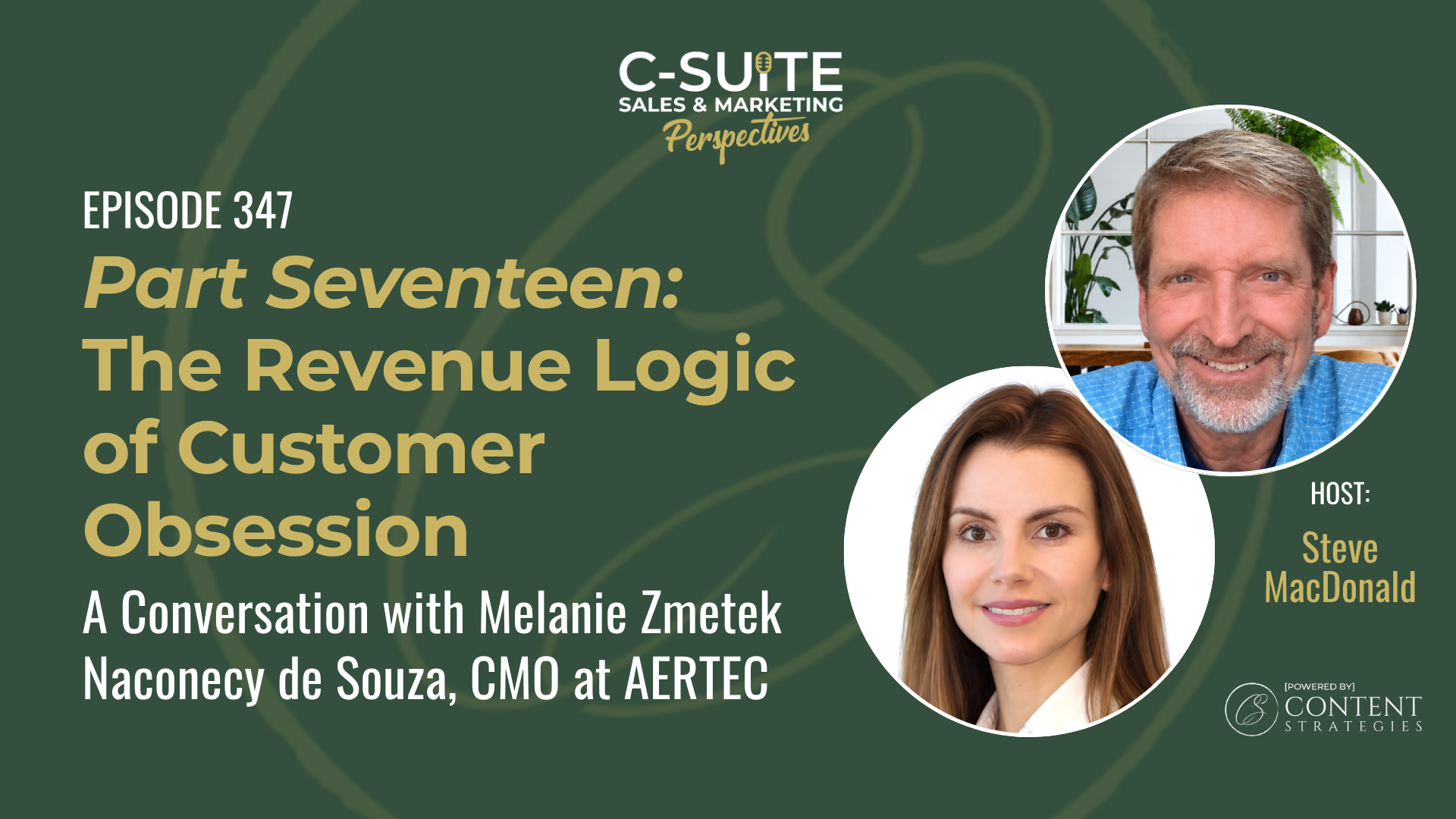


Episode #347:
Melanie Zmetek Naconecy de Souza, Chief Marketing Officer at AERTEC, explains why customer obsession begins with clarity. She shares how purpose, shared customer understanding, and brand consistency align complex B2B organizations. Her perspective shows how marketing can build trust before a sales conversation begins.
“A stronger brand can build trust. I think that’s the role of B2B marketing because the relationship with the client is built in a very long cycle, in a very personal way. The customer relationship is not only rational, but it’s emotional as well. Brands have this appeal to have a place in the minds and sometimes in the hearts of the customers.” – Melanie Zmetek Naconecy de Souza
In this conversation, Melanie shows how leaders can turn complex offerings into clear customer value. She explores the role of purpose in aligning teams, the discipline of sharing one view of the customer, and the brand-building work that happens before a buyer speaks with sales. Her experience connects customer understanding, focused communication, and trust to sustainable revenue growth.
Follow Melanie Zmetek Naconecy de Souza on LinkedIn
Follow Steve MacDonald on LinkedIn
[Transcript]
[00:00:10] Steve MacDonald: Welcome, everyone, to the C-Suite Sales and Marketing Prospectus podcast. I’m Steve MacDonald, your host, and today we’ve got a very special guest, Melanie Zmetek. Now, Melanie, I’m going to try to do justice to your background because you’ve got such an interesting background. You’re currently a Chief Marketing Officer at AERTEC, and I’m going to let you talk a little bit about AERTEC and what you’re doing. Very complex aerospace B2B go-to-market company.
[00:00:35] Steve MacDonald: You have, though, a background in B2C, in consumer goods, and on the agency side and in advertising. I have a background, too. You were at Grey; I wasn’t. I was at Foote, Cone & Belding, and all kinds of different agencies, and we live off of our creativity, our innovation, and I know that you bring that to your current role here as CMO, and we’re going to get into that and learn a lot more about that today. But you also have an interesting relationship with aerospace because you met your husband on an airplane. You had a long-distance relationship, and you were on airplanes all the time.
[00:01:13] Steve MacDonald: It’s almost fitting where you’re at here today. What I would love to do, though, is listen to you a little bit more about your background before we dive in, because the topic, what we’re going to talk about here today, is all about the revenue logic of customer obsession, and I really want to lean into your B2C background and talk a little bit about that and how you carry that forward. But I’d love to learn a little bit more about you first.
[00:01:41] Melanie Zmetek Naconecy de Souza: Thank you so much for the introduction, Steve, and thank you for the opportunity of having this conversation today. Yeah, that’s true. I come from a very different background than I am today. I started my career in advertising, and I am very passionate about it. I’m a passionate professional in creativity and marketing, and I’m always looking for ways to engage consumers and build brands.
[00:02:08] Melanie Zmetek Naconecy de Souza: I started my career in São Paulo, and then I moved to London and then to Panama, and now I am working in Spain. I’m based in Málaga, where I currently serve as the CMO of an aeronautical company. Not only do I come from a different background, meaning that I was an advertiser and now I am on the client side, but I come from consumer goods, and now I am in a very complex business, which is a great opportunity for me. I see the knowledge that I can transfer from one business to another, but I am also very humble and learn a lot.
[00:02:50] Steve MacDonald: I want to start out with some of that learning and what you brought into the world of B2B, and you called it a client-centric mindset, and you talked about creating clarity around process and purpose. I wanted to unpack that first and just learn what you meant by that around a client-centric mindset.
[00:03:14] Melanie Zmetek Naconecy de Souza: When I started working in AERTEC, I realized that sometimes, when you have a very complex business, people can believe that the communication also needs to be complex, and I don’t agree with that. I believe that clarity always facilitates the relationship with the brand. The more complex the business, the more important clarity becomes, and I think that people can handle complexity, but they struggle with ambiguity. So, I hate when some people say that they like navigating ambiguity. I don’t think that’s true. I don’t like navigating ambiguity. I like eliminating ambiguity, and that’s closely related to my role in translating the innovation we develop at AERTEC into language people can understand.
[00:04:11] Steve MacDonald: And immediately, when you started talking about taking something that’s complex, and I don’t think there’s any one of us that’s going to be listening to this podcast that doesn’t think that we have a complex business, complex product, complex technology, services, right? We’re always thinking about how we can simplify it. But there’s a great quote from Mark Twain: “I didn’t have time to write you a short letter, so I wrote you a long one instead.” It’s very easy to just keep writing, put out product one-sheets or different things that are long and robust, and what takes a skill is to really see through all that complexity and make it simple to understand.
[00:04:56] Steve MacDonald: If we don’t make ourselves simple to understand, there’s an entire world that our buyers and our customers, they’re trying to navigate, and they don’t have time to understand our complexity. If we make it complex, we lose, and the other thing you talked about was creating a relationship that is easy to understand. As soon as you enter complexity and it’s hard and it’s difficult to understand, we are in a relationship-based business. The B2B world is all about relationships. How does the lack of complexity in making things not ambiguous, how does that work towards creating a better relationship and establishing trust and things like that?
[00:05:41] Melanie Zmetek Naconecy de Souza: I think it’s all about understanding the consumer and the challenges the consumer is facing. I believe that my role, and it was also before when I was working in agencies, is to be this bridge between the business or the commercial team and the clients. Of course, they also manage the relationship directly, but sometimes they need the tools to understand the market. They need to understand competitors and trends, and in marketing, we manage these tools and the market research. We translate this data into more approachable language and make it clear how our product or service can solve the challenges or problems our consumers have. So, it’s always about understanding the consumers.
[00:06:42] Steve MacDonald: There’s power in brevity, right? Making things less complex, less ambiguous. If we make it too hard to understand, they won’t, and they’ll move on. There’s real power. Our human brains, at any one interaction, can remember two to three things max. So, we love talking and talking about our product, our services, our technology, and how it helps, and all kinds of stories and different things. But at the end of the day, we really need to leave them with something that’s powerful, that, to your point, connects to their problems, but in a way that they can understand as a takeaway.
[00:07:19] Steve MacDonald: They’re going to leave that conversation or that website page or that e-book or video or webinar or whatever it was, and they’re going to remember one or two things. And if we don’t think about that and say, “What are the one or two things we want them to remember?” and engineer towards that. I just keep hearing you. It’s not easy to be succinct. It’s not easy. It’s easier to be complex, and I think we fight that constantly. So, I know you’re surrounded by engineers, right?
[00:07:54] Steve MacDonald: Yeah, who love their products and their technology and do amazing things, and they want to talk about everything. Now I’m going to transition to, like, how do we think about making complex simple? How did you approach really intelligent engineers that built this phenomenal company and love their product, their technology, and say, “We’re going to make this a lot simpler.” How did you even approach that subject with them?
[00:08:25] Melanie Zmetek Naconecy de Souza: Well, because the business is so complex, even inside my company, there are some internal communication challenges because the teams that are part of one division do not always understand what is done by other divisions. My strategy to handle this internal communication challenge was the same as the strategy I used for external communication. It was to define the purpose of AERTEC because, of course, when the company is already 30 years old, and when it started, it was, of course, simpler than today. Today, we are responsible for three business divisions. Two divisions were sold in the last year and a half.
[00:09:22] Melanie Zmetek Naconecy de Souza: So, when I entered AERTEC, there were five business lines. Now we have three, which is still very complex, but when I started, there were five, and each team struggled to understand what the company did as a whole. They are very focused on their own business, on their own clients and objectives. But they weren’t always able to explain what the company does, and my answer was that we had to go back to the purpose. Why AERTEC exists. One of the first exercises for me was to refresh the mission and the vision. They had the mission and vision well established, but they needed to refresh them. Of course, a 30-year-old mission and vision had changed.
[00:10:23] Melanie Zmetek Naconecy de Souza: The values hadn’t changed. It’s a very nice cultural environment there. They really value the people. So the values almost hadn’t changed, but they had to sit down and think about why they do what they do and the purpose of the business, and this would help with internal and external communications. It was a beautiful exercise, and I’m glad that this is something that marketing usually does. But it’s useful for everyone, for them to understand why they are working there.
[00:11:01] Melanie Zmetek Naconecy de Souza: So, we were talking before about clarity, and clarity is great because clarity gives people a direction of where to go, and purpose gives people a reason why they are going in this direction. We can use purpose in our communication with potential talent, people looking for a job, potential clients, and our employees as well, and it’s the basis for all the campaigns we use. Everything that we do needs to be aligned with the purpose.
[00:11:35] Steve MacDonald: I love that, taking it back to a very fundamental company’s vision, mission statements, values, purpose. Those can be a page on a website, and nobody really looks at them. It used to be a plaque on the wall, but everything has to line up with the company’s overall mission. And what I love is I asked you what you thought the two greatest challenges were to creating long-term sustainable growth. Across about 150 C-suite executives, internal alignment is the number one challenge: that we’re not even aligned internally. And so, what you did is you used the mission, the purpose of the company itself, to align all the different departments into their different divisions. My question is, what role did the customer have in that?
[00:12:32] Steve MacDonald: The mission, the vision of the company, ultimately is to serve a particular customer, and you had told me that you think in your years of B2C and the discipline of really focusing on the customer, it was something that B2B often misses. I just want to know: how did that play into the development of this mission and the vision, the clarity, the purpose, the bringing the company internally together?
[00:13:00] Melanie Zmetek Naconecy de Souza: The biggest thing I learned in this process and during my adaptation from B2C to B2B is that whatever the business model is, we are always dealing with people. So, in B2C marketing, we understand the business; we understand the consumers in a very direct way. Sometimes we are the consumers of our business. You understand people’s choices. You hear their objectives, you hear their problems, and you need to understand their motivations. And I realized that this is also valid for B2B because, at the end of the day, it’s not B2C or B2B; it’s P2P. It’s person to person.
[00:13:56] Melanie Zmetek Naconecy de Souza: There is always a person on the other side of the decision, someone that needs to solve a problem, someone that has priorities, someone that has to make a decision and trust the people that are making this decision with them. So, for me, customer understanding isn’t a B2C discipline, it’s a business discipline whether you are selling toothpaste or aerospace technology.
[00:14:23] Steve MacDonald: I know that you, within this process, you came to an agreement between marketing and sales and business development on a view of the customer that was common, that it wasn’t there before. Different definitions, and that happens all over the place. Our ideal customer profiles: you ask one person in sales and one person in marketing, and you get a completely different answer. What happened when you started sharing the same view of the customer?
[00:14:50] Melanie Zmetek Naconecy de Souza: So, as I mentioned before, usually in B2C we are also the consumers of our brands and the companies that we work for. In this case, I’m not a consumer. So, during my adaptation at AERTEC, I sat together with each business development team, meaning the commercial team, to understand the profile of our clients and how they handle these relationships. I had to rely on this information, and it was also a nice exercise for them because I brought some marketing tools from my B2C experience, and we were defining the sales cycle together.
[00:15:33] Melanie Zmetek Naconecy de Souza: Each business line had a different sales cycle, and we defined where marketing could impact in each phase of this cycle. And now we handle this database together. We have a CRM tool that is used for sales, and it’s also used for marketing communications. So, I think that this makes marketing stronger because, of course, we are not only focused on corporate communication or on communicating my company as a whole, as I said, with the purpose and for the general audience. But I can also make the communication more personalized to each business’s different audiences. This makes the audiences engage more. This helps audiences understand each business better, and it’s much more customized.
[00:16:35] Steve MacDonald: When you weren’t on the same page with sales and now you are, there’s internal issues that arise from that, but lots of times marketing can be saying one thing and sales is saying a totally different thing. That’s very common in the industry, unfortunately. I’m hearing very clearly from what you’re talking about here, there’s a lot that you’re doing that has aligned people internally, but then it impacts external communications, external business development strategies, that there’s an alignment there as well. And so, what it means is we’re just all singing off the same song sheet, and we’re not adding, again, to clarity before; a big part of that is that we all have one customer, one description of the customer, one idea of what that customer is, what we’re doing for them, how we serve them.
[00:17:28] Steve MacDonald: I’m just taking away from this that there’s a big alignment that has impacted everything internally and externally, and is that, like, a good takeaway, a fair takeaway from what you’ve been saying here?
[00:17:41] Melanie Zmetek Naconecy de Souza: Yes, totally. As you said, in some companies marketing says one thing and the commercial teams say another. That’s not true at AERTEC anymore. I think this is a common effort. It’s not just a marketing effort; we’re truly committed, and I would say our business development team uses the same language when we explain what we do. This is very important because it is a niche company. It’s a niche business, and we cannot spread our efforts in different ways. We need to stay focused so our communication effort is stronger.
[00:18:26] Melanie Zmetek Naconecy de Souza: If everything is saying the same, we can have a consistent brand and a brand that will be known for the same attributes. If everyone talked differently about how we describe our business, we would lose the opportunity to build this brand. I would say that this doesn’t happen anymore at AERTEC. It’s just because it’s a common effort. It’s not that we are all clear and using the same words, but we try to. It’s an everyday effort that we do together.
[00:19:04] Steve MacDonald: You know, one of the things that you said when we last got together was that the buyer today is waiting longer and longer. They’re making more decisions independent of reaching out to companies like AERTEC. By the time that they want to talk to us, they’ve made the decision, and they’re just validating the decisions that they’ve made, and they’re selecting a vendor.
[00:19:28] Steve MacDonald: You talked about winning before sales enters the room and the role with the customer before sales engages, and obviously that’s an incredibly important engagement, but it is being delayed longer and longer in the buying journey. So, when you talk about winning before sales enters, what does that mean to you?
[00:19:51] Melanie Zmetek Naconecy de Souza: It’s to have a stronger brand because today, especially with the AI, information is abundant. It’s easier to compare the services and products. Many consumers already have an idea, and they use AI or search tools to validate what they think. They can do it very easily. Of course, the sales cycle is longer for B2B, but information and a stronger brand can make the decision easier for the customer.
[00:20:30] Melanie Zmetek Naconecy de Souza: A stronger brand can build trust. I think that’s the role of B2B marketing because the relationship with the client is built over a long cycle, in a very personal way. This client can bring other clients, or we can increase the business with the same client. Client testimonials, or customer testimonials, are a great way to bring more business to AERTEC and help build this strong brand. The customer relationship is not only rational. I think it’s emotional as well, and brands have this appeal to have a place in the minds and sometimes in the heart of the customers.
[00:21:22] Steve MacDonald: So, I love that. The title that we gave this was The Revenue Logic of Customer Obsession, and you’re getting into a really interesting area here, which is the hearts and the minds, the emotions of the buyers. Here, we’re talking about AERTEC, right? We’re talking about the airline industry and technology and manufacturing parts and engineers that run the business. And so, you could think this is one of the least emotional, right? But people, you said it before, it’s P2P, it’s people to people, and there’s a risk of going with one company over another. There’s inherent emotion.
[00:21:53] Steve MacDonald: In fact, it’s been proven in B2B that there is more emotion in the purchase decision than there is rational tire-kicking. You’ve got such a unique perspective coming from B2C and now so heavily in very complex B2B selling. What do you see as the revenue logic of customer obsession, and how does it work in what you’re doing today?
[00:22:19] Melanie Zmetek Naconecy de Souza: In our case, specifically, we develop some services and some products, or technology products, that are customized. I think this is the ultimate example of hearing our customers because it’s a very specialized business. Everything we develop and the innovation we do comes from listening to customers.
[00:22:52] Melanie Zmetek Naconecy de Souza: On the other side, talking about B2C, we can check the business performance every day online. Like, when I was, for example, responsible for Nestlé or for P&G or these other fast-moving consumer goods, we know if the product is going well, if people like what we are selling, by the sales. That’s very direct. If we understand, and especially nowadays with social media, that is an open channel to listen to our customers, we can make our products and our services more aligned with the needs of the consumers.
[00:23:40] Steve MacDonald: That’s an entire area we could just do an entire podcast on. But I want to ask you one last question. We’ve gone through so much on the podcast here, and our poor human brains can only remember about two or three things at a time. If there was one thing that you wanted the executives that are gonna be consuming this podcast to take away from our conversation here today, what would that one most important thing be?
[00:24:08] Melanie Zmetek Naconecy de Souza: I would say that the more complex the business, the more important clarity becomes. And when I say clarity, I would say purpose is part of this clarity as well. Customers and the company need to understand the complexity. Purpose gives a reason why we are working on this and why customers will buy it or trust the brand. I think these are the key takeaways of our conversations today.
[00:24:48] Steve MacDonald: I have to say that it’s fascinating because we get to talk to executives from all over the world. You’re a chief marketing officer calling in from Spain. We talk to people all over Europe, all over North America, Australia, you name it. There’s always something incredible to remember from every conversation, and what I’m taking away is ruthlessly removing complexity from your business. Nobody wants to go through the complexity of what you do except you. Your buyers, they just don’t.
[00:25:22] Steve MacDonald: They’re dealing with so much. We’re all buyers. Think about the last time you purchased something for your tech stack or something like that. It was one sliver of everything that you do, and so we have to remember those people that we’re selling to, that if we don’t make it so clear and so powerful, that we’re gonna just lose them. We’re gonna have broken the trust bond of the experience of what it’s gonna be like to work with us because it’s just gonna be too hard and complex. So marketing does play an incredible role in building that brand and establishing that trust and that awareness upfront. That’s my big takeaway from our conversation today.
[00:26:00] Steve MacDonald: I just wanted to say, Melanie, thank you so much for coming on and sharing all your wisdom from your career in B2C and now very hardcore B2B go-to-market. I just appreciate you coming on today.
[00:26:11] Melanie Zmetek Naconecy de Souza: Thank you so much, Steve. I agree with you on these takeaways as well. It was really nice talking to you. I hope we will talk soon, and you can count on me if you need anything.