
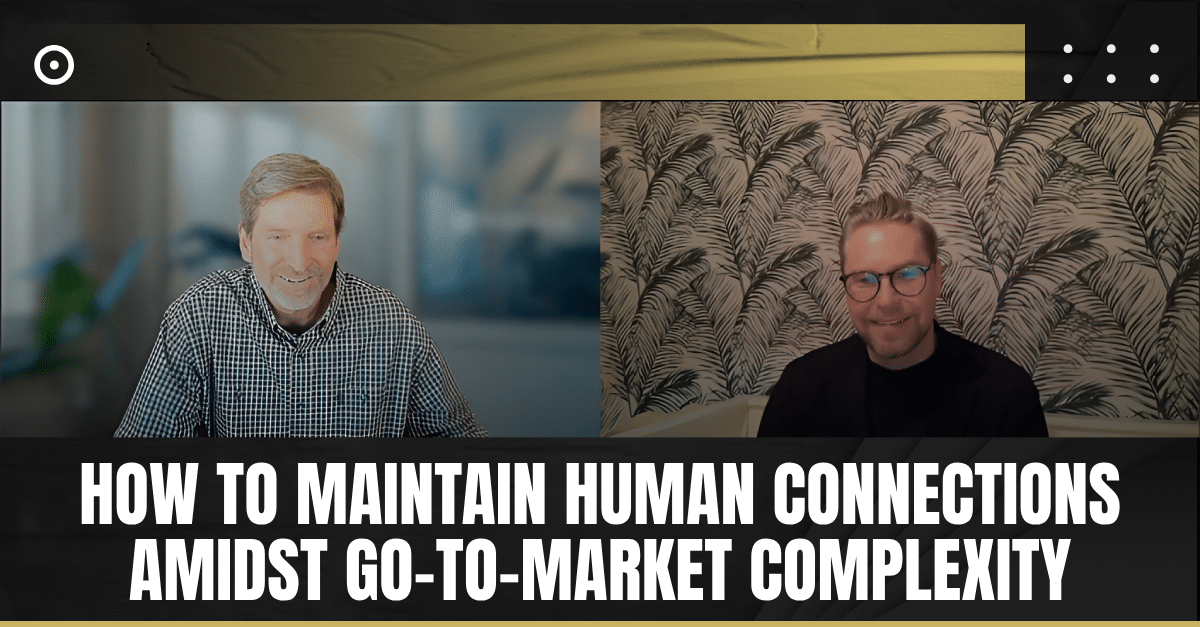


Felix Bartels, CMO of the Serviceplan Group, shares his journey from medicine and sports science to marketing. He explores blending emotional engagement with AI, automation, and big data while maintaining authenticity. This episode highlights storytelling, trust, and human connection as keys to B2B marketing success.
“For companies nowadays, go-to-market strategies are complex. I think the solution is to leverage technology to manage this complexity. However, the real secret is adding an emotional touch—being human, real, and transparent. It’s not just about being the first to use the best technology.” – Felix Bartels
Felix presents a transformative perspective on modern B2B marketing, emphasizing a human-centric approach, storytelling, and consultative strategies. This shift moves businesses from traditional product-focused messaging toward an integrated experience that prioritizes authenticity, emotional connectivity, and innovation. By adopting these insights, companies can strengthen relationships and enhance brand loyalty in an evolving market.
Follow Felix Bartels on LinkedIn
Follow host Steve MacDonald on LinkedIn
[Transcript]
[00:00:00] Steve MacDonald: Welcome, everyone, to the C-Suite Sales and Marketing Perspectives Podcast. I’m Steve MacDonald, your host, and today we have a fascinating conversation with Felix Bartels. Now, Felix, you are the CMO at the Serviceplan Group, and you have a background that is fascinating. So, not only do you have a CMO background, but you’ve also been a Chief Business Development Officer as well, right?
[00:00:24] Steve MacDonald: Which is something that everybody wants—the CMOs to be very sales-focused and business development-focused these days, right? That’s fantastic. You started out in medicine and sports medicine and somehow wound up over here as a CMO. I would love to turn it over to you and maybe have you explain a little bit more about your background before we get started because today’s conversation is about how to maintain human connections amidst go-to-market complexity.
[00:00:50] Steve MacDonald: And why that’s even important.
[00:00:53] Felix Bartels: Absolutely. Hello, hello, Steve. Thanks for having me. First of all, I’m really looking forward to this. Yes, it’s true—what you’re saying. I started studying human medicine, and after that, I studied sports science. I have never met people who ended up in marketing with this history, and it wasn’t planned on my side, either.
[00:01:12] Felix Bartels: During my second studies—sports science—I figured out I had plenty more time than in my first study of medicine. So, I founded a small company. Within sports science, there was a deep dive into public health, and public health is all about how to bring people to a behavior change—leading a healthier life, incorporating more movement into daily life. With my company, I really thought about how to bring people to buy something—to buy my story, my small business. And so, I started to really dive deep into understanding how to convince people, thinking about what they really care about, and what could help them change their lives, buy something, or become interested in something.
[00:01:59] Felix Bartels: And so, I ended up in marketing, in an agency doing advertising, and I’ve been here for 15 years now because this really caught me. I’m really enthusiastic about this topic—talking to people and reaching people’s emotions in the end.
[00:02:15] Steve MacDonald: Well, I love that. We all know how important B2B decision-making is, right? It’s driven by emotion. We know that, but we don’t always know what to do with it. And I think we’re going to start unraveling that here today. And we have a kindred spirit—I have an agency background myself. I was in agencies for over 15, 20 years before I started my own SaaS companies and things like that.
[00:02:37] Steve MacDonald: So, you’re in charge of the B2B relationships, right? Bringing in marketing and helping to bring in new business to the agency. So, here’s what I’d love to do—I’m just going to ask you, right from the start: Why is it important to have these human connections amidst go-to-market complexity?
[00:02:57] Felix Bartels: Yeah. I think there are a couple of answers to this. Maybe first, let’s take a look at the increasing role of technology and its impact on complexity. There’s really a rapid race and a rapid pace of technological advancements—AI, automation, big data—and this forces businesses, now more than ever, to continuously adapt.
[00:03:23] Felix Bartels: Companies must integrate multiple tools—CRM, analytics, social media—which creates challenges in compatibility and efficiency, as well as challenges in terms of motivation and training for colleagues. Even though these technologies enable real personalization and automation helps streamline efforts, they require significant investment and expertise.
[00:03:49] Felix Bartels: Then, there’s the issue of marketing channels—fragmentation leads to operations across numerous channels: social media, email, search engines, influencers, and so on. Each channel requires a unique approach. What works on Instagram may fail on LinkedIn or TikTok. Omnichannel marketing is essential nowadays, but managing consistent branding and messaging across platforms is really complex.
[00:04:19] Felix Bartels: Regarding evolving target groups and consumer behavior, there’s even more complexity. So, all in all, the interplay between these factors is what, on the one hand, makes navigation challenging, but on the other hand, really offers new opportunities for marketers. The solution is not just about using all this technology for go-to-market strategies, but about combining it with a human touch—with emotional anchors, for example. I think companies today face immense go-to-market complexity, and the solution isn’t just about using technology effectively. The real secret lies in emotional connections—being human, being real, being transparent—not just being the first to adopt the latest technology.
[00:05:17] Steve MacDonald: It’s interesting because we can have a tendency to hide behind technology. We have so much data these days that we never had before, right? We can run reports endlessly. We can find all kinds of information defining our ICP, their stage in the purchase process, and much more.
[00:05:38] Steve MacDonald: But we can’t forget the basics of human nature, right? People want to do business with people they like and trust—people they believe have expertise that is valuable to them. That’s the Gartner trusted advisor status, right?
[00:06:02] Steve MacDonald: But how we develop that trust, how we create that connection so that people like, know, and trust us from a human perspective—it’s easy to lose that. You said something in one of our past conversations that stuck with me. You said, “There’s an art in selling without selling.” What did you mean by that?
[00:06:25] Felix Bartels: Yeah. Selling without selling. Honestly, nobody really likes to be in a conversation or see an advertisement where it’s obvious—”I want to sell you something.” We all want to decide what we need, and we want to make our own purchasing decisions. We don’t want a salesperson or an ad telling us, “You have to buy this now.”
[00:06:43] Felix Bartels: But, of course, in B2B, business is all about selling—getting new customers and clients. Even in B2C, it’s about consumption. But what we try to do, both for our company and in consultancy with our clients, is not just talk about products or services. Instead, we focus on the story behind them—what drives the company, the people behind it, and what they are trying to solve or build. Even if it’s obvious that there’s a product being sold, it’s not just about the product or price.
[00:07:20] Felix Bartels: It’s about the story, the people working on the product every day. There’s a mechanism—an art to storytelling—that allows you to sell without selling. And even more, it’s about brand DNA, authenticity, and transparency. That’s the better way to sell in the end.
[00:07:43] Steve MacDonald: There are two really big questions I want to ask based on what you were saying there. One is about human connections—focusing on connections—and one is about storytelling.
[00:07:51] Steve MacDonald: So remind me if I don’t come back to storytelling. But this idea of human connections, right? If we take the connections part out of it, what you were talking about there is how to connect with someone in the business world, right? Not only do we have to be nice and likable people, but we also have to prove something.
[00:08:10] Steve MacDonald: We have to prove that we have something valuable to talk to them about, and guess what? It’s not our product. It’s not our service. It’s about them. In the world of B2B marketing, we are experts at product marketing—hugely important, right? But it’s not until the latter stages of the buyer’s journey that they want to know specifically about the product, kick the tires, and everything.
[00:08:38] Steve MacDonald: They’re doing all their due diligence and making the determination of who’s on that shortlist before they ever talk to any of us, anyway, right? So that connection—that thought leadership content—is crucial. They’re consuming content before they even decide to talk to us, where we can then do everything we’re talking about here.
[00:08:57] Steve MacDonald: So that connection part—if it’s not about us, it’s about them. How important is it to know their challenges? Not just the ones we solve for them, which are really important, but the greater challenges—proving in that human connection that we have something valuable to say about it?
[00:09:18] Felix Bartels: Absolutely. I think regarding selling and what you’re talking about, it’s even more about listening. It’s what I call the hidden agenda. Because yes, it’s not only about what we can solve—or what I can solve as an agency. It’s about what keeps them up at night. It’s about listening, understanding the whole context of the company and the person.
[00:09:39] Felix Bartels: It’s a human business as well. It’s about getting to know what this person is thinking about—their personal goals as well as their company goals. And this is all about listening. I also think it’s about talking straight—about what we can solve and what we can’t. It’s about forming a partnership.
[00:09:59] Felix Bartels: So it’s about discussing what’s important for you in a partnership and for us—what are the red lines? It’s all about listening, talking straight, being honest, and being transparent. I think this is crucial for entering the market and building a connection. Even more than, as you said, saying, “Hey, look at my website, look at my sales materials.”
[00:10:20] Felix Bartels: You can find any information online. AI even helps me learn more about you. But it’s not about just gathering information—it’s about talking to each other, understanding the hidden agenda, listening, and then bringing these thoughts together.
[00:10:36] Steve MacDonald: As agencies, we have a different perspective when it comes to the agency world.
[00:10:39] Steve MacDonald: We pride ourselves not only on delivering campaigns—performance marketing and everything—but also on working with our clients at a strategic and consultative level. We take on challenges beyond just what we post on social media or the performance marketing campaign.
[00:10:59] Steve MacDonald: We talk to them about their business, right? That’s a part of our service that isn’t always in the statement of work we write for them, but it’s an ever-present part of the value we contribute to that relationship. You have a unique perspective as an agency CMO—a B2B CMO of an agency.
[00:11:26] Steve MacDonald: It’s woven into our DNA—learning more about our clients and consulting with them. What is missing from a traditional B2B environment, where a typical B2B CMO doesn’t always have an agency or can’t afford one?
[00:11:56] Steve MacDonald: They’re left to do this on their own. They don’t have a consultative partner like agencies do. What’s your recommendation for them to understand their audience and their ICP, and build that deep, consultative relationship with their customers?
[00:12:17] Steve MacDonald: I just asked 10 questions in one, right? But hopefully, you get what I’m getting at here because I know from experience—that’s the secret sauce agencies have, right?
[00:12:24] Felix Bartels: Yeah, absolutely. I totally agree. And I think my perspective is even more unique because at Serviceplan Group, we are family-owned, partner-driven, and very entrepreneurial.
[00:12:35] Felix Bartels: So in our first conversations, we make it clear to our clients that we understand they need to sell something. We understand they are entrepreneurs—even in B2B business. They need to make every marketing dollar or euro count.
[00:12:54] Felix Bartels: Many B2B clients either can’t afford an agency or don’t think agencies are useful for consulting because they know their product and target groups best. But my recommendation is to choose wisely where you need consulting and where you don’t.
[00:13:18] Felix Bartels: I think companies should use agencies to step out of their bubble. As humans, the deeper we are in a product or company, the more we develop our own ideas and biases, thinking, “This is really going to work.” But it’s always valuable to get a second opinion from an expert—to challenge ideas, thoughts, and the direction of marketing or communication.
[00:13:38] Felix Bartels: You don’t need an agency for everything, but I think agencies are crucial for challenging assumptions—especially in today’s complex landscape of technology, diversification, and globalization.
[00:14:20] Felix Bartels: Nearly every product is available somewhere cheaper or faster. That’s why my recommendation for B2B companies is to use agencies not just for communication insights, but to challenge their ideas and thinking from an outsider’s perspective.
[00:14:37] Steve MacDonald: I still want to come back to the story thing, but you said something else in there—challenge our preconceived thinking.
[00:14:43] Steve MacDonald: Because here’s one thing that happens with every ICP, every ideal customer profile in every B2B industry—they’re complex, and they’re always changing. Challenging the assumptions we make really means we have to stay in constant contact with our ICP—not just our customers or prospects, but their peer community.
[00:15:05] Steve MacDonald: I know from my past experience with agencies, we love to do research with the customers. We love it because we know that’s the highest authority—over our opinion, over our client’s opinion, over preconceived notions, over current existing go-to-market strategies. They are going to be innovated.
[00:15:28] Steve MacDonald: They are going to be challenged. They are going to be stretched. They are going to be refined if we bring in the voice of the customer. The best example of this is the empty chair policy that Amazon has. It used to be in physical meetings, but now it’s like the virtual empty chair.
[00:15:42] Steve MacDonald: Like, hey, if the customer were actually here in this meeting—in this operations meeting, in this finance meeting, in this delivery meeting—how would they be influencing the decisions we make? Without that voice, how can we properly decide to create the right campaigns and the right go-to-market strategies?
[00:16:01] Steve MacDonald: And so, as agencies, we love that. And we need to be open—this is what I’m taking away from your last segment here—that we need to be open to being challenged. As the agency, as the CMO, as the B2B company, we need to be open to saying, maybe we need to think about this differently. And maybe we need to help translate that to all the other different departments as well.
[00:16:23] Felix Bartels: Absolutely. And I think coming back to these really rapid phases of development and all the AI stuff—every client I’m talking to, and every B2B client as well, is thinking about AI. They are thinking about AI in marketing as well, of course.
[00:16:39] Felix Bartels: But I think the role of an agency is also to give insights and recommendations regarding which tool is really helpful—what level of depth or financial investment is truly necessary—because not everything that is big and expensive is the best solution.
[00:16:57] Felix Bartels: And I think this is another really important role of B2B businesses—to get some technological infusion for their needs. The way people consume content has drastically changed. Many B2B marketers are aware of this but may not know how to handle it.
[00:17:18] Felix Bartels: In some conversations I’ve had, they think, “Yes, that’s true in B2C, but in B2B, it’s the same as it’s been for the last 50 years.” And I don’t agree with this. Because we are all humans—it doesn’t matter if we work in B2B or B2C—we all want to be inspired. And we want to have trustful and relevant conversations.
[00:17:36] Felix Bartels: The way people consume content has really changed. The rise of short-form, snackable content. The shift to on-demand and personalized content. The change where authenticity and relatability outrank high product value.
[00:17:53] Felix Bartels: For example, I have had conversations where B2B professionals are focused on high product value, and of course, this is crucial. But even in B2B, they often forget that authenticity and relatability are becoming more and more critical. I would love to have more of this kind of consultancy with B2B clients.
[00:18:17] Steve MacDonald: Okay, so you’re going to make this an hour-and-a-half podcast because you keep saying things I want to follow up on, and I keep writing them down. But one of the things you just said that I think is so important is that we have to understand that content is how buyers evaluate us before they even want to talk to us.
[00:18:45] Steve MacDonald: Using snackable, bite-sized content has become increasingly important. Studies have shown that B2B buyers want short-form video and interactive content, right? So, we’re all saying the same thing—we have to serve it up correctly.
[00:19:00] Steve MacDonald: If that’s so important in getting into the consideration list—because not all of us are household names—we’re not going to automatically be on a company’s list just because of who we are.
[00:19:07] Steve MacDonald: We would love to get there, right? We’re challenger brands. We have to create content to build our brand, build connections, and foster one-on-one human interaction. Nobody is going to buy from us without having a conversation with us.
[00:19:25] Steve MacDonald: Forbes magazine said it best: “Content marketing solves problems. Thought leadership sparks conversations.”
[00:19:51] Steve MacDonald: That human connection is that conversation. And how we spark it is by not talking about ourselves—but by talking about them. If the key is talking about them, then the key is understanding them and providing value that transcends what we do.
[00:20:00] Steve MacDonald: And here’s the biggest takeaway I want you to reflect on from what you just said. This comes from a McKinsey study.
[00:20:14] Steve MacDonald: The study looked at over 400 highly profitable B2C and B2B companies that had the greatest return on shareholder value. Do you know what they found as the number one differentiator across all those companies? CX. The experience.
[00:20:14] Steve MacDonald: It wasn’t the product. It wasn’t the price. It wasn’t the things that history has taught us—that product differentiation is the most important thing.
[00:20:36] Steve MacDonald: We all know that some of the best technologies and services in the world have failed, while some mediocre products and services, with the right brand and experience behind them, have risen to the top. People will forgive shortcomings if the experience of working with us overall gets them what they want.
[00:21:00] Steve MacDonald: So, my takeaway is that what you’re doing in marketing—creating those conversations, that thought leadership, and that brand—is just as important as the very product or service we sell.
[00:21:06] Felix Bartels: I absolutely agree. There are some great examples. In the early days, Red Bull, the energy drink—it wasn’t about the product. It was all about the experience and the story behind it.
[00:21:24] Felix Bartels: Or Amazon, for example. Of course, now they are incredibly fast and cost-effective, but their success is built on the seamless experience.
[00:21:43] Felix Bartels: It’s not just about how fast I can buy something or how well they remember my behavior—it’s also about how they align with my interests and values. That’s all part of the experience nowadays.
[00:22:00] Felix Bartels: Nearly every product is available from multiple companies. Of course, there are differences, but as you said, to truly succeed in the market, to close deals, it’s about the experience. And it’s also about the personal experience between people.
[00:22:05] Steve MacDonald: It’s just so enlightening, right? Because we think about the executive committee meetings that you’re in on a regular basis and everything we’re talking about as a company to plan to succeed, right? How many times do human connections come up? How many times does the thought leadership that we’re creating out of our organizations—that is the brand, that is as important as the product or service that we’re providing—how many times do those things come up in our conversations?
[00:22:40] Felix Bartels: Not enough. Not enough.
[00:22:42] Steve MacDonald: Absolutely. Here’s what I’d like to do. I’ve shared some of my takeaways along the way, and I literally think this could have been a three-part podcast because I want to ask you two things. You talked about telling the story, right?
[00:22:55] Steve MacDonald: And here’s what immediately came to my mind—we remember things as humans 23 times better if they’re told to us in the form of a story versus just, “Here’s the list of facts,” or “Here’s the analysis.” So why do you think, in a B2B human connection environment, telling the story is so important?
[00:23:19] Felix Bartels: Because I think with the right story, you get a better connection and better trust. If you are on a shortlist, for example—or even a long list—they already know your product. They know, “This could be something I need,” or “This could be the right one.” These five products, these five companies—yeah, this could be my solution. But then it’s all about the story. What’s the story about the product? What’s the story about the people? It’s about the connection. It’s about what we call emotional marketing.
[00:23:52] Felix Bartels: The people making decisions are human. They are humans. So they don’t only make decisions based on Excel lists—they do it because it’s about trust, because it’s about communication.
[00:24:03] Felix Bartels: How straightforward is the communication between the people talking to each other? And sometimes, as a family-owned, Germany-based business, the final winning point is that we come from the same market. Or we have the same way of thinking. The two decision-makers have the same way of thinking.
[00:24:22] Felix Bartels: That’s the last box that gets checked. Maybe sometimes our product or service isn’t the best—we’re always trying—but it’s always about the story. Because stories connect people through emotions.
[00:24:37] Steve MacDonald: So if I could—one last question for you. I’d love to get a 30-second answer, okay? And there’s a reason for 30 seconds. We’ve talked about a lot, but our poor brains can’t remember more than two or three things at a time. So what would you say is the most important takeaway you want the audience to have from this podcast?
[00:25:00] Felix Bartels: Okay. I think my recommendation is to not only rely on your data. Do not only rely on your product. Rely on your gut feeling—regarding emotions, regarding the people you’re talking to, and regarding the experts consulting your business. Think about what would truly resonate with the people you’re talking to. What really interests them?
[00:25:27] Felix Bartels: Do not rely only on data and insights. Rely on gut feeling and on what connects humans—and that is emotion.
[00:25:38] Steve MacDonald: I love it. I love it. I’m going to end it there. I know people are going to have additional questions. Would it be appropriate for me to share a link to your LinkedIn profile so people can contact you and ask questions?
[00:25:52] Felix Bartels: I would love that. Yes, of course. This is a topic I’m really interested in. I talk to many clients on a daily basis, so yes, please share my LinkedIn profile. I would love to have deeper conversations with some of the listeners here.
[00:26:05] Steve MacDonald: Well, Felix, thank you so much for coming on and sharing all of these insights.
[00:26:13] Steve MacDonald: If we can each do this—share from our own perspectives how we become successful—then that’s the rising tide that lifts all boats. So, I appreciate you being a part of that today.
[00:26:22] Felix Bartels: I appreciate it. Thanks for having me, Steve. Appreciate it.