
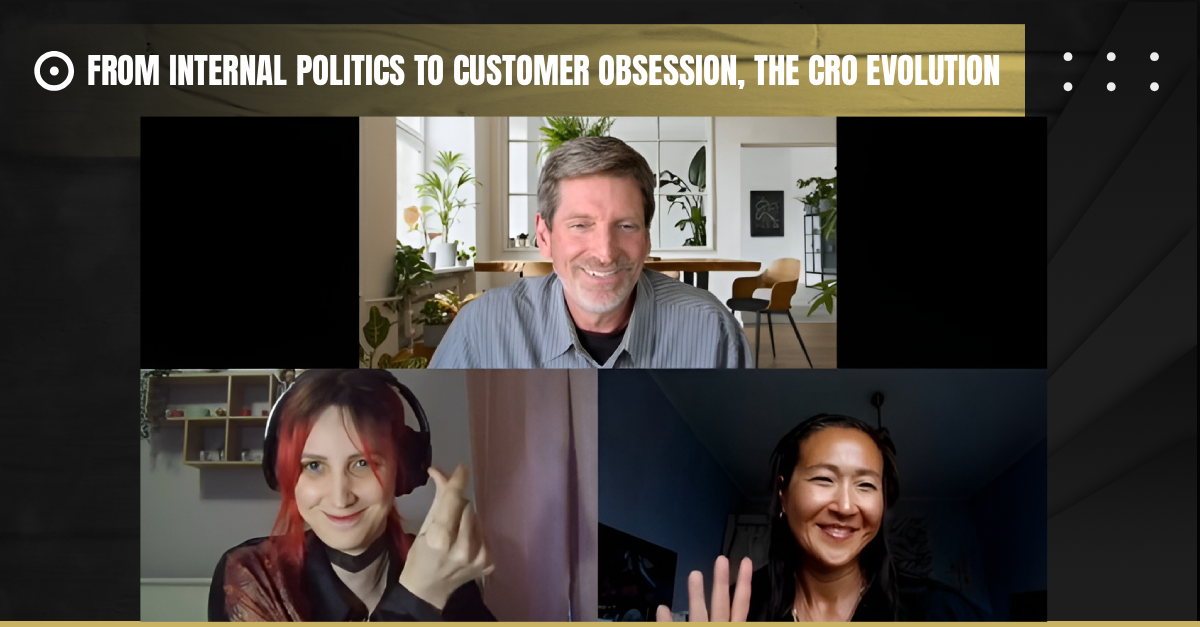


Episode #210:
Luna Shirley, Chief Revenue Officer at ROI Hunter, and Sanja Gabler, Chief Revenue Officer at Trapets, discuss the most complex growth barriers. They unpack internal alignment, customer obsession, and trust as core levers. They share lessons from long cycles and crowded SaaS markets that turn insights into practical execution.
“Once you ensure the general direction is aligned, you are good to go.” – Luna Shirley
This episode brings two CROs together to unpack alignment, trust, and customer obsession. They contrast clarity of direction with interdepartmental micromanagement, explain how narrative consistency builds buyer confidence, and share practical ways to balance quarterly targets with long-term brand work.
Follow Luna Shirley on LinkedIn
Follow Sanja Gabler on LinkedIn
Follow host Steve MacDonald on LinkedIn
[Transcript
[00:00:05] Steve MacDonald: Welcome, everyone, to the C-Suite Sales and Marketing Perspectives podcast. I’m Steve MacDonald, your host. Today we have on two very special guests to talk about a topic that is so important to all of us. We’re talking about a report that was put together from interviewing over 45 different C-Suite executives, CEOs, CROs, CMOs, Chief Growth Officers, Chief Experience Officers, and everyone was asked the same question.
[00:00:34] Steve MacDonald: What are the two greatest challenges to creating long-term sustainable growth? So we’re focusing today on the top challenges that we see as C-suite executives in our B2B go-to-market strategy in growing our businesses. And we’re gonna get into exactly what those challenges are, but we’re really gonna talk today about: internal politics is one of the biggest challenges, internal alignment.
[00:01:01] Steve MacDonald: We’re gonna talk all the way to customer obsession, and we’re gonna talk about the evolution of the CRO role. Both Luna and Sanja here are CROs today. And I’m gonna have each of you, if you wouldn’t mind, explain a little bit more about your background. But Luna, you’ve been a CRO for a number of different years, and Sanja, you’ve, uh, transitioned actually from a Chief Marketing Officer to a Chief Revenue Officer.
[00:01:30] Steve MacDonald: So here’s what I’d love to do. Maybe Luna, you can kick us off and just tell us a little bit more about your background and then Sanja, and then we’re gonna get right into the report and those learnings of what we think about it.
[00:01:42] Luna Shirley: Of course. Fantastic, Steve, and firstly, thank you for having us here. So when it comes to my background, I’ve basically come from, well, a marketing background as well.
[00:01:54] Luna Shirley: So that’s where I first started. I was working as a marketer for a bunch of online retail omnichannel business businesses. As well, either on the side of the client, the agency, the software provider, and then because I really, really loved looking at revenue improvement and actual cash, I somehow transitioned into becoming Chief Revenue Officer.
[00:02:20] Luna Shirley: And something that is quite dear and near to my heart is making sure that I’m helping businesses, both the one that I’m working for and the clients that we work with. Towards a sustainable growth.
[00:02:34] Steve MacDonald: Fantastic. Thank you. Thank you, and Sanja?
[00:02:37] Sanja Gabler: Thanks, Steve. Hi, it’s great to be here, and thanks for having us, Steve.
[00:02:41] Sanja Gabler: Um, so I have, I think, 20 plus years of background within the marketing field. However, I always say that I’m not the traditional marketeer. My driver has been curiosity, but also growth, growing a business, and that has led me to where I am today, working in a tech scale up and as a Chief Revenue Officer pursuing a scale-up phase for, PO-owned company.
[00:03:08] Steve MacDonald: Fantastic. Here’s what I’m gonna do. For everybody who’s listening or watching right now, there is a link to the full challenge report and everything that came out of it. The top three challenges, though, that we’re gonna talk about here today, number one was an internal challenge. Actually, 70% of the answers by C-suite executives were: the greatest challenge to creating long-term sustainable growth was ourselves.
[00:03:34] Steve MacDonald: It was internal, which is very counterintuitive ’cause we like to talk about what’s going on in the market and our competition, the things that are keeping us from doing what we wanna do, when the truth of it is we’re our own internal greatest challenge, and we’re gonna talk a lot about that. Secondly is that we have a high, high degree of familiarity with our customers.
[00:03:55] Steve MacDonald: We as C-suite executives acknowledge that we don’t really have a handle on the voice of the customer and on an ongoing, regular basis. And to be a truly obsessed, you know, business, we all say that we’re customer first. We’re customer obsessed, but to really act on that. Do we really have the right kind of programs or just a mentality about bringing the voice of the customer into our decision making and our go-to-market strategies?
[00:04:24] Steve MacDonald: The third biggest challenge was one. There is a hidden challenge, whereas a hidden challenge because it wasn’t mentioned upfront by C-Suite executives, but acknowledged as one of the most important things to our growth, and it’s about trust, and there is a trust epidemic today. If you look at any of the LinkedIn Edelman studies, they’ll show trust all over Europe, all over the United States, over the world.
[00:04:49] Steve MacDonald: It’s just been on the decline for decades. And in fact, in that same study, over 61% of B2B buyers. Talked to like 32,000 respondents in this study. They said that 61% of ’em said that they felt that we, as the selling organizations, were being intentionally misleading. Intentionally misleading. So there’s plenty of other studies out there that have equally as alarming facts, but our brands are trust marks, right?
[00:05:16] Steve MacDonald: If we don’t have trust in our brands, what do we have? And that’s the reason why I think the voice of the customer is so, so important and bringing that forward because that’s the voice that the people that we’re selling to, that’s their peer community. They trust them at the same level. Peer to peer as we do scientists.
[00:05:36] Steve MacDonald: Right? So those are the big topics that we’re gonna start out with here today. But I’m gonna start with the first one. And Luna, I’m gonna ask you the question first off here. Why is internal alignment, we talked about it as the red herring distracting us from growth?
[00:05:54] Luna Shirley: Well, of course, of course. So look, I am.
[00:05:59] Luna Shirley: Absolutely for harmony within the business, but there is a difference between a strong internal alignment and what I see that can be perhaps called interdepartmental micromanagement, which is something that it’s very easy to fall into, and it has a tendency to really turn into a huge rabbit hole. And as senior managers, we have to have really the ability to check ourselves and trust in our colleagues.
[00:06:31] Luna Shirley: And once you ensure the general direction is aligned, you are kind of good to go and. If you don’t do that, like often, the most expensive people will spend their valuable time looking inward without really keeping an eye on what’s actually out there in a market and be with your clients because that’s where the changes are currently happening.
[00:06:56] Luna Shirley: The market right now is incredibly slack, and we need to be focusing on clients, prospects. We need to be looking outward rather than internally. If we know and if we are able to have that close alignment, but not interdepartmental micromanagement, I would generally just summarize it as. Not over align, but rather nurture that trust between each other.
[00:07:23] Luna Shirley: Trust that your people that you have in your team, your peers, will find the best way and deliver and really focus on its execution. So that’s basically my take on this. So
[00:07:38] Steve MacDonald: Is your point that internal alignment is easier? Than actually executing on what we all agree on. That’s where it falls apart, or, I’m trying to understand a little bit more.
[00:07:52] Luna Shirley: Hmm. So, uh, no, not really. In a way, I think that there are slight differences between being internally aligned. Kind of have that interdepartmental micromanagement because it’s very easy when you are discussing how to be aligned in trying to get into, like, operational things that one person was unable to align with another.
[00:08:16] Luna Shirley: There is internal drama. It’s energy draining. It takes a lot of time and if we would be able to take that time and focus it out, I would be able to bring in much more added value to the business, and potentially that, even that reason for that micromanagement that’s happening or the alignment would not even happen because we would find out that it’s pointless and it’s useless.
[00:08:41] Luna Shirley: So what I’m saying and locating towards is you have. I would say that a lot of businesses, there are great teams that want to do great things. They are very smart people. Just ensure that there is a trust between teams, between departments, and there is a general direction. When there is, move your people to it.
[00:09:03] Luna Shirley: Focus on execution. Don’t overcomplicate things.
[00:09:08] Steve MacDonald: You know, Sanja, I’d love to know because you’ve now, you’ve played in multiple departments, you’ve worked with multiple departments. What’s your point of view on this internal alignment as one of our greatest challenges?
[00:09:21] Sanja Gabler: I think, as Luna is mentioning, the trust, trusting each other, trusting your peers.
[00:09:27] Sanja Gabler: I usually say don’t suspect that people are there to do bad jobs. People wanna do a good job, so trust your peers. So I think that is super important because that itself will obviously, you know, raise and build trust, and you get that natural alignment across departments, across teams, across individuals. I think that is super important to trust and also respect each other’s jobs.
[00:09:53] Sanja Gabler: So I’d say, but like, I think it’s all about the focus. If you are not super clear on what the company is, where you are positioned, where you’re heading, and that is all about focus. Then you get too much of this internal, you know, mismatch discussions, processes, who does what. I think it’s all about focus, and that usually is prioritize what is, you know, three things, what are the most important things, and if they have that, and that takes a lot of.
[00:10:22] Sanja Gabler: A good leadership, a great management, but also great kind of, you know, guidance. Where are we heading? Then you can hopefully get that alignment across the whole organization.
[00:10:34] Steve MacDonald: You know, the whole idea, and we talked about it up upfront, that came out of all of these interviews was the lack of trust we had, but it was all focused externally.
[00:10:45] Steve MacDonald: And what you’ve just brought up is one of the most important things is building our own internal trust. Because if we’re not aligned and we don’t have our go-to-market strategies and we’re not trusting each other. We’re not gonna succeed, right? So internal trust is something we’ve really gotta build and focus on, and yet we’re all really good at trying to understand the needs of our customers.
[00:11:06] Steve MacDonald: But that’s really our first customer, right? Is everyone else inside of the company itself? Um, that’s a really profound, I think that’s really important, especially as we’re gonna move into here now talking about trust. And I mentioned upfront the lack of trust that we have, and it’s a direct reason why this external lack of trust that the buyer has with us.
[00:11:27] Steve MacDonald: There’s, there’s a direct correlation between the reason why the buyers have been waiting longer and longer now to want to even talk to us, right? This buyer journey has significantly changed. They’re trying to make as many decisions as they can on their own before they even talk to us. By the time they want to, most often they’ve got their top, you know, couple, two or three, and top company in mind that they think they’re gonna wanna deal with.
[00:11:52] Steve MacDonald: So I’d love to, Sanja, ask you. How is this impacting how you are thinking about creating the go-to-market strategy these days? The whole idea of lack of trust.
[00:12:06] Sanja Gabler: Um, we talk a lot about trust, so our business is quite long-cycle business, so there needs to be trust all the way from like the first interaction with any of our channels.
[00:12:19] Sanja Gabler: But then along the way, I talk about having somebody holding the buyer committee, several people holding their hands throughout the journey, and that requires, as we mentioned, internal alignment, same stories, same narrative. Are we heading the same direction so that the customer on the other side understands, well, actually they’re saying the same things, they are proving the same things, and start building that trust.
[00:12:47] Sanja Gabler: And I think that is super important as an element that even though that. Because we are many people involved in a business a deal today that is important then that every person that is involved from the different departments, that they understand how we create trust with the buyer committee and how we get them through the whole journey, so to speak.
[00:13:09] Sanja Gabler: Um, so we talk about a lot around trust and I think once again, it’s not only when we are talking to the customers, also they are out scouting for customer referrals. So I think that is really a big driver. Our customers today, their referrals back to, you know, the potential prospect. So it’s also important not to lose out on building, obviously building trust when you’re in a prospect, but also building the trust with your customers all constantly, all the time.
[00:13:39] Steve MacDonald: It really goes back to that point about our buyers trust their peers, right? So our customers are their peers. If we’re not using the voice of the customer to help speak, for us to help validate, right? To help substantiate all the important points that we’re saying about ourselves, right? The, the reason why they wanna hire us, right?
[00:13:59] Steve MacDonald: It’s bringing in that voice of the customer. I love that you brought that up, Luna. How are you tackling trust as an issue?
[00:14:06] Luna Shirley: Absolutely. So it’s, quite interesting to hear it from Sanja because I really love her point of view on that. Now I’ll offer a slightly different angle on the trust here. So I have actually been thinking about it.
[00:14:23] Luna Shirley: Trust for a long time because I as a person am generally mistrusting a lot of things. I get prospected every single day about 20 times, things like that. So I have kind of created quite thick skin. But talking about trust, I have.
[00:14:54] Luna Shirley: Realized that a lot of SaaS businesses, specifically SaaS businesses have gotten incredibly complacent in, uh, the current state of the market.
[00:14:54] Luna Shirley: But in truth, the golden age of SaaS is over, market is too crowded. Tech budgets that we were able to tap have become bloated, and now they are getting slashed. And while I really choose to believe that building a trust is incredibly important, there is also a certain misalignment between how the business communicates, consistently and what it communicates and how it is being perceived and heard by prospects. And while I choose to believe that no respectable business would want to intentionally mislead their prospects or customers, a lot of miscommunications can happen during a process, especially when there is a lot of noise out in the market.
[00:15:24] Luna Shirley: And one thing that I really want to mention is that.
[00:15:45] Luna Shirley: Well intentioned, but very slippery slope can be, uh, success stories and showing success stories because that is just something that a lot of sales reps lead with. Hey, this is our success story. This is what we’ve been able to deliver to client X, Y, Z.
[00:16:09] Luna Shirley: But those success stories can be very easily misrepresented as typical results that customers can expect. And while it can definitely happen. It may not be the case all the time, so in this case, execution on the side of sales, on the side of marketing can actually turn into a lack and breach of trust on the side of clients and prospects.
[00:16:35] Luna Shirley: So how I generally try to tackle this is that when we are working at GTM and talking with clients, I’m a hundred percent there with Sanja. Just make sure that there is consistency. Consistency needs to be there at every single step, every single touch point with the client, because that is ensuring that there is that level of trust and there are no red flags.
[00:16:59] Luna Shirley: But I am also a huge proponent of setting lower expectations than those we can actually deliver upon. And we always internally strive to give more than the clients expect. So it’s about front-loading the value, being there for clients at a critical moment. So we can even look at a certain SLA that is towards clients, but internal SLA needs to be even stricter.
[00:17:28] Luna Shirley: We internally need to be striving to do more than we are telling clients that we would be doing. So they will really think about us as partners, as those like really bearing their weight. So, really looking at where we are, especially in sales, I would say we need to go back to the basics where US was like 10, 15 years ago and now the businesses really need to reprove themselves if they are to survive.
[00:17:59] Luna Shirley: We need to really showcase that our prospects and our current clients can continue trusting us, that we are not just sleeping in a very comfy bed. And that’s kind of my take here.
[00:18:12] Steve MacDonald: You know, you both have brought up such important points that there are things that are constantly pulling us away from creating a unified voice that builds trust, right?
[00:18:25] Steve MacDonald: And misalignment is one, right. Overpromising and under-delivering is another big one. And Sanja, you said something in our previous conversations. You said literally everything that we have learned and known is not valid anymore. This market is changing so much, right? Influx of changes, influx of changes in personnel, lack of alignment, everything we’ve been talking about here.
[00:18:55] Steve MacDonald: How do we navigate that?
[00:18:57] Sanja Gabler: I think, um, I mean this is where you as an individual team leader need to really impose the fact that you plan for change. Have a process to actually change for, you know, the unknowns of the market. I can sometimes, so if I do have a sales rep, we have the pitch, it didn’t work out.
[00:19:17] Sanja Gabler: There was somebody on the other side. I said, no, no, but this is the research you should have done. Of course, it was different from the pitch maybe yesterday, but that’s how you know the market is. And that is a fact that you need to really, you know, say what we learn and what we know now is not valid. And that is just a mindset that you need to work on in your team, I think.
[00:19:40] Sanja Gabler: And it’s behavioral, so you need to really nag around. Like we share stories, we share customer meetings, and what can we say? Okay, so that meeting didn’t really go as expected and we said no. What can we learn from that? And then we iterate. And we iterate. And I think that is really to kind of impose to my team that what you know yesterday might not be valid today or tomorrow.
[00:20:05] Sanja Gabler: So you guys need to be on top of your prospects, your pitches, who’s on the other side in the market, and the knowns, uh, you know, try to get as many unknowns known as possible. And I always, we support with that.
[00:20:19] Steve MacDonald: What you’re talking about here is we are on a never-ending learning journey. Right? You know, we wanna feel like we get it.
[00:20:26] Steve MacDonald: We know our ICP, we understand them. Like it’s an uncomfortable place to say, I always need to keep learning. And what I do know may not be true. That’s not a comfortable place to be. Yeah. And Luna, you actually even gave a really great story about one customer and one prospect that had major upheaval.
[00:20:48] Steve MacDonald: There was one week where all of a sudden everything that was known kind of got thrown up. If you could tell us a little bit about that.
[00:20:55] Luna Shirley: Yeah. Okay. So, definitely. It happened not that long ago when we were in a long negotiation process with the customer. Everything really looked well. We went through lengthy legal, we went through all the negotiation processes.
[00:21:16] Luna Shirley: We went through, I would say, four, five, just stakeholders that were supposed to give us their blessing that, yeah, we can go, they can go with ROI Hunter. So we really did the whole dance, and just before we were supposed to sign everything and get started, well, we have started hearing nothing. Nothing. Zilch.
[00:21:46] Luna Shirley: And we were like, what the hell is going on? There were all the right signals. We went through all the process. We had a buy-in, but nobody was communicating with us. Well, then we found out the entire marketing department was fired. So it’s like, okay, how can you really operate in this environment when things can be changing so drastically and dramatically?
[00:22:13] Luna Shirley: Who do you then talk to? How do you ensure that there is stability? Well, it’s very difficult. So, I will kind of tie it to also, Sanja was saying it out, try to also tie it into internally, because there’s another quite interesting thing, and I expect to hear Happy Birthday because just last week, ROI Hunter had its 11th birthday.
[00:22:40] Luna Shirley: That’s something that we, uh, celebrate. By the way, I’m still not hearing Happy Birthday.
[00:22:44] Steve MacDonald: Happy birthday. Happy birthday. Thank you.
[00:22:49] Luna Shirley: So, uh, it’s like very interesting because we have been right now discussing things externally towards customers, how things are changing out in the market, but also it goes internally as well.
[00:23:04] Luna Shirley: And I’ll give you yet another situation that I’ve been dealing with quite frequently, and it also ties into the company being more than a decade old, and it’s really about a situation when I’ve been discussing with finance a lot. Exceptions. Exceptions here, exceptions there. And they are very frustrated quite often and rightfully so, and they’ve been challenging me like, okay, why are we always giving exceptions?
[00:23:37] Luna Shirley: It seems like we don’t know what we are doing. Well, we don’t. We really don’t because the market has been changing so frequently. And what we see internally is that right now we need to build a common understanding, and that kind of gets us back to internal alignment, but I would say also internal trust, nurturing that, so there exists a common understanding about what’s really the business needs to move forward and ensuring that people who care, and those are frequently found in finance and operations, that they have.
[00:24:22] Luna Shirley: A seat at the table and are not just passengers, and they really see what is happening out in the market so they will be able to help us. And as I said before, I also quite often have those discussions about policies and exceptions, and they are often like well-intentioned policies. Since we are like 10, 11 years old now, they are very detailed, too detailed for our own good.
[00:24:51] Luna Shirley: And those not only provide firm structure, but they also invite those exceptions far, far too often. So more than they are currently helping in a market situation that is ever-changing. And we really need to find a way how to operate and revalidate everything. They more than are helping, they are actually souring relationships.
[00:25:18] Luna Shirley: So that kind of gets me to the point that I think that the common understanding needs to be that right now we really live in turbulent times. That goes both externally as well as internally, and we have to, and we should retain rational boundaries that will enable us to perform and deliver as a team.
[00:25:40] Luna Shirley: But not too detailed that would basically bind our hands, forcing us to have those discussions about interdepartmental micromanagement, dealing with exceptions, dealing with conflict that may happen between two people, both well-meaning, or two teams, both well-meaning, but naturally. Understanding that we are really living in the situation where the rules are ever-changing and the game is changing every week, every month, every year.
[00:26:13] Luna Shirley: Far too often.
[00:26:14] Steve MacDonald: You know, I want to start talking about what we do about this, and Sanja, you had brought up a concept of the North Star. What’s the North Star in our business, right? And the voice of the customer is your North Star. Tell me a little bit about, you know, your thinking behind that and how we navigate these waters of turbulence and constant change.
[00:26:40] Steve MacDonald: Right.
[00:26:42] Sanja Gabler: No. So I mean, when I talk about the North Star, yeah, it’s the voice of the customer. But if translated maybe more, um, internal lingo, it is our ICP, like who is our ideal customer profile. That is our North Star. That’s what we’re aiming for. That is something that we iterate all the time, more often than I would like to.
[00:27:04] Sanja Gabler: I mean, currently we don’t all iterate it enough, and that is back to that we don’t, you know, we have so many other things to do, but I think this is super important to have that process, to iterate it, you know, monthly, quarterly. I mean, iteration can be just like, okay, it’s still valid. It’s still valid.
[00:27:23] Sanja Gabler: Okay. Then we have iterated it, then we move on. So I think that is super important. And I also believe when we talk about North Star, that means that it is owned by the management. There is not a special role or a title in the company that owns the ICP or customer. It’s the whole company that owns the ICP or customer.
[00:27:44] Sanja Gabler: And I see that often that it’s the CMO that owns our ICP, or it’s the CRO that owns our ICP. Whereas I say, no, it’s the management that should own the ICP. We should all tap into that. It’s not owned by one, you know, role or a person or a team. It is actually the management. So I think that is also super important that the iteration is done by the management on a continuous basis, because once again, the ICP should be owned by the management.
[00:28:15] Sanja Gabler: Not just the CMO or CRO.
[00:28:18] Steve MacDonald: And you know, Luna, you had a really interesting point of view in all this too, ’cause your point was that our ICP doesn’t always know what they want, right? The market’s changed. That’s the truth. So it really is incumbent upon us to talk to as many of our ICP as we can in deep and meaningful ways, because it is the accumulation of those conversations that’s really gonna provide clarity, because they are, they’re dealing with all the uncertainties, the upheaval, the changes constantly.
[00:28:52] Steve MacDonald: We forget they’re in the middle of all that as well.
[00:28:55] Luna Shirley: Absolutely a hundred percent. And you have said it very correctly. They are also in the middle of that. So we’ve been right now discussing, okay, how do we see it? But our customers are dealing with exactly the same challenges. Rules of the games are changing for everybody.
[00:29:16] Luna Shirley: We can say that it’s because of the market situation, the dynamics happening with the US, politics, AI, everything. There can be a lot of forces out there. But the real truth is it is changing for everybody. We all have to do more. We have to be on top of our game a hundred percent. So I’m kind of looking into the situation in a way that, and you know what, let me just give you a single story that I’ve been kind of dealing with, uh, about a month ago.
[00:29:50] Luna Shirley: And that is when we were working with one of our big partners, and we have a very close relationship with that partner.We are discussing with their partner manager on a weekly basis. How are we moving forward? We have common challenges that we are solving for our common customers. Everything is working really well.
[00:30:13] Luna Shirley: Then we have somehow started finding out that it is not working. Like we are doing everything that we can, but we are not hearing much from our partner’s sales teams or their customer success managers. And it seemed that they don’t really want to interact with us. And we were like, okay, what is happening?
[00:30:34] Luna Shirley: We are more aligned than ever. We are ensuring that we are delivering everything that a partner wants. Well, we have kind of forgotten one thing. Yes, a lot of things changed for that partner and we’ve been focusing on things that may be still important, but are considered nice-to-haves. We have not realized it.
[00:30:56] Luna Shirley: We did not see it. So I do see that what is very important in this ever-changing environment is to focus on one thing, and that is the lowest common denominator of the partnership, of the service that you deliver, or the value that your clients get from you. Get it right, get it correct. If it’s delivering them good ROAS, great. If it’s about delivering them scalability on a certain channel, great. Fine. Get it right.
[00:31:21] Luna Shirley: And then everything else, be it a platform adoption, be it some nice metrics that they are looking for from you, well, those are currently nice-to-haves because they can change for them easily, and we may not even know, we may find out it’s too late until the information trickles down to us.
[00:31:53] Luna Shirley: Focus on the core of your value.
[00:31:56] Steve MacDonald: It’s so true. We get very enamored with how much we can do to help that we grow the value. We constantly try to grow the value that we deliver, but if it diffuses the core value of why they really hired us to begin with and it distracts us from really doing that well, then we’re not doing ourselves justice at all.
[00:32:19] Steve MacDonald: Yeah. You know, on that vein of all the things that we do, there are things that we do internally, right, that we’re tasked with as C-suite executives, and there’s two different buckets that I want to talk about. One is very short-term benefit things we do. One is very long-term benefit things that we do.
[00:32:44] Steve MacDonald: And you both have this incredible background in marketing and now revenue generation selling, right? So I just wanted to hear, maybe Sanja you could kick us off here in how you think about the balance of focusing on things, responsibilities that have both very short-term effect, which is what our CEOs and our boards are all focused on, and doing the things that we know wae need to do, like building the brand and building trust and maintaining those client relationships and focusing on those core things. How do we balance that?
[00:33:18] Sanja Gabler: I think that is one of the challenges internally as a C-suite. It is upon us that, um, for me, I need to really balance the short term, you know, the weekly, the monthly quotas versus having that strategic, you know, three-to-five-year-old plan.
[00:33:34] Sanja Gabler: Uh, that is something that I am struggling with daily and hoping other people do as well. But I think, I mean, really it’s about leadership skills. I think I don’t push my team to think too long term because I know that I need to box them in, and now we’re looking at the quarterly and making sure that is the focus.
[00:33:56] Sanja Gabler: However, when time is needed, then we are looking, you know, stretching and looking at the long-term growth. And I think to be able to set the context on the context where we are short term versus the context of where we are long term, I think that really helps, especially my team, to navigate, okay, what mindset should I come in with now?
[00:34:17] Sanja Gabler: What should I do to execute on the short term versus what are we actually doing to execute on the long term? So I think contextual setting is super important, but for me, I mean obviously we, as a C-suite role, we need to navigate both. And I think I’m what, soon a year in as a CRO. I think a lot of my skill that I’m bringing in as a CMO is the fact, the balancing of that, because I think CROs usually maybe think a little bit more short term. I’m not gonna say for sure, but in my opinion, that has been a little bit the case, and here I think my experience as a CMO, where you need to really, you know, focus on the long term, which is the brand building, which is positioning, which is the market intel. That changes. I think those skills are kind of helping me now in my current role, kind of balancing that.
[00:35:08] Steve MacDonald: There was a thing that a really smart CMO had said on my podcast at one point, that today’s brand is tomorrow’s demand.
[00:35:17] Steve MacDonald: Right? If we aren’t doing the balance, we are going to sacrifice the short term, right? There’s no doubt about it. But Luna, I want to get your opinion on this.
[00:35:27] Luna Shirley: Yeah, of course. So, from my point of view as CRO, that’s been doing this job for quite some time right now, I do see it in a way that I have to really live in the future.
[00:35:44] Luna Shirley: Like really, truly, I’m talking three, four, even five quarters ahead. That is incredibly difficult, especially when everything can change on a dime. Like it’s quite, quite difficult. But how I do it, how I’m kind of looking at it, is building a framework that can sustain those shifts, which generally means, okay, I have a certain customer success team.
[00:36:11] Luna Shirley: How do I ensure that I always have enough capacity within a customer success to process changes that I need to? How much do I have to look into generating pipeline for the sales team in order to hit targets that can be changing? How do I build in that buffer that enables me to say that, okay, things are not going great, but we are still able to ensure that if you deliver on a certain percentage, the company would still be stable?
[00:36:48] Luna Shirley: So that is how I’m looking at long term. How do I put in place certain measures that will enable us to make those tactical changes, those operational changes without negatively impacting the business as a whole? And for that, you have to have a healthy business, which is why I’m always propagating sustainable growth because that enables me to plan in such a way long term.
[00:37:17] Luna Shirley: And when it comes to shorter tactical as well as operational, Sanja said it very correctly. I think that it’s about leadership skills. Be there, provide them with that support, that calm, that decision-making skill set. Be able to make those calls even if you know that you do not know what’s the right thing to do, but you have the gut feeling, you need to say it in a resolute way.
[00:37:44] Luna Shirley: That’s how we’ll be able to do it. Make sure that people in your team trusted will be able to deliver it. Give them calm so they won’t be panicking and they will be able to deliver at their best. So as a CRO, think CRO, put measures in place, but be there for them on a daily basis. Provide them that support, provide them that leader that is there when they need them.
[00:38:10] Steve MacDonald: You know, there is so much depth in everything that we could go into and spend hours and hours here, but I want to give each of you an opportunity to basically provide us with one takeaway from this conversation, because we’re talking about some of the greatest challenges that we face, right, as C-Suite leaders.
[00:38:31] Steve MacDonald: If there were one thing that you wanted other C-Suite leaders to take away from our conversation today, Sanja, what would that be?
[00:38:41] Sanja Gabler: I mentioned that we talk about the changeable and the unknowns. So I think, I mean, some sort of process or plan to actually deal with change, I think that is the most important thing. Also, kind of a side note to that is that, let go of your prestige from reciting something. Like you need to also make sure that, I mean, I can be that sometimes that, oh no, but that was me pushing for that decision, but knowing I need to pull back.
[00:39:11] Sanja Gabler: But that’s fine. Like, don’t be prestigious about that. Just let that go because that is needed for the business. So I think those are what I would say, like have a plan or process to manage change, and don’t be prestigious when it comes to your decision that needs to be changed.
[00:39:28] Steve MacDonald: I love that. Luna, what would you say?
[00:39:32] Luna Shirley: Well, for me, I would say that the biggest takeaway from all that we had discussed would be to ensure that you give enough trust to your peers, your teams, other departments, because they all want the same thing. They want to succeed, they want to deliver a great product, they want to do their very best.
[00:39:56] Luna Shirley: Sometimes you may, and it’s very easy to get lost in detail, but give them the opportunity to figure out those details themselves. Don’t micromanage. Give them enough trust and that also covers clients, but be empathetic towards them. They are dealing with a lot of challenges themselves. Be empathetic towards them.
[00:40:18] Luna Shirley: Make sure that you are there as a partner, supporting them, delivering more than they paid for. So whenever everything will be settled, everything will be calmer, they will remember the name of your brand, the people that have helped them and supported them during their hard times.
[00:40:38] Steve MacDonald: Yeah. Well, you know, I have to tell you, we lots of times get, you know, reports and things that come out of the industry that highlight challenges, that highlight issues and trends.
[00:40:52] Steve MacDonald: But we don’t always get in those reports what do we do as a result of knowing this information, and what you’ve provided here today I think is color commentary on what does all this mean to us. Right? We have to actually implement a go-to-market strategy based on all of these challenges, and we’re not going to face the CEO or a board that says, oh, there’s a lot of turmoil, there’s a lot of change.
[00:41:16] Steve MacDonald: The playbooks have changed. I get it. I give you all kinds of grace, right? It’s like we have to perform, we have to succeed in spite of all of this. And so I just wanted to say thank you for giving that color commentary today to some of the most important challenges that we face, and that’s the mission overall of this podcast, that if we can really understand the biggest challenges, but then get all kinds of different insights and perspectives on what we should be doing to solve those challenges, break through, and actually create success, that’s the rising tide that lifts all boats. And I just wanted to say that I think you were both a very important part of that rising tide today. So thank you for coming on.
[00:42:04] Sanja Gabler: Thanks, Steve. Thanks for having us.
[00:42:07] Luna Shirley: Thank you, Steve.