
Internal Alignment Is the Growth Mandate Hiding in Plain Sight

Asked to name their two greatest challenges to long-term sustainable growth, 71% of B2B C-suite executives — unprompted — said internal alignment. The growth lever every leadership team is trying to pull is sitting upstream of every quarter’s pipeline, every renewal, every board conversation — and the roadmap for operationalizing it as a growth strategy is in this article.

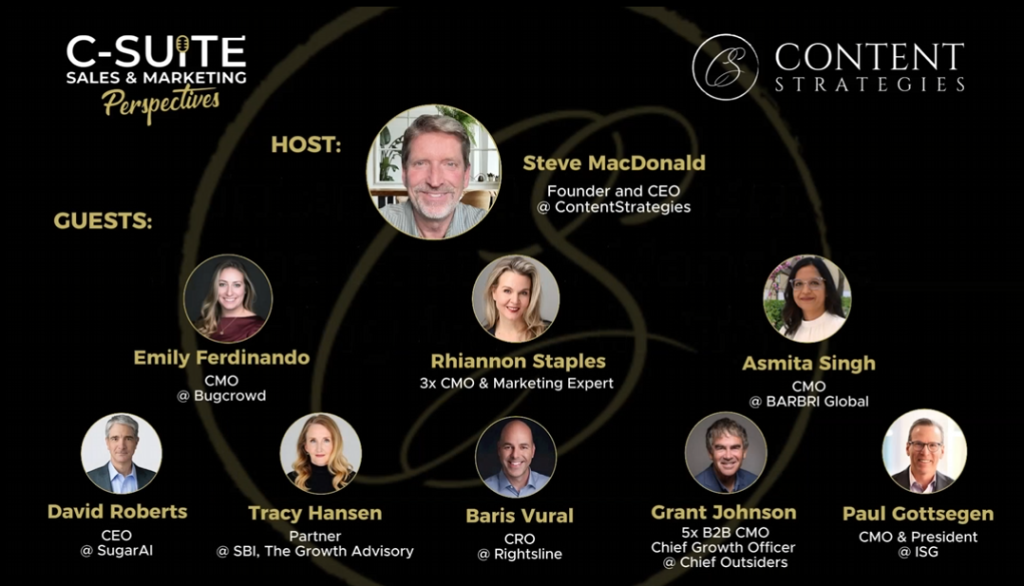
Eight C-suite peers reveal the operational layer most B2B leadership teams haven't built yet — and the one that turns everything else they're doing into actual growth.

In the five-minute video or article below, eight B2B C-suite peers walk through the three-layer roadmap behind solving the #1 challenge to creating sustainable growth — and reveal why the third layer, the one most leadership teams haven’t yet built, is the one that turns everything else they’re already doing into actual growth.

“We asked more than 100 B2B C-suite executives one open question: what are your two greatest challenges for creating long-term sustainable growth? I never put the words on the table. I asked, and I listened. Unsolicited, 71% of the time, the first answer back was internal alignment.”
— Steve MacDonald, Founder, Content Strategies

Highlights Video
Internal Alignment as a Growth Engine

Key Takeaways

Three Layers Drive Growth Alignment

The three operational layers — structure, metrics/measurement, and voice of the customer — are the roadmap for turning the alignment challenge into a growth strategy; the leadership teams that work all three are the clear winners.

Voice of Customer Drives Trust

Voice of the customer is the layer most B2B leaders find structurally hardest to operationalize, and the same layer most directly tied to trust and revenue durability.

Customer Truth Compounds Growth

Captured publicly and connected across the organization, customer truth becomes the rare growth asset that works in two directions at once — aligning the C-suite internally and compounding revenue externally from the same articulation.

Three vantage points. One diagnosis.

Two third-party advisors who work with B2B companies and their GTM models for a living, and a CRO running a $50M ARR SaaS business, corroborated the finding from three different vantage points.

“72 to 74% of companies are not aligned across the C-suite. It’s not that leaders aren’t thinking along the same lines. They’re looking at the business through their own functional lens — the CFO through finance, the CRO through sales — and even when they nod their head at the table, they go back to their respective functions and keep solving for their function.”
— Tracy Hansen, Partner, SBI Growth Advisory; 3x B2B CMO

“We’re finishing a proposal for a big firm and they need a new operating model because they’re not aligned. You get that all the time.” Paul Gottsegen, CMO & President, Information Services Group; 4x B2B CMO

“If you ask the ICP question — who are we serving, who is our ideal customer profile? — to six executives, you get six different answers. Extrapolate that to cross-functional leaders, and you get 10 or 20 different answers. That, to me, is misalignment.”
Baris Vural, Chief Revenue Officer, SmartLinx

Internal alignment is not one thing. It runs across three layers

Within the prep-call interviews and recorded conversations, internal alignment kept resolving into three operational layers, each without clear ownership within the C-suite. 

  • Structure — how the leadership team operates as a team. 
  • Metrics and Measurement — the numbers everyone agrees to and how performance is measured. 
  • Voice of the Customer — the foundation for trust and alignment. Also, the layer most B2B leaders find structurally hardest to operationalize, and the one most directly tied to revenue. 

When working together, the three layers serve as a roadmap for turning the alignment challenge into a growth strategy.

LAYER 1 • Structure

“My number-one job as a CEO is to drive alignment across the leadership of the company. If leaders are aligned, they can solve problems on their own. If they’re not, I have to step into every instance to break ties on things that shouldn’t need me.”
— David Roberts, CEO, Sugar AI

“When we go into a client’s business, they tell us what they think the problem is — the wrong quota, the wrong top of funnel, missing territory alignment. One of the very first things we do is ask the executive team to take an alignment study. It lets us see, across the C-suite, whether they’re seeing things the same way.”
— Tracy Hansen, Partner, SBI Growth Advisory

LAYER 2 • Metrics and Measurement

“We have to have a unified view on the metrics that matter most. Otherwise, if everyone’s bringing their own numbers and interpretations, we’ll never be aligned. It’s like we’re all speaking different languages that each other doesn’t understand.”
Grant Johnson, Chief Growth Officer, Chief Outsiders; 5x B2B CMO

“The biggest unlock is the way the leadership team decides to measure team performance. What’s our shared number? How are we doing this together? You’d be surprised what people figure out how to do on their own when the objective is shared.”
Emily Ferdinando, CMO, Bugcrowd

“A deal comes in. It’s really not our ICP. But it looks good because it’ll save the quarter. Nobody calls it a bad customer. Everybody knows it could churn. Nine months later, horrendous implementation, product doesn’t fit, bad GRR, struggling NRR. That’s where misalignment shows up.”
Baris Vural, Chief Revenue Officer, Rightsline

LAYER 3 • Voice of the Customer

Forrester’s research finds that only 3% of B2B companies are truly customer-obsessed. McKinsey finds that fewer than 15% consistently incorporate customer input into decision-making. The work of operationalizing customer truth at scale is structurally hard.

“The ideal customer that stays and grows: that’s the voice you’re listening to. They will tell you what’s important to them. That, in my opinion, is a truth serum for executive teams. If you can align on listening to that, it’s objective input to drive that alignment.”
Rhiannon Staples, CMO, ClearCompany; 3x B2B CMO

“Sometimes we forget the foundations and try to go after other things. But for me, in the go-to-market voice of a customer, it’s a foundational element.” Asmita Singh, CMO, BARBRI

From private to public. Same truth. Every touchpoint.

Voice of the customer in B2B mostly lives privately — in sales recordings, NPS responses, CAB notes, and CMO listening tours. As David Roberts put it: “structured data is the language of business; unstructured data is the language of relationships.” The third layer becomes a system, not a stated value, when that voice moves from private to public.

That’s the role of peer-level podcast conversations, captured publicly across the revenue relationships that matter most in B2B — cold, ABM-targeted accounts, stalled deals, top revenue-expansion customers, and at-risk clients. Unstructured buyer intelligence, structured into go-to-market intelligence. 

“How do you build trust? You build it through your brand and through the voice of customers.”
Rhiannon Staples, CMO, ClearCompany

“The number one thing every C-suite or peer community should focus on is having a strategy to connect customer voices in a more meaningful way across the organization, using it as a tool to devise a growth strategy, and make that information available across functions, across the organization.”
Asmita Singh, CMO, BARBRI

The roadmap, in three moves.

The three layers aren’t a diagnosis; they’re the work. Structure, metrics/measurement, and voice of the customer. Leadership teams that operationalize all three turn alignment from a soft theme into the foundation of how the company grows.

The two layers most teams already attempt — structure and metrics — make alignment visible inside the room. The third voice of the customer, captured publicly, connected across the organization, and structured by AI, is what makes the same articulation work in two directions at once: aligning the C-suite internally and compounding revenue externally through sales enablement, demand generation, thought leadership, and customer expansion.

What AI structures the customer truth into is what the go-to-market team runs on every day: real buyer challenges in your buyer’s own peer voice — answering objections before they kill the deal, validating the selling statements that close it, and giving every rep, every campaign, and every executive conversation the same customer-backed foundation to win from.

Same articulation. Both directions. Working at the same time.

The leadership teams that build the third layer aren’t doing more work — they’re doing the work that makes the other two layers actually compound.

The question worth sitting with...

ELEVATING CONTENT MARKETING STANDARDS RAISES A CRUCIAL QUESTION:
Why shouldn’t the very act of creating thought leadership content also spark new conversations with in-pipeline deals, top prospects, and high-priority customers for revenue expansion? Or serve as the cornerstone for learning and applying voice-of-customer strategies? That’s the power of ABM Podcasting—engaging B2B buyers and customers in meaningful conversations that uncover essential go-to-market insights, support long sales cycles, reinforce your market perspective, build peer-level trust, and dismantle objections that kill deals.

Picture of Steven MacDonald

Steven MacDonald

Steven MacDonald is the founder of Content Strategies, CEO of a MarTech SaaS Company, fractional CMO consulting with leading B2B companies and former Director of Strategy and Client Service at top ten digital marketing agencies.

Follow Steve on LinkedIn.
Picture of Steven MacDonald

Steven MacDonald

Steven MacDonald is the founder of Content Strategies, CEO of a MarTech SaaS Company, fractional CMO consulting with leading B2B companies and former Director of Strategy and Client Service at top ten digital marketing agencies.

Follow Steve on LinkedIn.

Explore more articles

Part Nine: The Revenue Logic of Customer Obsession

Episode #328: Michael Scott, Global Chief Revenue Officer at LoopMe, explains the revenue logic behind customer obsession. He shares how deeper customer understanding helps companies ...
Read More

Stop Chasing AI Tools and Start Building Better Thinking

Episode #327: Trine Tirsgaard, Group Chief Marketing Officer at Twoday, explains how customer understanding, data, experimentation, and continuous learning can create greater strategic value with ...
Read More

(4:09 Q&A Video) “Customer Value Elevates Marketing Into Strategic Business Leadership”

In this 4:09 video, Trine Tirsgaard explains why customer curiosity and business understanding are essential for creating meaningful value in modern B2B marketing. She emphasizes ...
Read More

Part Eight: The Revenue Logic of Customer Obsession

Episode 326: Laura Davis, Chief Marketing Officer at Rimes Technologies, explains why customer obsession must translate into commercial outcomes. She explores customer intelligence, AI, data ...
Read More

(5:22 Q&A Video) “Customer Conversations Turn Marketing Into Strategic Intelligence”

In this 5:22 video, Laura Davis explains why staying close to customers gives companies a stronger understanding of changing priorities. She shares a high bar ...
Read More

How to Become a Successful AI-Native Company

Episode #325: Nick Malone, Chief Revenue Officer at XTM, explains what separates successful AI-native companies from organizations simply adopting new tools. He explores value-led AI, ...
Read More