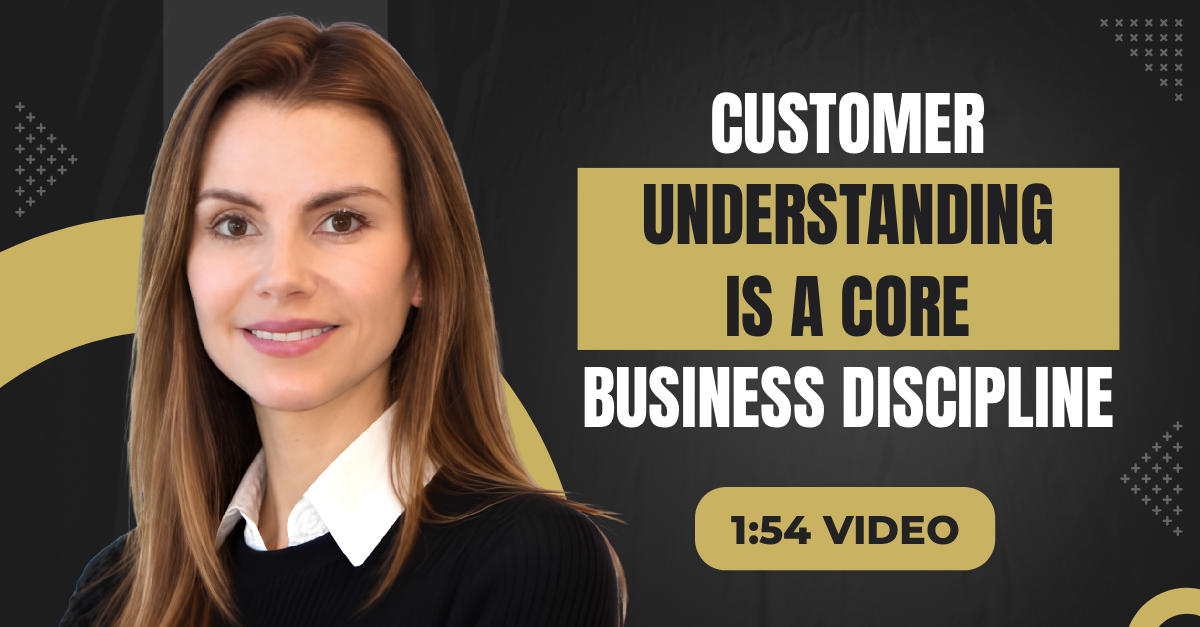



(2:52 Summary Video) “Best Practices in Staying Customer-Obsessed for Businesses”
In this 2:52 video, Nicolas Deswarte discusses the importance of leveraging the Ideal Customer Profile (ICP) and customer experience (CX) to drive business success. She highlights how understanding customer signals helps refine marketing strategies, perfect the customer experience, and build a sustainable growth strategy.
Customer obsession is essential to any successful business strategy in today’s competitive market. Nicolas Deswarte emphasizes that businesses must stay in tune with client needs while adapting to shifting market dynamics. This balance between intuition and structured approaches is vital for long-term success.
To build and sustain customer-centric organizations, Nicolas stresses the importance of deeply understanding how customers use products. By actively engaging with customers, businesses can avoid strategic missteps and ensure their products become indispensable to their clients, driving long-term loyalty and success.
“The first step is to make a good selection of who you will talk to. Second, you need to have your own objective for the conversation. You can then orient the way you frame the conversation with simple questions.” – Nicolas Deswarte
To learn more, watch the 2:52 video or read the article below.
To catch the full interview with Nicolas on “How to Create Alignment Between Your ICP and Go-to-Market Strategy.” CLICK HERE.
Article: “Best Practices in Staying Customer-Obsessed for Businesses”
This article is based on a podcast interview with Nicolas Deswarte, CMO at Thiga
Building Strong Customer Relationships Through Sales Teams
The first step in forming a customer-obsessed strategy is recognizing the pivotal role of the sales team. Nicolas emphasizes that working closely with the sales team is essential for success. The key is finding the right individuals within the organization who are directly engaged with customers and have a deep understanding of their evolving needs.
Building strong relationships between the sales team and other departments requires more than regular meetings. It involves fostering a culture where feedback is actively pursued and valued. Nicolas highlights the importance of ensuring that sales team members, who act as ambassadors between the business and customers, are satisfied with the products and have a positive view of the company.
Once a solid connection is established, businesses can transform raw customer feedback into actionable insights. Nicolas stresses the importance of guiding customer conversations with strategic questions to drive meaningful outcomes. By framing these conversations around simple, targeted questions, businesses can obtain relevant data that will help move them closer to their customer-centric objectives.
The Balance Between Feedback and Observation
Customer feedback is undeniably invaluable, yet it must be approached with a discerning eye. Nicolas emphasizes that truly understanding customer feedback goes beyond simply listening to the grievances clients voice. In his experience with a FinTech firm, customers expressed frustration with Microsoft Excel. On the surface, this feedback seemed like a clear signal to develop solutions addressing that pain point.
However, the reality turned out to be more complex. Nicolas shares that despite launching a campaign targeting Excel-related frustrations, the initiative failed to meet expectations. CFOs, his primary audience, remained firmly entrenched in their use of Excel, even though it was recognized as a source of errors and inefficiencies. His reflection on this outcome serves as a cautionary tale for businesses that might rely too heavily on customer feedback without thoroughly analyzing the broader context in which that feedback is given.
Nicolas’s experience also highlights the importance of observing customer behavior and routines. While customer feedback provides valuable insights, it may not always capture the underlying complexities of their work habits. By combining feedback with behavioral observation, businesses can develop strategies that more accurately reflect the needs and preferences of their target audience, ultimately leading to better outcomes.
Analyzing Campaign Outcomes: Lessons from a Failed Digital Initiative
Examining the failure of the digital campaign against Excel offers valuable lessons in campaign management. Despite the initial excitement surrounding the strategy, the outcomes highlighted a disconnect between campaign intentions and market reality. Businesses must recognize the importance of adaptive strategies, evaluating real-time performance metrics, and staying agile in response to unforeseen market reactions.
Nicolas’s account of misalignment underscores the often-unspoken challenge of staying adaptable to changing customer landscapes and expectations. Pivoting strategies when necessary becomes crucial in the face of evolving needs. This perspective reminds businesses that maintaining customer obsession requires continual adjustment—understanding ingrained user habits and what truly constitutes value for the customer must guide every strategic decision.
Nicolas emphasizes the importance of understanding how customers work on a daily basis. Ongoing assessment—both situational and temporal—enables firms to recalibrate and ensure alignment with authentic customer needs. By observing how customers interact with tools and processes, companies can stay in sync with their evolving workflows and provide solutions that genuinely improve their experience.
Conclusion
Nicolas Deswarte’s insights emphasize the importance of aligning customer feedback with practical strategies to foster meaningful progress. By combining feedback with observational insights and ensuring marketing campaigns are both reactive and responsive, businesses can move beyond just listening to customers to truly understanding their needs and preferences.
He further explains that effective collaboration between sales and internal teams creates a holistic approach to customer relations. This collaboration ensures that businesses remain adaptable and responsive to the complexities of genuine customer relationships, a crucial aspect of mastering customer-obsessed strategies.
ELEVATING CONTENT MARKETING STANDARDS RAISES A CRUCIAL QUESTION:
Why shouldn’t the very act of creating thought leadership content also spark new conversations with in-pipeline deals, top prospects, and high-priority customers for revenue expansion? Or serve as the cornerstone for learning and applying voice-of-customer strategies? That’s the power of ABM Podcasting—engaging B2B buyers and customers in meaningful conversations that uncover essential go-to-market insights, support long sales cycles, reinforce your market perspective, build peer-level trust, and dismantle objections that kill deals.
Steven MacDonald
Steven MacDonald is the founder of Content Strategies, CEO of a MarTech SaaS Company, fractional CMO consulting with leading B2B companies and former Director of Strategy and Client Service at top ten digital marketing agencies.
Steven MacDonald
Steven MacDonald is the founder of Content Strategies, CEO of a MarTech SaaS Company, fractional CMO consulting with leading B2B companies and former Director of Strategy and Client Service at top ten digital marketing agencies.